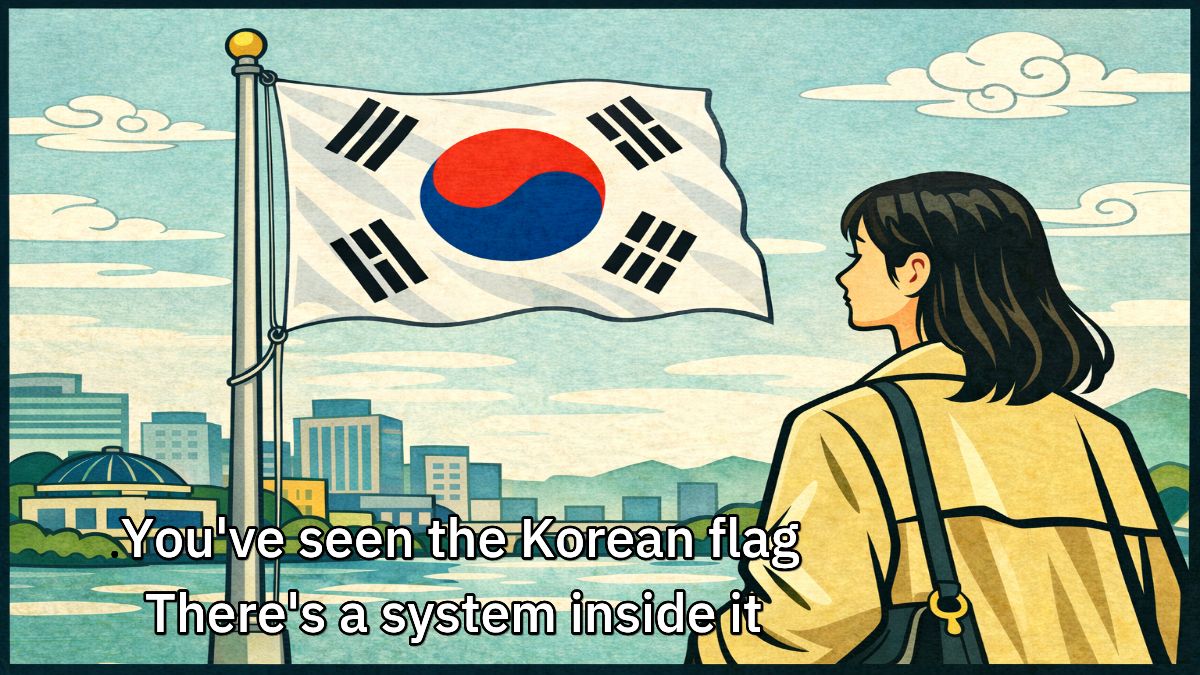

There is a flag most people have seen but few have read.
Tour guides call it balance. Teachers call it ancient philosophy. Travel blogs call it beautiful design.
Nobody looks at it and sees a system.
That distinction matters. A symbol carries meaning. A system carries instructions.
The Taegeukgi carries both — but the instructions are what most people miss. Understanding Taegeukgi Meaning starts here.
A Philosophy Older Than the Flag Itself
The Taegeukgi was officially adopted in 1882. But the philosophy encoded in it is thousands of years older.
It begins with the I Ching (주역: ju-yeok, the Book of Changes) — one of the oldest texts in recorded human thought. Chinese in origin, written and rewritten across centuries, the I Ching observed a single principle at the core of everything: nothing stays the same, and change itself follows a pattern.
Not random change. Structured change.
The I Ching mapped that structure using combinations of broken and unbroken lines — gwae (괘: gwae, trigrams and hexagrams). Each combination described a state of transition. Together, they described the full cycle of how things move, grow, consolidate, dissolve, and begin again.
This wasn’t mysticism. It was observation. The same way meteorologists track pressure systems, early scholars tracked change systems. The patterns held across nature, seasons, human relationships, political orders, and personal life cycles.
Korea inherited this framework. And then did something with it that China, over time, did not.
What Korea Did Differently

The I Ching reached Korea during the Three Kingdoms period. It traveled through the Goryeo dynasty and into the Joseon dynasty, where something significant happened in the fifteenth century.
Joseon scholars didn’t simply preserve the I Ching. They applied it.
The Gwan-sang-gam (관상감: gwan-sang-gam, the Royal Bureau of Astronomy and Geomancy), a state institution that operated throughout the Joseon dynasty (1392–1897), studied these principles as a formal discipline. Scholars spent careers mapping how I Ching patterns applied to human life — not just celestial events, but personal timing, family dynamics, career transitions, health cycles. The state funded this research. It became part of the national examination system. Knowledge accumulated across generations within institutional structures designed to preserve and refine it.
What emerged was Myeongri (명리: myeong-ri, the study of cyclical life patterns) — a Korean framework for reading time through the lens of I Ching philosophy. Not a copy of Chinese practice. A development of it. The result was distinct.
China had the roots. Korea cultivated the tree.
In Korea, the tradition didn’t just survive. It deepened. Joseon scholars brought their own observations, their own climate, their own historical patterns to the framework. It adapted. It refined. It became what is now called K-Saju.
The Taegeukgi, designed within the same Joseon scholarly tradition, encoded the core of this philosophy into a national symbol. Not as decoration. As documentation.
What the Flag Actually Shows
At the center of the Taegeukgi is the Taegeuk (태극: tae-geuk, dynamic alternation between opposing forces). The red and blue spiral doesn’t show balance — it shows movement. Two forces generating each other in continuous rotation. Neither wins. Neither stops. The rotation is the point.
This is the first principle of Myeongri: change is not an event. It is a state. Everything is always in transition. The question is never whether something is changing. The question is which phase of change is active right now.
The four black symbols in the corners of the flag answer that question.
These are gwae — four specific trigrams selected from the I Ching’s sixty-four hexagrams. Each represents a distinct phase in the cycle of change. Together, they form a complete map of how transformation moves.
Not sometimes. Always.
Four Phases, Four Corners
Geon (건·☰) — Initiation
There is a moment when something that didn’t exist begins to exist.
Not because conditions are perfect. Because the pressure to begin overcomes the comfort of waiting. An idea becomes a project. A question becomes a search. A feeling becomes a conversation. This is Geon (건·☰): the phase of initiation.
Geon is yang at maximum — outward, expansive, generative. It creates surface area. It opens possibility. It moves fast because speed is its function.
In Myeongri, Geon periods carry a recognizable quality: everything feels like it could work. Multiple directions present themselves. The temptation is to pursue all of them simultaneously.
Geon’s risk is not failure. It is premature multiplication — starting so many things that nothing receives what it needs to continue. There is a reading where Geon appeared in three consecutive annual cycles. Each year began with new projects, new directions, new energy. Each year ended with the same unfinished foundations. Not because the ideas were wrong. Because Geon kept firing before the previous cycle completed.
Gon (곤·☷) — Stabilization
There is work that doesn’t look like work.
Writing the documentation after building the product. Establishing the routine after finding the direction. Creating the foundation under a structure that’s already standing. This is Gon (곤·☷): the phase of stabilization.
Gon is yin at maximum — receptive, consolidating, structural. Where Geon opens, Gon holds. Where Geon generates, Gon organizes. The two are not opposites. They are sequential. Geon without Gon produces momentum without direction. Gon without Geon produces structure without life.
In Myeongri, Gon periods feel slower than Geon. External output decreases. Internal architecture increases. From outside, it can look like stagnation. From inside, it is consolidation — the work that makes everything else durable.
There is a reading where Gon held for two years after a period of rapid expansion. From outside, nothing seemed to be moving. From inside, everything was being rebuilt.
Gon’s risk is calcification. When stabilization becomes identity, structure becomes constraint. The system maintains but stops adapting. Everything runs smoothly until conditions shift, and the rigid structure cannot flex.
Gam (감·☵) — Restructuring
There is a phase that looks like nothing is happening.
Energy drops. Clarity fades. Decisions that came easily last month feel impossible now. Direction that seemed obvious becomes uncertain. This is Gam (감·☵): the phase of internal restructuring.
Gam is water — moving downward and inward, finding the lowest point, reorganizing from below. It is the most misread phase in the entire cycle. Modern culture calls it stagnation. Myeongri calls it necessary.
What happens during Gam cannot be seen from the outside because it happens internally. Old assumptions dissolve. Priorities reorder without external pressure. The cognitive architecture reconfigures itself. This takes time. It cannot be rushed and does not respond to force.
In Myeongri, forcing output during Gam produces a consistent pattern: high activity, negligible meaningful progress, accumulating exhaustion. The system is processing and reorganizing. Adding more input during this process makes the processing harder, not faster.
There is a pattern that appears repeatedly in readings where Gam gets misread as failure: the person pushes harder, generates more activity, achieves less, and eventually encounters a forced stop — illness, crisis, collapse — that does what Gam was trying to do naturally. The phase was not the problem. The resistance to the phase was.
Ri (리·☲) — Expression
There is a moment when what was internal becomes external.
Decisions that felt impossible last week clarify. Communication that felt forced now flows. The direction that was murky becomes obvious. This is Ri (리·☲): the phase of expression.
Ri is fire — visible, upward, illuminating. It doesn’t create clarity. Gam created it. Ri reveals it. The restructuring that happened internally during Gam now has a form it can take in the world.
In Myeongri, Ri periods carry a quality of alignment: things fit together in ways they didn’t before. Not because circumstances changed. Because the internal architecture shifted during Gam, and now external expression matches internal structure.
There is a reading where Ri arrived three months after the quietest period of the year. The person had nothing to show for those months. Then everything came at once.
Ri’s risk is premature activation. If Ri fires before Gam completes its reorganization, the output looks confident but lacks coherence. The opposite risk is delayed expression — insight that restructured internally but never moves outward, staying trapped in private complexity.
At a certain point, Ri must return to Geon. Clarity without new action becomes commentary. Expression without movement becomes another form of stagnation.
The Cycle That Never Stops

Geon, Gon, Gam, Ri — and back to Geon.
This is not a journey with a destination. It is circulation — the same way seasons move, the same way breath moves, the same way any living system sustains itself. No phase is the goal. All phases are necessary. Each creates the conditions for the next.
The Taegeukgi visualizes this as a closed system because that is what it is. The four gwae in the corners don’t point outward. They face the center. They face the Taegeuk — the continuous alternation that holds the whole structure together.
This is what Myeongri formalized over centuries of observation: systems that cannot rest break. Systems that cannot begin stagnate. Systems that skip internal reorganization accumulate contradictions until collapse becomes the only available form of Gam. The cycle doesn’t stop because something went wrong. It stops when something refuses to move.
K-Saju and the Modern Application

K-Saju applies Myeongri principles using birth data as a timing baseline.
The birth moment — year, month, day, and hour — creates a starting configuration. That configuration describes tendencies in how a person moves through the four phases. Not destiny. Not fixed personality. A rhythm. A starting point in the cycle, the way a seed planted in autumn carries different seasonal timing than one planted in spring.
Classical Myeongri tracked this across multiple time scales simultaneously:
Daeun (대운: dae-un) runs in decade cycles — the longest rhythm, shifting approximately every ten years. It sets the structural terrain. A decade in Gon means the underlying pressure across those years is toward consolidation, regardless of what shorter cycles are doing.
Yeonun (연운: yeon-un) operates as the annual layer within the decade. It introduces a different phase quality each year. A Daeun in Gon with a Yeonun in Geon creates the first level of friction — the decade says hold, the year says begin.
Wolun (월운: wol-un) runs as monthly shifts within the year. Shorter oscillations, faster transitions. When Wolun and Yeonun align, the phase signal is clear. When they conflict, the month pulls against the year.
Ilun (일운: il-un) is the finest resolution — daily rhythms that most readings don’t track, but which explain why certain days inside an otherwise productive month feel structurally resistant.
Reading these layers together explains tensions that single-scale thinking cannot. A decade cycle in Gon and a monthly cycle in Geon creates a structural conflict between consolidating and initiating — not a psychological problem, but a timing problem. Two phases pulling in different directions at different scales. Recognizing this changes how the tension gets addressed.
K-Saju doesn’t ask: what will happen to you?
It asks: which phase are you in, which transition is approaching, and what does this phase need to complete?
Why the Flag Carries This— Taegeukgi Meaning Decoded
The Taegeukgi was not designed as decoration. It was designed by people who understood what it encoded — scholars working within a tradition that had spent centuries mapping how change moves.
Most people walk past the flag and see a national symbol. That reading is not wrong. It is incomplete.
The flag shows something older than the nation it represents. It shows a system — the same system that I Ching scholars first observed, that Myeongri scholars in Joseon refined across generations, that K-Saju now translates for modern use. A system that appears in every cycle of every life whether or not anyone recognizes it.
Change follows a pattern. The Taegeukgi has been showing us that pattern for centuries. Most people just kept reading it as decoration. A flag. Four phases. One system. This is where K-Saju begins.
Some content in this post was created with AI assistance.