

You lay out the Celtic Cross and something organizes. Tarot spread timing shows you what’s active. K-Saju reads what cycle that moment is sitting inside. The positions give the cards a relational frame — what’s beneath, what’s ahead, what’s blocking, what’s possible. The spread doesn’t create meaning. It creates the conditions for meaning to become visible. That’s a precise and deliberate piece of design, and when the layout lands, it lands because the architecture was built to hold it.
K-Saju works with a different kind of structure. Not a spatial layout, but a temporal one. Where the spread maps what’s active across positions, K-Saju maps what’s active across time.
Two architectures. Two ways of making structure visible.
What a Spread Is Actually Doing
A tarot spread is a frame. Each position carries a question — what’s beneath the surface, what’s moving toward you, what’s working against the current, what you haven’t seen yet. When cards land in those positions, they’re not generating random meaning. They’re placing the current energies of a moment into a pre-designed relational structure and showing what emerges.
The Celtic Cross holds ten positions. A three-card pull holds three. Each layout is a different way of organizing what’s active — past informing present, present in tension with future, the seen alongside the unseen. The spread is internally coherent. The positions have relationships with each other, and a skilled reader works those relationships, not just the individual cards.
That relational reading is where tarot’s precision lives. The Five of Cups in the loss position reads differently than the Five of Cups in the opportunity position. The same card shifts meaning depending on where it lands in the architecture — and a reader who understands the structural logic of the spread is reading the whole configuration, not just pulling individual interpretations and adding them up. The spread is a system. Each card activates inside a relational field.
What the spread captures is the configuration of this moment. The relational geometry of what’s alive right now. It’s precise about the present. It wasn’t designed to ask how long this configuration has been building, or when it shifts.
The Layer K-Saju Is Reading
K-Saju builds its structure differently. Your chart is constructed from four pillars — year, month, day, hour of birth — each carrying a Heavenly Stem and Earthly Branch that encode a specific combination of theFive Phases (오행: o-haeng). That structure doesn’t change. What moves through it are the cycles: the Daewoon (대운: dae-woon, decade cycle) shifting every ten years, the Sewoon (세운: se-woon, yearly pillar) cycling annually.
These cycles don’t describe what you’re feeling. They describe the conditions the ground is running under. What the terrain supports right now. What it resists. Whether this is a period where external movement is structurally favored, or one where the same energy goes inward before it surfaces.
The spread maps what’s active across positions in space. K-Saju maps what’s active across positions in time. One shows you the relational geometry of the moment. The other shows you where that moment sits inside a longer arc.
The spread is a cross-section. K-Saju is a different cut of the same material — taken along the time axis instead of the spatial one.
When the Same Spread Keeps Returning
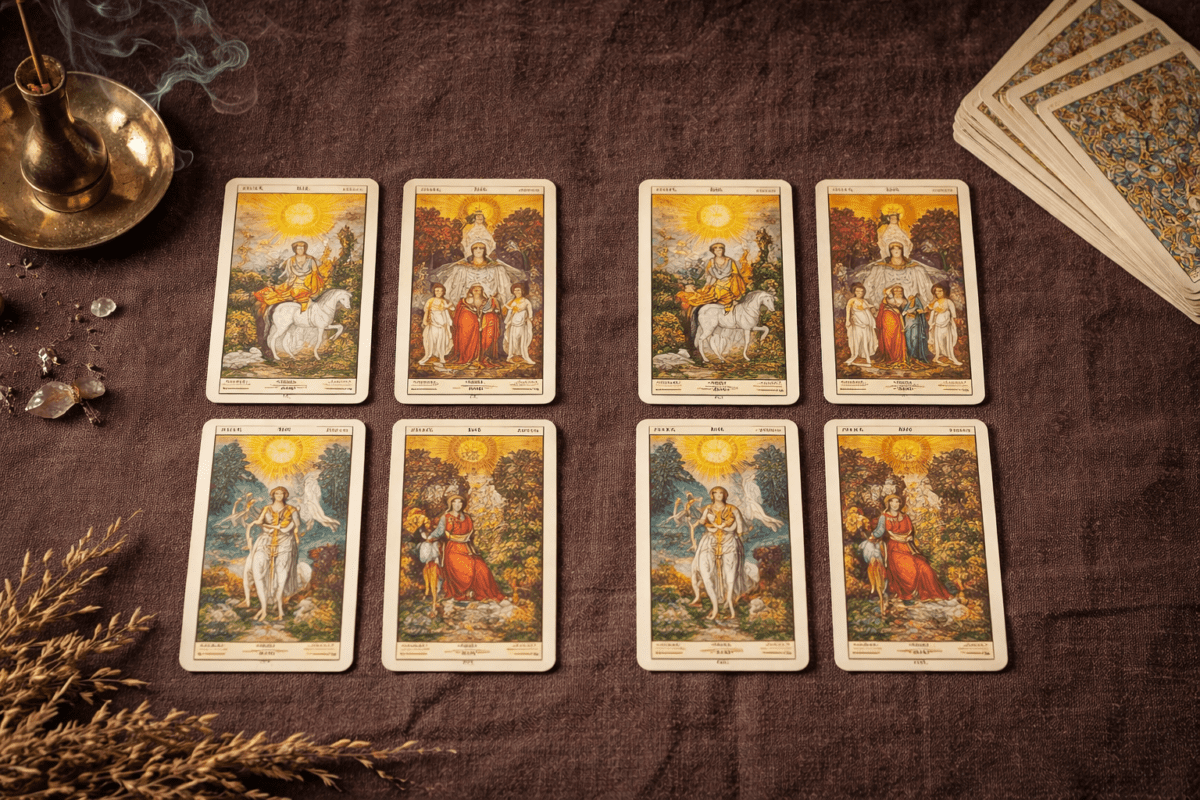
You shuffle differently each time. Different day, different deck, different intention. And the same configuration keeps appearing.
A tarot reader reads that as meaningful information — and it is. Repetition in a spread is data. The same cards landing in the same positions across multiple readings signals that something persistent is active. The field is consistent. The spread is doing its job accurately.
K-Saju reads the same repetition from a different angle. If someone is moving through a Daewoon where her dominant element is running into structural friction, readings taken across months in that period will keep reflecting the same configuration. The Five Phases driving that friction haven’t shifted. The spread is accurately reading what’s being generated — and what’s generating it is a cycle that hasn’t moved yet.
The spread reads what’s consistent across moments. K-Saju reads what’s consistent across years. Two different definitions of consistent.
Same Spread, Different Seasons
Two people pull the Tower in the same week. In tarot, the Tower carries disruption — a structure coming apart so something more aligned can emerge. Both readings are accurate. Both women are experiencing a form of structural change.
One is in a Daewoon where her Metal (금: geum, discernment force) force is running against her natal Fire (화: hwa, expression force). Metal and Fire in opposition creates exactly this — the steady dismantling of what was built in a previous phase. She’s watched projects stall, relationships reconfigure, plans that looked solid dissolve without clear reason. The Tower isn’t a warning arriving from outside. It’s a confirmation of what the structural cycle has already been doing for months. The spread named what she’s been living.
The other is entering a Daewoon where her natal Wood (목: mok, initiation force) is finally meeting the cycle that amplifies it. She pulls the Tower in the same week. For her, the disruption isn’t loss — it’s reorganization ahead of expansion. The old structure is clearing space for what her chart has been building toward. What looks like collapse from the outside is the ground shifting to support something larger. The spread named that too — accurately.
Same card. Same week. The spread read both accurately. K-Saju reads the temporal layer the spread wasn’t designed to address — not because the spread missed it, but because that wasn’t the question it was built to ask.
What Each Structure Is Built to Show
A spread shows you the relational geometry of right now. Which energies are in tension, which are in support, what’s visible and what’s operating underneath. That’s a complete picture of the present moment — one that doesn’t need additional context to be useful.
K-Saju shows you the temporal position of right now. Which cycle is running, how long it’s been running, what the structural conditions of this period favor or resist. That’s a complete picture of the arc — one that doesn’t need a spread to be useful.
The spread reads the configuration. K-Saju reads what produced it and what comes next. They’re drawn from different vantage points — and neither is partial.
A spread and a chart aren’t competing for the same territory. The spread reads the present moment with a precision that a chart approaches differently — the specific emotional texture of this week, the interpersonal dynamic running through this decision, what’s surfacing in your particular situation right now. That’s not a partial picture. That’s a complete one, drawn from a specific vantage point.
The Structure Behind the Reading
Every spread is sitting inside a cycle. The Celtic Cross you laid out this morning is accurate about what’s active right now — and what’s active right now is being shaped by a Daewoon that’s been running for years, and a Sewoon moving through it this year. The spread reads what’s present. The cycle determines what the present is made of.
The spread doesn’t need to know that to do its job. It reads what’s present with precision — the emotional texture of this specific week, the relational dynamic running through this particular decision, what’s rising to the surface in your situation right now. That’s a complete and accurate reading. The present moment, held clearly.
K-Saju reads the longer structure that present moment is embedded in. What built the configuration the spread is reflecting. Which cycle generated the conditions the cards are reading. When those conditions are scheduled to shift — and what the structure looks like on the other side of that shift. Two different layers of the same moment, each read with its own instrument.
That’s not a gap between the two systems. Each one was designed to carry a different layer. The spread holds the present in a way only a present-tense reading can. K-Saju holds the arc — the years-long structure that produced this moment and is already shaping the next one.
Is the spread showing you the structure of this moment — or the cycle you’re in?
Next: (Part 3) Tarot Timing vs K-Saju: When the Card Says Now — The card names the moment. K-Saju reads whether the cycle is ready for it.
Some content in this post was created with AI assistance.