
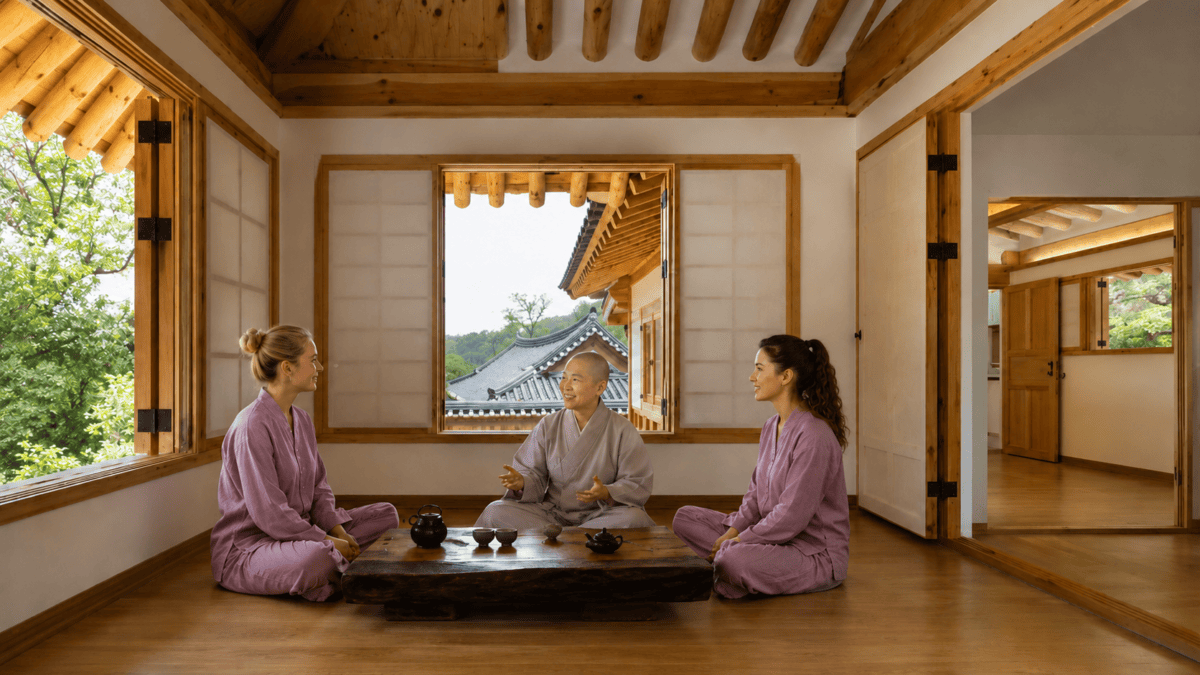
The bus pulled away at ten. The temple stay Seoul was already behind us — ten minutes by road, further than that by everything else.
Neither of us reached for a phone. Not from discipline — the habit simply hadn’t remembered itself yet. The city assembled outside the window, district by district, apartment blocks replacing pine trees the way one sentence replaces another. We watched it happen without talking.
By the time we reached Yeonsinnae, the temple was already ten minutes behind us by bus. Ten minutes. The same distance as a convenience store run. That fact hadn’t landed properly until now, sitting on a bus with ginkgo leaves still on our shoes.
What the Bus Carries Back
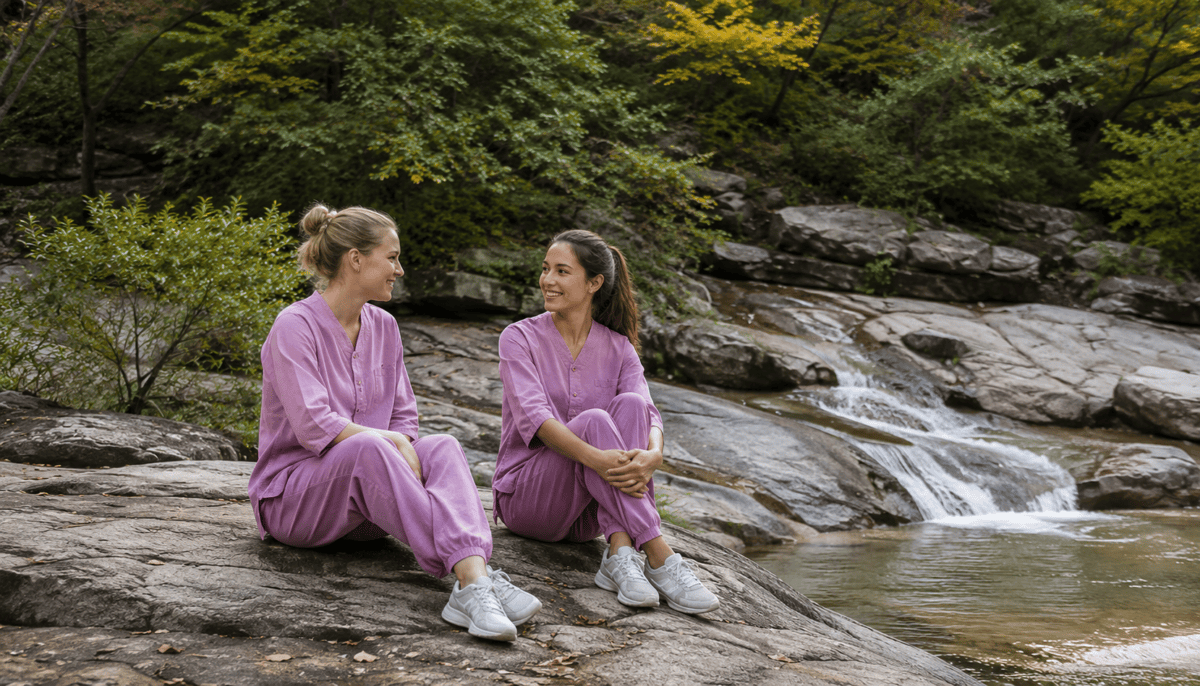
The ride from Jingwansa to the city center takes about forty minutes.
By the first interchange, the 4 AM bell was already becoming a memory with edges. By the second, the specific texture of ginkgo leaves underfoot was fading into the general category of autumn. The temple stay Seoul experience compresses fast on the return journey — not because it wasn’t real, but because the city is very good at filling the space things leave behind.
What didn’t compress was smaller. More physical.
One of us noticed it first: neither of us had checked a notification in two days. The phone was in the bag. The bag was at our feet. Nobody had decided this. It had simply been unnecessary. Now, with the city reassembling outside the window, the phone still felt unnecessary — not from discipline, but because the habit hadn’t yet remembered what it was for.
That gap between the habit and its object. That was what the temple stay Seoul had left behind.
Not peace. Peace is too clean a word for what it was. Just a space that hadn’t closed yet. Thin as the interval between one breath and the next. But there.
What Stayed

By evening, the line between before and after had started to blur.
Hot shower. Coffee that took four minutes instead of arriving at a fixed time. The refrigerator, the laundry, the accumulated weight of a life that had continued without needing to be managed. The apartment received us the way apartments do — unchanged, patient, entirely indifferent to what had happened inside a temple gate two days earlier.
We didn’t try to hold onto it. That much we’d understood on the bus. The robes were staying at the temple. The schedule was already gone. The attempt to carry the whole thing home in your hands was the wrong move — you end up with wet palms and nothing to show for it.
What stayed was smaller than that. More durable.
The first week back, we kept expecting the feeling to disappear all at once. It didn’t. It faded unevenly. Some habits returned immediately. Others seemed to pause before remembering themselves. We found ourselves waiting a little longer before reaching for the next thing, lingering a little longer in ordinary moments without deciding to. Nothing dramatic had changed. The city was the same. We were almost the same. But there was still a little more space between one moment and the next than there had been before.
A month later, we booked the temple stay Seoul again.
Not the same program. This time: the full schedule, both days, no modifications. We knew what the bell sounded like. We knew about the ginkgo tree that had no intention of stopping. We booked anyway — not to repeat the experience, but because something in the first visit had been left unfinished in a way that felt worth returning to.
The first visit had answered practical questions. The second seemed more interested in the ones we hadn’t known how to ask. Returning wasn’t about certainty anymore. It was about seeing what familiarity would make visible.
The bus stop looked exactly the same. Nineteen floors. Hana High School gates closing. The ordinary compressed landscape of a district where 100,000 people live in the kind of density that makes Seoul Seoul. And behind it, just visible, the ridge of Bukhansan and the rooftile curve of Eunpyeong Hanok Village catching the afternoon light.
The city hadn’t moved. The mountain hadn’t moved. The gate was exactly where it had always been.
What had changed was us — not dramatically, not in any way we could have explained to someone who hadn’t been there. Just slightly less surprised by the silence. Slightly more willing to let the pace be what it was.
The Wall That Kept Something
Before the evening ritual, one of the nuns led us to Chilseonggak — one of three halls that survived when the Korean War destroyed the rest of the complex.
She stopped in front of the reproduction of the Taegeukgi (태극기: tae-geuk-gi, Korean national flag) discovered at Chilseonggak in 2009. Most of the story was familiar by then. What felt different on the second visit wasn’t the history itself, but the way it was told. She pointed quietly to the burn mark, then let the silence do the rest. Standing there, we realized the temple had never been trying to preserve the past. It had simply kept holding it until someone was ready to see it.
We stood in front of the reproduction on the wall and didn’t say anything.
What stays with you isn’t the history. It’s the logic of it. A place that held something for eighty years without being asked to. The same logic as the earthenware jars outside the main hall — some fermenting, some empty, all of them waiting. Not storing. Holding. There’s a difference, and standing in Chilseonggak you feel it.
After the evening bell — thirty-three strikes, the same as last time — we joined the slow circle around the stone pagoda in the courtyard.
Tapdori (탑돌이: tap-do-ri, walking in circles around a pagoda). No instruction beyond: walk slowly, move in a circle, continue.
The pagoda is Goryeo dynasty. The stone is worn in ways that suggest a long history of unhurried repetition. The circle is not large — thirty seconds per rotation, maybe. After five minutes, neither of us had counted how many times we’d gone around.
Moving in a circle with no destination sounds easy. It isn’t. The mind keeps trying to convert it into a route, looking for the end point, the place the motion is leading. There isn’t one. After the tenth or eleventh rotation, the calculation stopped. We were just walking. The circle had become what the circle does when you stop trying to finish it.
The city lights were visible between the pine trunks at the edge of the courtyard. Seoul, exactly where it had always been. Ten minutes by bus.
Tea, After
The last morning: tea with one of the resident nuns in a small room looking out onto the courtyard through two wooden-shuttered windows.
She asked what had brought us back. We said we weren’t entirely sure. She said that was a reasonable answer.
The tea cooled slowly. Nobody filled the silence. Outside the window, someone was sweeping the path with a broom made of bound twigs. The ginkgo tree at the far end of the courtyard was still dropping leaves. The courtyard was not clean. It was cleaner. The tree had no opinion about this.
Before we left, we walked through Eunpyeong Hanok Village — ten minutes from the temple gate on foot, tucked between the apartment blocks and the mountain base. Old rooftiles and narrow lanes and the particular quiet of a place that knows what it is. Not separate from the city. Not the city. Something held between the two, the way Jingwansa itself is held between the apartment blocks and Bukhansan.
That’s what a temple stay Seoul offers that a mountain retreat doesn’t. Not escape. Adjacency. The gate is visible from the bus stop. The bus stop is a short walk from a thousand-year-old bikhuni temple. Both of these things are true at the same time, and somehow that makes each of them more itself.
The gate opened every morning. It was still open when we left.
Content in this post was created with AI assistance.