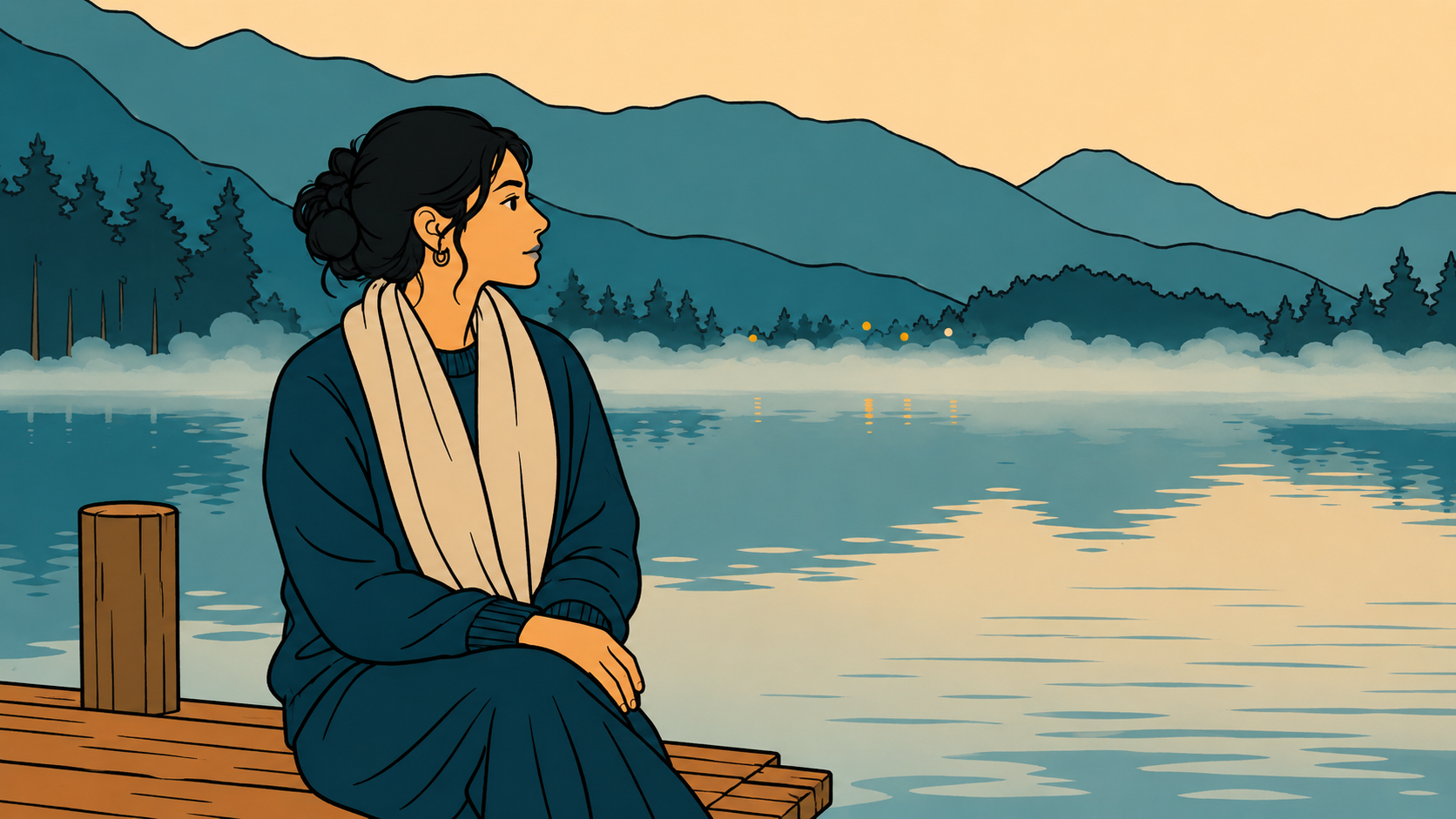

There’s a specific kind of year that doesn’t make sense until much later.
Nothing launches. Nothing resolves. From the outside — and sometimes from the inside — it looks like stalling. The projects are there but not moving. The decisions are close but not made. The version of yourself you’re becoming is somewhere ahead of you, recognizable but not yet arrived. You’re doing the work. Reading, thinking, sitting with questions that don’t have answers yet. But there’s no visible output. No momentum that registers on anyone else’s scale.
And then, two years later, everything you built in that quiet period becomes the foundation for something you couldn’t have constructed any other way.
The year that looked like nothing was the year everything was happening. Just underground.
Water element meaning comes down to this in K-Saju: the force of depth doing exactly what it’s designed to do. And if you’ve lived a year like that — or if you’re in one right now — this is worth understanding precisely.
The Structural Logic of Water in K-Saju
Water (수: su, depth force) is the fifth force in Ohaeng (오행: o-haeng, the five forces), and it corresponds to winter. Not the end of the cycle — the preparation for the next beginning. The season in which what will eventually become Wood’s upward drive is quietly accumulating underground, forming density and direction before any of it becomes visible.
In water element meaning, Water is defined by its movement: downward and inward. Where Wood (목: mok, initiation force) drives upward and Fire radiates outward, Water seeks depth. It flows toward the lowest point — not because it lacks direction, but because depth is where accumulation happens. Where things become concentrated enough to matter.
This is why Water energy, when it’s functioning, doesn’t feel like activity. It feels like readiness building. The sense of something forming that isn’t ready to be named yet. The quality of attention that goes inward rather than outward — not withdrawal, but a different kind of engagement. Thinking that happens beneath the surface of doing. Understanding that arrives slowly and stays.
Water’s relationship to the other forces defines its range. Metal (금: geum, discernment force) holds Water — discernment creates the container that gives depth somewhere to accumulate. Wood (목: mok, initiation force) is fed by Water — the accumulated depth becomes the conditions for initiation. And Fire (화: hwa, expression force) is controlled by Water — expression that has something real beneath it, visibility that draws from genuine depth rather than surface energy.
When Water has what it needs — Metal to hold it, Wood to eventually feed, Fire to regulate — it deepens. When it doesn’t, it either floods or disappears entirely.
What Water Imbalance Actually Looks Like

Every force has a version that looks like a virtue until you see what it costs.
Water’s version is the most invisible of all five. Which is appropriate, and also the problem.
The first version: Water present but uncontained. The person who accumulates endlessly — knowledge, experience, perspective, insight — without any of it ever consolidating into action. The reading list that never ends. The understanding that deepens but doesn’t move. The capacity for complexity that becomes, over time, a reason not to decide. Everything is nuanced. Every option has merit. Every potential action has a counterargument that Water can generate with equal fluency.
This isn’t wisdom. This is Water without Metal to hold it — depth without the container that gives it direction. The accumulation is real. The problem is that accumulation without structure eventually becomes its own kind of paralysis. Not the paralysis of fear, exactly. The paralysis of too much held in a space with no defined edges.
The second version is harder to recognize because it presents as its opposite. The person who is always moving — always producing, always visible, always in the middle of something. Output that comes fast and lands well. A life that looks, from every external angle, like it’s working.
But ask them about the last time they sat with something long enough for it to change them. The last time they let a question stay unanswered long enough to actually deepen. The last time they did something that produced nothing visible and felt that was enough.
The silence that follows is Water absent. Movement that has no depth beneath it. A life built on the surface of itself.
That specific restlessness — the feeling of covering ground without arriving anywhere — is what Water starvation feels like from the inside. Not emptiness. Thinness. The sense that everything is happening and nothing is accumulating.
How Water Loses Its Direction
Water’s failure mode isn’t passivity. It’s a specific disconnection between what’s being built and what’s being expressed — either too much building with no expression, or too much expression with no building.
In K-Saju analysis, Water imbalance shows up in patterns organized around the theme of depth. The person who understands everything intellectually and struggles to act on any of it. The one whose inner life is vastly more developed than their outer circumstances suggest — who has been thinking about a particular change for years, building the case from every angle, arriving at the same conclusion repeatedly without the conclusion producing movement.
In relationships, Water imbalance has a signature that takes time to recognize. The connection begins at an unusual depth — Water people don’t do surface easily, and early conversations tend to go to places that take other relationships years to reach. There’s an intimacy to it that feels extraordinary. And it is.
What Water without Metal produces over time is a different quality. The depth that arrived so quickly starts to feel like density — too much held, not enough released. The conversations that once felt like discovery start to feel like excavation. The intimacy becomes a weight rather than a foundation, because Water has kept taking in without the discernment function that would clarify what’s been understood and what can be let go.
Or the inverse — Water absent in relationship. The connection moves fast on the surface, produces quickly, looks functional from every angle. But there’s no accumulation. The relationship doesn’t deepen with time — it just continues at the same register it started. Pleasant, sometimes even close, but without the specific quality of being known over time that Water builds and only Water can build.
Water element meaning reads this at the structural level. Not “why does she overthink everything” but “what is the force configuration that makes depth feel safer than action.” Not “why does he keep starting new things before the last one lands” but “what is depleted in this structure that makes accumulation feel like stalling.”
The answer is almost always the same: Water dominant without Metal to give it edges, or Water starved with Fire running unchecked above it.
Too much depth without direction. Or too much surface without anything underneath.
The force that moves without being seen hasn’t been given — yet — either the container it needs to become useful, or the stillness it needs to form at all.
Water to Wood — and What Metal Makes Possible

Here’s what changes when Water is balanced.
Water nourishes Wood (목: mok). Depth and accumulation become the conditions for initiation. What Water has built underground — the understanding, the readiness, the slow formation of direction — becomes the fuel that Wood’s upward drive needs to move with purpose rather than just speed. This is the cycle working. The quiet years aren’t lost. They’re the source.
But this only happens when Water has actually accumulated something rather than dispersed it. Water moving without Metal to hold it gives Wood nothing concentrated to draw from. The initiation phase arrives and the energy is there but diffuse — starting happens, but without the density that makes starting go somewhere.
Metal holding Water is the mechanism that makes depth productive rather than just extensive. A functioning Metal-Water relationship means that what accumulates gets shaped — not by cutting the accumulation short, but by giving it edges. Direction. The difference between a reservoir and a flood. Water held by Metal doesn’t stop deepening. It deepens in a way that can eventually be directed.
Fire controlled by Water is what gives expression its substance. Visibility that draws from genuine depth has a different quality than visibility that draws from surface energy. The work that comes from a Water-fed Fire phase lands differently — not necessarily louder, but with a density that registers in ways fast-produced work doesn’t. The audience for it is smaller and the staying power is longer.
You can feel this distinction in your own output. The work produced during or just after a Water phase — after real accumulation, real sitting with things — versus the work produced when Water has been starved for months. Both can look similar from the outside. From the inside, only one of them feels like it came from somewhere real.
When Water Deepens — and When It Surfaces
Water Daewoon (대운: dae-woon, decade cycle) cycles are among the most misread in K-Saju — consistently, by practitioners and the people living them alike.
From the outside, a Water cycle looks like slowing down. The visible output decreases. The launches become less frequent. The energy that was going outward starts going inward. In a culture that reads productivity as proof of progress, a Water cycle can feel like falling behind — like something has gone wrong, like the momentum that existed before has been lost.
What’s actually happening is different. Water cycles are when the next phase gets built. The understanding that will eventually become Wood’s direction is forming now, underground, where it can’t be seen or measured. The depth that Fire will eventually need to sustain its next period of visibility is accumulating now, in the stillness. The foundation that Earth (토: to, integration force) will eventually hold and Metal will eventually clarify is being laid now, in the apparent quiet.
The person who fights a Water cycle — who pushes for output that the cycle isn’t designed to produce, who reads the inward pull as a problem to solve rather than a condition to work with — tends to arrive at the next active cycle without the depth the active cycle requires. The Wood phase comes and the initiation is there but the roots aren’t. The Fire phase comes and the visibility arrives but there’s nothing underneath it.
The person who can read a Water cycle — who understands that the apparent stillness is the work, that the accumulation happening below the surface is as real as anything visible — arrives at the next phase with something the previous cycle built. Not luck. Not sudden readiness. Preparation that happened in the period everyone else thought was stalling.
Sewoon (세운: se-woon, yearly pillar) Water years operate the same way at smaller scale. The year that asks for depth rather than output. The year where the most important thing you do might be the thing that produces nothing visible until three years later.
Water Dominant: What the Configuration Requires

Water element meaning makes Water dominance one of the configurations most likely to be misread as a problem — by the person carrying it, by the people around them, and by anyone applying a productivity-based framework to assess whether a life is working.
It looks like this: someone of obvious depth and capacity whose external circumstances don’t reflect either. The understanding is there. The insight is there. The potential is legible to anyone who engages closely enough. But the translation from internal to external keeps not happening, or happens in bursts that don’t sustain, or produces things that feel genuinely significant and disappear without trace.
This isn’t failure. It’s Water dominant without the Metal structure to give the depth direction, or without the Wood activation that would turn accumulation into initiation.
A chart with strong Water and strong Metal is one of the most quietly powerful configurations in K-Saju. The depth has edges. The accumulation has direction. What this person builds takes longer to become visible than almost any other configuration — and tends to last longer than almost any other configuration once it does.
A chart with strong Water and weak Metal requires Metal cultivation not as a correction but as the condition that makes Water’s depth actually usable. Not to cut the depth short — but to give it somewhere to go. To turn the reservoir into a river.
And here, at the end of the five-force sequence, is where the full picture finally becomes readable.
Every force is a version of the same question asked in a different register: what does this configuration need in order to do what it’s actually capable of? Not what’s wrong. Not what needs to be fixed. What conditions does this particular structure require — and which of those conditions have been consistently absent?
Water asks this question most quietly of all. It doesn’t announce its depletion or its excess. It just moves — or stops moving — beneath everything else, shaping the depth of what’s possible long before anything visible begins.
The years that looked like nothing. The accumulation that happened underground. The foundation that was being built in the silence.
It was always there.
You just couldn’t see it yet.
This post was planned and edited by a human, with AI assistance.