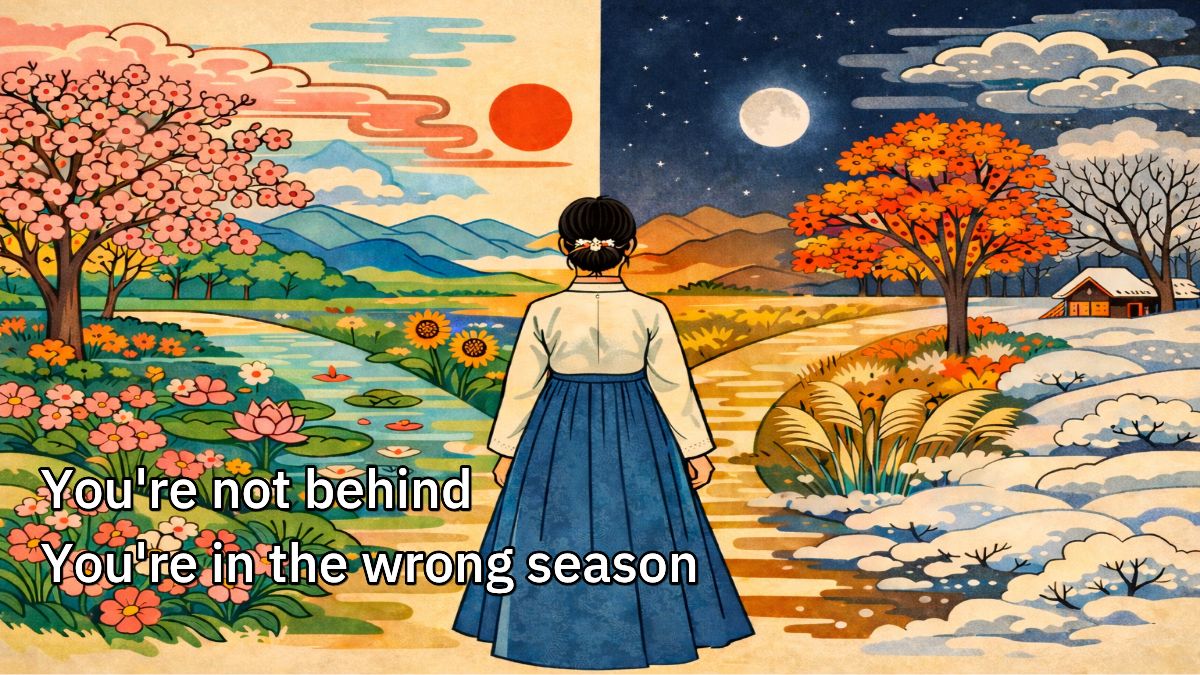

The Korean System That Reads Your Timing
There is a question that surfaces when people first encounter K-Saju. Not about what it predicts. Not about what it resembles. Something quieter: Can it explain why I keep ending up in the same place?
That question is the right starting point.
Most frameworks offer descriptions. They name who you are, what you tend toward, where your patterns originate. K-Saju begins differently. It asks what phase you are in — and what that phase requires of you right now. The distinction sounds small. In practice, it changes everything about how a person reads their own life.
K-Saju reads timing — specifically, the structural patterns that appear when a person’s natural rhythm meets the cycle of a particular year, decade, or phase of life. The Korean word saju (사주: sa-ju, four pillars) refers to the four elements of a person’s birth timing: year, month, day, and hour. But saju alone is only the raw data. K-Saju is what happens when that data is read through Myeongri (명리: myeong-ri, the study of cyclical life patterns) — a philosophical framework developed over centuries in Korea.
What it identifies is not fate. It identifies pattern.
A Different Kind of Question
There is a question most frameworks do not ask.
Not ‘Who are you?’ Not ‘What are your strengths?’ Not ‘What does your chart say about your personality?
K-Saju asks something different: ‘What phase are you in — and what does that phase require of you right now?’
This is not a better question. It is a different one. Most tools that help people understand themselves are built around identity — what a person is like, how they tend to behave, where their patterns come from.
K-Saju starts elsewhere. It starts with time. Specifically, with the relationship between a person’s structural tendencies and the cycle they are currently moving through. The same person in a different phase of their Daewoon (대운: dae-woon, 10-Year Energy Flow) will make different decisions, feel different resistance, and need different conditions to function well. Not because they changed. Because the surrounding rhythm changed.
That is the question K-Saju is built to answer. Not who you are. How you move — and what the current timing is asking of you.

The Architecture Underneath the Pattern
In K-Saju, structure means the proportional distribution of how a person processes action, pressure, emotion, and rest.
Every person begins with a certain internal structure. Not a fixed personality, but a ratio — a distribution of tendencies that shapes how they communicate, how they process pressure, how they make decisions, and what they reach for when things fall apart.
This ratio is not destiny. It is a baseline. The default setting that determines a person’s first impulse, their natural pace, and the kind of environment where they function well.
Some people move fast and think later. Some absorb the emotional temperature of a room before anyone else notices it has changed. Some push hard until they collapse. Some wait so long for the right moment that the moment passes. These differences are not random. They reflect the structural ratio underneath — the proportion of five phases that K-Saju calls Oheng (오행: o-haeng, five phases).
There is a reading where the same structural pattern appeared across four different clients in a single month. Different ages, different countries, different problems. The ratio was almost identical. The repeating behaviors were almost identical. The timing was completely different — which is why their experiences, on the surface, looked nothing alike.
That is what K-Saju reads. Not the surface. The structure beneath it, and the timing that activates or suppresses different parts of that structure at different points in a life.
A Water (수: su, connection phase)-dominant person in a Metal-heavy Daewoon may find their natural empathy turning rigid — not because they changed, but because the cycle is asking for boundaries they don’t naturally carry.
A Fire (화: hwa, expression phase)-dominant person in a contraction cycle may find their natural drive turning into frustration — not because they lost ambition, but because the timing is asking them to consolidate rather than expand.

What Timing Actually Means
Most people use the word timing casually. Good timing. Bad timing. Wrong place, wrong time.
K-Saju uses timing as a technical term.
Timing in K-Saju refers to the interaction between a person’s structural baseline and the larger cycles moving around it. There are four layers to this: Daewoon, Yeonwoon (연운: yearly flow),
Wolwoon (월운: monthly flow), Ilwoon (일운: daily rhythm). Each layer moves at a different speed. Each one changes the environment around a person’s structure without changing the structure itself.
This distinction matters.
A person with strong Fire does not become less expressive during a contraction cycle. But the environment becomes less receptive to that expression. The same drive that felt like momentum one year feels like friction the next — not because the person changed, but because the surrounding rhythm shifted.
This is why the same advice works for one person and collapses for another. Same information, different structure. Same structure, different timing. The mismatch is not personal failure. It is a reading problem — a failure to account for the actual conditions in play.
K-Saju is a framework for reading those conditions accurately.
Consider what this means practically. Two people launch the same kind of project in the same month. One gains traction immediately. The other hits resistance at every turn — funding delays, wrong collaborators, conversations that go nowhere. From the outside, the difference looks like execution. From inside a K-Saju reading, it looks like timing. One person’s structural tendency aligned with the current cycle. The other’s didn’t. Neither worked harder or smarter than the other. The cycles simply weren’t equivalent.
There is a reading where someone described the same year as both the hardest and the most clarifying of their life. The structure hadn’t changed. The Daewoon had.
When the conditions are read correctly, the same person who felt stuck in one cycle finds traction in the next — not because they worked harder, but because the rhythm finally shifted in their direction.

Why Korea Developed This System
The Taegeukgi — the Korean national flag — encodes the same philosophical framework that underlies K-Saju. The four trigrams in the corners represent the four primary phases of change: Geon (건: geon, initiation phase), Gon (곤: gon, stabilization phase), Gam (감: gam, internal restructuring phase), and Ri (리: ri, expression phase). Not as symbols. As a mechanical sequence.
Korea did not invent this framework. It arrived through the I Ching from China in the fourth century and deepened over centuries of Joseon-era scholarship. The Gwan-sang-gam (관상감: gwan-sang-gam), the Royal Bureau of Astronomy and Geomancy, studied these principles as a formal state discipline throughout the Joseon dynasty (1392–1897). Think of it as Joseon’s MIT — a state-funded institution where the brightest minds studied the heavens, the calendar, and the forces that shape a human life. This was not folk tradition. It was institutional knowledge.
What happened in Korea over those centuries was refinement. Joseon scholars brought their own observations, their own climate, their own historical patterns to the framework. It adapted. It deepened. The philosophical system that emerged — Myeongri — became something more precise than its origins.
In Korea, the tradition didn’t just survive. It was reframed — not as a system for predicting fate, but as a framework for reading personal rhythm and timing. That reframing is what is now called K-Saju.
What K-Saju Is — and Is Not
K-Saju is a philosophical framework. It reads time as a pattern, not a prophecy. It works the same way whether or not you believe in it — the same way a calendar works.
It does not tell you what will happen. It does not determine your fate or override your choices. It is not therapy. It is not a personality test. It does not require you to adopt a belief system or surrender to any external authority.
What it does: it shows where your natural rhythm is supported by the current cycle — and where it is working against you. It explains why some years feel like swimming upstream and others feel like the current finally turned. Why the same problem keeps returning in a different shape. Why advice that worked for someone else produced nothing for you. Why a decision that felt right in one year felt impossible in another.
These are not random experiences. They are structural. They follow a pattern that K-Saju is designed to read.
K-Saju does not solve all of that. But it makes the pattern visible. And a visible pattern can be navigated — with less confusion, less self-blame, and more clarity about what the current timing is actually asking of you.
There is a difference between not knowing what to do and not knowing where you are. Most people who feel stuck are experiencing the second problem while trying to solve the first. They add more information, more strategies, more effort — when what they actually need is a clearer read on the current conditions. A person in a consolidation cycle who keeps trying to expand will exhaust themselves not because expansion is wrong, but because the cycle isn’t built for it yet. The same person, six months into a different Daewoon, may find that the same moves that produced nothing before now produce results without the same resistance. Nothing about them changed. The terrain did. K-Saju doesn’t promise outcomes. It reads terrain.

The Right Starting Point
Most spiritual tools tell you who you are.
K-Saju tells you where you are — in time, in cycle, in phase.
That difference is subtle, but it changes how a person reads their own life.
It does not feel familiar at first. Less like recognition, more like entering a room you didn’t know was there.
Western spiritual frameworks are highly refined around identity.
Archetypes, elements, shadows, attachment styles — the language is rich, and often genuinely helpful.
K-Saju begins somewhere else.
It does not start with identity. It starts with timing.
The same person, moving through a different phase of their Daewoon, will face different resistance and require different conditions — not because something is wrong with them, but because the surrounding rhythm has shifted.
This is where many people get stuck.
They keep asking who they are, when the real question is what this period is asking of them.
Seen this way, some experiences that felt like personal failure read differently.
Not as flaws of character, but as mismatches of timing.wan-sang-g
And timing, unlike identity, can be read.
The Taegeukgi (태극기: tae-geuk-gi, the Korean flag encoding cyclical change) has been showing us that pattern for centuries. Most people never learned how to read it.
A flag. Four phases. One system.
This is where K-Saju begins.
Next: What Is K-Saju? (Part 2) The Structure Inside You
Not a personality type like MBTI. K-Saju reads five phases as a ratio inside every person. A map of how you process pressure and timing.
Some content in this post was created with AI assistance.