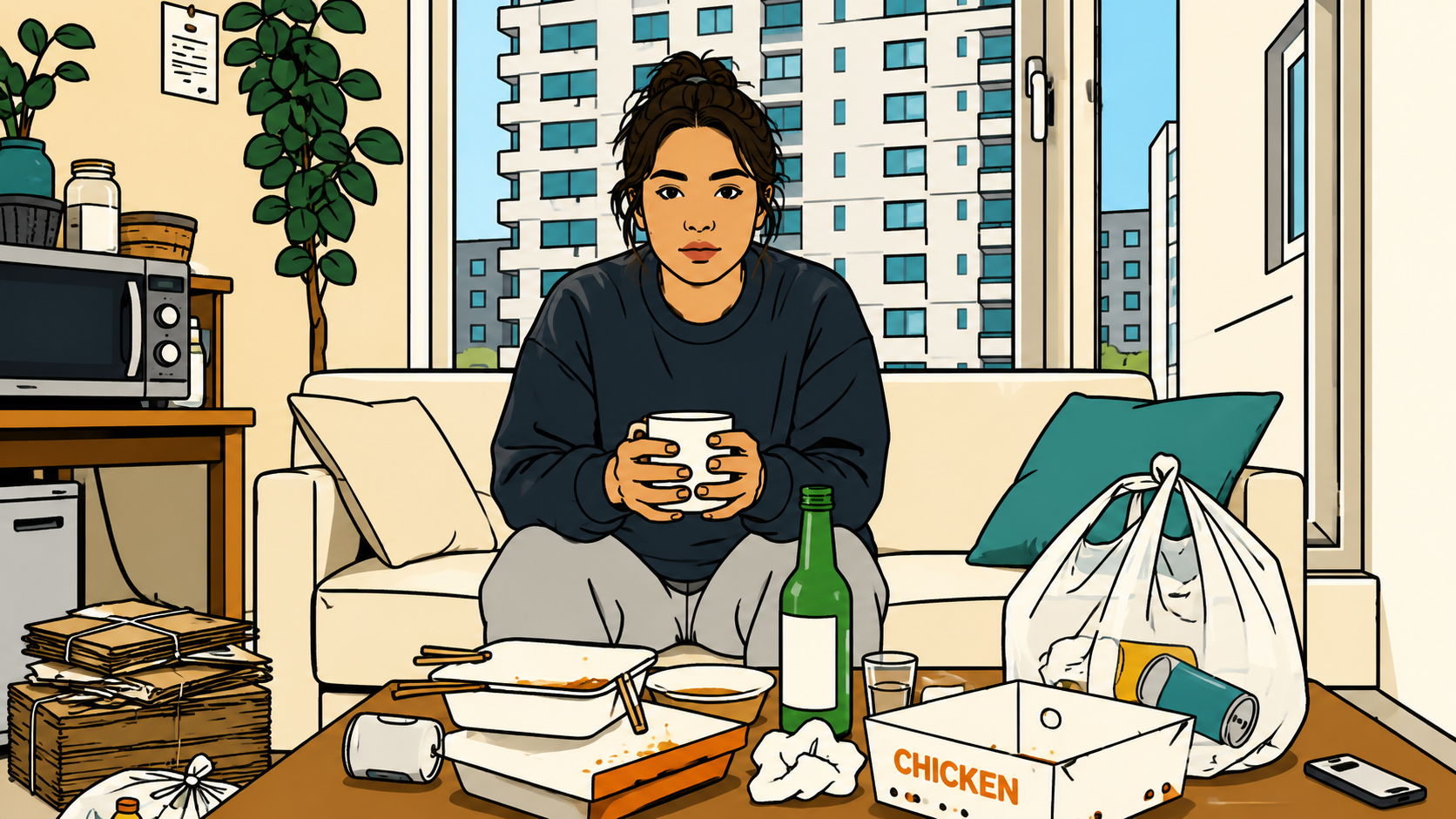

What is self destructive behavior at its most precise? It follows a schedule, and week eleven is right on it. Eleven weeks — the longest stretch of order her life had held in years.
The routine was running itself by then. The budget balanced without heroics, the mornings had a shape, the work was getting done ahead of deadlines instead of behind them. People had started commenting on it. She’d started, carefully, to trust it. And then, in the space of one weekend, she took the whole thing apart — the spending, the sleep, the skipped commitments, a three-day unraveling so efficient it looked planned.
Monday morning she sat in the wreckage with her coffee, waiting for the surprise to arrive. It didn’t. That was the unsettling part — some region of her had known this was coming, had almost cleared space for it, the way you set out a bowl for an expected guest.
The timing is what everyone gets wrong about this, including the person it happens to. It reads as random — I was doing so well, and then out of nowhere. But it wasn’t nowhere. The schedule is precise: not during the struggle, not in the fragile early weeks, but at the exact point where the new order stops being an experiment and starts becoming the life. The collapse doesn’t interrupt the arrival. The arrival triggers the collapse.
This is the pattern at its final checkpoint — the last argument the old version of you makes before conceding the ground.
What Is Self Destructive Behavior Doing Just Before It Erupts
Run the tape back on any of these collapses and the “out of nowhere” story falls apart quickly.
The weekend didn’t start the unraveling. It started ten days earlier, in increments too small to file a report on. She’d begun checking the budget app less often — not because it stressed her, but because it didn’t. A workout got moved, reasonably. Then a second one. She stayed up late on a Wednesday for no particular reason, scrolling past the point of enjoyment, and noticed a familiar flavor in it — a low hum of something loosening, almost nostalgic.
The signals were early, the way they always are — small preferences for the old rhythm, surfacing one at a time, each absorbed into a reasonable explanation. By the time the visible collapse arrived, it wasn’t a beginning. It was a conclusion. The weekend just made public what the ten days had been drafting in private.
That’s worth knowing, because it relocates the intervention point. The relapse can’t be stopped on the weekend it erupts — by then it has momentum and a story. It can be noticed ten days earlier, in the first small vote for the familiar. The vote itself isn’t the danger. Not seeing it as a vote is.
Why Stability Itself Can Feel Like a Threat

Here’s the part that sounds backward until it doesn’t: the collapse isn’t triggered by the difficulty of the new life. It’s triggered by the arrival of it.
Struggle, for all its cost, is a known country. When things are hard, you know your job — endure, adjust, push. There’s even a version of you that’s excellent there, forged by long practice. Stability offers no such role. When the systems run themselves, when nothing is on fire, when the week simply works, a strange unemployment sets in. The crisis-manager in you stands in an empty office. And identity hates an empty office.
If I’m not the one holding it all together, who am I in this picture?
That question, unasked and unanswered, is what makes the quiet feel dangerous. The old equilibrium — scrambling, recovering, almost-managing — was never comfortable, but it was yours, staffed entirely by versions of you with clear job descriptions. The new one asks you to be someone who simply lives inside a working life, and there’s no résumé for that yet. So the system does the one thing that instantly re-employs everyone: it manufactures a crisis.
He’d seen it in his brother, years before he recognized it in himself. Eight months sober, new apartment, steady work — and the family dinner where everyone finally exhaled was, in hindsight, the exact week things turned. Not because the dinner went badly. Because it went well. Someone said you’ve really made it through, and something in his brother’s face closed, briefly, like a man being read a job termination in the kindest possible voice. Relapse before stability recruits from exactly that moment — the one where the struggle officially ends and takes a role with it.
This kind of self destructive behavior isn’t an escape from the new life. It’s a return to the old job.
Why Self Destructive Behavior Peaks Right Before Things Hold
There’s a detail about this pattern that almost nobody is told, and it changes everything about how the collapse should be read.
The relapse tends to be loudest at the very end. Behavior researchers have watched this for decades in every kind of pattern: the old response often surges right before it fades — one final, intensified performance, as if the pattern knows the funding is being cut. The tantrum peaks just before it stops. The urge spikes just before it loosens. The eleventh-week weekend arrives precisely because eleven weeks was working.
Read one way, the collapse says: see, you can’t hold this — you were always going to end up back here. Read correctly, it says something closer to the opposite: the new order got real enough to threaten the old one into its last full mobilization. Nobody stages a counterattack against something that isn’t winning.
A relapse this close to stability isn’t evidence the change failed. It’s evidence the change was about to hold.
She didn’t know that on the Sunday night of the wrecked weekend, sitting in the familiar wreckage with the familiar verdict loading. Which is exactly when the reading matters most — because the interpretation chosen in that hour decides whether the weekend becomes a comma or a period.
After the Relapse — What Actually Changes

Because here’s what the old story leaves out: the relapse doesn’t return you to the beginning.
It feels like it does. The wreckage looks identical to every previous wreckage, and the voice narrating it uses the same script — back to square one, all that work for nothing. But the eleven weeks happened. The body that lived inside a working routine for eleven weeks is not the body that never has. The budget that balanced, the mornings that had a shape — those are no longer theories about a life you might be capable of. They’re memories of one you already ran. A relapse can interrupt the pattern. It cannot delete the evidence.
This is the asymmetry that makes this kind of self destructive behavior survivable in a way the early collapses never were. Back then, falling apart erased a hope. Now it interrupts a record. Hopes have to be rebuilt from nothing; records just have to be reopened. The difference between those two recoveries is the difference between starting over and picking up.
And this is where relapse before stability differs most from every earlier collapse: the recovery time tells the story. The first time she fell apart, years ago, the wreckage lasted a season. This time, she was back inside the routine by Thursday — not because she fought harder, but because the routine was still there, warm, recently lived-in. The new equilibrium doesn’t feel safe yet, but it has started to feel like hers — and things that feel like yours get returned to.
So the practical move, if the weekend has already happened, is narrow and specific. Don’t audit the collapse — audit the return. How fast did you come back, compared to last time? What survived — the app still installed, the habit still findable, the shape of the morning still known by heart? That’s the actual scoreboard. The old pattern gets one last loud weekend.
The new one gets Thursday. And Thursday, quietly, is the one that decides.
This post was planned and edited by a human, with AI assistance.