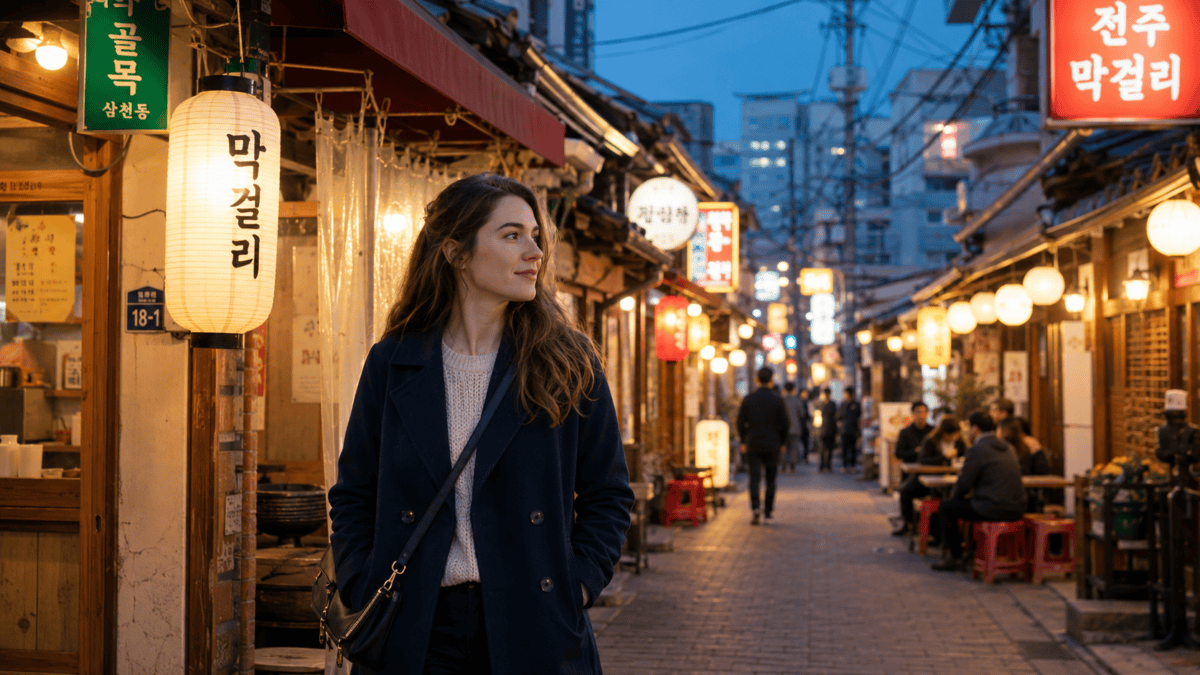
By evening the city has done its slow work on you, and there is one thing left, which is to stop trying to see Jeonju and simply sit in it. That happens in an alley, over a kettle. Jeonju makgeolli is not really a drink you order. It is a table you set in motion, and once it starts, the night takes over the arithmetic.
You have eaten your way across this small city by now, and the last stop is not a monument or a view. It is a low table, a kettle, and whoever happens to be sitting beside you.
The Alley That Fills at Dusk
Samcheon-dong (삼천동: sam-cheon-dong) holds the oldest of the city’s makgeolli alleys, a two-hundred-meter lane with twenty-some houses standing shoulder to shoulder, close enough that the smell of one kitchen bleeds into the next. The city has marked it as something worth keeping, a piece of its future heritage, which is a strange and lovely thing to call a street full of drinking houses.
At dusk the doorways come on one at a time, paper lanterns and warm bulbs, and the lane begins to fill the way a bath fills, from the bottom, warmth first. A kettle goes down on a table with a dull metal knock. A burner clicks and catches. Somewhere a group is already laughing at something, too early in the night for it to be the drink, so it must just be the relief of having arrived. Down the road there are younger alleys, Seosin-dong (서신동: seo-sin-dong) among them, with trendier plates and a younger crowd, but Samcheon-dong keeps to the old dishes and the old rhythm, and tonight that is what you want.
Bicycles lean against the walls. Shoes are lined up at the doorways where you sit on the floor. Steam rolls out each time a door slides open, carrying frying oil and something fermented and the sharp green of cut scallion. You pick a doorway for no reason except that it looks full, which is the only reason that has ever mattered here.
One Kettle of Jeonju Makgeolli

The rule is simple and it is the whole point: you do not order food. You order a kettle, and the whole spread arrives with it, free, eight or ten dishes set down at once until the small table is a problem of geometry.
The makgeolli itself comes cloudy in a dented tin kettle, and you pour it not into a glass but into a shallow bowl, which changes how you drink it. It is cool and tart and faintly sweet, thick enough to feel like it is on your side. The bowl matters more than it should. A glass would make this a drink; the wide shallow bowl makes it something you share a table over, closer to soup than to wine in the way it asks to be handled.
There are choices if you want them, a darker unfiltered one with more bite, a pale chestnut version for people who think they do not like makgeolli and are usually wrong. One kettle is built for three or four people, so by the simple shape of the order you are already not meant to be alone here.
It costs almost nothing. A kettle runs about the price of a coffee somewhere less generous, and it arrives with a meal attached. Jeonju makgeolli was once the best in the country, lost the title for a while when the nation went looking for stronger and shinier things, and quietly got it back when the country remembered what it liked. None of that is on your mind as you pour the first bowl. It is just very good, and there is a lot of it coming.
You fill your neighbor’s bowl before your own, because that is the one rule of the table written nowhere, and in time someone fills yours back. The kettle sweats. The first sip is colder than you expect, and it lands somewhere behind the breastbone, the same place the morning broth found days ago.
The Anju Keeps Its Own Time
The dishes do not wait to be understood.
A seafood pancake still hissing at the edges. A plate of boiled pork. Soft tofu in a warm broth. A small pot of spicy fish stew for the table. Seasoned greens, pickled things, a fried thing you cannot identify and do not need to. For the bold there is hongeo-samhap (홍어삼합: hong-eo-sam-hap), the pungent trio of fermented skate, pork, and kimchi that announces itself before it arrives. It is anju (안주: an-ju), food that exists to walk beside the drink, and it keeps its own clock entirely.
Then you order a second kettle, and the alley shows you its best trick: an entirely new spread comes down, different dishes from the first, as if the kitchen has been waiting to see whether you were serious. The table does not stop. The anju outlasts your thirst, and then it outlasts your hunger, and still it comes. By the second kettle the table has two layers again, the way the daytime one did, except no one here is trying to impress you.
The pancake gets torn by hand and passed. The stew is topped up from a bigger pot somewhere in the back. A grandmother owner moves between tables with a kettle in each hand, refilling, refereeing, remembering who ordered what without writing a word of it down.
But it never feels like the grand formal table you sat at in daylight. That one was quiet and careful and meant to honor you. This is loud and crowded and elbow to elbow, the couple at the next table leaning over uninvited to tell you which house along the lane does the best pancake, the owner topping up a kettle two tables down without being asked. It is a belonging you didn’t have to earn, poured out with the second kettle to anyone who took a seat. Nobody here needs to know your name to be glad you came.
Last Kettle, Then the Long Way Home
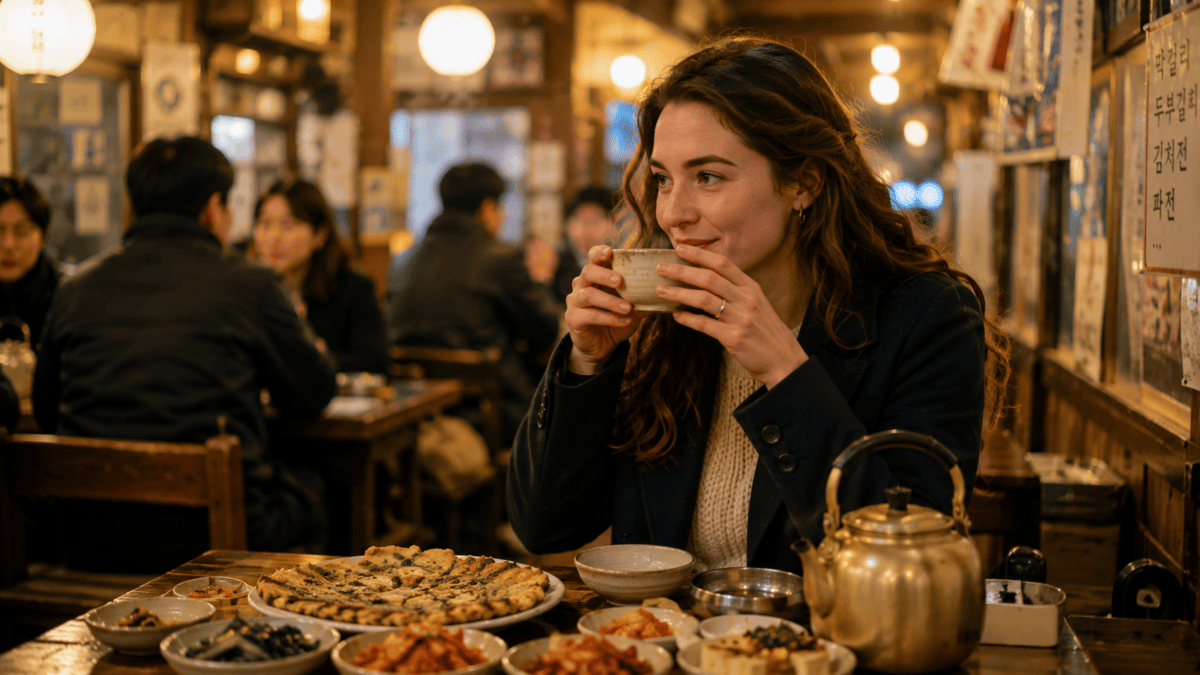
Somewhere in the warmth the whole day catches up with you at once.
The bowl you built with your own hands that first morning. The two bowls the city could not choose between. The table you were never meant to finish, and the roofs that finally made sense from above. It all settles quietly into this, a shallow bowl of cloudy wine in a loud bright alley, which turns out to be where the city was heading the whole time. Jeonju does not save its best for last. It just keeps handing you more, slowly, until you understand that the handing over was the point.
The alley is loudest now, and you are quiet in the middle of it, which is its own kind of rest. No one is hurrying you toward a bill. No one is hurrying you toward anything at all.
You do not finish the makgeolli. You were never going to, and by now you know better than to try. Finishing has not once been the thing this city asked of you.
Outside, the lane is cold after the heat of the room, and the paper lights blur a little at the edges. The laughter carries out into the street behind you and thins into the dark. Somewhere underneath the noise, in the part of the night that no one is watching, the next day is quietly assembling itself, the way it always does while people are busy being glad they came. You will not remember every dish.
You will remember the temperature of the room, and the sound the alley made, and the exact moment the day stopped asking anything of you. You take the long way back to where you are staying, because in this city the long way was always the point, and the taste of the wine stays with you well past the last lit doorway, cool and sweet and slow to leave.
This post was planned and edited by a human, with AI assistance.