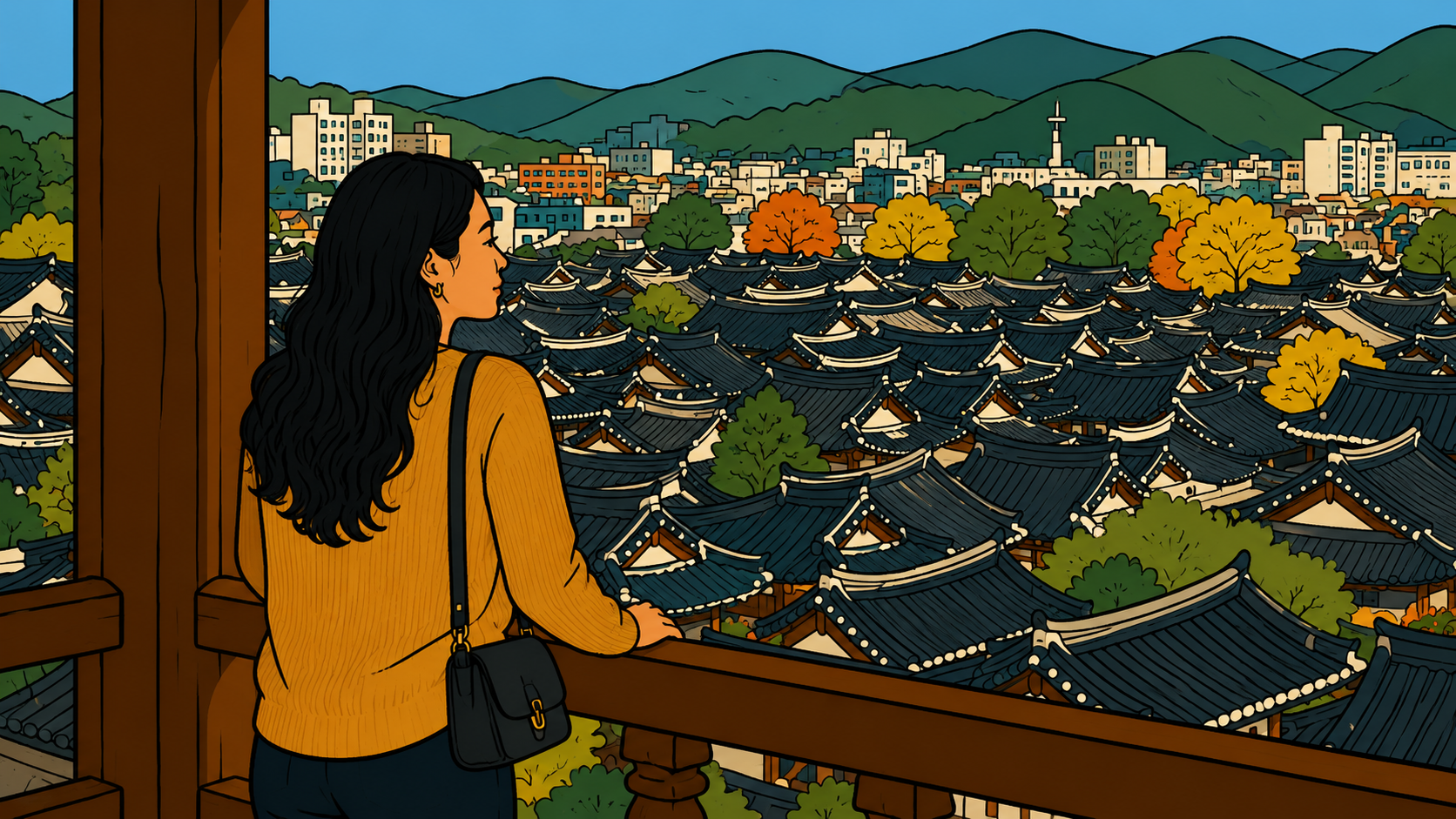
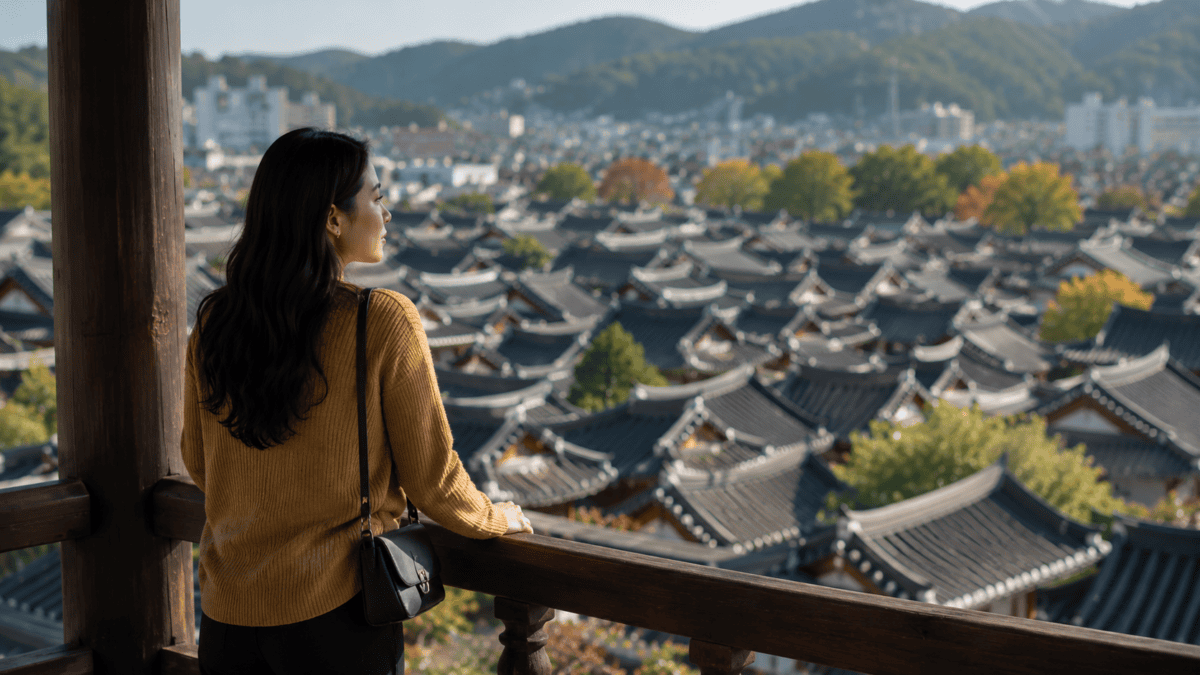
Some cities you understand at street level. Jeonju you have to climb a little, and the climb ends at Jeonju Omokdae (오목대: o-mok-dae), a low wooden pavilion on a rise at the edge of the hanok village. But you do not start there. You start down by the water, because the best way up is the long way, and in this city the long way has been the point all along.
A place gives up its secrets in a certain order, and Jeonju keeps its plainest one for last: you cannot really see it until you are standing above it.
The River Below Hanbyeokdang
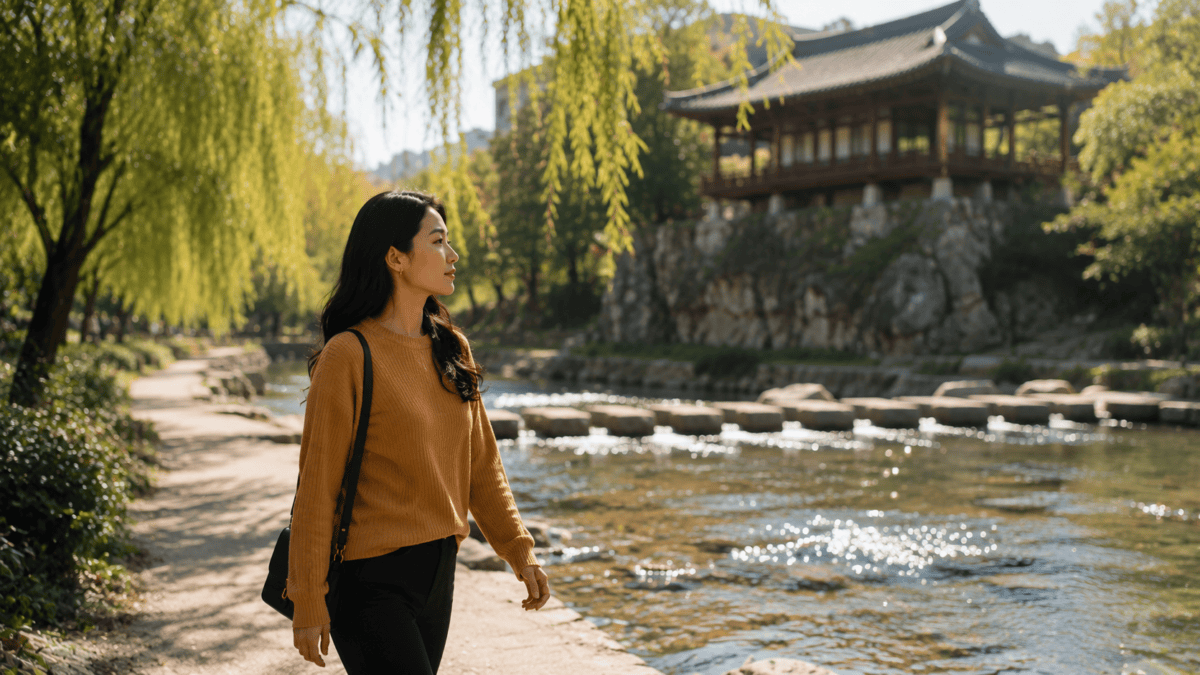
Jeonjucheon (전주천: jeon-ju-cheon) runs shallow and clear along the old edge of the village, the same stream that has drawn the water line of this city for centuries. You come down to it in the early afternoon, when the light has gone long and easy, and you walk the path beside it. Stepping stones break the current. Willows lean in. The water makes the particular sound shallow water makes over rock, a sound with no urgency in it at all.
Above the stream, on a shelf of rock, sits Hanbyeokdang (한벽당: han-byeok-dang), a pavilion first raised six hundred years ago by a man who left his post to come home and teach. Old poets counted the view from here among the finest in the region, and gave it a name for the clear mist that lifts off the cold water at dawn. There is a story attached to the rock here, the kind every old place keeps: a great centipede that once haunted the water below, and was finally put down, so that the pavilion sits on ground that had to be made safe before anyone could call it beautiful. You do not have to believe it.
You only have to stand where a great many people have stood and feel the same cold air lift off the same water. The pavilion is empty this afternoon. You stand under its eaves for a while and watch the stream do the one thing it has always done, and then you get hungry.
A Pot That Comes Still Boiling

On the short street that links the village to the pavilion sit a few old houses that have cooked essentially one thing for generations.
The dish is omogari-tang (오모가리탕: o-mo-ga-ri-tang), and the name comes from the pot. Omogari (오모가리: o-mo-ga-ri) is the Jeonju word for the heavy earthenware vessel the stew is boiled and served in, and the pot is not a detail. It is thick-walled and slow, and it holds heat so completely that the stew is still boiling when it reaches the table, climbing the sides, spitting red at the rim while you sit back out of range.
Inside it is a spicy freshwater stew, the fish pulled from river water: catfish or bullhead, whichever you point at. You choose the way locals do, by pointing, and the choice barely matters once the broth takes hold. The smell reaches you first, chili and river and something green underneath, and it clears your head before the first spoonful. Under the broth are dried radish greens, siraegi (시래기: si-rae-gi), that have simmered long enough to give everything back. It is deep and hot and a little rough, food that was built to put warmth into people who worked outdoors in the cold.
You take one of the flat benches set out by the river and eat it there, with the water moving a few feet away. The benches fill early; people come for the seat as much as the stew, to eat with the current at their feet and the pavilion above them going gold as the light drops. By the time the pot has calmed enough to touch, the fish is falling off the bone into the broth, and you spoon it over rice and eat slowly, because there is a river to watch and nothing left to hurry for.
The side dishes are few and plain: seasoned bean sprouts, a stack of roasted laver, some dressed greens. The rice comes cooked with black beans in an iron pot, and when the rice is gone they pour water into the crust and bring you the toasted, nutty tea that hides at the bottom. One pot, a handful of plates, a river. It is the exact opposite of the endless table you sat at before, and it is every bit as much this city.
The Climb to Jeonju Omokdae
Full and warm, you climb.
The path lifts away from the river and up through the back lanes, past low walls and the backs of houses, and then onto a wooded rise where the steps steepen and the pines close in. Your breath shortens. The village drops away behind you, roof by roof, until you cannot see it at all, only the trees and the next set of stairs.
This is the strange part. You spent the morning inside those lanes, turning where they turned, and you never once saw their shape. A maze does not show you its plan while you are in it. It is a shape you cannot see from inside it, and the only cure is height.
At the top of the rise stands Jeonju Omokdae. It is a modest thing, a wooden pavilion and a stone marker, and the weight it carries is all history: six hundred years ago the man who would found the last dynasty stopped on this hill on his way home from a battle in the south and held a feast here, on the very ground his own ancestors had left generations before. He was celebrating a victory. He was also, though he could not have known it yet, standing on the future.
A second marker sits close by for the ancestors themselves, the ones who left this ground generations before it meant anything. The two of them face each other across the rise like a question and its answer, and you catch your breath between them while the sweat cools on your back.
The Whole Town, at Once
Then you turn around, and the roofs are there.
All of them, at once, below you: hundreds of grey tiled roofs packed close, their ridges curving up at the ends, laid out in the shallow bowl of the town like tiles set by a patient hand. The maze you walked all morning resolves, from up here, into a pattern. You can pick out where you have been: the line of the eating street, the gap where the river must run, the pale wall of a shrine you passed without once looking up.
The lanes you got lost in have a logic. The village you were inside turns out to have a shape, and seeing the whole shape at once quietly rearranges everything you thought you understood down at street level.
The wind comes up the slope and moves through the pines behind you. Somewhere below, small and far, a gate opens and closes. The roofs hold the afternoon light the way tile holds heat, slow and even, giving it back long after the sun has started down.
You could have taken a photograph from the street and called it Jeonju. But you would have been standing inside the thing you were trying to see. It took the climb, and the river before it, and the slow pot before that, to earn the one view that makes the rest of the day make sense.
You start back down. The roofs disappear behind the trees, one row at a time, and by the time you reach the lanes again they are just walls and turns once more. But you know their shape now. You carry it down with you, the way you carry the heat of a good bowl long after the bowl is gone.
This post was planned and edited by a human, with AI assistance.