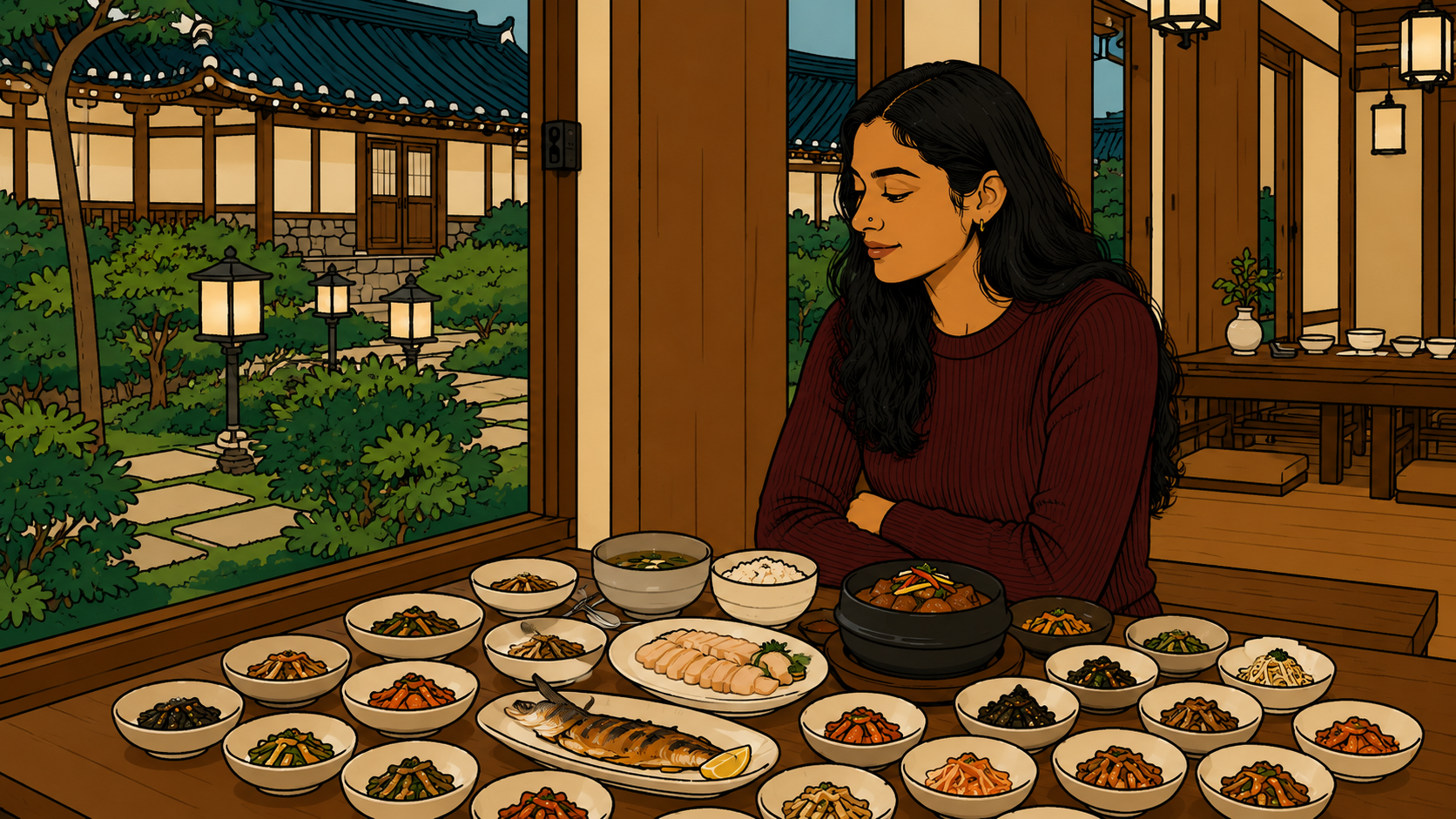
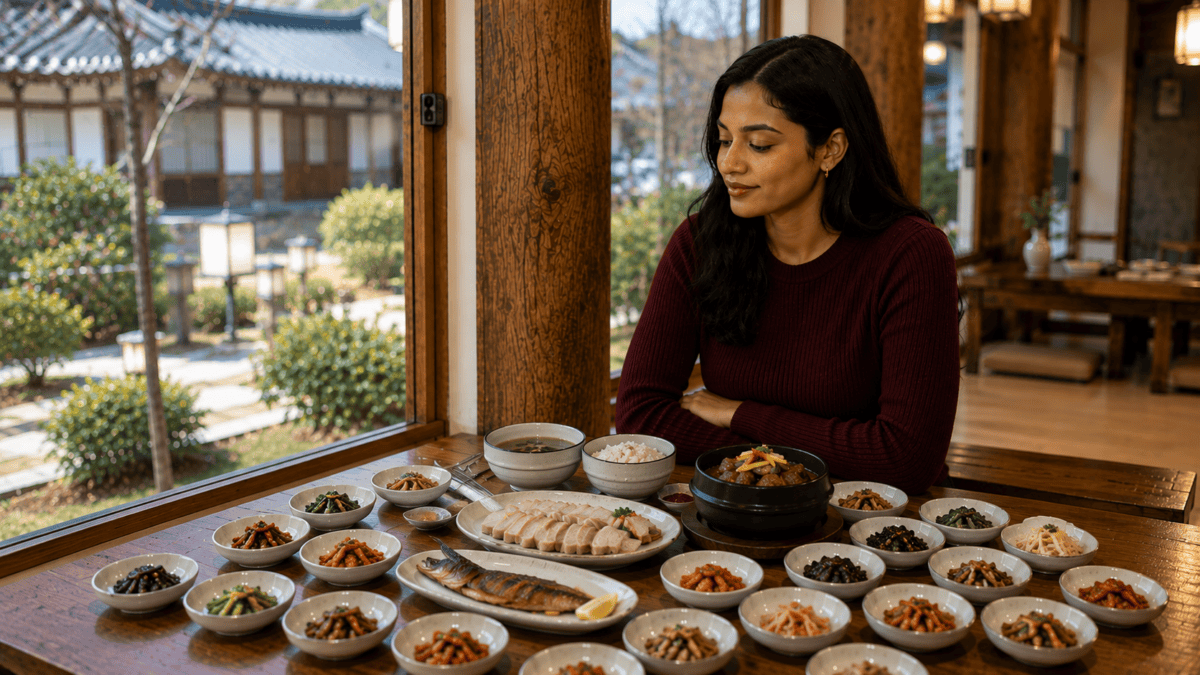
There is a kind of meal in Jeonju you do not so much order as surrender to. You sit down, you say how many people, and then the table begins to fill, and the trouble is that it does not stop when you think it should. Jeonju hanjeongsik is the city at its most generous, and generosity here is not a gesture. It is a quantity.
Sitting Down to Jeonju Hanjeongsik
The room is quiet in the way old wooden rooms are quiet. You leave your shoes at the step and the floor is warm underfoot, heated from beneath, and you sit low at a long table with the courtyard framed in the window like a picture no one needs to look at twice. This is the meal Jeonju keeps for the days that matter, for anniversaries and for guests a family wants to honor, the sort of table the rest of the world would file under Korean table d’hote and leave at that.
It did not begin humble. The form came down from the royal court, passed through the houses of the old aristocracy, and picked up the plainer dishes of ordinary kitchens along the way, until what sits in front of you now is three centuries of different tables agreeing to become one. A single scroll hangs on one wall. A brass spoon and chopsticks sit squared on the cloth. Somewhere behind a sliding door a kettle ticks.
You booked this table, and that already tells you something: a hanjeongsik is not a meal you fall into on the way to somewhere else. Families drive in for it. Couples mark years by it. It costs what a good dinner costs and takes the better part of an afternoon, and both of those are the point, not the price of getting in. A server sets down a few small plates and a bowl of soup, unhurried, and for a moment you think you understand the size of what you have ordered.
You do not.
When the Plates Don’t Stop
They come in waves.
First the cold and seasoned things: wild mountain greens dressed in sesame, three kinds of kimchi, a dish of watery radish kimchi still fizzing faintly, a saucer of salted roe, a square of acorn jelly. Then the warm ones begin, and they do not queue politely. A savory pancake, crisp at the edges. Deep-fried lotus root. Grilled fish still ticking from the pan. A soybean stew that has been going since morning. Boiled pork, bossam (보쌈: bo-ssam), with leaves to wrap it in. Short-rib patties, dark and sweet. And for the brave, a small dish of fermented skate, hongeo (홍어: hong-eo), that clears your sinuses from across the table before it ever reaches your mouth.
There is no menu to track, no order in which things are meant to come. A dish of raw blue crab in soy. A knot of steamed egg. Marinated perilla leaves stacked like the pages of a book. Each one lands, is tasted, and is half forgotten by the time its neighbor arrives. The server never announces what she brings; she sets it down, nudges the dishes around it a half-inch to make room, and is gone again before you can even ask what it was.
The plates are small and white and there are too many of them. They cover the table, and then they cover each other, the server easing a second layer over the first without a word, angling bowls into gaps you did not know were there. Five colors laid against one another, five ways of cooking in a single glance, grilled and boiled and steamed and fried and raw, so that the table is not a pile but a kind of order you could read if you had the time. The smell of it all at once is its own dish: sesame and soy and hot pan oil, and under everything the sour lift of kimchi doing what kimchi does.
By now the table has a geography. You have a corner you keep returning to, a small dish of something briny you cannot name and do not want explained, and you go back to it the way you would keep pressing a bruise, because it is yours for the length of this meal and will not be here tomorrow.
You think it is finished somewhere around the twelfth dish. Then five more arrive. The kitchen keeps giving past the point of use, past hunger, past anything one table of people could reasonably put away.
You came to eat a meal. The meal turned out to be a tide.
You Can’t Finish It (That’s the Point)
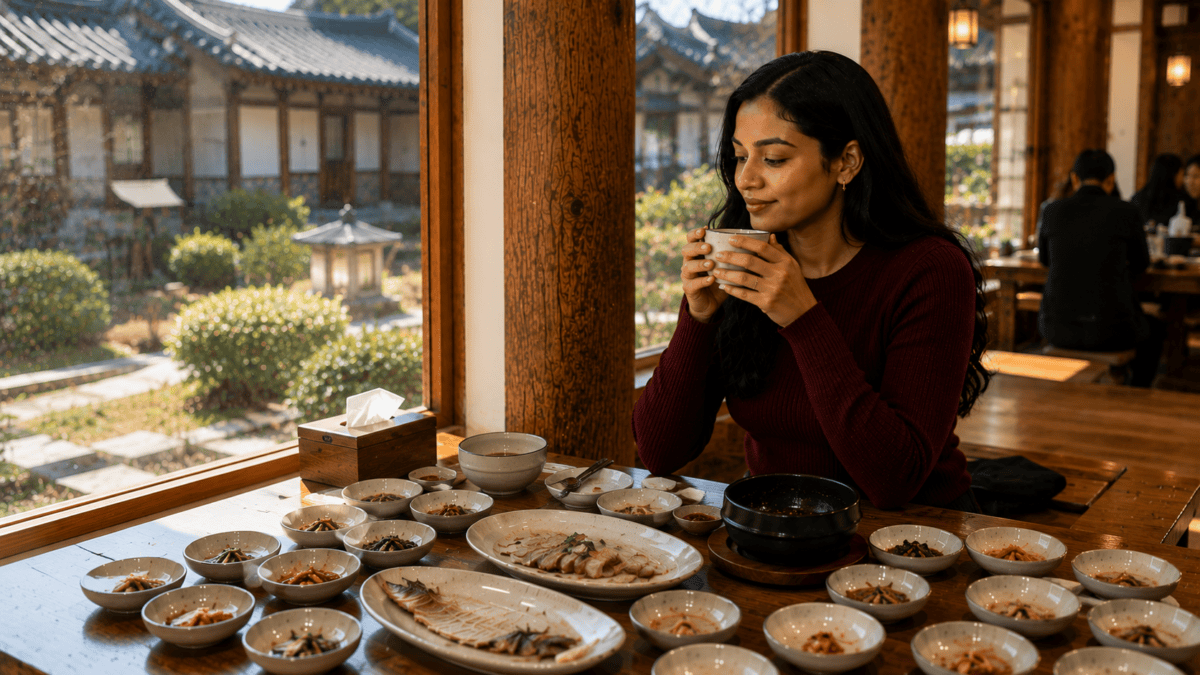
Here is the thing no one tells you and no one needs to: you are not going to finish it.
No one finishes it. That was never the arrangement. The abundance on the table is not a serving size that got out of hand; it is the entire message, and the message is that you are worth more food than you can eat. In this part of the country a Jeonju hanjeongsik is simply how regard gets expressed. Not in speeches. Not in a hand on the shoulder. In dishes, in number, in the quiet insistence of a table that refuses to look modest.
It is care with nothing said out loud. The host may barely speak to you. The kitchen you will never see. And yet you are being told, in the oldest language a Korean kitchen has, that your visit mattered enough to cook all of this and mean none of it as a burden.
You notice yourself resisting it at first, the way anyone raised to clear a plate resists being handed ten. Then you feel the resistance loosen. There is nothing to clear. There is only more than enough, and the rare, quiet permission to leave some of it. The only wrong response is to feel guilty about the waste, and even that softens as you eat, as you give up the idea of finishing and settle into the slower work of simply tasting, one small plate and then another, in no particular order, for no particular reason but that it is good and it is here.
Somewhere in that giving up, you stop counting the dishes and start remembering the meal.
What the Table Leaves Behind
By the end the table is thinned but never bare. A few plates emptied, most only visited, the rice bowls scraped, the stew gone cold and still half full. You could not win and you were never meant to. The bill, when it comes, is almost an afterthought, and smaller than the table it paid for. No one hurried you toward it. In a hanjeongsik house the check waits on the guest, and never the other way around.
Then the last thing arrives, and it is sweet and cold: a small cup of rice punch, sikhye (식혜: sik-hye), grains floating on top, or the darker persimmon-and-cinnamon sujeonggwa (수정과: su-jeong-gwa) that tastes like a cold version of a warm memory. It closes the meal the way a lid closes a box. You sit back. Your knees have gone stiff. An hour or two has passed that you did not feel passing, and this, you understand now, is not an accident. Jeonju is an official Slow City, and the phrase stops being a tourism slogan somewhere around the second hour on the warm floor.
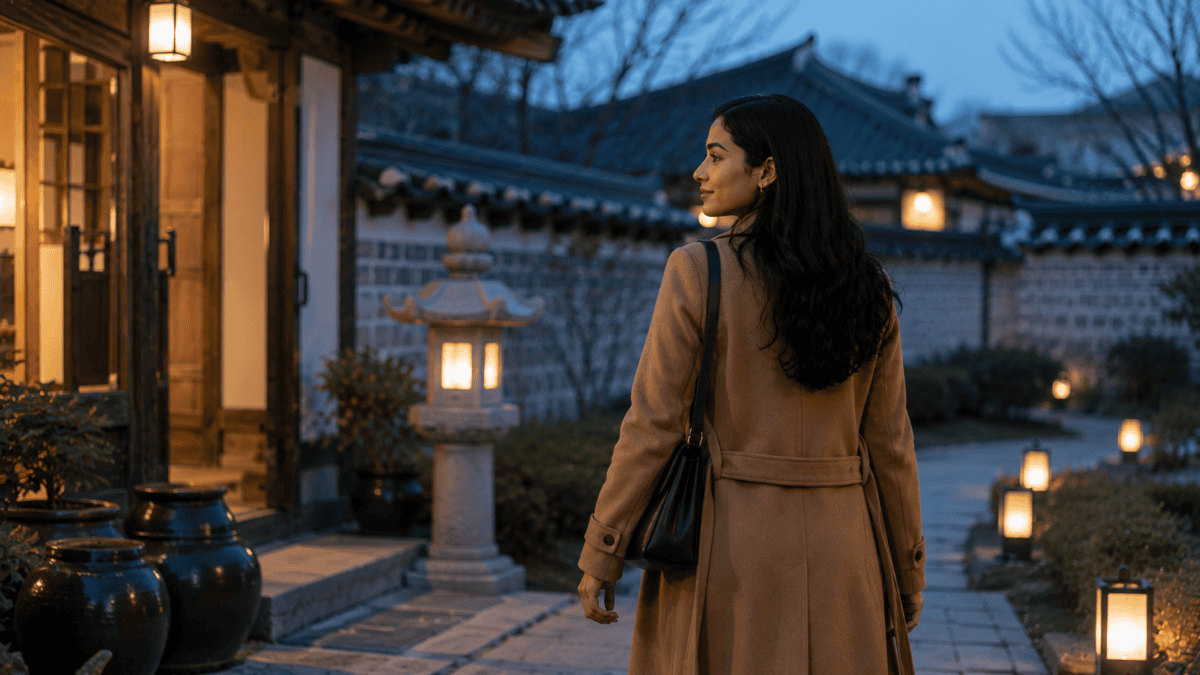
Outside, the courtyard has tipped into mid-afternoon, the light gone long and low. The cool air meets you at the step and takes the warmth off your face, and the sweetness of the sikhye stays on your tongue a while, long after the hundred small flavors behind it have blurred into one. You did not finish the table. The table finished you.
This post was planned and edited by a human, with AI assistance.