
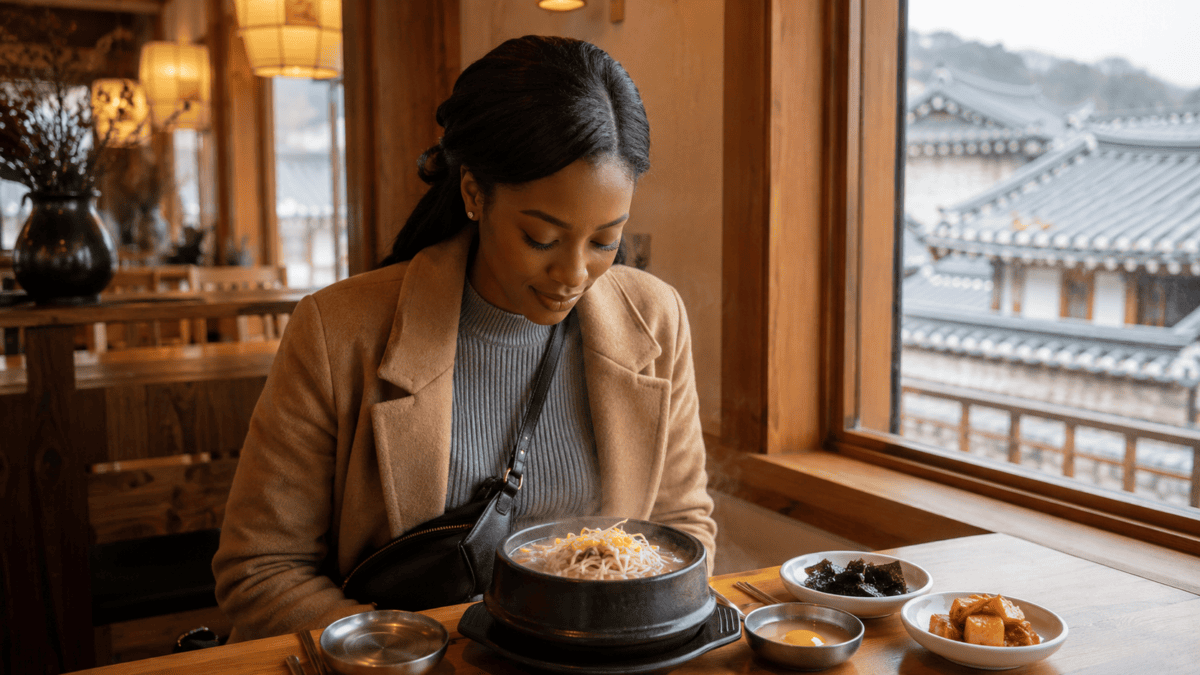
Jeonju kongnamul gukbap is not one thing. It is a bowl of bean sprouts and rice and clear broth, and it reaches your table in two completely different states depending on which door you walked through. The city has served it both ways for as long as anyone remembers, and it has never once felt the need to choose. That refusal is itself a kind of answer.
Morning at Nambu Market

You come to Nambu Market (남부시장: nam-bu-si-jang) before the day is fully up. It is the oldest and largest of the city’s markets, trading on this same ground since long before anyone alive, and at this hour it belongs to the people who run it. Vendors hose down the concrete. Crates come off the backs of trucks. A woman stacks radishes into a wall taller than she is, and does not look up.
The smell reaches you in layers. Wet stone and cold air first, then something richer underneath: broth, somewhere, a great deal of it, simmering since before dawn in pots the size of drums. Dried pollack and bean sprout, long and low. Under it, the sharper notes of the market: raw fish on ice, cut ginger, diesel, oil frying in a pan that has never once been new.
Steam lifts off a counter where three or four people already sit, coats still on, spoons already moving. This is where the market eats before it sells. No one here is a tourist. No one is photographing the soup.
Jeonju kongnamul gukbap was born poor. It came up in the hard years, when bean sprouts were cheap and a little rice could be stretched thin across a lot of broth, and for decades it was breakfast for market hands and men stepping off the night trains, sold around this market and the old station for the price of small change. It never lost that. A bowl still costs less than a coffee, and it is still eaten fastest by the people who work here.
You have walked the market awake; now you leave it for the quiet of a good bean-sprout house nearby, and take a table by the window.
Two Ways to Serve Jeonju Kongnamul Gukbap
Sit down in one kind of house and the bowl comes to you calm.
The cook fills it with rice and sprouts, then ladles hot broth over the top and pours it back out, over and over, a dozen times, until the rice is warmed all the way through without ever coming to a boil. This is toryeom (토렴: to-ryeom), and it is slow on purpose. You can watch it happen, the cook’s wrist turning, broth arcing from ladle to bowl and back to the pot, a small steady rain of it. The bowl that reaches you is hot but not scalding, the sprouts still crisp, the broth clean and quiet. You can eat it the second it lands. It was built to be ready before you arrived.
Walk into another kind of house and the same soup arrives still raging. Here the bowl is an earthenware pot carried straight off the flame, the broth boiling so hard it climbs the sides and spits on the wood, the sprouts gone soft in the roll of it. One old place became a legend this way, serving only three hundred bowls a day and taking the number for its name. You wait a full minute before you touch this one, because you have no choice, and the waiting is part of what you paid for.
The broth beneath both is the same patient work: dried pollack and roots and the heads of things, boiled down through the night until the water turns gold and deep. Whatever a house adds on top of that is its own secret, twenty ingredients or five. What never changes is the sprouts. They go in near the very end so they keep their snap, and that snap against the soft rice is half the reason to order it at all.
It is the same broth, the same sprouts, the same rice, sent two different directions. One bowl asks you to slow down. The other one makes you. The city keeps both, and people will defend their side of it the way they defend a hometown, which in a sense is exactly what they are doing.
The Egg, the Moju, and the Small Decisions
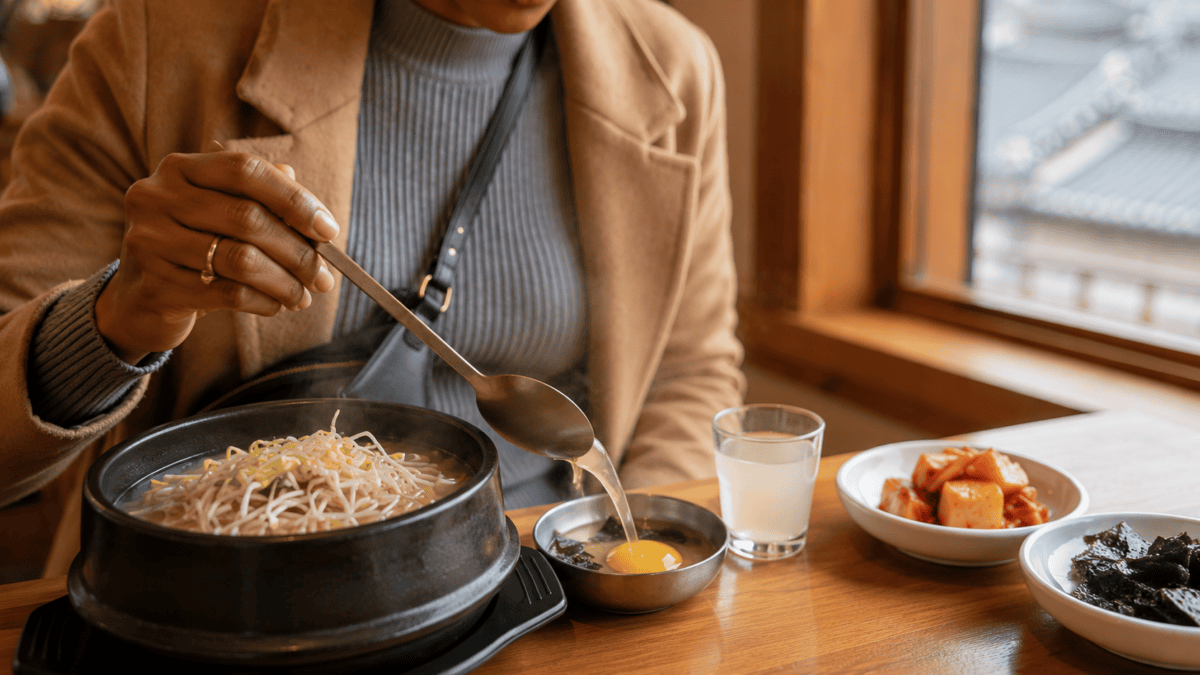
Then there is the egg.
It comes on the side, raw, in a small metal bowl of its own, and what you do with it is left entirely to you. Tear the sheet of roasted laver, gim (김: gim), over the top. Spoon three ladles of the hot soup in and stir, and the broth cooks the egg just enough, into something soft and gold that you drink down before you touch the rice. Or tip the whole thing into the pot and let it vanish into the boil.
Add a dab of salted fermented shrimp, saeujeot (새우젓: sae-u-jeot), for salt, a spoon of red paste for heat, or add neither. No one instructs you. The bowl assumes you already know what you like, or that you are old enough to decide.
On the counter within arm’s reach sit the things you finish it with: a jar of that fermented shrimp, a dish of chopped chili, a tub of kimchi you refill yourself as many times as you want. The whole meal, soup and rice and all of it, costs about what you would leave as a tip somewhere else.
And beside it, more often than not, a small cloudy glass of moju (모주: mo-ju): makgeolli simmered low with cinnamon, ginger, and jujube until the alcohol has cooked away and only the warmth and the spice are left. It is sweet and thick and barely a drink at all, and people take it with breakfast without apology. One glass is enough.
It is a drink invented by someone frugal and kind at once, unwilling to waste a batch of makgeolli gone slightly past its best, and unwilling to send anyone out into a cold morning with nothing warm inside them. This is the bowl Jeonju reaches for on the morning after, when the night before asks quietly to be undone, and the moju is part of the undoing.
Each small choice is yours. The soup only lays the ground.
Around the Bowl
By the time you set your spoon down, the market has woken all the way up.
The counter beside the soup is stacked with blood sausage, pisundae (피순대: pi-sun-dae), dark and thick and steaming, sold by the plate to people who eat it standing with a toothpick and a paper cup. Somewhere close a pot of pork ribs is going down slow into something sweet and sticky for the lunch crowd. Shutters roll up along the aisle. A radio starts mid-song. The soup counters fill and empty and fill again, the same bowl going out a hundred times before noon, each one a little different in someone’s hands.
A cat threads between the stools, unbothered, having done this every morning of its life. Old men read the paper over empty bowls. A vendor eats standing between customers, bowl in one hand, eyes already on the next sale. Two women argue cheerfully about which counter does it properly, and neither of them is going to move to the other.
None of it is a performance. This is only how the city starts, and has always started, every single morning: a bowl that is a rhythm, not a rule, a warmth you build to your own taste, sold cheap to whoever turns up hungry. You leave your chair still warm for the next person, and no one thanks you, because that was always the arrangement.
Outside, the light has come up fully, flat and grey over the market roofs. The broth stays with you a long time, somewhere behind the breastbone, well after the cold air has taken the last of the steam.
This post was planned and edited by a human, with AI assistance.