

You do not eat Jeonju bibimbap the moment it arrives. It reaches the table almost complete and still unfinished, a brass bowl of rice and color waiting for the one thing only your hand can do. But the bowl comes later. First there is the walk, and the walk is slow, because the city around it has been in no hurry for six hundred years.
The Village You Enter on Foot
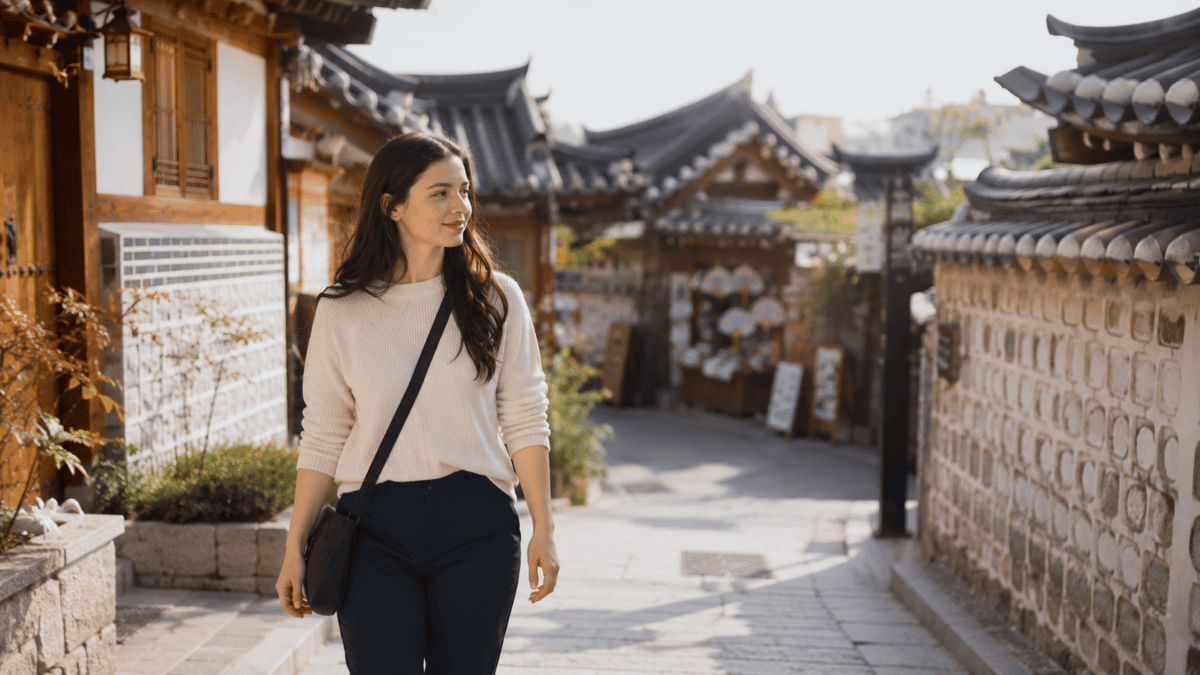
The hanok village (한옥마을: han-ok ma-eul) does not announce itself. You turn off a wide modern street and the roofs begin, hundreds of them, low and grey and tiled, their eaves curving up at the ends like the tips of something about to lift. Most are wood and clay, kept the way they have always been kept. You walk on stone, and the stone is uneven under your shoes, so you slow down whether you meant to or not. Some places quietly change how you move through them, and this is one of them.
This was the hometown of a king. The founder of the last dynasty traced his family line to this ground, and the quarter still carries that weight, quietly, in the things it chooses to protect. Gyeonggijeon (경기전: gyeong-gi-jeon) sits behind a long wall, holding the royal portrait (어진: eo-jin) of that first king in a dim hall that smells of old timber and cold stone. Guards once stood here for the founder’s face; now the courtyard is bamboo shade and slow footsteps.
A few streets over, Jeondong Cathedral (전동성당: jeon-dong-seong-dang) rises in Romanesque brick, finished in 1914 on the ground where early Korean Catholics were put to death, its rounded arches strange and calm beside the wooden roofs. Near the old Confucian school, Hyanggyo (향교: hyang-gyo), ginkgo trees hundreds of years old hold the morning light in their leaves before it reaches the ground.
Between the landmarks the lanes narrow and fill with smaller things. A shop selling hand-folded fans. Another stacked with pale sheets of mulberry paper. A doorway where someone presses patterns into rice cakes without looking up. Jeonju has made its paper and its fans for centuries, and the craft carries the same unhurried logic as everything else here, one careful layer at a time. People move at the pace the stones set. No one is walking fast. There is nowhere in these lanes that rewards it.
The air keeps changing as you walk. Wet stone. Woodsmoke from somewhere behind a wall. Under it, faint and constant, the sweet-sour breath of makgeolli fermenting in a courtyard, and rice steaming behind a kitchen screen. Then, closer to the eating streets, the first thread of sesame oil, warm and nutty, pulling you the rest of the way in.
A place that spent six hundred years refusing to rush is not going to hand you lunch in five minutes.
A Brass Bowl and Everything Around It
You sit on the floor at a low table, and before the bowl comes, the table fills.
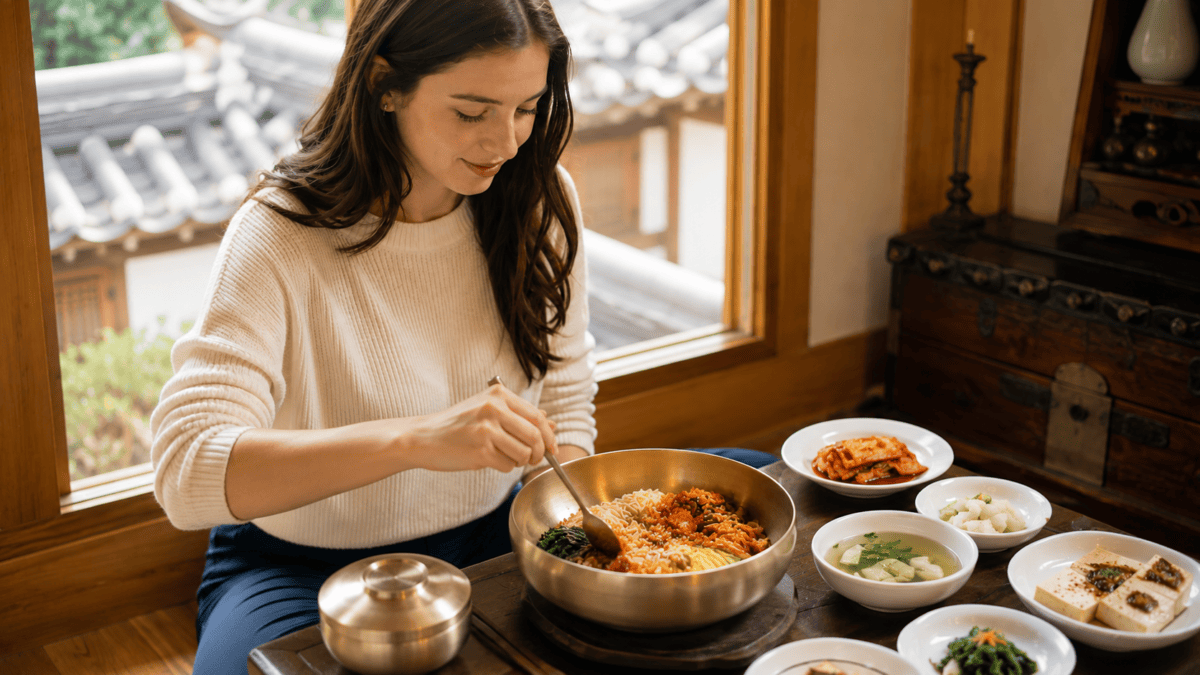
The side dishes arrive in small white plates, more of them than you can count on the first pass. Kimchi, of course, but also seasoned greens, a soy-braised root, a soft block of tofu in broth, pickled radish, a saucer of something fermented and sharp. In a proper Jeonju house the banchan alone would be a full meal, and the meal has not started. This is the city being what it is known for. It does not give you enough. It gives you too much, on purpose, and it waits to see whether you understand that the excess is the welcome.
Then the bowl. It lands warm and heavy, brass under your fingers, and you look at it before you touch anything. Someone sets it down without a word and steps back. The brass is old-fashioned on purpose; it holds heat the way the city holds its habits, slowly and all the way through.
Rice at the bottom, and over the rice the colors arranged in a slow wheel: bracken and spinach, pale bellflower root, orange carrot, courgette, a translucent slice of yellow mung bean jelly (황포묵: hwang-po-muk) that belongs to this city and few others, a mound of raw beef, yukhoe (육회: yuk-hoe), with an egg yolk resting whole in the center and a red spoonful of chili paste at the rim.
Nothing is mixed. Everything is placed. Each ingredient keeps to its own quarter of the bowl, separate and bright, the way the roofs outside each keep their own line against the sky. Five colors, laid out on purpose, because in this kitchen how a thing looks and how a thing is made are the same question. The sesame oil rises off the warm rice and fills the space above the table.
You could eat it like this. You are not supposed to.
How Jeonju Bibimbap Is Built, Not Served
Here is the part only you can do.
Jeonju bibimbap does not come to you finished. It comes ready to be finished, and the finishing is yours. You take the spoon, break the yolk so it runs gold into the grains, and begin to fold, from the bottom, where the rice has been quietly steaming in the brass the whole time. In the old houses that rice is cooked in beef broth, so the base is already seasoned before a single vegetable touches it. The bowl was working before it ever reached you.
This dish once fed kings and once fed field hands, and it never quite decided which it belonged to. Royal or plain, it hands every pair of hands the same last job.
You mix slowly. There is no fast way that ends well. The spoon drags, the ingredients resist, then give, and you can hear it, a soft wet turning under the low talk of the room. The red of the paste bleeds into the green, the green into the white of the rice, the egg binding all of it, until the neat wheel is gone and what is left is one warm, even, russet-colored thing that did not exist a minute ago.
The arrangement had to be destroyed for the meal to arrive. That is the whole point, and it is why the bowl is built at the table and not in the kitchen. The last step was never theirs to take.
The making takes maybe a minute. That minute is where the meal actually begins.
The Bowl Empties Slowly
Then the first spoonful: warm rice, the faint chew of the greens, sesame low underneath, the quiet heat of the paste behind it. It tastes like something you made, because you did. Everything good here arrives on its own time, and never a moment before you have done your part.
You eat slower than you meant to. The banchan keeps you company, one small plate leading to the next, and the clear soup goes between them to make room again. Around you the other tables are doing the same, each person bent over a brass bowl, mixing at a different speed. No two of you finish together. By the time the brass has cooled under your hand, you have been at the low table longer than any lunch at home would allow, and no one has come once to hurry you along.
When you stand, your knees complain and the room tilts slowly back into place. You slide the door open and step into the alley, and the roofs are exactly where you left them, curving up at the ends, holding the same grey light. A wooden gate knocks shut somewhere down the lane. A group drifts past in rented hanbok, laughing, in no rush to be anywhere.
The sesame stays on your fingers a while longer than the taste stays in your mouth. The roofs have not moved. The morning has.
This post was planned and edited by a human, with AI assistance.