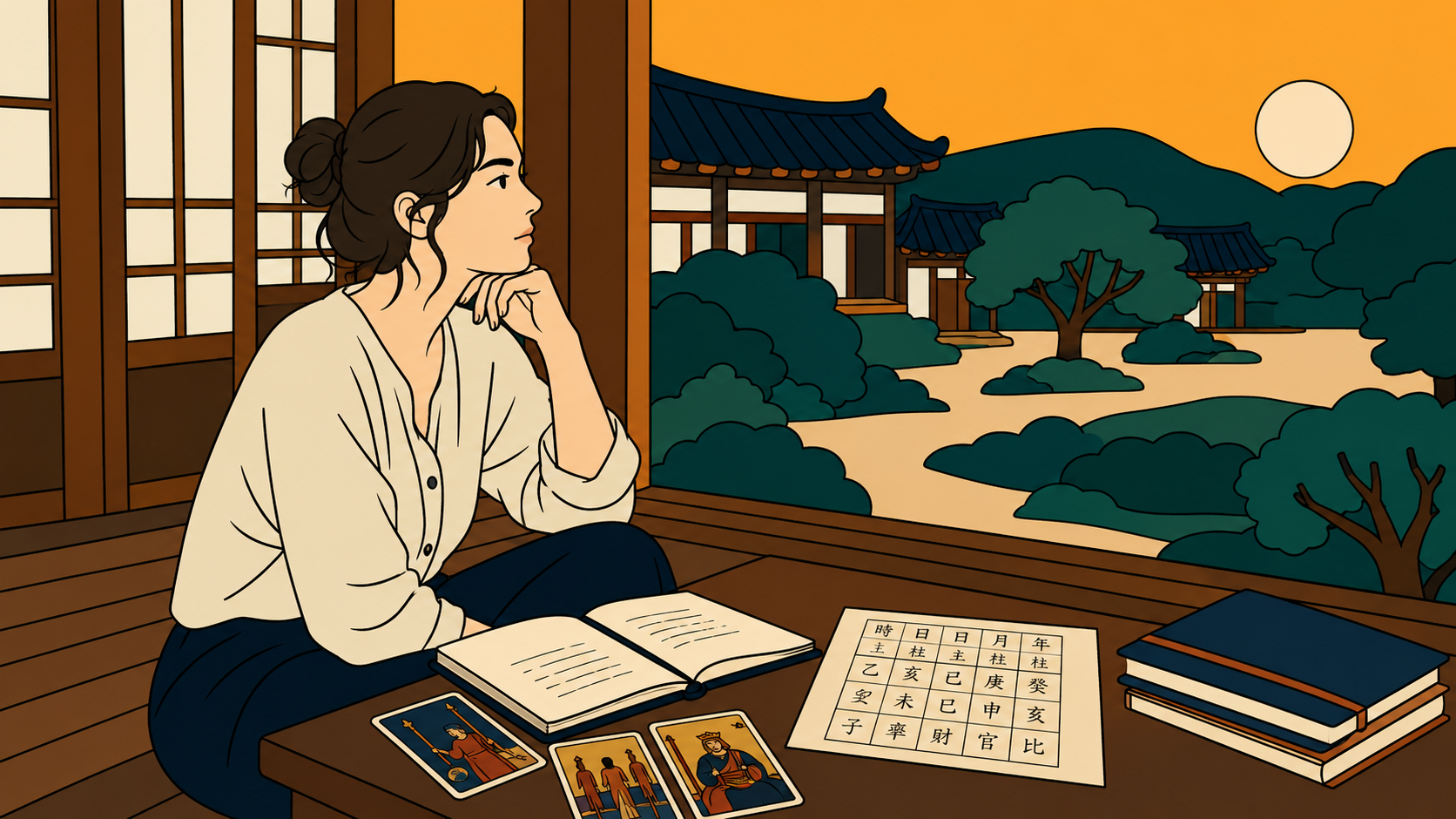

You pull a card and something clicks. The imagery lands exactly where you are — the emotional texture, the decision you’ve been circling, the dynamic you haven’t been able to name out loud. That’s not coincidence. That’s what tarot is built to do. A system refined over centuries pulls up what’s active in this moment and makes it visible.
K-Saju starts somewhere else. It looks at the same moment and asks something different. Not what’s activated right now — but what cycle is this moment sitting inside.
These two systems aren’t answering the same question differently. They came in with different questions from the start.
The Portrait a Tarot Reading Makes
A tarot reading is a snapshot. You sit down with a specific situation — a relationship that’s gone quiet, a career decision that won’t resolve, a feeling you can’t quite name — and the cards map what’s active in that moment. The tension underneath the surface. The emotional current running through the decision. The part of the dynamic you’ve been avoiding looking at directly.
This is what tarot does precisely and consistently. The imagery works because it’s archetypal — it reaches into patterns that human experience keeps returning to, and names what’s present before you’ve found language for it yourself. A skilled reader isn’t predicting. They’re reflecting back what’s already moving in the field.
That precision has been refined over centuries — tarot decks first appeared in 15th-century Italy before evolving into the divination system widely used today. The suits carry elemental resonance — Cups reading emotional currents, Wands tracking drive and momentum, Swords cutting through the cognitive layer, Pentacles grounding in the material and the practical. The court cards map behavioral modes. The major arcana tracks the larger forces moving through a life at a given moment. The system is internally coherent, and when it lands, it lands because it was designed to.
That reflection is genuinely useful, and it catches something K-Saju structurally can’t — what’s alive in you right now, before any cycle gets factored in. It’s a snapshot, not a smaller version of a bigger picture. K-Saju is reading a different layer entirely, not a deeper version of the same one.
The Cycle Underneath the Moment
K-Saju (사주: sa-ju, the Four Pillars) starts somewhere else entirely. Your chart is built from four pillars — year, month, day, hour of birth — each carrying elemental forces that interact with each other and with the cycles moving through your life in real time. The question K-Saju asks isn’t what energy is present right now. It’s what phase are you in, and what does this moment mean inside that phase.
The Daewoon (대운: dae-woon, decade cycle) — the decade-scale cycle at the core of K-Saju — is a roughly ten-year arc that shifts the structural conditions of your life. The annual cycle moves through it like weather through a season. These two layers interact with your natal chart in ways that are specific to your data — not archetypal, not universal, but calculated from the exact configuration you were born into.
What that means in practice: two people born in the same year, running the same annual cycle, can be in structurally different phases because their Daewoon arcs diverged years ago. One is in a phase where her dominant element is being amplified — where the conditions of her chart are set up to support outward movement and visible return. The other is in a phase of internal restructuring, where effort goes underground before it surfaces. Both are in the same calendar year. The ground underneath them is different.
K-Saju isn’t reading the same thing tarot reads, just from further back. It’s tracking a different axis entirely — phase, not presence. Each one tells you something the other can’t.
The Same Moment, Two Different Questions

Here’s where the comparison becomes concrete.
Two people pull the same card on the same day — the Three of Wands, forward movement, expansion, something arriving from a distance. Both readings feel accurate. Both people feel the pull toward action.
One is two years into a Daewoon that structurally supports outward movement. Her natal Fire (화: hwa, expression force) is being amplified by the current cycle. The card read something real, and the ground underneath is set up to receive it. She’s been building toward this for longer than she realized — the Daewoon created the conditions months before she felt them. When she moves, things land not because she moved at the right moment, but because the structure was already there waiting for the movement.
The other is in a cycle where her dominant element is running into friction — not failure, but the kind of structural resistance that routes effort sideways before it converts. The card read something equally real in her. The energy of expansion is genuinely present. What the card wasn’t built to track is the cycle underneath — just as K-Saju isn’t built to catch the exact feeling she had reaching for that card in the first place. She’ll move, put in the work, and watch results arrive late or land somewhere other than where she aimed. Not because she read the card wrong. Because the phase she’s in absorbs momentum before it returns it.
Same card. Same energy. Different phases. Tarot read what was active in both of them. K-Saju reads what that moment was sitting inside. Two questions. Each one answered on its own terms.
What Each System Is Actually Asking
Neither question replaces the other. They don’t even overlap. Tarot asks — what is alive right now. The emotional current, the tension underneath the decision, what’s rising to the surface. K-Saju asks — is the ground set up to let what’s present actually land. Whether the timing is energetic or structural. Whether you’re in a phase that converts effort, or one that accumulates it underground until the cycle shifts. Each question has its own territory.
The card reads the signal. K-Saju reads the frequency it’s running on.
She pulls the Moon. Late at night, alone, after a conversation that didn’t resolve the way she needed it to.
The card is accurate. Something is hidden. Something is running underneath the surface that hasn’t come into language yet. The imagery lands because it’s true — not metaphorically true, but true about this specific moment, this specific unresolved thing.
K-Saju is reading a different layer of the same night.
Not what’s hidden — but why now. Why this particular season keeps producing this particular kind of unresolved. Her Daewoon has been running a cycle that routes emotional material inward before it surfaces. This isn’t the first time she’s sat with something she couldn’t name. It won’t be the last — not because something is wrong, but because the phase she’s in is built for depth before clarity. The Moon landed because the cycle created the conditions for it to land.
The card caught something real in that moment — something K-Saju, looking only at cycles, would have missed entirely. K-Saju caught something the card was never built to track.
Both readings are true. They just answered different questions about the same night.
One System, One Question
Tarot and K-Saju aren’t two versions of the same tool. They’re two different tools for two different questions, and the fact that both involve birth data and timing doesn’t make them comparable in the way most people assume.
Tarot reads presence. What’s active, what’s surfacing, what’s true about this specific moment for this specific person. That’s a complete and legitimate inquiry that doesn’t need K-Saju to validate it.
K-Saju reads phase. What cycle you’re in, what the structural conditions of that cycle support or resist, when the phase is scheduled to shift. That’s also a complete inquiry — one that doesn’t require tarot to be useful.
The question isn’t which system is more accurate. It’s which question you’re actually asking. If you’ve been using one to answer the other’s question, that’s worth knowing — not because either system failed, but because the right tool changes what becomes visible.
Next time you reach for a card, pause and ask yourself which question you actually want answered first, right now.
Are you asking what’s present — or where you are?
This post was planned and edited by a human, with AI assistance.