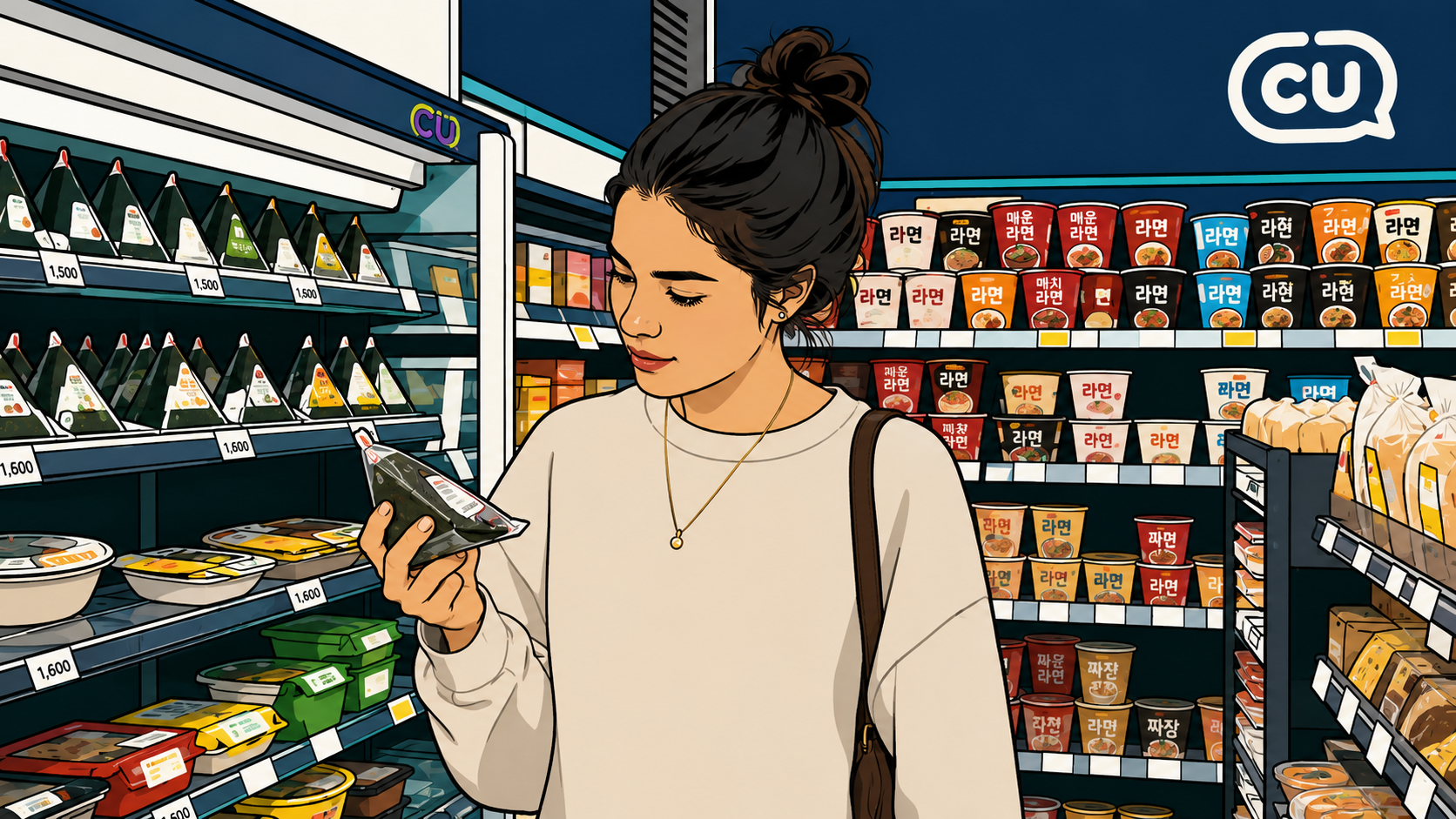

The heat lamp above the hot bar clicks on before the sun’s even up. Nobody watches it happen. By the time the first customer leans over the glass case, the tteokbokki (떡볶이: tteok-bokki) is already red and simmering, the fried chicken skewers are already glistening, and no one in the store remembers exactly when they were made or by whom. Korean convenience store food doesn’t have an origin story. It just appears, warm, in its plastic tray, waiting for someone to scan a barcode.
That’s not a complaint. It’s the whole design. Nobody in line questions it, nobody asks who made the food or how long it’s been sitting there. The whole system runs on an unspoken agreement that freshness here means something different — always warm, always replenished, never explained.
What Korean Convenience Store Food Is Actually Built For

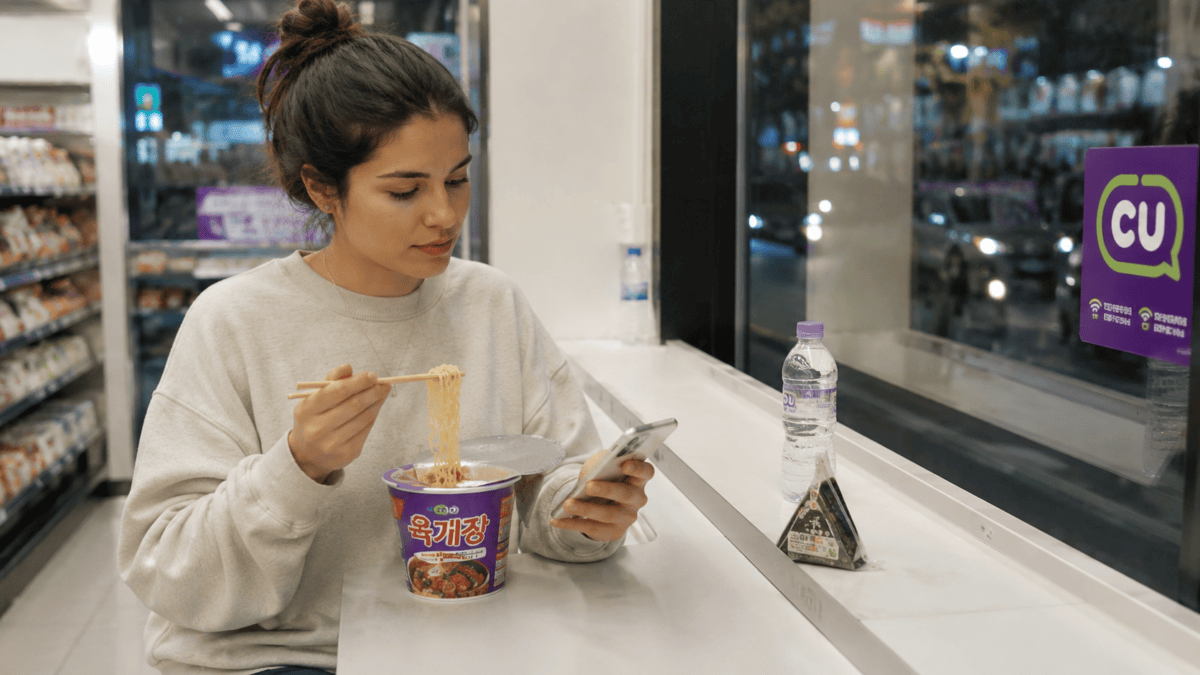
You pick up a cup of instant noodles, and the clerk points you toward the hot water dispenser without being asked — the gesture so automatic it barely counts as help. The kettle sputters, water pours, steam climbs off the surface in a thin curling column. Three minutes later, the lid comes off, that steam rising into your face, and the noodles are ready. No stove. No dishes. No decision about what to make, because the decision was already made for you the moment you picked the cup off the shelf.
The triangle kimbap works the same way. Peel the plastic strip, twist, pull — the seaweed wraps itself around the rice as if the whole thing assembled on its own. There’s a specific sound to it, a dry crinkle-snap that every regular could pick out blindfolded, even with their eyes on their phone. Get the twist wrong and the whole thing falls apart in your hand, rice scattering into the wrapper, and you eat it anyway, standing right there, without embarrassment. The rice is cool against the tongue, slightly firm at the edges where the fridge air reached it longest, the filling — tuna, or spicy pork, or just plain egg — barely warm from sitting under the store’s steady fluorescent light.
This is food built for a body that doesn’t have thirty minutes to spare. It asks nothing of you except hunger, and it answers that hunger without a single extra step in between. Even the packaging cooperates — pull tabs instead of scissors, pre-portioned instead of measured, everything designed so that the gap between deciding you’re hungry and no longer being hungry stays as short as it can possibly be.
The Standing Counter
By the window, a narrow shelf runs the length of the glass — just wide enough for one elbow, one tray, one phone propped against a drink bottle. There are no chairs pulled up to a table. You stand, you eat, you watch the street through the glass while the street watches you back, and neither side thinks much of it.
A woman in office clothes eats her kimbap in four bites, checking the time on her phone between each one. A student blows on a spoonful of ramyeon broth, not looking up, the smell of it — sharp, a little smoky — cutting through the store’s usual sterile air. An older man in a delivery vest eats standing sideways, one eye on his phone screen where an order’s counting down, chopsticks moving fast and without ceremony. Nobody talks. Nobody needs to.
Somewhere along the way, eating a triangle kimbap standing at a plastic counter stopped needing an excuse. Nobody at the register asks if you’re waiting for someone. Nobody at the next stool glances over to check if you’re eating alone because something’s wrong. You’re just a person with fifteen minutes and a hot bar tray, exactly like the person who was there before you.
There’s a particular kind of freedom in that — a meal stripped of every social requirement a table usually carries. The tray asks for nothing back. Korean convenience store food never asks you to explain your evening, your schedule, or why you’re standing there alone at an hour that has no name. It just waits, warm, for whoever walks up next.
What Never Changes on the Shelf
Walk into a different branch in a different city and the same rows greet you. The same brand of triangle kimbap, folded the same way. The same cups of noodles stacked in the same order — spicy on the left, mild on the right, seafood tucked somewhere in between. The hot bar holds the same tteokbokki, the same fried skewers, sweating faintly under the same heat lamp, the same faint film of oil collecting at the tray’s edge by afternoon.
Even the sound is familiar: the soft click of the fridge door, the crinkle of a wrapper, the low electronic beep at checkout, the hiss of the hot water dispenser refilling itself between customers. A new employee might rearrange the register, swap out a poster, change the playlist piping faintly from the ceiling speakers — but the food itself never moves far from what it’s always been, as if the menu answers to something steadier than any one manager’s taste.
The convenience store’s own steadiness — the same unchanging light no matter the hour — carries into the food itself. The rice ball tastes the same at nine in the morning as it does at two in the morning. The tteokbokki holds the same heat under the lamp regardless of what kind of day led you here. It’s Korean convenience store food built around a structure, not a schedule — not something you control, but something you learn to move with.
What’s Left on the Tray
The tray goes in the bin, the wrapper follows, and within a minute there’s no trace you were ever standing there. The counter’s already cool enough for the next elbow. Outside, the street keeps moving at whatever pace it was moving at before you stepped in.
There’s no receipt to keep, no photo most people think to take, nothing that marks the meal as having happened at all. A few minutes from now you won’t remember which branch it was, whether the kimbap was tuna or spicy pork, whether the noodles were the red packet or the white one. The meal disappears from memory almost as fast as it disappeared from the tray — not because it didn’t matter, but because it was never built to be remembered. It was built to close a gap, and it closed it, and that’s the whole job finished.
Somewhere behind you, someone else is already peeling the plastic off a fresh triangle, already listening for the same crinkle-snap, already standing at the same angle by the same window. The store doesn’t keep count of how many trays have passed through tonight, and neither does the street outside, and neither, in an hour, will you.
You’ll do this again — maybe tomorrow, maybe at an hour you can’t predict yet, standing at a different branch with a different tray, tasting the same broth, hearing the same crinkle of seaweed pulling free. The hand reaching for the shelf won’t feel like a decision so much as a return, the body finding its way back to the one place in the city that never asks it to explain itself. Nothing about the routine will feel worth mentioning to anyone else, and that’s exactly why it keeps happening — some habits survive precisely because they’re too small to justify or defend.
Some describe it as the country’s most democratic meal — equally available to anyone, at any hour, asking nothing about who you are before it feeds you. Whatever it is, it will taste exactly the same as it does tonight, and exactly the same again the next time you forget you were ever hungry until you weren’t anymore.
This post was planned and edited by a human, with AI assistance.