
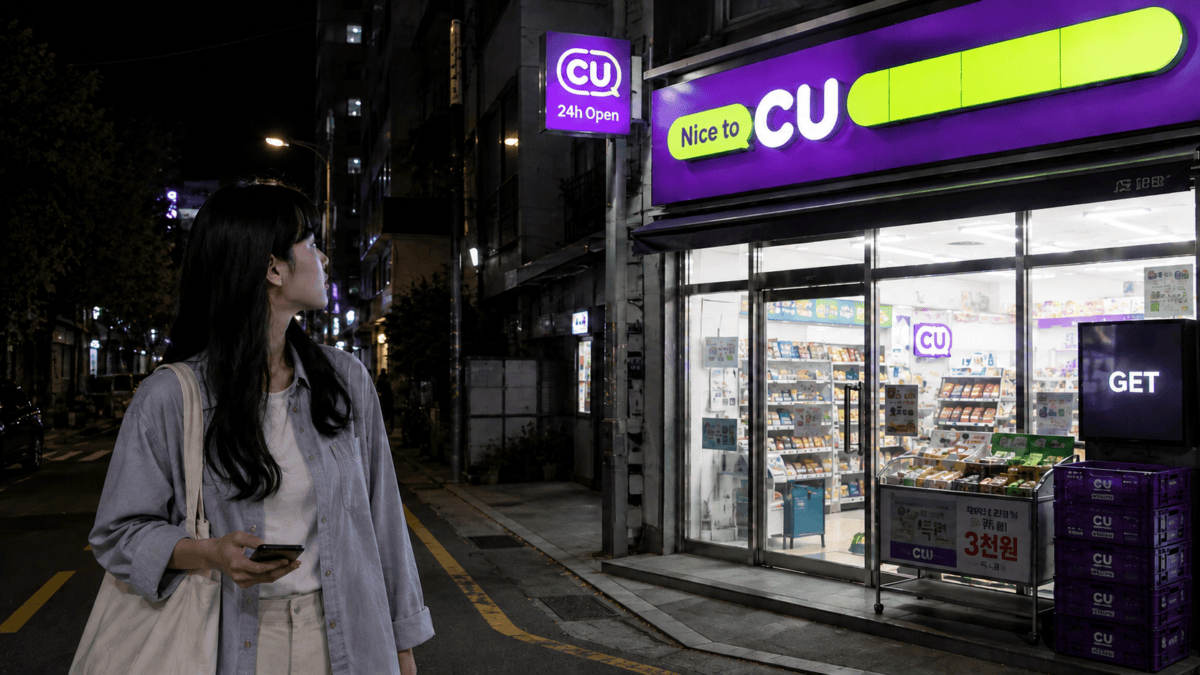
There’s a particular purple that only exists on one sign in Korea, and once your eye learns it, you stop needing to read the letters.
CU convenience store Korea marks itself the way a lighthouse does — not with a message, just a color, repeated on every block, in every neighborhood, until the color itself becomes the message. Round a corner exhausted, disoriented, looking for nothing in particular, and that purple finds you before you find it. By the time you’ve registered what you’re looking at, your feet have already turned toward the door.
What the Purple Actually Means
The sign glows the same electric purple whether it’s mounted above a subway exit, tucked between two apartment towers, or standing alone at the edge of a rice paddy outside the city. Nothing about the shade changes. Nothing about the size changes. Walk toward it from any angle and the purple reaches you first, followed by the white accent along the edge, followed only last by the letters themselves — C, U — which by then feel almost unnecessary. Your body already knew what it was looking at.
The color does the work language would otherwise have to do. You don’t think “there’s a convenience store.” You think, more simply, there’s purple — and purple means the door will open, the lights will be on, and nothing inside will require an explanation. CU convenience store Korea earned that shorthand slowly, one identical storefront at a time, until the brand stopped being a name and became a landmark instead.
Step inside and the branding continues in miniature. The shopping baskets carry the same purple trim. The staff vests carry the same purple-and-white combination. Even the till receipts print with a small purple logo in the corner, as if the store wants you to remember, on your way out, exactly which shade of trust you just walked through.
A tired commuter grabbing a canned coffee at six in the morning barely glances at any of it, and that’s the point — the branding isn’t asking to be noticed. It’s asking to be recognized without effort, the way a familiar face is recognized across a crowded platform before a single word passes between you. Even the plastic bags at checkout carry the same trim, so that walking home with one swinging from your wrist is its own small announcement — you were just there, under that light, inside that color, and now you’re carrying a piece of it back into the dark.
A Sign With No Local Accent
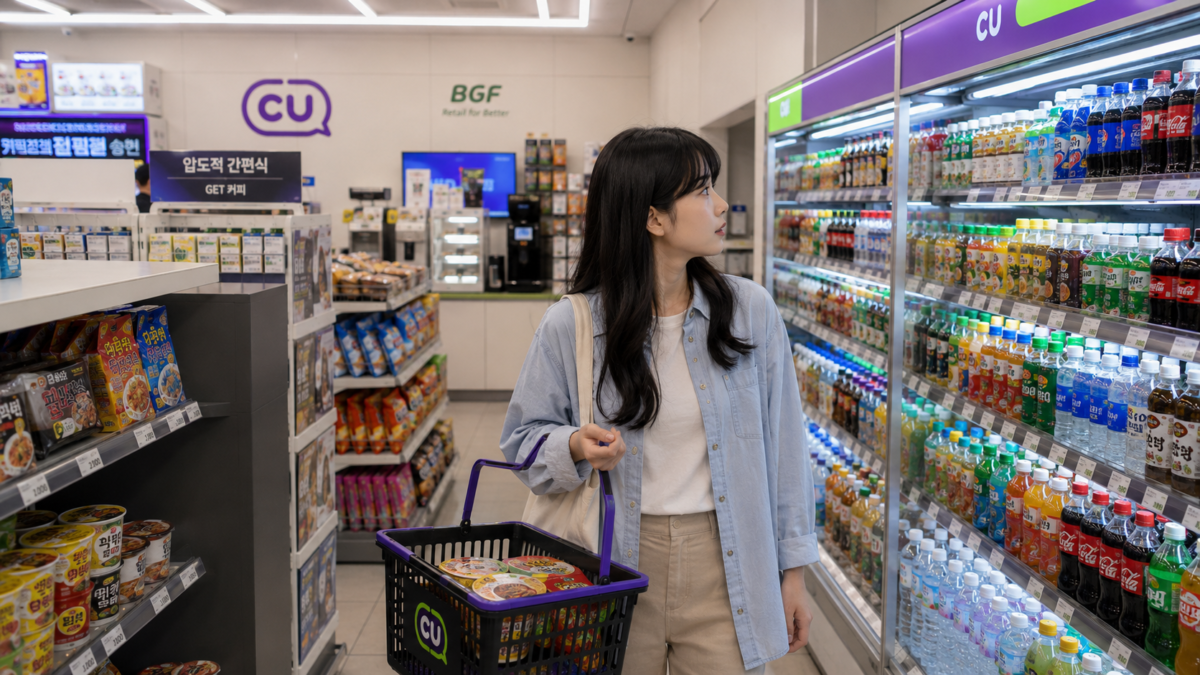
Walk into CU stores across Korea and much of the layout feels immediately familiar, right down to the ice cream freezer humming against the back wall. Walk into one in Busan and one in Seoul on the same day, and the only difference you’ll notice is the view through the window. The drink case sits in the same position. The snack aisle runs the same three rows deep. The self-checkout kiosk, when there is one, beeps the same two-tone confirmation whether you’re paying with a card in the capital or a province three hours south.
This sameness isn’t an accident of franchising — it’s the entire point. A traveler stepping off a late train in an unfamiliar city can walk toward that purple sign without needing directions, without needing to ask anyone, without needing to know a single word of the language on the shelves. The store has already decided, on your behalf, that you’ll find what you need exactly where you expect it.
As a Korean convenience store chain, CU built its reputation less on any single product and more on this predictability — the promise that the shelf you remember from one city will be waiting, unchanged, in the next. Ask a longtime resident why they favor CU over another purple-and-white chain down the street and they’ll often struggle to name a single concrete reason. It isn’t the coffee, isn’t the price, isn’t even the snacks. It’s simply that the layout never surprises them, and somewhere along the way, not being surprised became the whole appeal.
Regulars notice the seasonal shift before anyone announces it. One week the freezer case swaps out winter hot packs for cooling patches. A rack near the register fills with sunscreen sticks instead of hand warmers. Nothing is explained, nothing is advertised loudly — the shelves simply rearrange themselves to match a season the calendar hasn’t officially declared yet, and the purple sign outside never once changes to tell you so.
It’s a strange kind of comfort, watching a store anticipate the weather better than you have. Even the drinks rotate quietly with the temperature outside — barley tea moving toward the front of the case in August, a hot rice punch appearing near the register the moment the first cold snap hits — as though the season itself had a standing order it never needed to place twice.
The Products That Only Wear This Purple

Pick up a coffee can from the refrigerated case and you’ll find CU’s own brand printed in that same purple, distinct from the international labels stacked beside it. The store has spent years building its own small universe of CU brand Korea products — instant coffee blends, packaged desserts, a rotating cast of limited snacks that show up for a month, disappear, and get replaced before anyone thinks to miss them. None of it needs a national campaign to sell — the shelf itself is the advertisement, and the purple trim is the only endorsement it requires.
There’s a particular texture to holding one of these private-label snacks: the bag lighter than expected, the seal popping with a soft hiss of trapped air, a faint sweetness rising off the wrapper before you’ve even opened it fully. Many of these CU-exclusive snacks aren’t part of the regular selection at supermarkets or competing convenience store chains. They belong entirely to this purple sign, available nowhere else, disappearing the moment CU decides to move on to something new.
That exclusivity creates a small, specific loyalty. A regular doesn’t just prefer CU convenience store Korea out of habit — they’ve learned, over months of walking past that particular purple, that certain small pleasures only exist behind that door. Missing a favorite snack for two weeks straight means it’s already gone, and no other store will carry it, purple sign or not.
There’s a quiet grief in that, the kind reserved for things too small to complain about out loud but real enough to notice every time the shelf comes up empty. Online forums fill briefly with people asking if anyone’s spotted the discontinued flavor in some overlooked branch across town, a small search that rarely succeeds, and even more rarely gets mentioned again once it fails.
What the Sign Keeps Doing
Long after you’ve forgotten the specific snack you bought, the color stays. Ten years from now, dropped into a Korean city you’ve never visited, that particular electric purple will still reach you first — before the letters, before the layout, before you’ve consciously registered that you’re looking for anything at all. You’ll recognize it the way you recognize a smell from childhood — instantly, and without knowing why.
The store’s own steadiness mirrors something larger — the way the same signal can mean the same thing no matter where or when it appears. A sign doesn’t ask you to interpret it twice. It asks you to notice it once, and then trust that noticing for as long as the purple keeps showing up.
Somewhere behind that door tonight, the freezer is humming its same low note, the register is printing its same small logo, and the purple sign outside is doing exactly what it’s always done — waiting to be recognized, needing nothing more than color to do it. You don’t have to know the language to know what that shade means — you just have to have seen it once, and your body remembers. The next time you round a corner in a city you don’t know, it will find you again, exactly the way it always has.
This post was planned and edited by a human, with AI assistance.