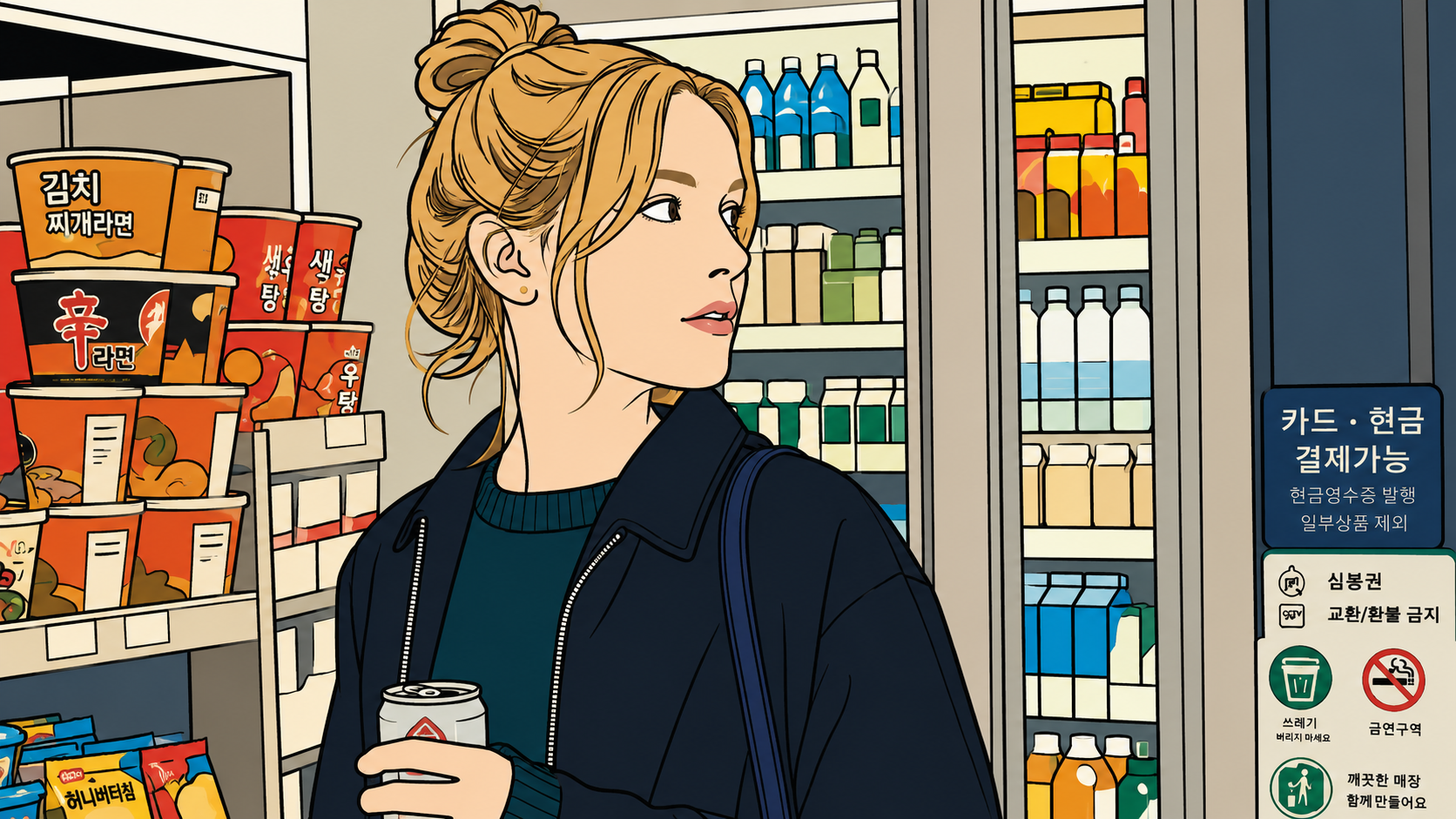

Every Korean convenience store keeps the same hour, no matter the clock. The door chimes before you’ve fully stepped inside — not a bell exactly, but a short electronic phrase, four notes, the same in every branch across the country, so familiar that people stop hearing it. Inside, the light is total. No shadows, no dim corners, no sense of an hour. The place at midnight looks exactly like it does at noon, and that sameness is the first thing your body notices before your mind can name it.
Outside, the street has changed color. The shops have pulled down their shutters, the restaurants have flipped their signs, the sky has gone the flat orange of a city that never fully darkens. But here, behind the glass, nothing has dimmed. The refrigerators still hum their low continuous note. The rice balls still sit in their neat triangular rows. The floor is still bright enough to read by. The whole store sits there like a lit aquarium dropped into the dark street, glowing quietly for no one and everyone. Step through the door and you step out of the hour entirely.
You’ve probably done this without thinking — ducked into one for a single thing and stayed a beat longer than the errand needed, held there by all that light and quiet. It happens to everyone. The place is easy to walk past and strangely hard to leave, and most people never stop to ask why a small bright room at the end of the block should feel like that. This is a look at what that room is actually doing.
A Room With No Clock
There is no clock on the wall, and there doesn’t need to be. The store refuses time in a more thorough way — by looking identical no matter when you arrive.
You could walk in at seven in the morning on your way to work, or at three in the afternoon with nothing to do, or at two-forty in the deep middle of the night, and the light would be the same wattage, the shelves the same fullness, the hum the same pitch.
Most spaces tell you what time it is. A restaurant fills and empties. An office darkens. A park changes with the sun. The convenience store does none of this. It holds a single unchanging noon inside itself and offers it to anyone who walks in, at any hour, without asking why they’ve come.
That refusal is strangely restful. Somewhere behind you the day has a schedule, deadlines, a bedtime you’ve already missed. In here none of that applies. The store makes no demand on the hour and therefore makes no demand on you.
The layout doesn’t change either. Every Korean convenience store keeps the drinks at the back, so you walk the length of it to reach them — past the snacks, past the instant noodles in their stacked bowls, past the refrigerated wall of lunchboxes and rice rolls. The hot bar near the counter breathes out the smell of broth and fried dough. It’s the same in every branch, so precisely repeated across the country that walking into one you’ve never seen still feels like returning somewhere. The brand on the sign changes. The corner changes. The map underfoot does not.
What the Korean Convenience Store Light Is Doing

The brightness is not an accident. It’s engineered, and once you feel it you can’t unfeel it.
Everything under that light looks available. The drinks stand in their chilled rows behind the glass, condensation just starting on the nearest cans. The snack aisle runs in a wall of color — silvers and reds and yellows, each bag angled to face you. The fresh shelf glows with its plastic-wrapped rice and its sandwiches cut on the diagonal. Nothing is hidden, nothing is dim, nothing asks you to hunt for it. The whole small room is arranged so that your eye lands on something wherever it falls.
And it’s quiet in a specific way. Not silent — the fridges hum, the door chimes when someone new comes in, a kettle of hot water ticks somewhere near the instant noodles. But no one talks to you. No one hovers. The person behind the counter looks up, then back down. You can stand in the middle of that light for as long as you like, holding a single drink you haven’t decided to buy, and nothing in the room hurries you toward a choice.
The temperature is its own kind of neutral. Never cold, never warm — a mild even air that matches the light, so that stepping in from a summer night or a winter one feels almost the same. Your fingers find the chill of the refrigerated glass, then the warmth drifting off the hot bar a few steps later, the two edges of comfort held in one small room. It’s a space built to be easy on the body in every direction at once, and the body, walking in with nowhere else to be, quietly agrees to stay a minute longer than it meant to.
Who Passes Through
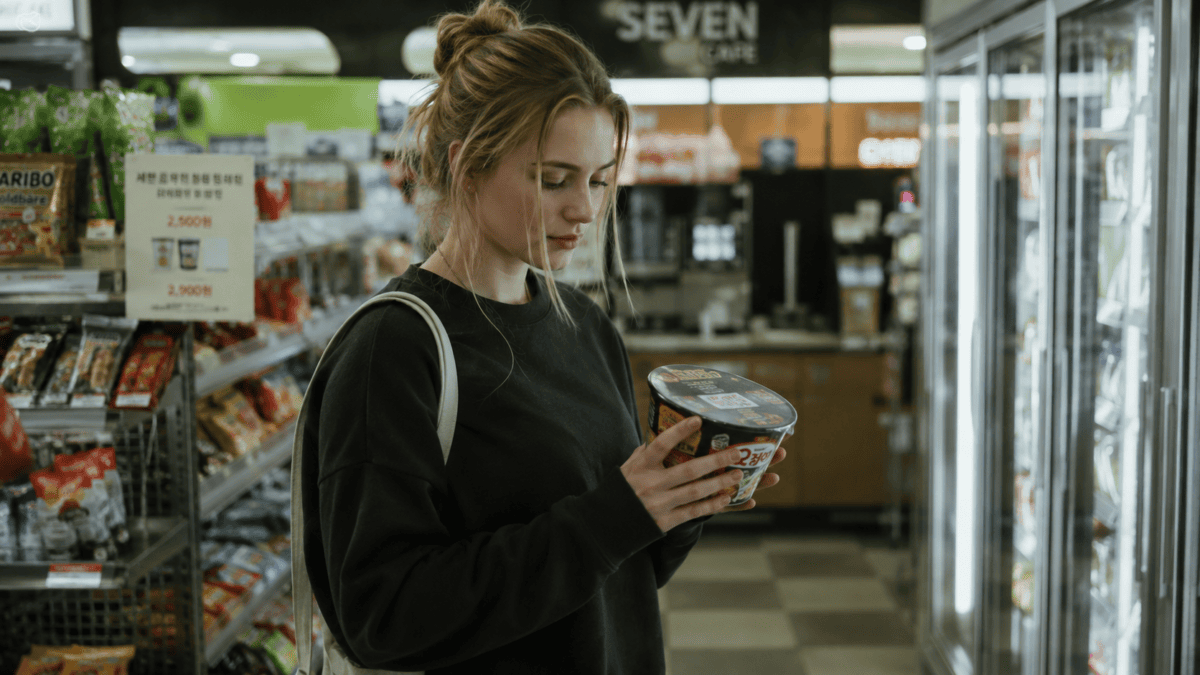
Watch the door for a while and the city walks through it in miniature.
A man in a wrinkled work shirt buys a single can and a lighter and leaves without a word. Two students share the narrow counter by the window, steam rising off a shared bowl, talking low. Someone in slippers shuffles in for something small and specific — a toothbrush, a drink, a foil packet of medicine — the kind of errand that only exists at this hour. A delivery rider stands near the hot bar warming his hands, helmet still on. None of them explains why they’re there. The store doesn’t require it.
They don’t interrupt each other. That’s the unspoken rule of the place: everyone is briefly here, under the same flat light, on the way to somewhere else, and no one owes anyone a reason. You can be tired, underdressed, wide awake at an hour that has no name — and the room takes you exactly as you arrive.
And they keep coming, a slow uneven trickle that never fully stops. There’s no rush hour here and no empty one — just a steady handful of people cycling through, one leaving as another steps in, the door chiming its four notes over and over into the night. Nobody stays long. Nobody is turned away.
The clerk rings up a drink, a rice ball, a phone charger, and goes back to whatever was on the counter before. Stand there a while and you stop being a customer and become part of the pattern too — one more person passing under the light, indistinguishable from the one before you and the one who comes after, each of you borrowing the same bright room for a minute on the way to somewhere the store will never see.
The Light You Carry Out
When you leave, the door chimes again — the same four notes, going the other way.
The street feels darker than it did before, your eyes still adjusting down from all that brightness. Whatever you came for is in your hand, warm or cold, and the errand that felt urgent a few minutes ago has already dissolved. Behind you the store keeps doing what it does: humming, glowing, holding its unchanging noon for the next person who steps in out of the hour.
You’ll pass a dozen more before the week is out — on the corner, by the station, halfway down a street you’ve never walked. The Korean convenience store repeats itself endlessly this way, each one lit the same, chiming the same, offering the same small refusal of the time. And some late night when you can’t say why, you’ll find yourself stepping toward that light again, not for anything in particular. Just to stand a moment inside a room that never closes, and never asks you to.
This post was planned and edited by a human, with AI assistance.