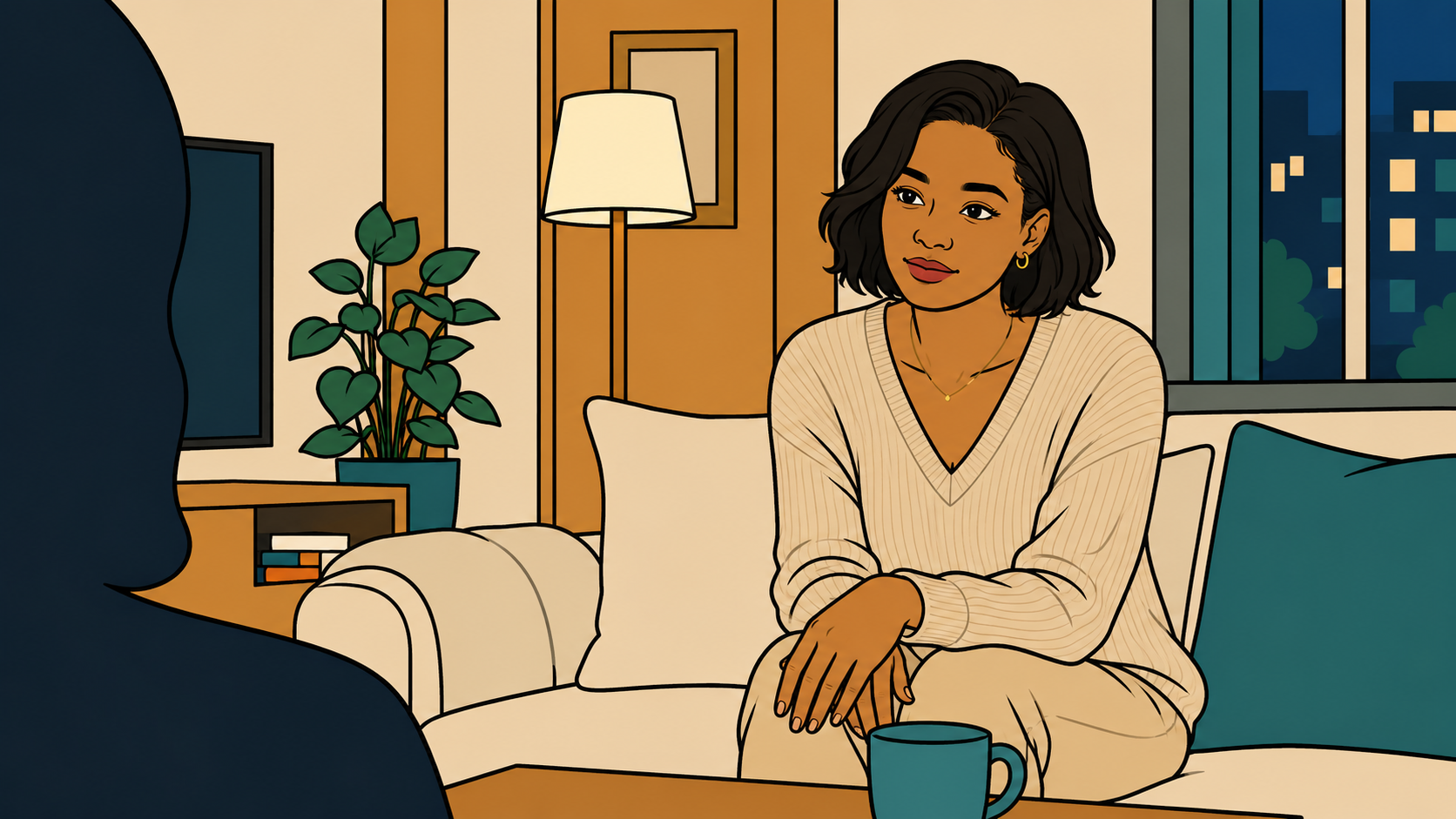

Emotional boundaries fail in a place most advice never looks. Someone you love walks in carrying a bad day. You can feel it before they speak — the set of their shoulders, the particular way the door closes. And here’s the reflex you know by now: their mood is already becoming yours. Not something you’re witnessing. Something you’re absorbing, adjusting to, quietly taking responsibility for.
This is where most advice tells you to set a boundary. Say no. Protect your energy. Draw the line. But if you’ve read this far, you already know the problem isn’t that you haven’t learned the techniques. You’ve probably read the techniques. You can likely recite them. And still the mood in the room becomes yours, every time, as if none of it applied to you. It’s that the line was never really about what you say to other people. The kind that actually hold start somewhere quieter — in the gap between noticing what someone feels and deciding it’s yours to carry.
The Line Isn’t Where You Think It Is

When people picture a boundary, they picture a wall. A firm sentence. A door that closes. Something you build on the outside, between you and another person, to keep their stuff from getting in.
But that’s not where your particular line goes missing. You’re not failing to say no loudly enough. You’re merging with people’s moods before a single word is spoken — in the half-second where you notice someone’s off and your own state shifts to match. No sentence fixes that, because it happens long before speech. The boundary you’re missing isn’t external. It’s the internal one, the quiet distinction between this is happening to them and this is happening to me.
That distinction is the whole thing. And it’s not a wall — it’s more like knowing where your own edge is. Being able to feel, in real time, that the sadness in the room belongs to someone else, and you can be near it without becoming it.
It helps to see why the wall model fails for someone like you. Walls are built to keep out people who push in — the ones who demand, criticize, take. But that was never your problem. No one had to push. You reached out and picked their feelings up yourself, unprompted, often before they’d have thought to hand them over. A wall is useless against a reflex that lives on your side of it. You can’t block your own hands.
Why Emotional Boundaries Aren’t Built With Words
Almost every guide to emotional boundaries hands you a script. Say “I can’t take this on right now.” Say “that sounds hard, and I trust you to handle it.” The phrases aren’t wrong, exactly. But they treat the boundary as a thing you say at the edge of a room, when your particular version was already lost in the middle of it, silently, before anyone spoke.
By the time you’d need the sentence, the merge has already happened. You’ve already scanned the face, matched the mood, started running the calculation about what you did and what you owe. A script arrives at the scene hours late. It’s trying to manage the outcome of a process that ran automatically long before words were on the table.
That’s why this can’t be solved by getting better at saying no. Saying no is a tool for the outer wall — the one that was never your issue. What you’re working with is quieter and closer in: the moment of absorption itself, the reflex that turns someone’s weather into your responsibility. You don’t talk your way out of that. You notice your way out of it.
Noticing Is Not the Same as Owning
Here’s the difference this whole series has been circling.
You can notice someone is upset without deciding it’s your job to fix it. You can feel the weather in a room without becoming responsible for the forecast. You can register a friend’s short reply without opening a case file about what you did wrong. Noticing is just information — the thing you’ve always been good at. Owning is what you add on top: the automatic step where the noticing becomes a task, a verdict, a weight.
Most people who care about others deeply have collapsed these two into one motion. Noticing and owning happen so fast, so together, that they feel like the same event. They aren’t. There’s a seam between them, and the entire possibility of a boundary lives in that seam — in learning to notice, and then not automatically pick the thing up.
You don’t have to stop being perceptive. That was never the problem. The perceptiveness is a gift. What costs you is the reflex that says: because I noticed, it’s now mine.
What Changes When You Can Feel the Seam

Nothing dramatic happens at first. You don’t suddenly stop caring, and you don’t turn cold — that’s the fear, and it’s unfounded. What changes is smaller and stranger.
Someone walks in with their bad day, and you notice it, same as always. But this time there’s a pause where the merge used to be. A tiny space where you register their mood without it overwriting yours. You can still offer them something — attention, warmth, help if they want it. But you’re offering it from your own ground, not from inside their weather, and the difference is enormous even though no one else in the room can see it.
That’s what an emotional boundary actually feels like. Not a wall you announce. A place you stand. You’re still close. You’re still kind. You’re just no longer confusing their inner life with yours.
And something quietly comes back to you in that space. Attention you didn’t know was out on loan. When you’re not carrying three other people’s moods across an evening, there’s suddenly room to notice your own — what you wanted from the night, whether you’re tired, what you actually feel about the thing being discussed. This is what emotional boundaries give you that no script ever could: not distance from other people, but access to yourself. The boundary doesn’t just keep something out. It gives something back.
The Part No One Can Do for You
There’s no script for the end of this. Anyone who hands you five phrases for setting boundaries has misunderstood the problem — the words were never the hard part. The hard part is the recognition, happening in real time, that a feeling in the room is not automatically an assignment.
So this doesn’t end with instructions. It ends with a question you can carry into the next room you walk into, the next mood you feel before anyone speaks: is this mine to carry, or am I just the first one to notice it?
It’s worth saying what this isn’t. It isn’t a switch you flip once and finish. The reflex you’re working with took years to wear its groove, and it won’t disappear because you named it — some part of it will still fire when someone you love walks in heavy, and you’ll feel the old pull to make it yours. The change isn’t that the pull stops. It’s that you start to catch it, sometimes, in the gap before you act on it. A little later that becomes a little sooner. That’s the whole arc, and it’s slower and quieter than any five-step version would promise.
You won’t always get the answer right. Sometimes you’ll pick things up out of old habit before you catch yourself, and that’s fine — the catching is the practice. But the question changes something just by being asked. It puts a hairline of space between you and the automatic yes. And in that space, for the first time, there’s a version of you that gets to decide.
You’ve spent a long time reading everyone else’s weather. It might be time to ask, finally, what yours is.
This post was planned and edited by a human, with AI assistance.