
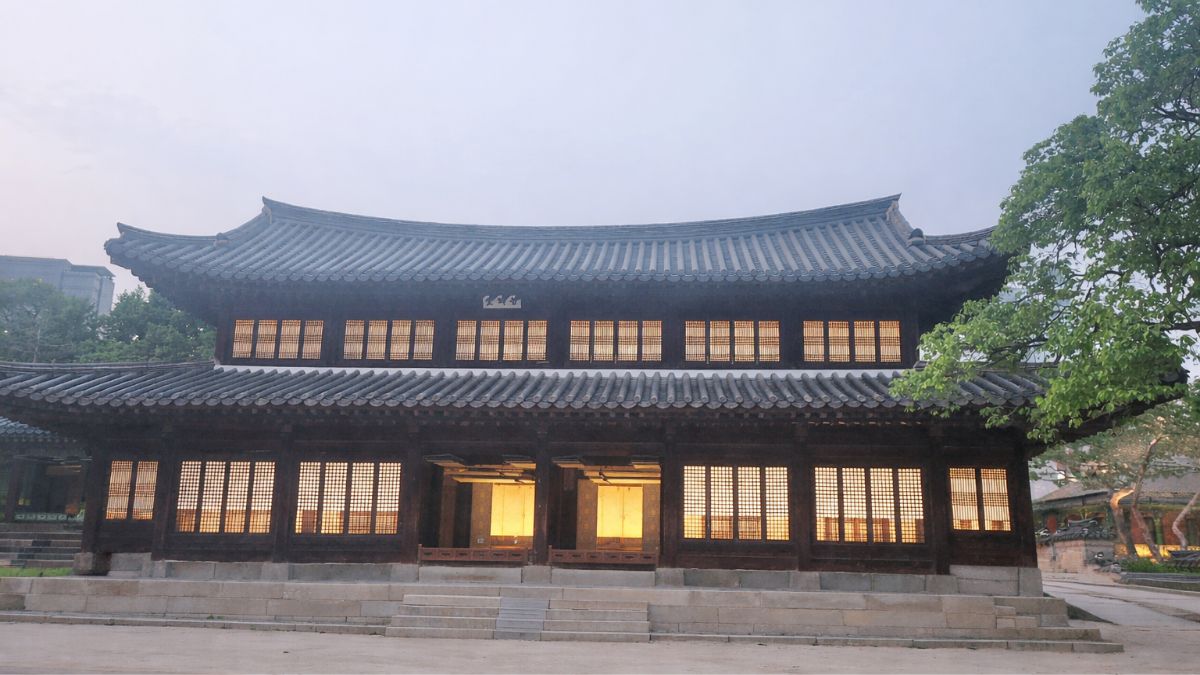
The dew doesn’t announce itself. By morning, it’s already there.
Gye (계: gye, yin water, the dew) is not the river. Where Im (임: im, yang water, the river) moves with force and direction — carrying everything forward, changing the landscape it passes through — Gye moves differently. It doesn’t flow. It seeps. It accumulates in the places where it lands, penetrating the surface rather than carrying it forward. The stone doesn’t know it’s being softened. The root doesn’t feel the moisture arriving. The change has been happening for longer than anyone noticed.
The yin water stem in K-Saju is the tenth and final Heavenly Stem and the yin expression of Water (수: su). In K-Saju, Water governs flow, depth, and the capacity to move through and around structure. In its yin form, that capacity is penetrating and still. Gye doesn’t move through the landscape. It moves into it — slowly, completely, and without announcement.
The Depth That Seeps

Gye (yin water, the dew) operates on a principle that distinguishes it from every other Water stem and from most yin stems: penetration as the primary output. Im (yang water, the river) produces momentum — it carries everything forward along the surface. Gye produces depth — it moves into whatever it touches, softening what was hard, nourishing what was dry, changing what it contacts from the inside rather than carrying it somewhere else.
In K-Saju, Gye is the yin expression of Water (수: su). Yin and yang within the same element are not opposites — they are the same energy expressed through different mechanisms. Both Im and Gye govern flow and depth. But where Im’s movement is directional and visible — the river’s path is defined by what it passes through — Gye’s movement is penetrating and invisible. The dew doesn’t have a path. It has a surface. And every surface it touches, it enters.
The mechanism is specific. Gye doesn’t move across structure — it moves through it. The pressure is not force but persistence. The penetration is not impact but accumulation. A single drop of dew on a stone doesn’t change the stone. Ten thousand mornings of dew on the same stone changes it completely — and the stone never felt the change happening.
The contrast with Im (yang water, the river) clarifies what makes Gye’s mechanism distinct. The river changes the landscape by moving through it with force — carving channels, carrying sediment, redirecting flow. The dew changes the landscape by seeping into it — softening rock, feeding roots, dissolving mineral. Same element. Fundamentally different mechanism. The river is visible. The dew is not. The river’s work is immediate. The dew’s work is cumulative. And when the dew’s work finally becomes visible, there is no single moment you can point to where it happened. It happened in all the mornings nobody was watching.
In the chart, a Gye Day Stem (일간: il-gan, primary stem) identifies a person whose primary operating mode is sustained penetration that changes what it touches from the inside. They are not the person who carries everything forward, refines toward precision, or holds the center under load. They are the person whose influence is invisible in the moment of contact and undeniable in retrospect. The room doesn’t shift when they enter. Something shifts in the people who spent time with them — and neither party can always say exactly when it happened.
Gye doesn’t move across the landscape. It becomes part of it.
This is why the yin water stem in K-Saju is the most consistently misread in the ten-stem sequence. The penetration is happening. The change is building. The reading just hasn’t caught up to it yet.
Four Ways the Penetration Fails to Reach Depth

Gye (yin water, the dew)’s failure is not evaporating — it is the penetration arriving at a surface that cannot absorb what it delivers.
The pattern looks like this: Gye has been working. The sustained contact has been maintained — the moisture has been arriving consistently, the penetration hasn’t stopped, the process has been running exactly as designed. But the surface isn’t absorbing. The depth that should be building isn’t developing. The dew is landing. The dew isn’t seeping. From outside, this looks like nothing is happening. From inside, the mechanism is running at full capacity — and the output is evaporating rather than penetrating.
This is Gye’s primary failure pattern: sustained penetration on a surface that cannot absorb it.
The second pattern is dispersion. Gye (yin water, the dew) penetrates through sustained contact with a specific surface. The mechanism requires concentration — the moisture accumulates at the point of contact and seeps in over time.
When the chart or the current Daewoon (대운: dae-woon, ten-year cycle) disperses the contact across too many surfaces simultaneously, the concentration drops below the threshold needed for penetration. The dew is still arriving. The moisture is distributed across too many points to accumulate at any one of them. What should be seeping is spreading instead. Too much surface area doesn’t produce deeper penetration. It produces a thin film that evaporates before it can sink in.
The third pattern is elemental. Earth controls Water in the controlling cycle (상극: sang-geuk, mutual constraint) — Mu (무: mu, yang earth, the mountain) or Gi (기: gi, yin earth, the field) in dominant positions exerts direct controlling pressure on Gye. For Im (yang water, the river), Earth constraint narrows the channel. For Gye (yin water, the dew), the constraint is different: the surface hardens.
The penetration mechanism is still present. The moisture is still arriving. But the surface that Gye is working on has become too dense to absorb what it’s delivering. The dew lands and runs off rather than seeping in. The contact is maintained. The depth isn’t developing.
The fourth pattern is the absence of Metal. Metal generates Water in the generative cycle (상생: sang-saeng, mutual nourishment) — Gyeong (경: gyeong, yang metal, the blade) or Sin (신: sin, yin metal, the gem) supplying the source from above. Without Metal support, Gye works through whatever stored depth the chart carries. The penetration is still happening. The contact is still sustained. But the moisture is being depleted faster than it can be replenished. The dew is thinning with each morning. At some point, there is nothing left to seep — not because the mechanism stopped, but because there was no longer anything feeding it.
All four patterns share the same underlying condition: the moisture is still arriving. What varies is whether the surface absorbs it, the concentration holds, or the source keeps feeding the mornings. Gye is still arriving, still making contact, still penetrating. The problem is not the depth. The problem is a surface that won’t absorb, dispersion across too many contact points, a hardened surface from Earth constraint, or depletion of the source. Each produces a different reading.
The failure is not absence of depth. It is depth with nowhere to go.
Consecutive Mornings — What Gye Needs to Complete the Change

Timing for the yin water stem in K-Saju is not motivational. It is structural. Gye (yin water, the dew) doesn’t perform better when the person commits more consciously to the depth or applies more effort to the penetration. It performs better when the chart’s relational conditions provide the right surface for the moisture to accumulate in — a structure that can absorb what Gye delivers, and the source material to keep the dew arriving morning after morning.
Three structural conditions allow Gye’s sustained penetration to complete rather than thin out before it reaches depth.
The first is Metal generating Water. In the generative cycle (상생: sang-saeng, mutual nourishment), Metal produces Water. When the chart carries strong Metal stems or branches — Gyeong (yang metal, the blade) or Sin (yin metal, the gem) — the Water element has a sustained source.
For Im (yang water, the river), this supply replenishes the current as the momentum consumes it. For Gye (yin water, the dew), it does something more specific: it ensures the moisture keeps arriving. Metal support is what separates a Gye chart that penetrates continuously across seasons from one that runs dry before the depth has fully developed. The dew doesn’t need more surface area. It needs the source to keep feeding the moisture through enough mornings for the penetration to complete.
The second is Wood receiving the depth. Water nourishes Wood in the generative cycle — Gye feeds Gap (갑: gap, yang wood, the sprout) and Eul (을: eul, yin wood, the vine). When Wood is present in compatible positions, Gye’s penetration has a purpose. The moisture isn’t just seeping into the structure — it’s feeding something that grows.
A chart where Gye’s depth is actively nourishing Wood gives the penetration both direction and output. The dew softens the soil. The root finds the moisture. The growth happens because the dew never stopped arriving. Without Wood, Gye’s penetration continues — but there is nothing drawing the depth upward into visible form. The moisture accumulates. The accumulation doesn’t produce.
The third is the Daewoon alignment. A Gye (yin water, the dew) Day Stem (일간: il-gan, primary stem) running through a Metal-dominant Daewoon (ten-year cycle) is in its structural window. The ten-year cycle is replenishing the source and providing the sustained conditions the penetration needs to complete.
This is when Gye’s cumulative depth becomes visible — not because the mechanism changed, but because the cycle finally provided enough consecutive mornings for the moisture to reach what it was always moving toward. A Daewoon that also activates compatible Wood elements gives Gye’s depth both the sustained source and the structure that draws it upward simultaneously.
The inverse configurations are equally readable. A Gye (yin water, the dew) Day Stem running through an Earth-dominant Daewoon is under direct controlling pressure — the surfaces are hardening. The moisture is still arriving. The penetration is running off rather than seeping in. A Metal-deficient Daewoon leaves Gye working on reserves — the dew is thinning. The contact is still sustained. Each morning brings less than the morning before.
The question that matters most for a Gye chart: not whether the penetration is occurring — it always is — but whether the current Daewoon is replenishing the Metal that feeds the source and activating the Wood that draws the depth into visible form. When both are present, the invisible accumulation that looks like nothing from the outside becomes the thing that changed everything — and nobody can say exactly when it happened.
Gye performs at peak when the source is sustained, the surface is receptive, and the cycle is giving the depth enough consecutive mornings to complete what it started.
Source, Surface, Direction — What the Dew Requires to Sink In
Gye (yin water, the dew) requires two things it cannot generate alone: a source to keep the moisture arriving, and a surface receptive enough to absorb what arrives. The penetration is real and it is continuous, but it requires two things it cannot generate alone: a source to keep the moisture arriving, and a surface receptive enough to absorb what arrives. What surrounds Gye in the chart determines whether that sustained depth changes what it touches or evaporates before it can sink in.
The most important relationship is between Gye and Metal. Gyeong (yang metal, the blade) or Sin (yin metal, the gem) generating Gye from above is not just a supply line — it is the condition that allows the penetration to continue through enough consecutive mornings for the depth to develop. Without Metal, Gye’s moisture is real but finite. The chart has a fixed amount of stored depth to work with, and once it is gone, the dew thins. With Metal in favorable positions, the source replenishes as the penetration occurs. The dew remains dew. The consecutive mornings continue — and what changes in stone takes ten thousand mornings, not one.
The relationship with Wood is what gives Gye’s depth direction. Gap (yang wood, the sprout) or Eul (yin wood, the vine) in compatible positions draws what Gye delivers upward into growth. Water nourishes Wood in the generative cycle — Gye is the source from which Wood draws its depth. When Wood is present and growing, Gye’s penetration isn’t just seeping — it’s feeding. The root draws the moisture upward. What was invisible in the soil becomes visible above it. Without Wood, Gye’s depth accumulates in the structure but has nothing drawing it into form. The moisture is real. The moisture stays underground.
The relationship with Earth is the most critical constraint. Mu (yang earth, the mountain) or Gi (yin earth, the field) in dominant positions hardens the surface — Earth controls Water in the controlling cycle (상극: sang-geuk, mutual constraint). The reading question is not whether Earth is present — some Earth in the chart gives Gye’s penetration a defined surface to work on, which is exactly what diffuse moisture needs. Dew on bare rock seeps differently than dew on packed soil.
The question is the degree. A single Earth stem in a compatible position gives Gye’s depth a receptive surface. Multiple Earth stems in dominant positions are hardening that surface to the point where the moisture runs off rather than seeping in. The dew arrives. The dew doesn’t penetrate.
Fire in the chart adds a dimension specific to Gye. Water controls Fire in the controlling cycle — Gye controls Byeong (병: byeong, yang fire, the sun) and Jeong (정: jeong, yin fire, the candle). For Gye (yin water, the dew), this relationship is more nuanced than it is for Im (yang water, the river). Im controls Fire with force — the current extinguishes what it passes over. Gye controls Fire differently: the moisture moderates the heat.
A chart with compatible Fire in favorable positions is a chart where Gye’s depth is being drawn upward by warmth — the morning sun that pulls the dew into the root rather than evaporating it off the surface. Too much Fire evaporates the moisture before it can penetrate. The right amount of Fire is what completes the cycle.
The strategic read for a Gye chart starts with the source. Is the Metal present to keep the moisture arriving? Then the surface — is the Earth receptive or hardened? Then the direction — is the Wood present to draw the depth into visible form? And finally the warmth — is the Fire completing the cycle or evaporating what the dew delivered before it could sink in?
The penetration in a Gye chart is structural — it does not stop. What the reading examines is whether the surface is receiving what the dew has been delivering. It reads whether the conditions around the yin water stem in K-Saju are set up to let that depth become change rather than just moisture.
What the dew has been delivering all those mornings only becomes visible when the surface is finally ready to receive it.
The stone at the base of the garden wall has been there for three hundred years. Nobody remembers when it began to change shape. Nobody was watching when it happened. But the hollow is there now — smooth and exact — and the dew has been arriving every morning for as long as the stone has been in that garden.
Some content in this post was created with AI assistance.