
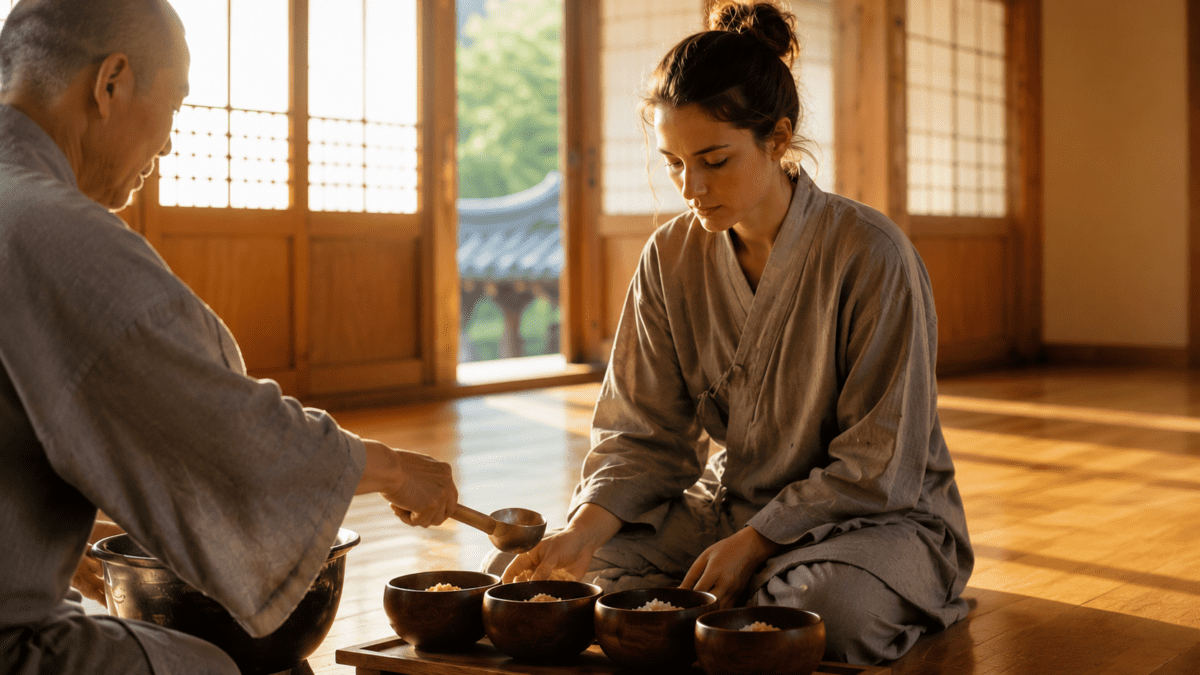
Most broths start with bones. Korean temple cuisine doesn’t.
The stock has no meat, no fish, no jeotgal. What Korean temple cuisine uses instead is two ingredients, a specific understanding of temperature, and time. The broth that results doesn’t taste like a compromise. It tastes like something that was built slowly, layer by layer, not extracted in a single session of heat.
No shortcut was taken. None was available.
What the Stock Is Actually Made Of
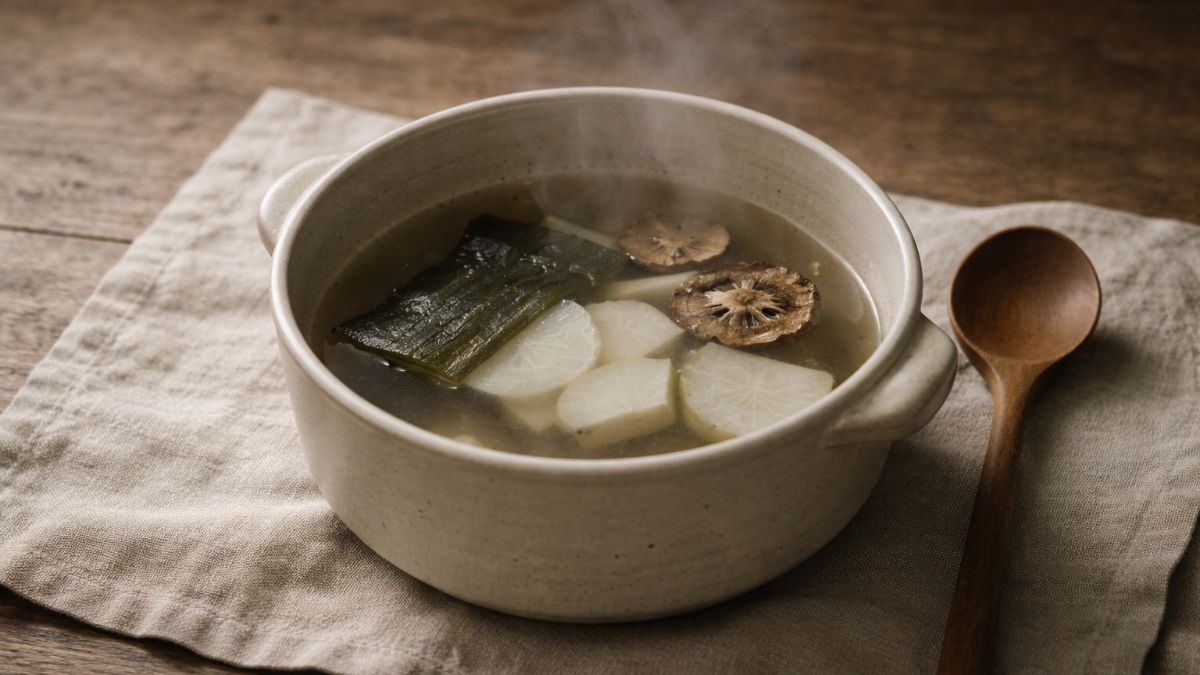
The temple kitchen at Bongjeongsa starts the stock before dawn. The monks will eat at six. The water needs time. The base is two ingredients: dried shiitake mushrooms (표고버섯: pyo-go-beo-seot) and kelp (다시마: da-si-ma).
Kelp goes into cold water first. Not hot — cold. The glutamates that give kelp its depth release slowly at low temperature. Rushed with heat, they turn bitter. The kelp sits in the water for anywhere from thirty minutes to several hours before the pot goes on the flame. By the time the water warms, the extraction is already most of the way there.
This is not a shortcut being avoided. It is a different understanding of what heat is for. In most kitchens, heat is the engine. In a temple kitchen, heat is the final stage of a process that began long before the stove.
Dried shiitake goes in next. The drying process concentrates the mushroom’s guanylate — a compound that amplifies glutamate and pushes umami deeper than either ingredient could alone. Fresh shiitake doesn’t do this. The flavor difference between fresh and dried is not a matter of intensity. It is a matter of structure. The drying is not preservation. It is transformation.
When kelp glutamate and shiitake guanylate meet in the same pot, the effect is synergistic. The depth that results is not additive — it multiplies. This is the same principle behind dashi in Japanese cooking, but Korean temple cuisine arrived at it independently, through a different set of constraints.
The stock is pulled before it overcooks. Kelp left too long turns the broth slippery and faintly bitter. The window is narrow. The cook knows it not from a timer but from the color of the water and the way the surface moves. The stock is finished before the doenjang goes in, before the radish, before anything else. It is the foundation, and the foundation has to be right before the structure above it means anything.
Why Doenjang Changes Everything
The stock becomes soup when temple-made doenjang (된장: dwen-jang, fermented soybean paste) enters the pot.
This is not store-bought doenjang. Temple doenjang is made on-site, in a process that takes the better part of a year. Soybeans are boiled and pressed into meju (메주: me-ju, fermented soybean block) in late autumn. The blocks dry through winter, developing a surface mold that begins the fermentation. In early spring, the meju goes into onggi (옹기: ong-gi, earthenware crocks) packed with salt and water, and the slow separation begins — liquid rising as ganjang (간장: gan-jang, soy sauce), solids deepening into doenjang.
By the time this paste reaches the soup, it has been fermenting for months. The flavor it carries is not sharp or young. It is rounded, layered, and specific to the conditions of that particular temple — the water, the salt, the air, the season. Two temples using the same soybeans will produce different doenjang. The difference is the place.
A spoonful dissolves into the shiitake-kelp stock and the soup becomes something else entirely. The umami compounds in the stock and the fermented amino acids in the paste reinforce each other the same way the kelp and mushroom did. Each layer deepens the one before it.
What’s notable is how unhurried the addition feels. The doenjang isn’t stirred in to fix or finish anything — the stock was already complete on its own terms. It’s folded in the way a season changes: gradually, without asking the rest of the dish to wait.
No bone was required. No animal gave anything. The depth came from time.
The Vegetables That Complete It
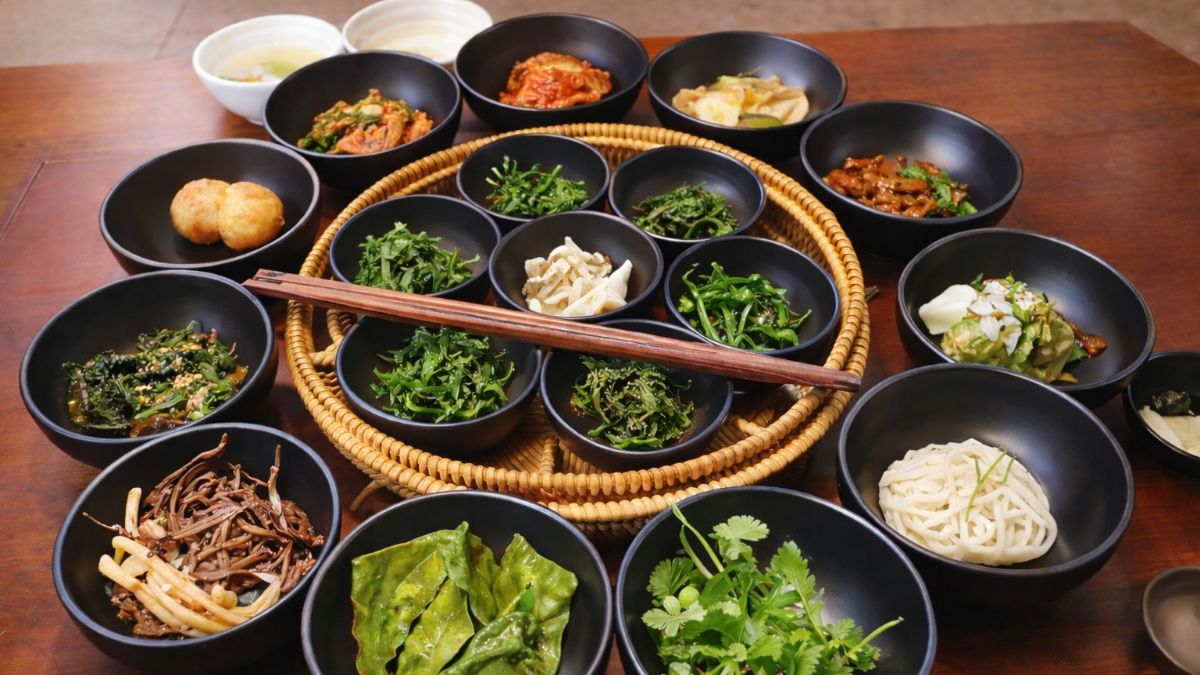
Into the soup goes whatever the season allows.
In spring, ssuk (쑥: ssuk, mugwort) goes in at the last moment — its bitterness is volatile and disappears with too much heat. Minari (미나리: mi-na-ri, water parsley) enters the same way, adding a clean herbal note that clears the back of the palate. Auk (아욱: a-uk, mallow) is added early in summer and cooked soft, its texture becoming almost silky in the doenjang base. Autumn brings mu (무: mu, Korean radish) — cut thick, simmered until translucent, holding the broth inside each piece.
The same chui-namul (취나물: chui-na-mul, aster scaber) that appeared blanched and dressed in spring returns in winter as muk-namul (묵나물: muk-na-mul) — dried, stored, then rehydrated and added to the broth. The flavor is quieter now. The green edge has softened into something rounder. It is the same plant at a different stage of its life, contributing something different at each one.
Hobak (호박: ho-bak, Korean squash/pumpkin) follows the same pattern across the year. In summer it arrives thinly sliced and added directly to the soup, soft and sweet. Later it is dried — the slices laid out in the mountain air until the moisture is gone and the flavor concentrates inward. In autumn and winter it returns to the pot, denser now, releasing that concentrated sweetness slowly into the broth. The same vegetable, three appearances, three different contributions to the same bowl.
None of these vegetables are interchangeable. Each one behaves differently in heat, releases different compounds, and lands in a different part of the mouth. The temple cook knows this not from a recipe but from repetition — the same pot, the same ingredients, season after season, until the adjustments become instinct.
What Depth Without Bones Actually Means
There is a version of this question that is purely technical: how does plant-based broth achieve the same perceived depth as animal-based stock? The answer involves glutamate synergy, fermentation chemistry, and the specific window in which kelp releases its compounds without turning bitter.
But the technical answer misses what Korean temple cuisine was actually solving for. The monks were not trying to replicate meat broth. They were not working around a limitation. They were building a different system from different premises — one where depth meant something that took longer to arrive, came from more sources, and left nothing behind in the bowl or in the world.
The soup that results doesn’t taste like an absence. It carries the specific flavor of accumulated time — cold water holding kelp through the early morning, fermentation crocks sitting undisturbed through winter, dried vegetables returning to the pot months after they were harvested. Every layer in the bowl has a before. Nothing arrived quickly. Nothing was forced.
Consider what the bowl contains by the time it reaches the table. Kelp that sat in cold water for hours before heat was applied. Shiitake that was harvested, dried over weeks, and stored before being rehydrated into the stock. Doenjang that began as soybeans the previous autumn, spent winter drying as meju, and fermented through spring and summer before being spooned into the pot. Radish or mugwort or mallow pulled from the mountain that morning, or dried months ago and returned. Every ingredient in the bowl has a timeline that extends far beyond the meal. The cook did not make the depth. The cook created the conditions for depth to accumulate — and then got out of the way.
The depth that surfaces in a bowl of temple doenjang-guk is not a substitute for bone broth. It is a record of everything that was done slowly, correctly, and without shortcuts — and what builds quietly over months has a way of arriving all at once when the time is right.
That is what Korean temple cuisine preserved across centuries of practice — not a recipe, but a method. The recipe changes with the season, the temple, the cook. The method doesn’t. Cold water before heat. Fermentation before seasoning. Time before everything else. The bowl is the result. The process is the point.
This post was planned and edited by a human, with AI assistance.