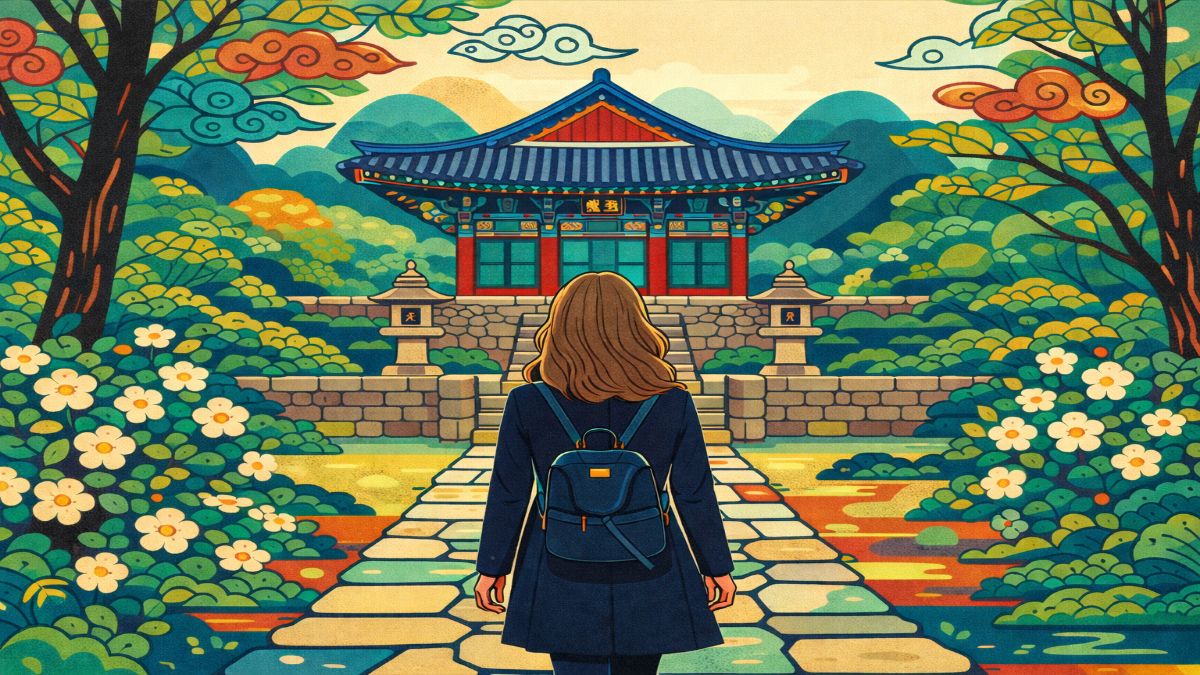
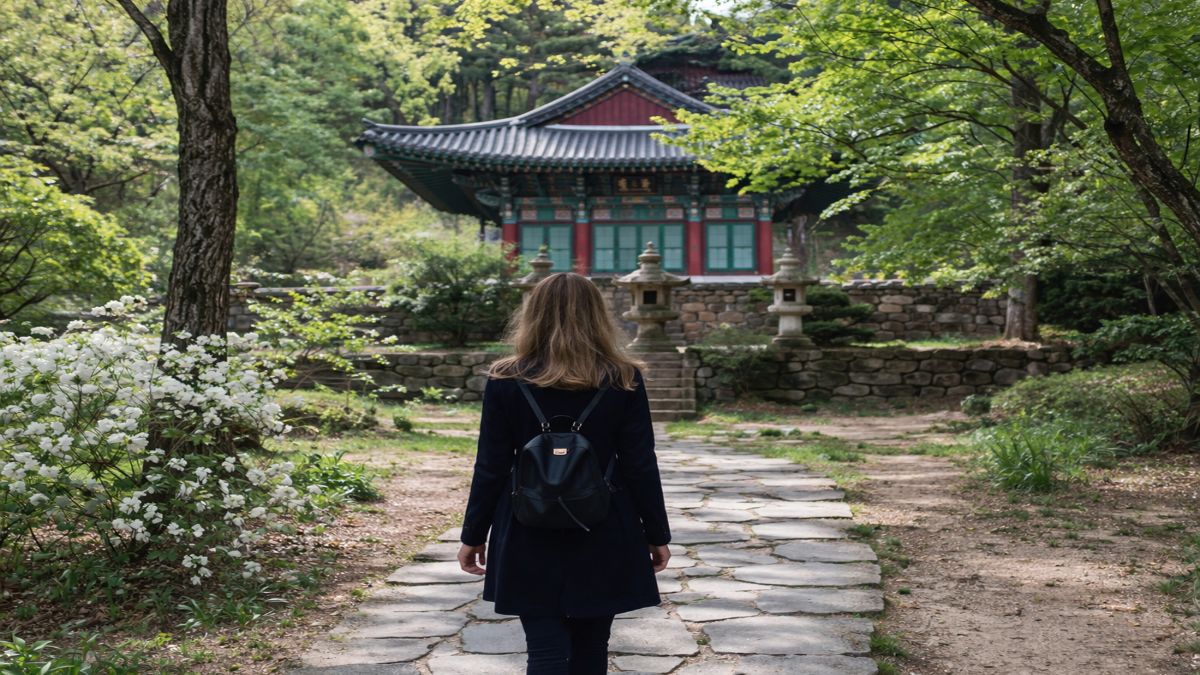
I almost didn’t go alone on my temple stay Korea.
Not because I wanted company, but because every version of this temple stay Korea experience I’d seen included it — a friend, a partner, someone to lean toward in the quiet, uncertain moments.
I booked it anyway. Tuesday night, alone at my desk. Slightly jet-lagged, slightly convinced I was making a mistake.
By Thursday afternoon, I was on a bus leaving Seoul with a small bag and a version of myself I hadn’t questioned until then.
The path up to the temple was steeper than I expected. Pine resin, cold dirt, the sound of the city disappearing behind me with every step. By the time the gate came into view, I was breathing harder than I wanted to admit.
I stood at the entrance for a moment. A sign listed the rules. No phones after 9 PM. Quiet hours from 10. I read it twice, adjusted my bag, and walked through.
The Room That Took Everything Away
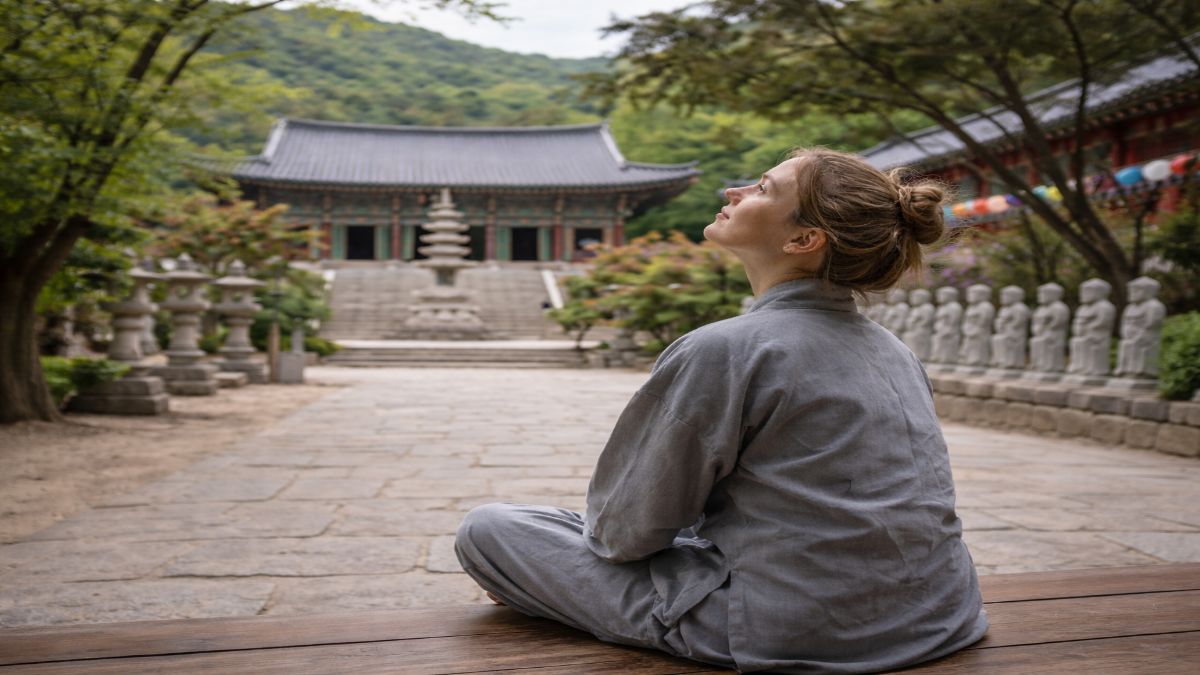
The monk at the front desk handed me a set of robes. Gray. Loose. The same cut as everyone else’s.
I changed in my room — small, wooden-floored, a low table and a folded blanket and a window that looked directly into the mountain. I folded my own clothes into a pile in the corner. The jeans I’d chosen that morning. The jacket. The particular self I’d assembled before leaving the guesthouse.
The robes had no shape that belonged specifically to me. I stood in them for a moment, not sure what to do with my hands.
There was no mirror.
I noticed this slowly. Then I noticed that I kept looking for one — at the back of the door, above the small shelf, in the corner by the window. Every morning routine I owned began in front of one. Without it, I had no idea how to start.
My room was called Inyong. I looked it up later: endurance, patience, the practice of bearing what is difficult without resistance. I wasn’t sure if that was a warning or a welcome.
I set my bag down. Outside the window, the mountain wasn’t doing anything in particular. Neither was I.
That turned out to be the first instruction.
The Afternoon: Mandala to Dinner
We’d been given free time after check-in — intricate printed mandalas, a box of colored pencils, no instructions beyond sit and begin. I’d assumed it would take forty minutes. Everyone else seemed to finish in about an hour. I was still coloring when the monk came to tell us dinner was ready.
Two and a half hours. My hand ached. My back ached. I’d filled in every section of a geometric pattern I couldn’t have described five minutes after finishing it.
What I remembered was the quality of attention it required. Not the kind I bring to a work deadline or a difficult conversation — that attention is sharp, forward-leaning, already thinking about what comes next. This was different. Slower. Each small section asked only for itself. The next section didn’t matter until this one was complete.
I didn’t think about much during those two and a half hours. That turned out to be the point.
Dinner was at 5 PM. I followed the sound of movement down to the dining hall, collected a tray, and stood in front of the food trying to remember the last time I’d eaten a meal without looking at my phone.
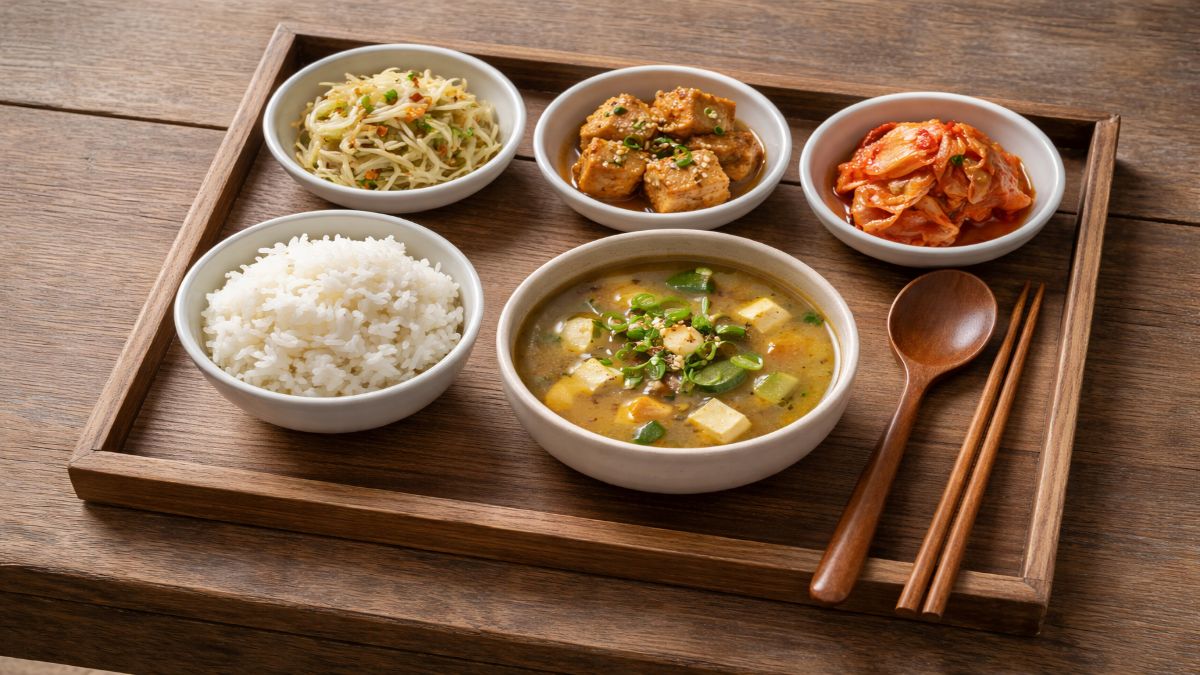
The spread was simpler than I expected: rice, doenjang soup, seasoned bean sprouts, a small dish of braised tofu, kimchi, a slice of hobakjeon — pumpkin pancake, pan-fried until the edges crisped. I took modest amounts of everything, sat down at a long wooden table, and ate.
It was the best meal I’d had since landing in Korea — not what I’d expected from temple stay Korea, but nothing about this place was.
Not because it was complicated. Because it wasn’t. Every ingredient tasted like itself — the bean sprouts clean and slightly nutty, the soup deep without being heavy, the pumpkin pancake sweet in a way that didn’t announce itself. I’d been eating around flavors for weeks, dishes designed to impress. This food had nothing to prove.
I went back for more bean sprouts. Then I sat there longer than necessary, not ready to leave.
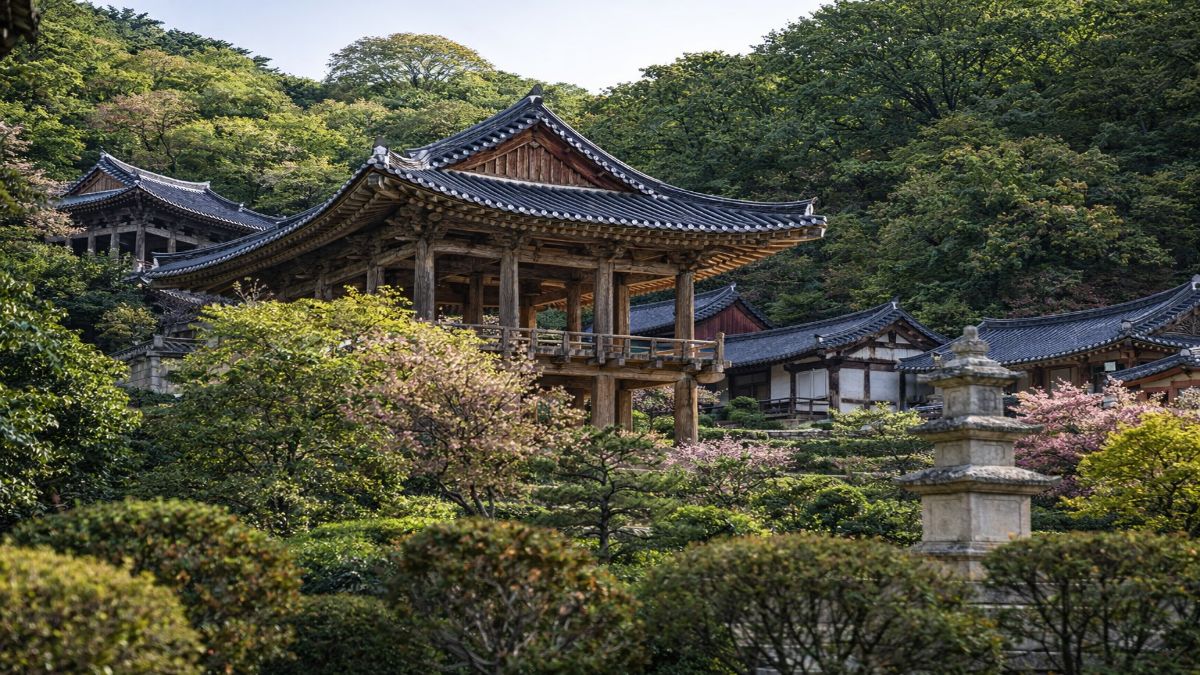
After dinner, a monk led us on a slow walk through the temple grounds. The complex was built into a cliff — different levels connected by stone steps, small shrine rooms tucked into the rock face, a waterfall frozen solid in the January cold. At one point the path opened onto a terrace and Seoul appeared below us, the whole city laid out in lights, close enough to feel unreal.
I’d come here to get away from something. I wasn’t sure yet what it was. But standing on that terrace with the frozen waterfall behind me and the city glittering below, I understood why people come back.
Evening: The Ritual and Reflection
The evening program began with yeobul — the evening ritual that marks the end of the temple day.
We gathered in the main hall. Eight of us, strangers, standing in a loose row behind the resident monks. The chanting started without introduction or explanation. Deep, rhythmic, the syllables rising and falling in patterns I couldn’t follow but didn’t need to. A large bronze bell hung at the far end of the hall. When it rang, the sound didn’t stop at the walls. It moved through them.
I’d stood in cathedrals before. Museums with famous acoustics. This was different. The sound wasn’t designed to impress. It was designed to mark time — to draw a line between the part of the day that was finished and the part that hadn’t started yet. Standing inside it, I felt the line.
After yeobul, we were free until lights out. I walked the grounds alone, stopped at a small room near the main hall where tea was set out — acorn tea, chrysanthemum, something earthy I couldn’t name. I poured a cup and sat with it for a while, watching the city lights below the cliff edge. The contrast was strange and perfect: borrowed robes, ceramic cup, the entire lit grid of Seoul spread out below me like something I’d temporarily opted out of. Nobody was talking. Nobody was checking anything. The tea cooled slowly. I let it.
The lights went out at 9 PM.
In my room, I lay on the floor mat and looked at the ceiling. No screen. No scroll. The mountain outside was completely dark. I could hear wind moving through the pine trees, and somewhere below, the city still running without me.
Night: Darkness and Stars
I woke up at 2 AM and couldn’t get back to sleep. This, I’d later learn, is not unusual for temple stay Korea — the early bedtime shifts something in the body’s clock before the mind agrees to it.
I pulled on my robes, stepped out onto the small terrace outside my room, and stood there in the dark. The city below was quieter now — fewer lights moving, the motorway sounds reduced to a low hum. Above the temple, the sky was doing something I hadn’t seen since leaving home: showing its full inventory of stars.
Seoul is a city of light. I’d spent two weeks barely seeing the sky at night. Standing on that terrace in borrowed robes, I counted stars the way I used to as a child — not to reach any number, just to keep looking.
I stayed out for twenty minutes. Maybe thirty. When I went back inside, the room felt different — not smaller, but more specific. A place I was actually in, rather than passing through.
I slept until the bell.
Next: (Part 2) Korean Temple Morning: Before the City Wakes
Korean temple morning: The bell starts at 4 AM. By strike five, your body is already moving. What it actually does before the city wakes up.
Some content in this post was created with AI assistance.