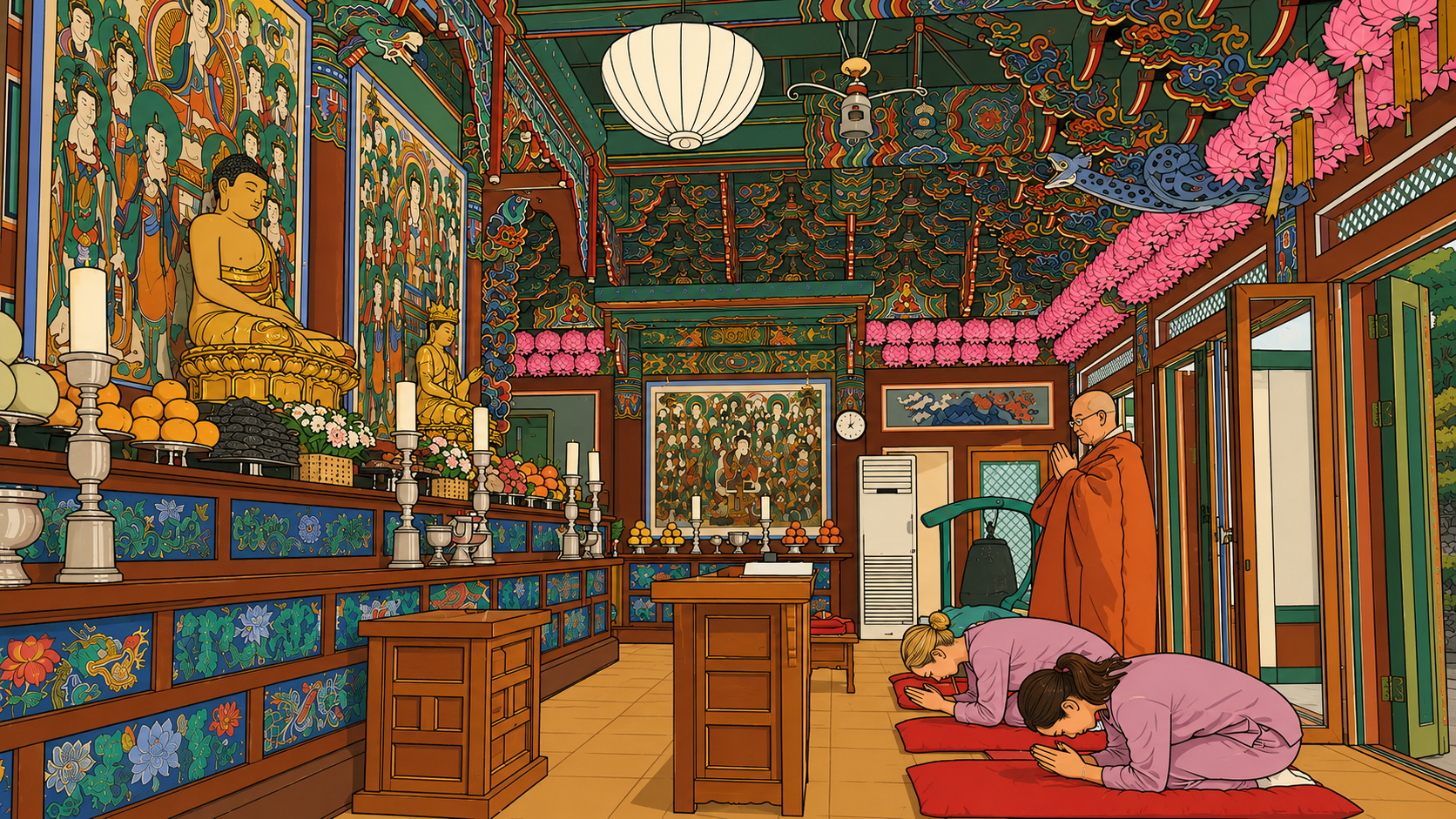
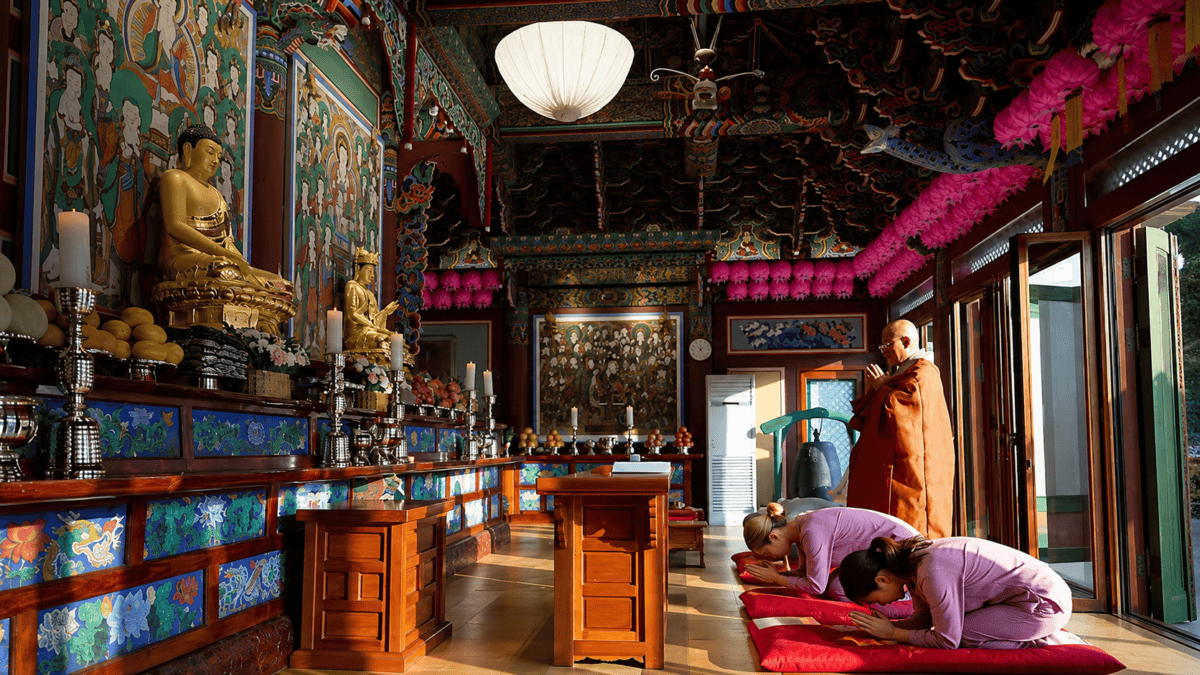
After 108 bows, something in the body has already moved before the mind catches up.
Nobody warns you about this before your first Korean temple experience. They hand you a set of robes, show you the room, point to the schedule on the wall. The schedule looks manageable. It isn’t the schedule that changes you. It’s the sequence underneath it — what happens to attention when everything that usually fills it has been removed.
By the second morning, I stopped waiting for something to happen. The day was already happening. I just hadn’t known where to look.
After the Bows, the Body Speaks
108 bows. Knees, forehead, palms flat on cold stone. Rise. Again.
By bow thirty the thighs were burning. By bow sixty I’d stopped tracking the burn — it had moved into the background the way a sound disappears when it’s been there too long. By bow one hundred and eight I was kneeling on the courtyard stone in my temple robes, forehead down, hands open beside my face, and there was nothing left to think.
Not peace. Not emptiness. Nothing left to think.
I stayed down longer than necessary. The stone was cold through the fabric at my knees. The air smelled of fallen leaves and pine and the particular cold that arrives before the sun has done anything. My back ached in a specific band across the shoulders. My hands felt strange — like they belonged to someone who had just set something heavy down and hadn’t quite registered the absence yet.
Standing back up, the mountain appeared first. Then the gate. Then the other participants straightening beside me, each of us arriving back into our bodies at slightly different speeds.
The body keeps the count long after the mind has stopped.
Most accounts of the Korean temple experience begin with the silence or the food. Nobody mentions this part: the specific weight of a body that has been asked to do something deliberate for two hours before dawn, and then carries that deliberateness into everything that follows.
I noticed I was walking more slowly than usual. Not from exhaustion. From something closer to deliberateness — as if the body, having been asked to do something deliberate for two hours in the dark, had decided to stay deliberate about everything else. The trees looked more specific. The stone steps held more weight. Nothing was more beautiful. It was just more present.
The Temple Doesn’t Explain Itself
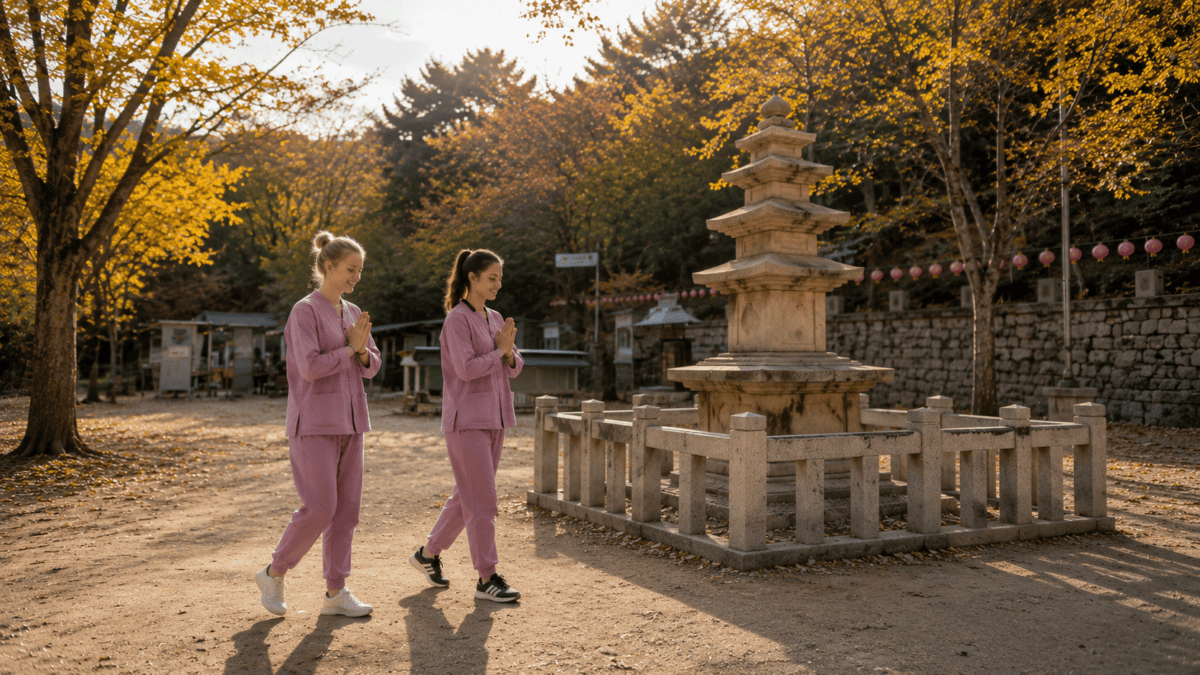
Jingwansa (진관사: Jin-gwan-sa, Buddhist temple founded in 1011 in Seoul) sits at the foot of Bukhansan.
The complex rises gently with the terrain. Stone steps connect one level to the next. Shrine rooms sit quietly along the slope — small, dark, a single lamp burning inside. The main hall faces a courtyard that opens toward the mountain.
I walked the grounds alone after the morning ceremony, before the day’s schedule resumed. No map. No guide. Just the path and whatever it led to.
What struck me wasn’t the scale — the complex is not enormous. It was the logic of the space. Every building sits exactly where it needs to sit. Not for aesthetics. For orientation. The main hall faces east, welcoming the morning light into the space where practice begins. The kitchen sits lower, accessible, central. The sleeping quarters are farthest from the bell — far enough to make the walk to morning bows a transition rather than a stumble.
Walking through a space built around function rather than impression does something to the body. The pace slows without deciding to. The path dictates the rhythm. By the time I reached the upper terrace — the one that opens onto the whole valley, Seoul visible in the distance — I’d been moving for twenty minutes and hadn’t once checked the time.
The autumn leaves had turned the hillside above the gate into something that looked arranged. It wasn’t. The mountain had simply been doing this for centuries, indifferent to observation.
This is what a Korean temple experience doesn’t advertise: not the ceremony, not the food, not the silence. The architecture. The way a space can move you through it at a pace you didn’t choose and didn’t resist. I stood on the terrace for longer than I meant to. The city below looked very far away. Not geographically. In some other unit of measurement I didn’t have a word for yet.
Eight Strangers, One Silence
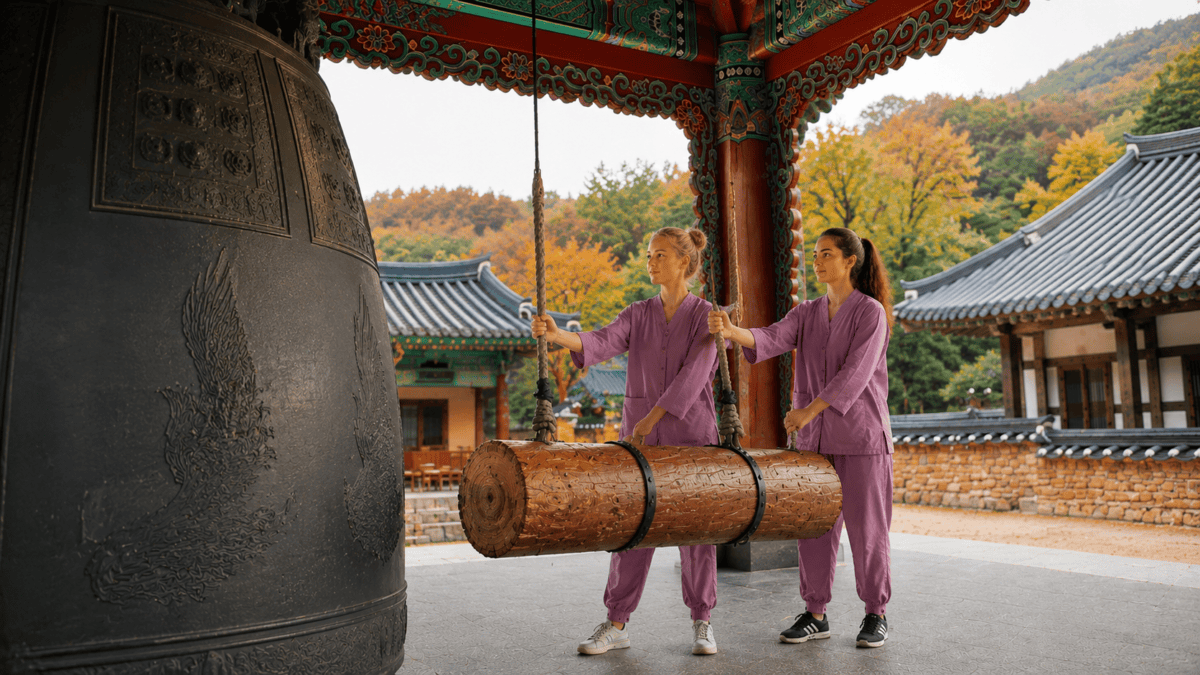
There were eight of us. I knew this the way you know things in a space with no noise — by counting presences rather than faces.
A man in his fifties who moved through every sequence like someone who had done it before. He never looked uncertain about where to stand, when to bow, how long to hold stillness. At breakfast he lifted his bowl with both hands before eating. Not performance — habit. The kind that takes years to stop being a decision. I found myself watching him the way you watch someone read a map in a foreign country — not to copy, but to orient.
Two women who arrived together and then, by the second morning, stopped arriving together. The temple had separated them the way silence separates people who are used to filling it. They sat at different ends of the breakfast table. One of them stared at her soup longer than necessary. Neither seemed troubled by this.
A young man who had clearly not slept after lights-out. At the 108 bows — baekpalbae (백팔배: baek-pal-bae, 108 prostrations) he was the last to rise each time — not from fatigue, or not only from fatigue. He had the particular stillness of someone running on something other than rest, present in a way exhaustion sometimes produces when the usual defenses have nothing left.
Nobody performed being at peace. That was what made the peace legible.
I don’t know what any of them were carrying into the temple. I don’t know what they carried out. But I watched them move through the same schedule, eat from the same bowls, bow the same number of times — and by the second day, the differences between us had become less interesting than the single fact underneath them: we were all still there. Still showing up when the bell rang. Still lowering our foreheads to cold stone, in a valley that had been asking this of people long before any of us arrived.
The Korean temple experience doesn’t promise transformation. It leaves fewer places to hide from the present. What’s left is smaller than you expected and more durable than anything you brought with you.
What the Dark Holds
Lights out at 9 PM.
The mountain outside the window was completely dark. Not city dark — the muted, ambient dark of a place where light is managed and leaks everywhere. Actual dark. The kind that arrives when there’s nothing to interrupt it.
I lay on the floor mat and listened. Wind through the pine trees — a specific sound, different from wind through broadleaf trees, higher and more continuous. Somewhere on the mountain, something moved through fallen leaves. The city existed below, reduced to a low hum, a presence without detail.
My body was still aching from the morning bows. The mat was thin. The pillow was harder than I would have chosen. None of this was the point, and somehow knowing that made it easier to stop negotiating with it.
I woke at 2 AM. I pulled on my robes and stepped onto the small terrace outside my room.
The sky above the temple was doing something I hadn’t seen since leaving home. Autumn had cleared the air. Every star was where it had always been, waiting for a city to stop talking long enough to be visible. I counted them the way I used to as a child — not to reach any number. Just to keep looking.
I stood there for twenty minutes. Maybe thirty. Not thinking about the morning or the city below or what I was supposed to be learning from any of this. The Korean temple experience has a way of removing that question — what am I supposed to be getting from this — and leaving only what’s actually there. The dark. The stars. The city below, still running without me.
I went back inside. The room felt specific in a way it hadn’t before — not smaller, but more actual. The mat, the low table, the window with nothing behind it. A place I was in rather than passing through.
The autumn leaves outside the window were invisible in the dark. I could hear them, though — a dry, intermittent sound as the wind moved through, like something being slowly turned over and set back down. The bell would ring at 4 AM. The bows would begin again. Morning would resume exactly where it had left off, because that is what structures do when they have been running longer than any single person inside them.
I lay down on the mat and closed my eyes. The city was still there below the mountain, still running without me. It didn’t need me. That turned out to be the thing that let me sleep.
This post was planned and edited by a human, with AI assistance.