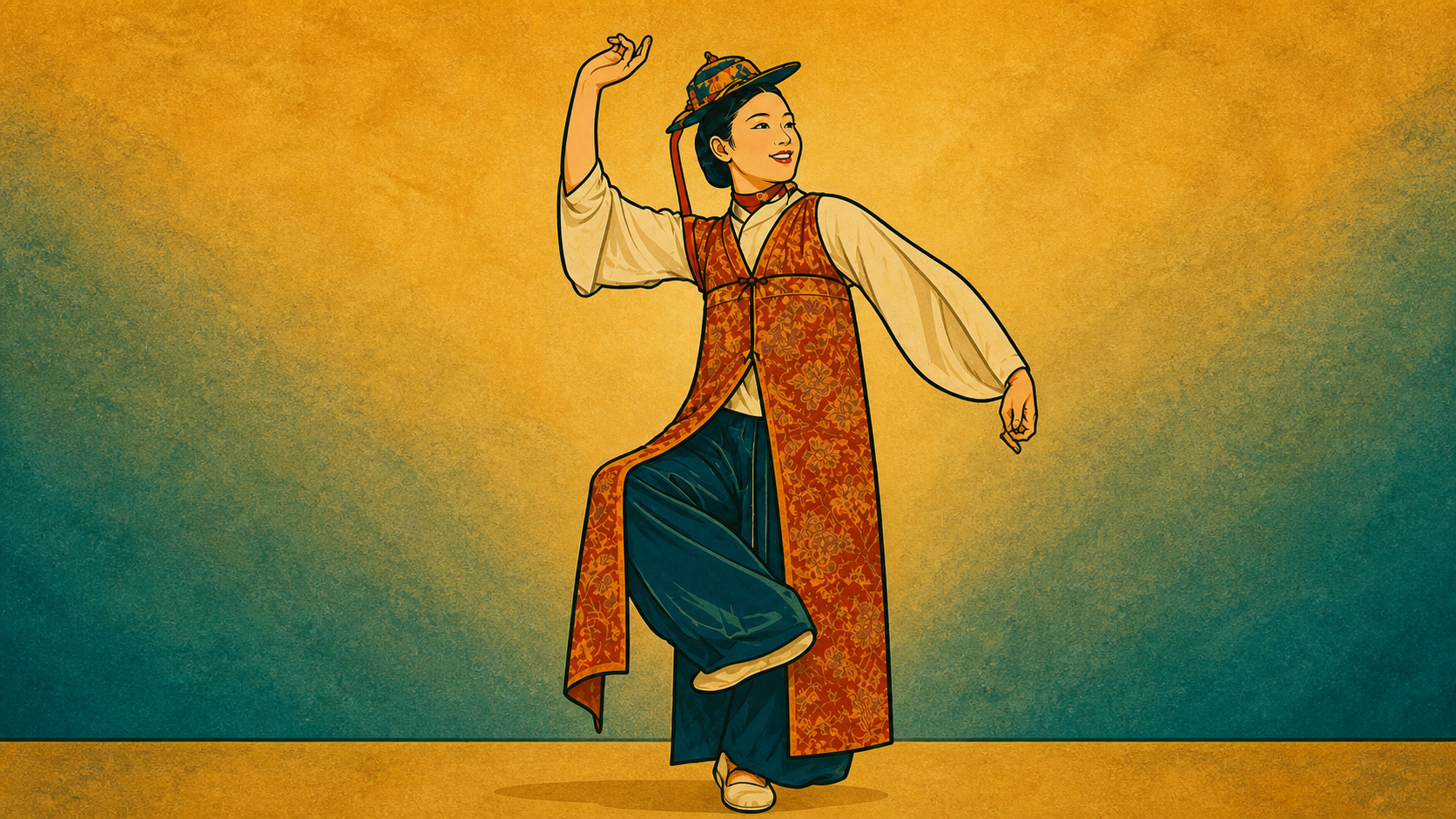
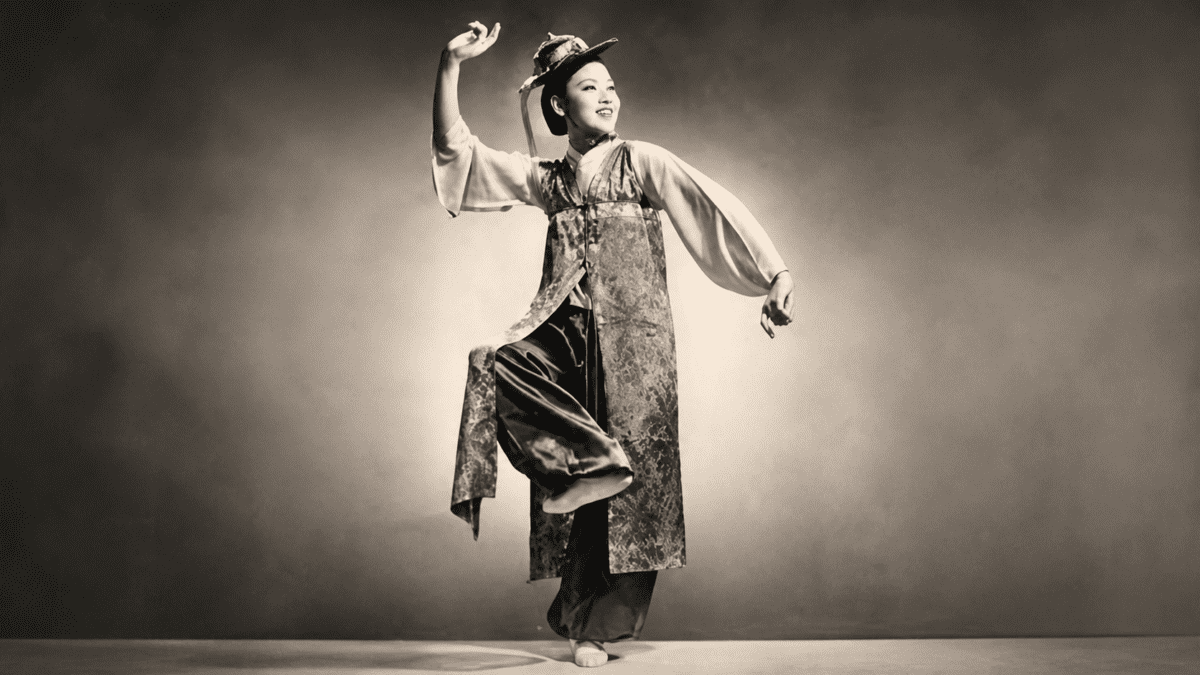
(Wikimedia Commons, Public Domain / Edited)
Why did a dancer who once conquered the world’s stages disappear from history?
Paris had celebrated her. Critics in Europe and America praised her originality and stage presence. She was not a historical footnote—she was a living, breathing presence on the world’s greatest stages, recognized across continents as a major artist of her age. During the 1930s and early 1940s, her name was international—documented, reviewed, celebrated across continents.
Yet by the 1950s, her name had nearly disappeared from public consciousness. What followed was a gradual erasure from public cultural memory and official visibility. Not through obscurity but through politics, displacement, and the fragmentation of historical memory itself.
The Return and the Rejection
She returned to Korea in 1946 carrying the authority of international acclaim. The nation that had produced her should have recognized her as proof of Korean cultural excellence. Instead, she encountered bewilderment and rejection.
The very qualities that had made her revolutionary in Paris—her modern technique, her rejection of classical forms, her fusion of Eastern and Western movement—were dismissed in Seoul as improper. The artistic establishment questioned her credentials rather than celebrated her achievement.
The distance between the world that had celebrated her and the Korea that now questioned her felt impossible to bridge. Her body, celebrated as expressing universal truths in Paris and New York, was now read as expressing transgression in Seoul.
Yet this rejection carried a complication that would shadow her legacy for decades. During the Japanese occupation—precisely the years when she had been conquering European and American stages—she had also participated in Imperial Japanese military performances. In 1941, she had performed in the militaristic film “The Day of Promise.” In 1943 alone, she had donated over 75,000 won to the war effort. These acts, documented and undeniable, would later place her on lists of suspected collaborators.
In 2008, the Institute for Research in Collaborationist Activities included her in its list of pro-Japanese figures. But in 2009, the official government committee did not include her in its final list of pro-Japanese and anti-national collaborators.
The exclusion was significant. Her documented wartime activities remained part of the historical record, but the official committee did not include her in its final list. The result left her legacy divided between artistic achievement and unresolved questions about the choices she made under colonial rule.
The Decision to Move North
In 1946, as Korea emerged from Japanese occupation, Choi Seung-hee made a decision that would define her final decades. She did not make this decision alone. Her husband, literary critic An Mak, stood beside her. Together, they made the choice. Together, they moved to North Korea.
An Mak was not a minor figure. He would become a guiding force in North Korea’s emerging cultural policies. The couple moved north as a unit—artist and intellectual, bound by marriage and shared vision of what the new Korea could become.
Korea was fracturing. The south was fragmented between competing ideologies. The north was being constructed as a new state with new cultural priorities. For a celebrated artist who had found Korea unreceptive, the north offered something the south could not: an institutional structure that valued cultural achievement. An Mak’s position would ensure that Choi Seung-hee’s artistry found recognition and support.
In the early years after their arrival, Choi Seung-hee’s legacy was recognized. She established the Choi Seung-hee Dance Research Institute in Pyongyang, serving as its director. She was awarded the titles of Honored Artist and People’s Artist. She was elected as a delegate to the Supreme People’s Assembly. The state recognized her as an asset—a celebrated international artist who could help establish North Korea’s cultural credibility.
She was not marginalized. She was not immediately silenced. For a time, there seemed to be a place for her artistry in the new nation being constructed.
She was not alone in this choice. Her daughter, An Seong-hee, had trained in classical ballet in the Soviet Union before returning to North Korea, where she too would become a dancer and choreographer. The family’s commitment to dance as a form of cultural and political expression persisted across generations.
The Gradual Withdrawal from Documentation
By the late 1950s, the public documentation of the Choi Seung-hee legacy became sparse. In 1958, her husband An Mak—the literary critic who had guided her transition to North Korean cultural life—was purged from the regime. As he was removed from power, so too was she removed from public visibility. His political fall became her cultural erasure.
Her name appeared less frequently in cultural records. Public performances were no longer reported. She ceased to appear in official announcements. Official photographs of her diminished. Her presence in the cultural sphere, which had once been prominent both in the south and now in the north, gradually receded into silence.
What caused this withdrawal remains largely undocumented. Several possibilities exist, but certainty eludes historical inquiry. Some scholars suggest that the state’s cultural priorities shifted during the 1950s, making her particular artistry less valued in new ideological frameworks. Others note potential factional disputes within the leadership. What is clear is that her disappearance followed directly from her husband’s fall—evidence that her cultural status in the north had been inextricably linked to his political position.
What makes this period significant is not what we know but what we cannot access. North Korean history is characterized by information restriction. Many records related to this period remain inaccessible, incomplete, or unavailable. The silence surrounding her is not metaphorical—it is literal. There are gaps in the documentary record where her presence should appear.
Her Later Years Remain Largely Undocumented
Choi Seung-hee’s final decade remains shrouded in uncertainty. What happened after her withdrawal from public life is not clearly established by any reliable source. Some accounts place her in seclusion. Others suggest she continued to teach in private contexts, passing knowledge to students who would never publicly acknowledge her. Still others offer different versions, none of them conclusively verified by documentation.
She died in North Korea in 1969, at fifty-seven years old. The circumstances of her death remain unclear. North Korean records, made public decades later, state she died of illness in August 1969; other accounts speak of purges and imprisonment. None of the competing versions can be fully verified.
The international community learned of her death only much later, long after it had occurred. By the time the world realized she had died, the figure it mourned was not the celebrated dancer who had dazzled Paris and New York, but a woman whose final decades had been erased from public knowledge. Her death itself became a kind of disappearance—not immediate erasure, but a slow fading from historical visibility.
What is remarkable is not what we know about her final years but what we cannot know. The absence of documentation is not accidental—it is structural. North Korean state control of information created conditions where even major cultural figures could vanish from the historical record. The Choi Seung-hee legacy became fragmented across multiple narratives, none of them complete, all of them partial.
What Remains
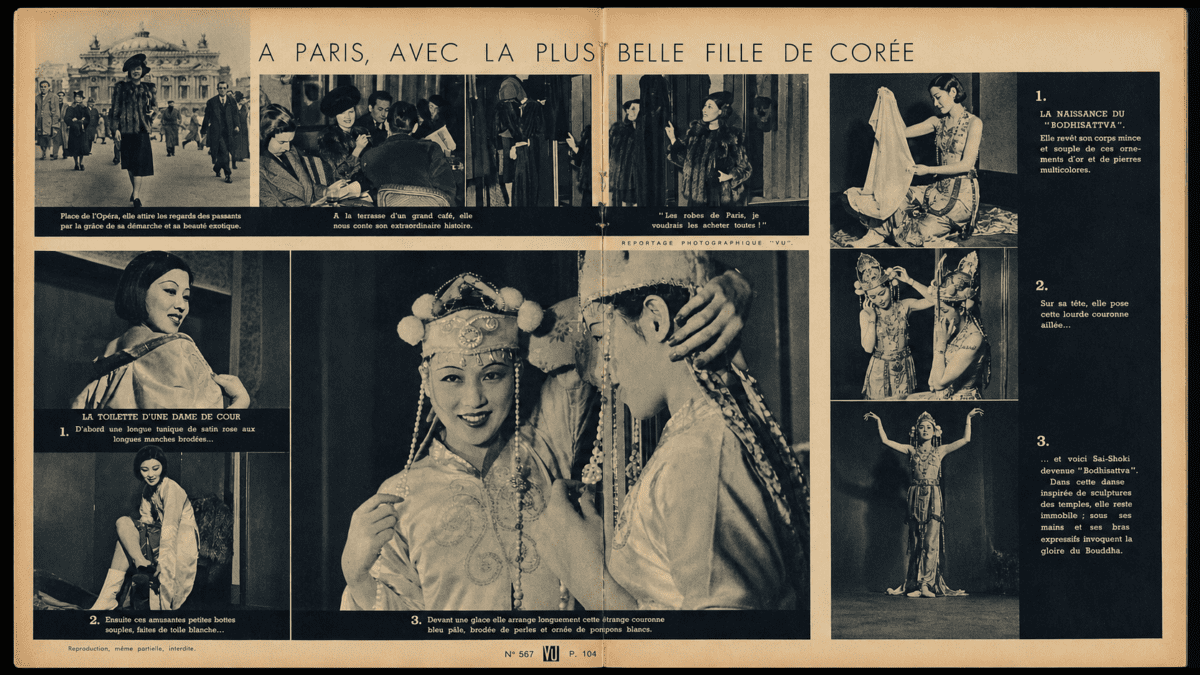
(Wikimedia Commons, Public Domain / Edited)
Despite the silence, the Choi Seung-hee legacy persists in fragments. Photographs from her Paris and New York performances survive. Reviews from those performances remain in archives. Some of her students from her teaching years in Korea carried forward what they had learned. The last remaining direct disciple, dancer Kim Young-soon, would eventually defect to the South in the early 2000s, carrying with her the living memory of Choi Seung-hee’s teachings. In South Korea, knowledge of her passed through oral transmission, whispered acknowledgment, the kind of memory that exists outside official channels.
International dance historians eventually recovered her story. Academic work in the 1990s and 2000s attempted to reconstruct her significance. The world that had forgotten her began, slowly, to remember.
In February 2003, thirty-four years after her death, Choi Seung-hee was officially rehabilitated by the North Korean government. She was posthumously reinstated to full honor, recognized once more as a cultural figure of national significance. Her remains were transferred to the Patriotic Martyrs’ Cemetery, a designation that transformed her from disappeared person to state hero. The reversal was remarkable—an acknowledgment that her artistic achievements and her place in Korean cultural history transcended the political circumstances of her final decades.
Her name reappeared in histories of twentieth-century dance. Scholars noted her contributions to the development of modern movement. She was repositioned in the narrative of global dance—not as an anomaly but as a significant contributor to the international development of twentieth-century performance.
On the stages of Paris and New York, what had her body said? Precision and fluidity that seemed to redefine what movement could express. A vision that was original. A quality that transcended technical mastery—the way her body seemed to think, to question, to articulate ideas that existed beyond the purely physical.
When New York named her, critics identified what made her unique: she was Korean. She was a woman. She was an innovator. These facts did not contradict her status as a world-class artist—they defined it. Here was proof that Korean consciousness, Korean artistry, Korean identity could stand on the world’s greatest stages not as exotic spectacle but as genuine significance.
This is what remained—not in documents, but in the structure of what came after. When Korean cinema exploded onto the global stage in the 21st century, it carried the same certainty she had embodied: that Korean identity and global artistry were not contradictions but definitions of each other. When Korean directors refused to explain their work, when Korean performers moved with precision born from their own tradition, when Korean artists insisted on their specificity as the basis of their universality—they were following a path she had already cleared.
Korean directors refused to explain their work. Korean actors moved with precision rooted in their own tradition. Korean artists did not reject their particularity. It became their power.
Like on a Paris stage in the 1930s.
Yet even with this official recognition, this recovery remains incomplete. Most people—even in Korea, even among dancers—do not know the Choi Seung-hee legacy. What she accomplished remains largely invisible outside specialized academic circles. The woman who had been celebrated on stages across the world, then disappeared, then officially forgotten, then finally rehabilitated, became in the end a figure requiring scholarly effort to retrieve.
What appears to be erasure is sometimes only delay. The world remembers. But usually after the silence has already done its work.
This post was planned and edited by a human, with AI assistance.