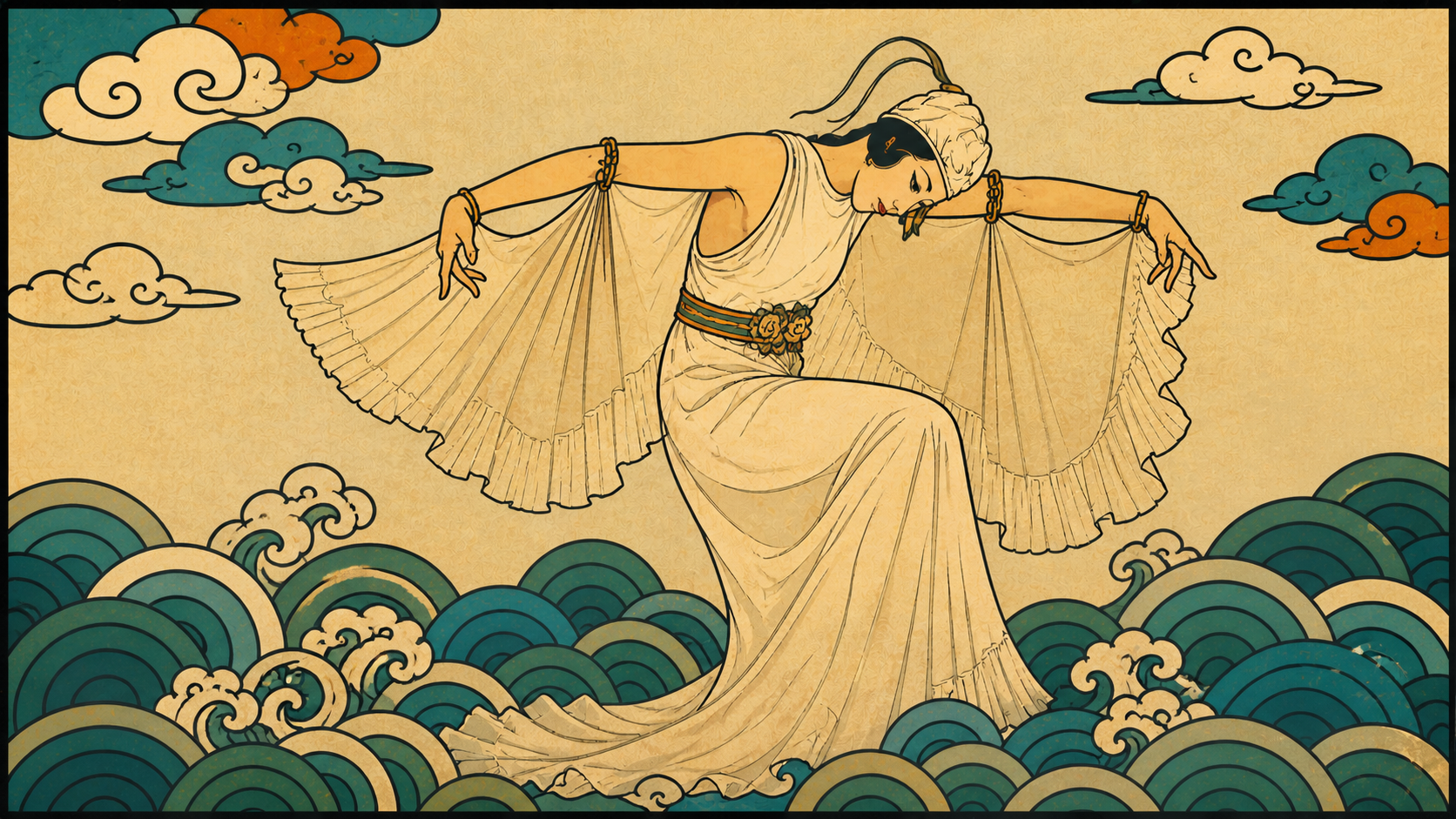
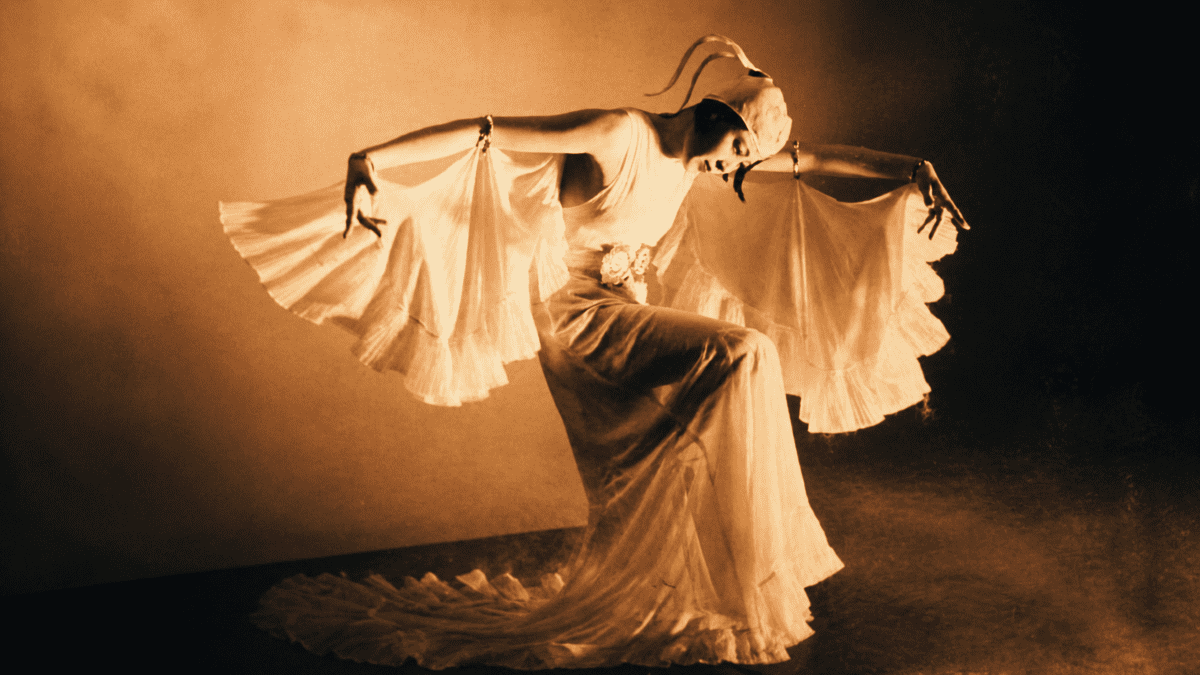
(Wikimedia Commons, Public Domain / Edited)
Choi Seung-hee (최승희, 1911–1969) left Korea at fifteen with a conviction that would define her era: that her body could speak a language the world would understand. Born into a time when Korean women were expected to remain invisible, she discovered through dance that movement could do what words could not. Years later, Choi Seung-hee dance would captivate audiences in Paris and New York, long before Korean culture became globally visible.
In 1926, at fifteen years old, she boarded a ship bound for Japan. Within three years, she had mastered contemporary movement at the highest level. By her late twenties, she was performing on the stages of Paris and New York. No global media machinery. No cultural infrastructure carrying her name abroad. Only artistry.
A Girl Who Left
The decision to leave was radical. She was born into a family of cultural legacy, yet her childhood was marked by financial hardship that would shape her entire life. This very struggle would grant her the resolve to pursue an unconventional path. Japan, despite being the colonizing power, paradoxically offered opportunity that Korea did not. In Tokyo, there were studios. There were teachers. There was a possibility of transformation that Korea had yet to imagine.
The journey itself was an act of refusal. By leaving Korea, she rejected the role prescribed for her: marriage into a respectable family, management of a household, invisibility. What she carried instead was a body that had already begun to move, a restless intelligence that would refuse containment.
Choi Seung-hee’s dance emerged from an unusual collision of influences. She studied modern dance in the Japanese tradition, absorbing rigorous movement techniques that had entered Japan from the West. But she did not simply copy. From the beginning, there was something in her movement that suggested she was asking her own questions. The patterns she learned became instruments through which she could express something distinctly her own.
Within three years, she had advanced with a speed that shocked even experienced teachers. By her late teens, she was already performing at the highest level of contemporary dance. She began performing publicly at sixteen, having started her studies with the legendary Japanese dancer Ishii Baku at fifteen. The speed itself was shocking. Teachers and audiences sensed that they were witnessing not merely technical proficiency but an artist discovering herself in real time. In those early performances lay the seeds of what would become Choi Seung-hee dance—a revolutionary form that defied easy categorization.
Paris Recognizes
By the early-to-mid 1930s, Choi Seung-hee had attracted the attention of impresarios and patrons who recognized exceptional talent. An invitation came to perform in Europe. On December 24, 1938, Choi Seung-hee stepped off the liner Paris at Le Havre, arriving in the French port as a celebrated passenger—reported that same day by the local press. By evening, she had reached Paris. Her first European performances would follow in January 1939, launching a continental tour that would reshape how the world understood Korean art. What had arrived in Europe was not exotic spectacle but Choi Seung-hee dance in its full artistic maturity.
Yet her work was not what they expected. She did not offer exoticism. She offered artistry. On Parisian stages, audiences encountered a young woman whose body moved with a precision and fluidity that seemed to redefine what movement could express. The technique was extraordinary. The vision was original.
The response was immediate. Critics wrote with language typically reserved for the greatest artists of the age. She was compared to legendary dancers. What distinguished her, they noted repeatedly, was a quality that transcended mere technical mastery—something about the way her body seemed to think, to question, to articulate ideas that existed beyond the purely physical.
Performance followed performance. The great Parisian stages welcomed her. Sold-out houses became standard. Her name appeared in major publications. The French press recognized what they were witnessing: an artist of genuine significance. The stage bathed her in light that made her fully visible—a visibility that would have been impossible in Korea. The carefully orchestrated lighting, the architectural frame of the theater, the rapt silence of audiences encountering something unprecedented—all of this created a space where her artistry could fully exist.
New York Names Her
From Paris, the invitations multiplied. New York beckoned. When she arrived on American stages in the late 1930s, she carried the aura of European success. But America’s response was not merely acceptance—it was recognition at the highest level. The city in those years was a stage for global culture, a place where ambition and innovation converged, and Choi Seung-hee’s arrival added another chapter to that story.
In New York, something shifted. Critics began to identify Choi Seung-hee dance not as an Asian anomaly or a bearer of exotic tradition, but as a global artistic form of the first rank. They named her. They wrote her name in programs, in reviews, in the historical records of dance. She was no longer merely “the Korean dancer”—formulations that flattened her into a category. She became “Choi Seung-hee,” a name that belonged to itself.
What made this naming significant was its refusal of erasure. In a world that typically rendered non-Western artists invisible or assimilable, she insisted on her specificity. She was Korean. She was a woman. She was an innovator. These facts did not contradict her status as a world-class artist—they defined it.
American audiences, perhaps more accustomed to the direct communication of emotion through the body, recognized in her movement something that transcended cultural translation. Here was an artist speaking a universal language through the most particular means possible: her own body, her own vision, her own refusal to be contained by imposed categories. Performance after performance sold out. She danced in the major theaters. She was interviewed by major publications.
A Global Star in the 1930s
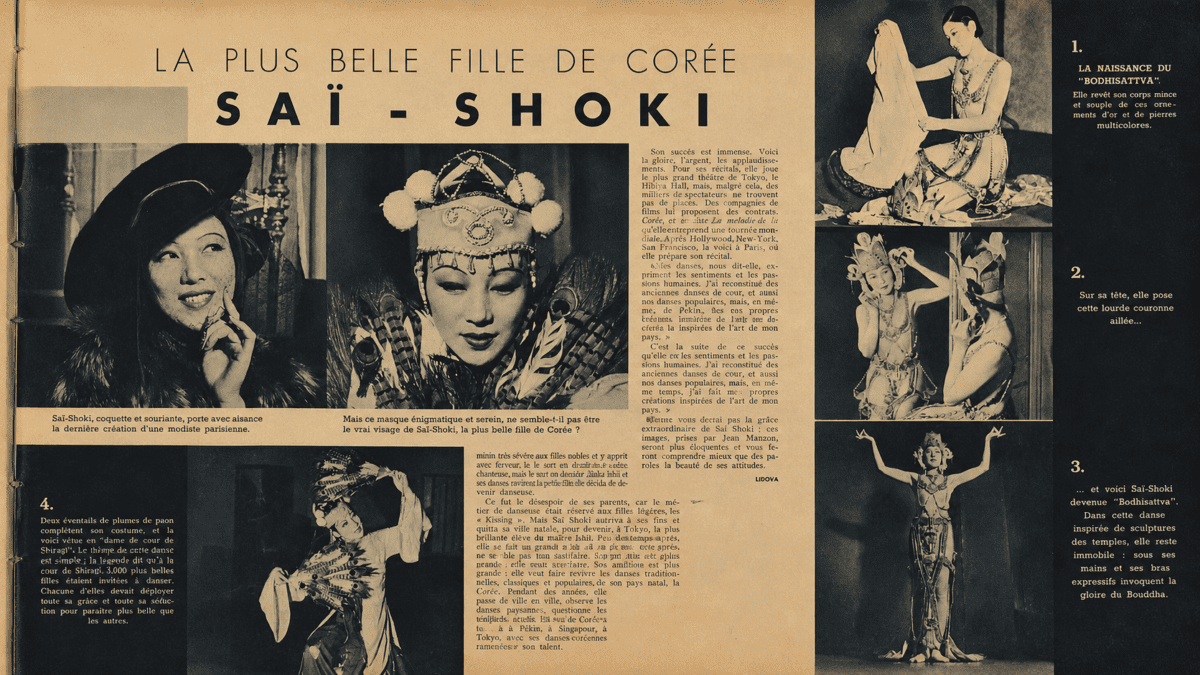
(Wikimedia Commons, Public Domain / Edited)
By 1939 and into the early 1940s, Choi Seung-hee became one of the most internationally recognized Korean performers of her era. Her name appeared in international publications. She had performed for audiences of thousands across multiple continents. She had proven that a Korean artist could stand on the world stage not as an exotic curiosity but as a creator of genuine significance.
What is crucial to understand is the scale of her prominence. In the late 1930s and early 1940s, before film became the dominant medium, before mass media flattened cultural boundaries, she represented something exceptional: a non-Western artist who had achieved prominence on the world’s most prestigious stages through sheer artistic merit. She toured Europe repeatedly. She performed in America’s major cities. She was recognized in Japan and China. She was interviewed by major critics.
This was not a small achievement. This was global prominence at a time when global recognition required genuine artistic excellence. There were no shortcuts, no international media machinery to amplify achievement. She succeeded because her artistry was undeniable. What appears as erasure is sometimes only delayed—and understanding her prominence requires grasping how fully the world once knew her name.
To understand the significance: consider that Yun Dong-ju, writing in secret in Korea, was virtually unknown to the world during his lifetime. Choi Seung-hee, dancing on the stages of Paris and New York in the same era, was celebrated across continents. The contrast reveals something essential about the nature of time itself in history. One artist moved through silence to eventual recognition. The other moved through recognition to eventual silence.
Yet both were part of the same cycle—erasure and return, visibility and invisibility alternating across decades. What appears as triumph or defeat in any single moment is merely one phase in a much larger pattern. The world knew Choi Seung-hee. Then it forgot. Then, eventually, it would remember again. History rarely moves in straight lines. Visibility and erasure return in different forms across generations.
Korea’s Complicated Response
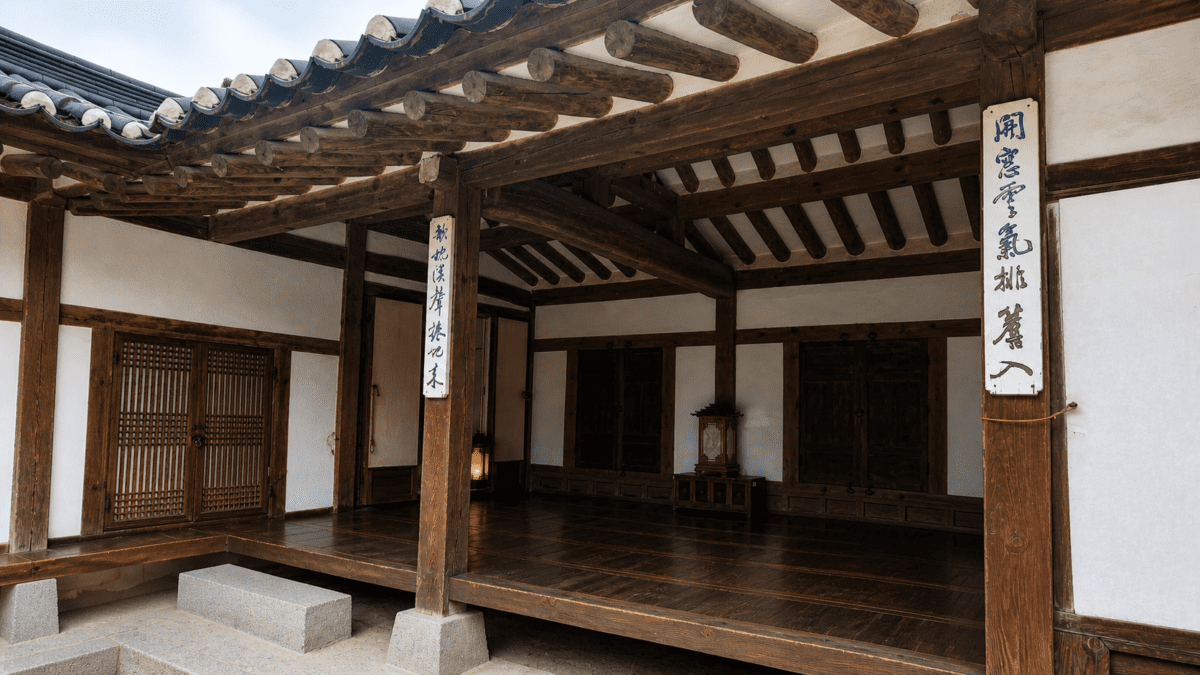
By the late 1930s, word of her success had reached Korea. Reports of her triumphs abroad circulated. Yet in Korea itself, the response was complicated. She had been gone for years. The world that had celebrated her remained largely inaccessible to most Koreans.
When she finally returned to Korea in May 1946, carrying with her nearly two decades of international acclaim, she encountered something unexpected. Rather than celebration, she found resistance. She returned with her husband, literary critic An Mak, yet even this marriage could not shield her from the judgment waiting for her.
The very qualities that had made her revolutionary in Paris—her modern technique, her rejection of classical forms—were dismissed in Seoul as improper and lowbrow. The artistic establishment that should have recognized her as proof of Korean excellence instead questioned her legitimacy.
The distance between the world that had celebrated Choi Seung-hee and the Korea that now questioned her felt impossible to bridge.
This post was planned and edited by a human, with AI assistance.