
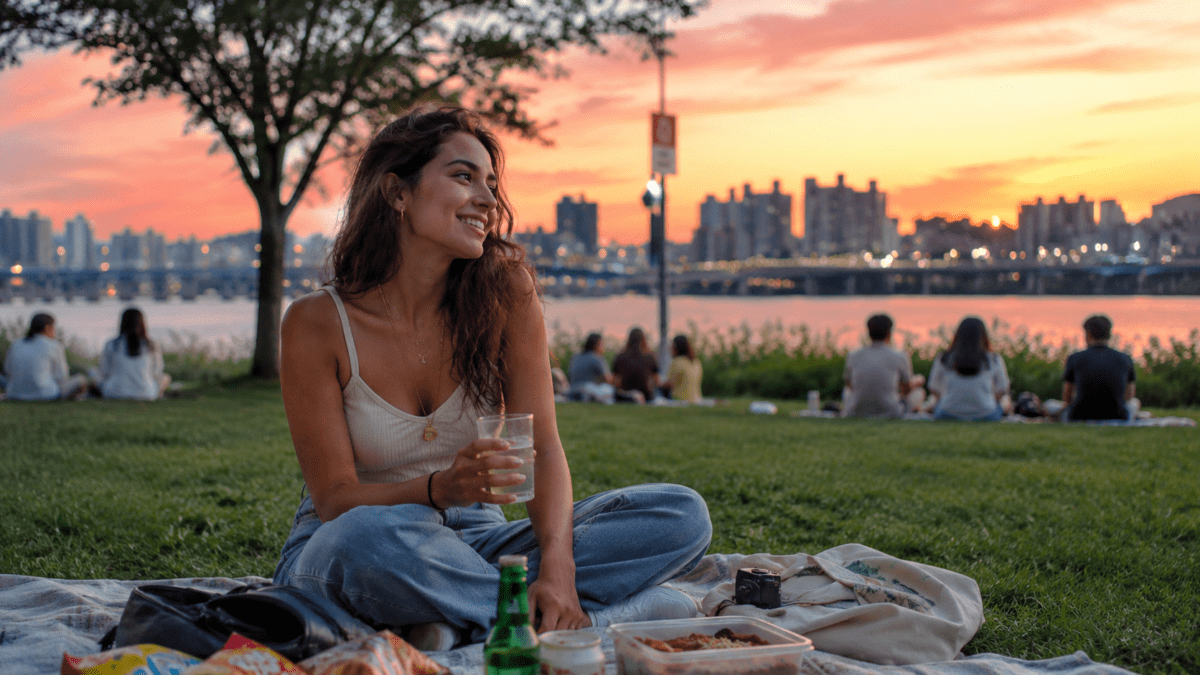
The Han River is not a park.
Parks have edges. They have entrances and exits, closing times, designated areas for designated activities. The Han River walk Seoul offers doesn’t work like that. It runs for over 40 kilometers through the middle of the city, open at every hour, accessible from dozens of points along both banks. There is no ticket. There is no gate. You arrive wherever you are, step onto the path, and it’s already yours.
This is the longest shared space in the city, built without calling it anything in particular. Not a landmark. Not an attraction. Just available to whoever shows up.
The Bank That Belongs to No One and Everyone
On a Saturday afternoon, the Han River path contains multitudes.
A grandmother in a visor walks at a pace that suggests she has been walking this exact stretch for twenty years. Thirty meters ahead, a cyclist in full kit passes without slowing. A group of friends has claimed a patch of grass near the water, their convenience store bags arranged like a small settlement. Two people sit on the stone steps leading down to the river, not talking, looking at the same water from slightly different angles.
None of these people are interfering with each other. That’s the first thing you notice. The path is wide enough, the space generous enough, that very different uses coexist without negotiation. The runner doesn’t resent the walker. The walker doesn’t resent the family with the picnic. Everyone has found their version of the same river and is using it simultaneously.
Most shared spaces sort people by activity — the running track here, the picnic area there, the walking path over the bridge. The Han River path doesn’t sort. It absorbs. The same stretch of the Han River walk Seoul accommodates the grandmother and the cyclist and the couple and the solitary walker, all moving at different speeds toward different versions of the same afternoon.
The absorption works because nobody is waiting for anyone else. The grandmother isn’t holding up the cyclist. The family with the picnic isn’t in the runner’s way. Each person has calibrated their use of the space to what the space allows, and the space allows quite a lot.
There’s a particular social ease that comes from a place with no entry requirement — no membership, no ticket, no implicit dress code. You show up as you are, and the river receives you as you are. That ease spreads. People who might be tense in a more curated environment relax here. The grandmother walks at her pace. The cyclist moves at theirs. The family spreads out without apologizing for taking up space. The river makes room for all of it without being asked.
Cyclists, Runners, and Walkers Moving Together
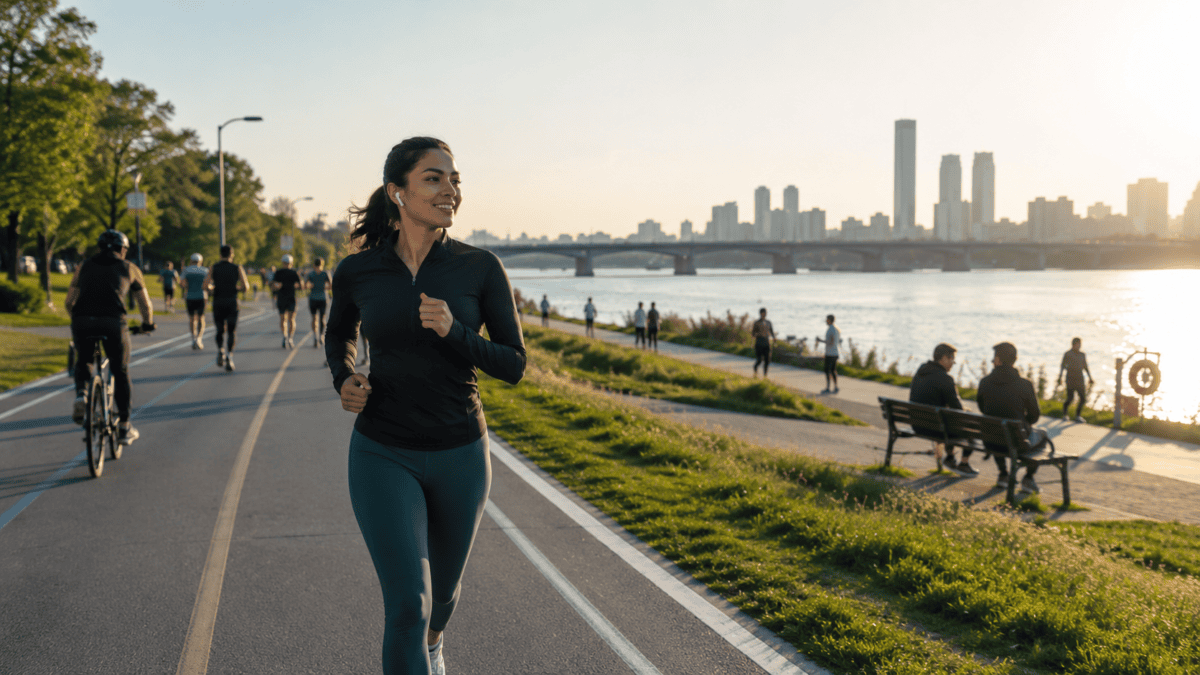
Watch the Han River path for long enough and a pattern emerges.
The cyclists stay right, mostly. The runners find their rhythm in the middle or to the right. The walkers take whatever’s left, which is usually enough. Nobody has agreed to this. The lanes are marked in places, but nobody is enforcing anything. The system self-organizes, imperfectly but effectively, the way shared spaces do when enough people use them consistently over enough time.
What makes it work is speed differential. The cyclists move fast enough that their presence is announced — you hear them before you see them, or you don’t, and then they’re already past. The runners move at a pace that makes them visible but not intrusive. The walkers anchor everything, slow enough to notice what the others miss.
The Han River walk Seoul offers is actually three different experiences happening in parallel. The cyclist’s version is about distance and speed and the particular feeling of the wind off the water at 30 kilometers per hour. The runner’s version is about rhythm and the way the path stretches ahead without complication. The walker’s version is about everything else — the light on the water, the city visible across the bank, the heron standing in the shallows that everyone else passed without noticing.
Same path. Three cities.
Why the Same People Come Back Every Weekend
The Han River path regulars are identifiable.
Not by appearance — by behavior. The way they move through the space without consulting it. The specific bench they head for without looking. The point where they turn around, which is always the same point, arrived at by some internal calculation that has nothing to do with distance and everything to do with how the afternoon feels.
They come back because this stretch of river is consistent in a way the rest of the city isn’t.
Seoul changes fast. Neighborhoods shift. Buildings go up and come down. A café that was there last month isn’t there this month. The pace of change is one of the city’s defining qualities, and most of the time it reads as energy, as possibility. But it also means that familiar things disappear without warning, and the ground beneath the familiar is never entirely stable.
The Han River doesn’t change. The water moves but the river stays — and that constancy is its own kind of timing, the kind most people only notice when everything else has shifted. The path is the same path it was last weekend and the weekend before. The heron is usually in the same spot. The view across to the opposite bank is the same view. In a city that reinvents itself constantly, the Han River walk offers something increasingly rare: a place that will be there when you come back.
That’s not a small thing. It’s the reason the same people show up every Saturday morning, year after year, doing the same loop at the same pace, and leave satisfied every time.
A Backyard the Whole City Shares

There is a particular quality to the Han River in the late afternoon.
The light comes in low across the water and catches the surface differently than it does at noon — less harsh, more directional, the kind of light that makes everything it touches look considered. The city on the far bank goes soft at the edges. The bridge upstream carries its usual traffic, but from down here it reads as part of the scenery rather than infrastructure.
People slow down at this hour without deciding to. The cyclists thin out. The runners who started in the early afternoon are finishing up. What’s left are the walkers and the sitters — the people who came for the river itself, not for the exercise it enables.
A backyard is a specific kind of space. Not a park, which is public and therefore slightly formal. Not a street, which is functional and therefore purposeful. A backyard is where you go when you don’t need a reason. When the day has room in it and you want to put the river in that room.
The Han River walk Seoul returns to, week after week, works like this: it lets you arrive in whatever condition the day left you. You can arrive tired, underdressed, with nothing planned beyond walking until you feel like stopping. The river keeps moving. The path keeps taking people in. The other people on it are too absorbed in their own version of the afternoon to register yours.
There is something genuinely freeing about a space this indifferent to who you are when you arrive. The city outside the river path has opinions — about how you dress, where you’re going, how fast you’re moving. The Han River path has none. You are simply someone walking beside the water, which is enough, which has always been enough, which will continue to be enough long after you’ve gone home and the light has changed and the river has moved on to its evening version of itself.
Seoul has many things. Museums and markets and neighborhoods that deserve their own full attention. But the Han River walk is the backyard — the space the city shares without ceremony, without admission, without any requirement beyond the willingness to show up and walk beside the water for a while.
Most people who live in Seoul stop noticing it. That may be the clearest sign that it belongs to them.
This post was planned and edited by a human, with AI assistance.