
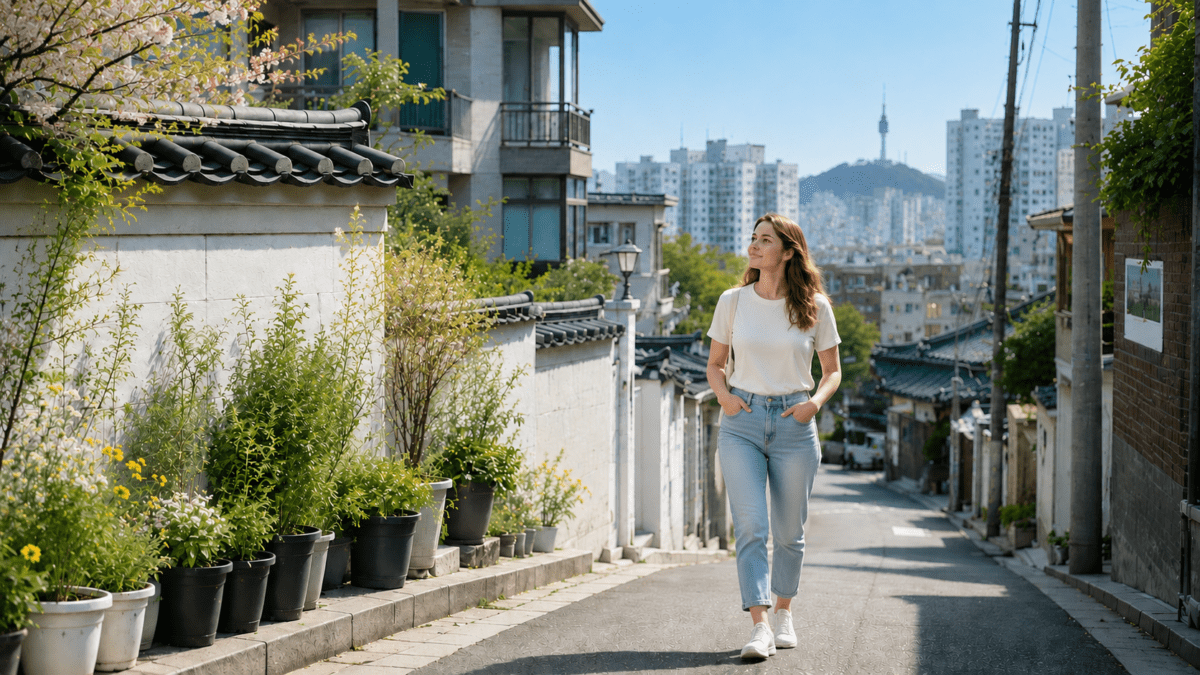
Most walks go somewhere.
A destination, a landmark, a café at the end of the route that justifies the effort. The walk is the means; arrival is the point. Korean neighborhood walking culture doesn’t always work like that. There is a specific kind of walk — common enough to be unremarkable, meaningful enough to be irreplaceable — that goes nowhere new at all. The same streets, the same turns, the same endpoint that is also the starting point. A circuit, repeated until the body knows it better than the mind does.
These are the Seoul neighborhood walks practiced for generations without ever naming the habit. This kind of walk doesn’t require a river or a mountain or a trail with a designated route. It requires only the block, the familiar radius — the path that runs along the stream two streets over, the corner where the road bends toward the school — and the willingness to walk it again.
A Route the Body Knows Before the Mind Does
The first time you walk a new route, you navigate.
You check for turns, register landmarks, build a mental map as you go. It’s effortful in a low-stakes way — the brain is working, cataloging, making sure the route is learnable. By the tenth time, something has shifted. The navigation drops out. The body takes over, turning where it knows to turn, adjusting pace on the slight incline without being told — finding the way without forcing the direction. The mind is free.
This is what Korean neighborhood walkers are doing when they set out on the same loop for the hundredth time. Not failing to find somewhere new. Deliberately returning to somewhere known, because known is what allows the mind to go elsewhere while the body handles the route.
It takes time to build this. The route has to be walked enough times that it becomes automatic — embedded not as memory but as muscle. In Korea, where neighborhood walking is often treated as a daily habit rather than occasional exercise, most long-term residents have at least one route like this. A circuit that runs on its own while the walker thinks about other things, or nothing at all.
The paradox is that the familiar route, precisely because it requires no attention, creates the most space. The unfamiliar route demands presence. The known route offers absence — a specific kind of useful, restorative absence that the body enables for the mind.
Familiar Faces, No Names Required
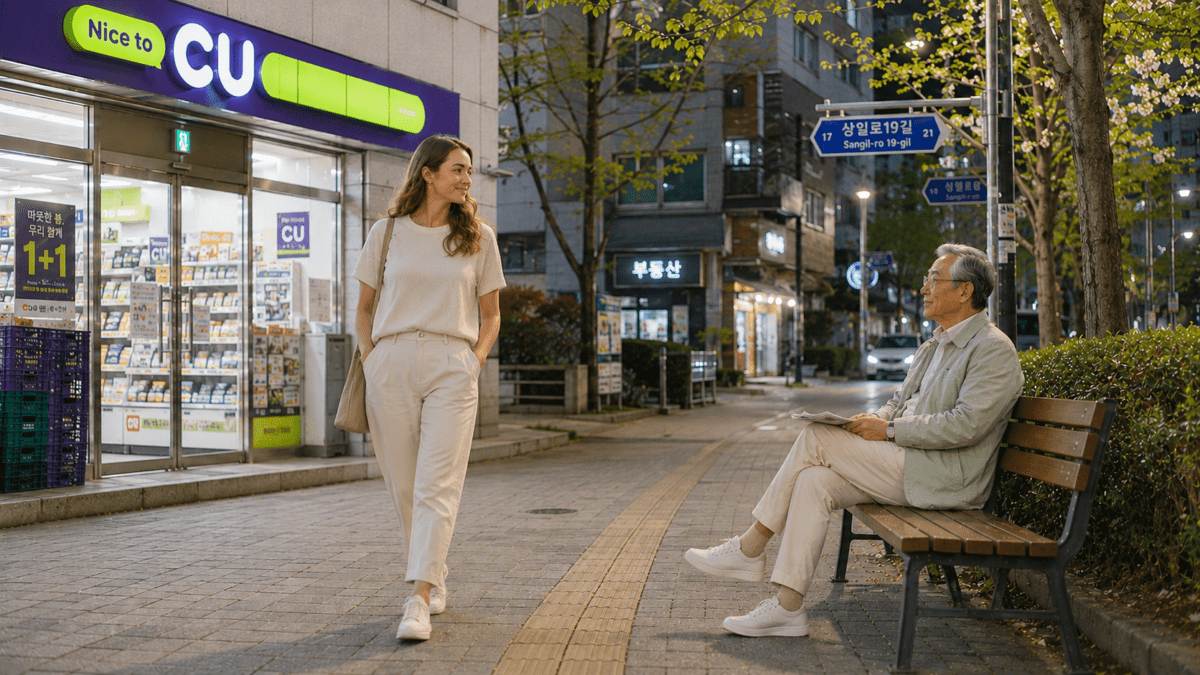
Repeat a route often enough and the route starts to populate.
Not with friends, exactly. With something more specific and in some ways more useful — familiar strangers. The older man who walks the small terrier at seven every evening, always stopping at the same bench near the corner to let the dog rest. The woman who does her loop in the opposite direction, so you pass each other at roughly the same point every time, and have developed a nod that contains an entire unspoken relationship. The teenager who sits on the steps outside the convenience store with headphones in, there so consistently that his absence on any given evening would register as a small wrongness.
None of these people know each other’s names. None of them have had a conversation beyond the occasional greeting. And yet they form a kind of loose community — not chosen, not organized, but real in its way. A community of repetition — the kind that forms along any Seoul neighborhood walking route. People who have ended up in the same place at the same time often enough that their presence has become part of the texture of the route.
This is what the Seoul neighborhood walk offers quietly and without announcement. It creates familiarity without obligation. The nod between regulars carries recognition without requiring anything further. You are known here, in the limited but genuine sense of being a familiar presence in a familiar place. That’s not nothing. In a city as large and fast as Seoul, it’s rarer than it sounds.
The familiarity accumulates without effort. You don’t decide to become a regular. You simply return often enough that regularity happens to you. One evening the woman walking in the opposite direction nods before you do — and you realize she recognized you first. The route has made you legible to someone who doesn’t know your name, your job, or anything about you except that you walk this block at this hour and have been doing so long enough to be expected. That’s a particular kind of belonging. Quiet, undemanding, and surprisingly hard to find anywhere else.
The Stops That Make the Walk

Every regular route has stops that aren’t officially stops.
The spot where the path opens slightly and you can see two blocks in either direction — you slow down there, almost always, without planning to. The section where someone has put potted plants along the building wall, adding color to what would otherwise be concrete — you notice them each time, register how they’re doing, whether the red one is still flowering. The bench that faces west, useful only in the late afternoon when the light is going, which you have sat on exactly four times but think about more often than that.
These micro-destinations accumulate over months of walking the same route. They’re not marked on any map. They exist only for the person who has walked past them enough times to notice what they offer. The route becomes personal not because it was chosen for its qualities but because time has made it specific. The generic block has become your block, with your stops and your landmarks and your particular knowledge of where the pavement is uneven and which dog behind which fence will bark.
In Seoul neighborhood walk culture, this accumulation is the point. The walk isn’t improved by going somewhere new. It’s deepened by returning to the same place until it gives up more than it offered on the first visit.
The process is slow enough that you don’t notice it happening. One day you realize you’ve been watching the same potted plant through three seasons without deciding to. That the bench facing west has become somewhere you think of on long afternoons, a mental shortcut for a specific quality of light and stillness.
That the uneven pavement near the corner has become a landmark — not because it’s notable, but because your body has logged it as a known thing in a known place. The route has done this to you gradually, the way all the things that matter most arrive: without announcement, through repetition, until one day they’re simply part of how you move through the world.
Neighborhood Walks Korea: A Map Drawn by Habit, Not by GPS
There is a map of every neighborhood that doesn’t exist on any phone.
It’s drawn by the people who walk the same streets repeatedly, over months and years, until they know things no map records. Which corner gets wind in winter. Where the ground stays wet after rain longer than it should. The exact tree whose roots have lifted the pavement into a ridge that needs stepping over — present in the muscle memory of every regular before it ever becomes a tripping hazard for anyone new.
Daily neighborhood walks in Korea are the method by which this map gets made. Not intentionally — nobody sets out to learn the micro-geography of their block. But repetition produces knowledge the way water produces erosion: slowly, without ceremony, until the shape of things has changed and nobody can quite say when.
The GPS map is accurate. It shows the streets as they are, the distances as they measure, the routes as they connect. But the habit map records something else entirely — the streets as they feel, the distances as they register in the body, the route as it has been lived. Both are real. Only one of them belongs to you.
That’s what the neighborhood circuit gives, in the end. Not novelty. Not discovery in the conventional sense. Just a piece of the city that has become yours through the unremarkable, irreplaceable act of walking it again.
This post was planned and edited by a human, with AI assistance.