
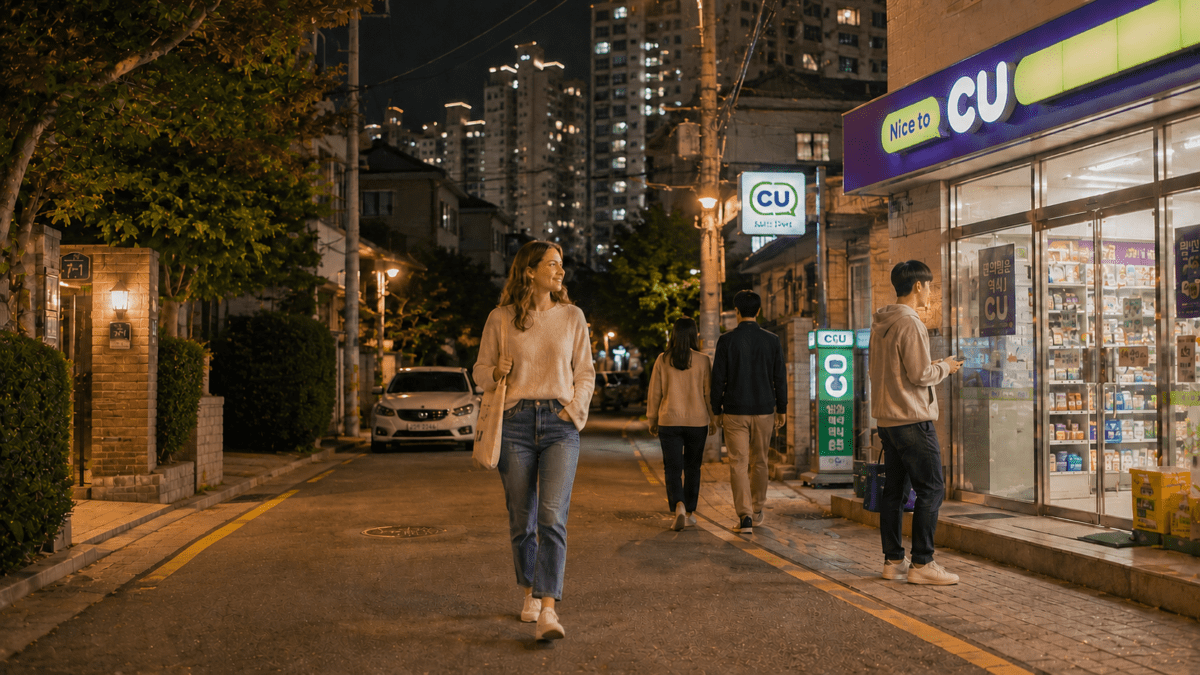
Nobody asks why you’re alone.
That’s the first thing you notice about walking alone in Korea. In many cities, a woman walking alone at night occupies a particular kind of social visibility — she is noticed, assessed, occasionally approached. The solitude reads as a condition requiring explanation, or at least acknowledgment. In Korea, it doesn’t work that way. You are simply someone walking. The street receives you without comment and moves on.
This isn’t invisibility. It’s something more useful — neutrality. The city doesn’t register your solitude as a problem to be solved. It registers you as a person moving through space — which is what you are, and all you need to be.
It has a texture that takes a few evenings to recognize. Once you do, it’s hard to unfind.
The Social Tax You Stop Paying
The social architecture of Korean public space is built around a particular kind of non-interference.
Not coldness — that’s a different thing entirely. Korean streets are full of warmth: the grandmother who notices you looking confused and points you in the right direction before you’ve asked, the convenience store clerk who bags your items with the same care regardless of how small the purchase. The non-interference is something else. It’s the absence of the specific social tax that solo women pay in many cities — the looks that linger a beat too long, the unsolicited commentary, the sense that your presence alone requires justification.
On a Korean street at night, you are not a puzzle. You are not a problem. You are not an opportunity. You are a person walking, and the street extends the same basic courtesy to you that it extends to everyone else moving through it at that hour.
This is rarer than it should be. Most cities have not figured out how to make public space feel equally public to everyone who uses it. Seoul, for reasons partly cultural and partly structural, has come closer than most — and walking alone in Korea is where that difference becomes tangible. The solo walker — female, foreign, unfamiliar with the neighborhood — moves through the evening streets with a freedom that surprises people who weren’t expecting it.
Private Thoughts in a Public Space
There is a particular quality of thought that only happens while walking alone.
Not the focused thinking of a desk, where problems are approached directly and solutions are the goal. Not the scattered thinking of a screen, where attention moves in fragments too small to follow. Walking thinking is slower, more associative, less directed. It follows its own logic, makes connections that wouldn’t survive scrutiny, arrives at things sideways.
The key is the body. When the body is occupied with the simple, automatic work of moving through space, the mind is freed from the task of managing it. The thoughts that surface in this condition are different from the ones you find at a desk. They tend to be the ones that have been waiting — the unresolved question, the feeling that hasn’t been named yet, the thing you’ve been too busy to notice you’ve been avoiding. It’s the kind of internal signal that surfaces only when nothing else is asking for attention.
Walking alone in Korea provides the specific conditions this kind of thinking needs. The streets are safe enough that the body doesn’t need to stay vigilant. The city is interesting enough that the eyes have something to do without demanding conscious attention. And the social architecture, with its comfortable non-interference, means the mind isn’t occupied with managing its presentation to others.
You are alone in public in the most useful sense: accompanied by your own thoughts, undisturbed by anyone else’s.
What Night Walks Feel Like

The city changes after dark in ways that favor the solo walker.
The daytime version of Seoul is dense and loud and fast — a city moving at the speed of its own ambitions, which are considerable. After ten, something releases. The density remains but the urgency drops out. The streets that were full of people going somewhere are now full of people simply being somewhere. The distinction sounds small. It changes everything.
At night, the convenience store becomes something closer to a living room — warmly lit, unhurried, full of people who have nowhere specific to be. The pojangmacha, if one is set up on the corner, creates a small warm island in the dark. The sound of the city shifts: less traffic, more voices, the occasional distant music from a window several floors up.
For the solo walker, this is the hour. The city is populated enough to feel safe, quiet enough to feel spacious, lit well enough to see without being seen too clearly. You can walk for an hour through residential Seoul at night — or run along the Han River at 2 AM, like the runner no one questions — and feel, consistently, that you are welcome here. Not because anyone has said so, but because nobody has suggested otherwise.
There is a specific pleasure in walking a city at the hour when it has stopped performing. The daytime city is always doing something — selling, moving, signaling. The nighttime city is just existing. The neon of the convenience store isn’t advertising anything at midnight; it’s just light. The voices from the pojangmacha aren’t part of anyone’s commute; they’re just people. Walking through it alone, you become part of the city’s nighttime texture rather than a visitor passing through its daytime version.
That negative space — the absence of hostility, the absence of unwanted attention, the absence of the ambient threat that solo female walkers carry in so many other cities — registers as its own kind of presence. A permission. A field in which something else becomes possible.
Walking Alone in Korea: The Quiet Freedom of Moving Without a Group
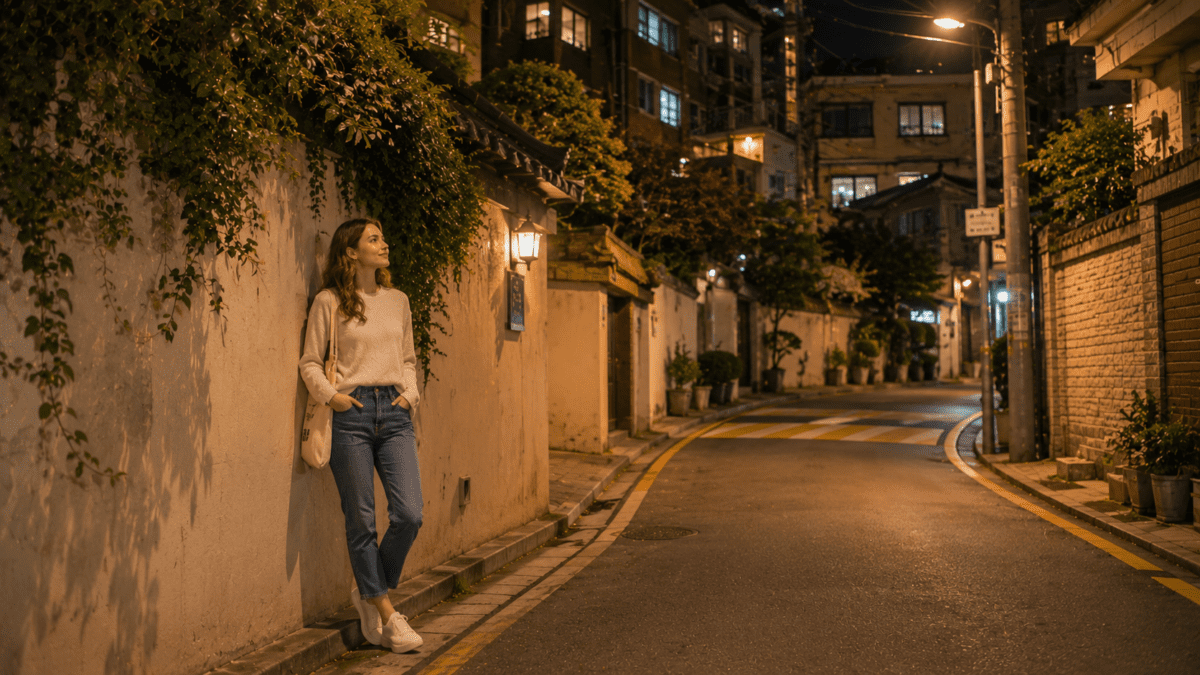
There is a version of a city you only access alone.
With other people, attention is divided — between the city and the group, between what you’re seeing and what you’re saying about what you’re seeing. The group creates its own weather, its own pace, its own priorities. The city becomes backdrop to the social experience rather than the experience itself.
Alone, the city comes forward. You stop when you want to stop, without negotiating. You slow down at the thing that caught your eye without explaining why. You take the longer way back because something about the light at this hour on this particular street is worth the extra ten minutes, and there is no one to convince.
Walking alone in Korea makes this possible in a specific way. It’s not just that the city is safe — many cities are safe. It’s that the city is indifferent in the right way. It doesn’t ask you to perform your solitude, to look purposeful, to justify your presence on the street after dark. You can simply be there, moving at your own pace, thinking your own thoughts, noticing what you notice.
The freedom isn’t dramatic. It doesn’t announce itself. It shows up in the quality of the attention you’re able to pay — to the street, to the evening, to yourself. It shows up in the particular satisfaction of arriving home after an hour alone with the city, having gone nowhere important and returned with something you couldn’t have found any other way.
It also shows up in small calibrations that are invisible when you’re with others. The pace that settles at exactly the speed your body prefers, without compromise. The route that extends itself naturally because you turned left on an impulse and nobody needed to agree. The moment you stop entirely — in front of a building, at the top of a slight rise, at a corner where the light is doing something interesting — and stay as long as you want, which turns out to be longer than you would have stayed if someone else had been waiting.
Some things only surface in solitude. Some cities make solitude feel like a gift rather than a compromise. Walking alone in Korea is both of these things at once — and the city doesn’t ask you to explain which one you came for.
This post was planned and edited by a human, with AI assistance.