
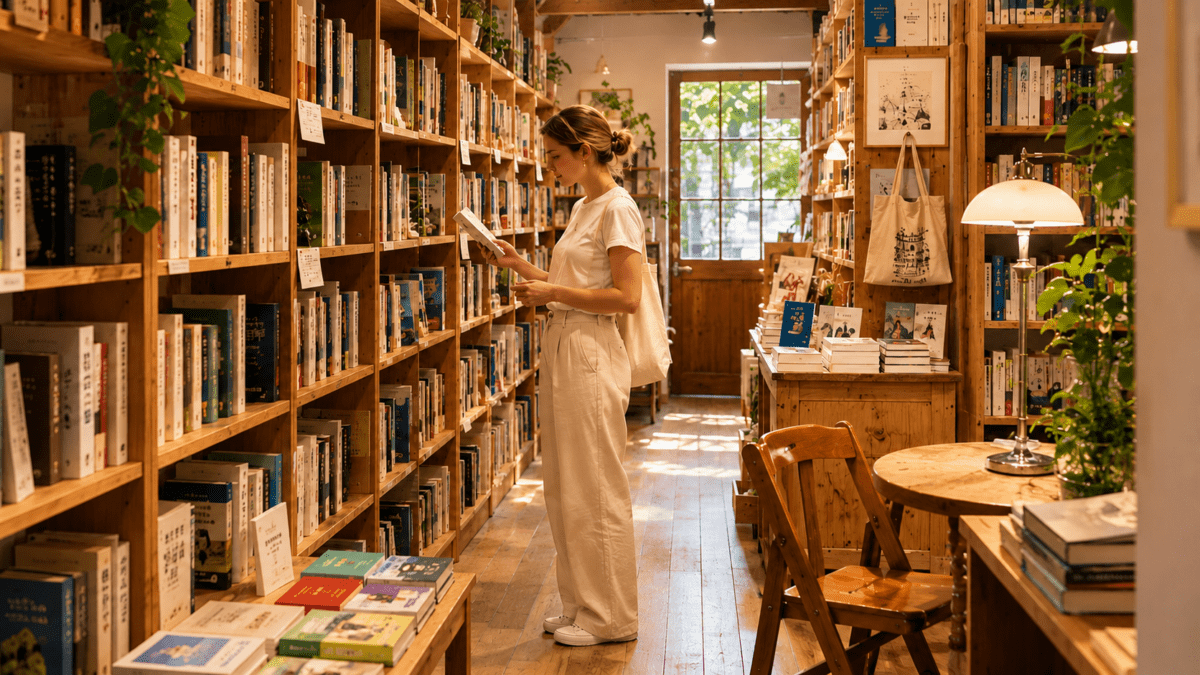
There is a bookstore in Mapo-gu that carries fewer than three hundred titles. The door sticks slightly in summer. Inside, the room is narrow enough that two people have to turn sideways to pass each other, and it smells the way small bookstores smell — paper, dust, the faint sweetness of old glue.
The owner chose every single one.
No algorithm decided the order of the shelves. No sales data determined which books faced outward. No corporate buyer approved the selection. The books on display are there because one person read them, or wanted to read them, or believed someone who walked through the door would need them — and made a judgment call.
This is what the Korean bookstore has been quietly building, one small shop at a time: a different kind of curation, rooted not in data but in discernment. In a country where the large chains still dominate floor space and foot traffic, the small bookstore has carved out something the chains structurally cannot replicate. Not a bigger selection. A more considered one.
Books Chosen by a Human, Not an Algorithm
The large chains are not bad at curation. They are, in fact, very good at it — in the way that any system optimized for scale is good at finding what most people want most of the time.
Kyobo’s bestseller tables are accurate. The recommendations at the front of the store reflect real purchasing patterns. The digital displays are updated in real time based on what is actually selling. If you want to know what Korea is reading right now, the front table of any major branch will tell you within a margin of error.
What it cannot tell you is what you specifically should read next.
That gap — between aggregate data and individual need — is exactly where the Korean bookstore operates. The owner of a small bookstore in Seongsu or Yeonnam or Insadong is not trying to serve everyone. They are trying to serve the particular kind of reader who walks through their particular door. The selection is a hypothesis about who that reader is. And it is a hypothesis made by a person, not a platform.
This is a meaningful distinction in a culture saturated with algorithmic recommendation. Streaming services, shopping platforms, social media feeds — all of them are constantly predicting what you want based on what you have already chosen. The independent bookstore works in the opposite direction. It proposes something you haven’t chosen yet, based on a human judgment about what you might be ready for.
The difference is not just aesthetic. It is structural. An algorithm narrows toward what you already are. A person can point toward what you might become. This is the quiet premise behind independent bookstores in Korea — that a reader is not a data point but a direction.
The Shelf That Tells You About the Owner

Walk into a chain bookstore and you learn what Korea is reading. Walk into an independent bookstore in Korea and you learn who the owner is.
This is not incidental. It is the entire point.
The shelf is a self-portrait. Spines at eye level, a few covers turned outward, one book propped on a small wooden stand near the register because someone wanted you to see it. It reveals taste, obsession, blind spots, enthusiasms.
A shop that carries three shelves of philosophy and one shelf of fiction is telling you something about its owner’s priorities. A shop stacked with translated literature from lesser-known languages is telling you about an orientation toward the world. A shop that organizes books by mood rather than genre is telling you about how the owner actually reads.
The reader who finds the right independent bookstore doesn’t just find books. They find a sensibility that rhymes with their own.
In Korea, this dynamic has produced an extraordinary range of small shops, each with a distinct curatorial identity. Some specialize narrowly — poetry only, or hiking literature, or books about architecture and urbanism. Others are generalist but strongly voiced, their shelves reflecting a coherent worldview even across subjects. A few are organized around a single obsession that the owner pursues across every category they stock.
What they share is the fingerprint of a human intelligence behind the selection. You can feel it in a way you cannot feel the logic of an algorithm. An algorithm explains its choices through similarity. A person explains their choices through meaning — and that is a different thing entirely.
Behind this kind of curation is an older Korean instinct: that clarity often comes not from adding more, but from knowing what stays and what goes. Not everything belongs on the shelf. The act of leaving something out is as deliberate as the act of including it. The three hundred books that made it onto the shelf say as much about the owner as the thousands that didn’t.
Conversations That Start Beyond the Transaction
In a chain bookstore, the interaction with staff is transactional by design. Where is the history section? Do you have this title in stock? Can I return this? The staff are helpful, efficient, and largely invisible as individuals — which is appropriate for a space that serves thousands of people a day.
In an independent bookstore in Korea, something different is possible.
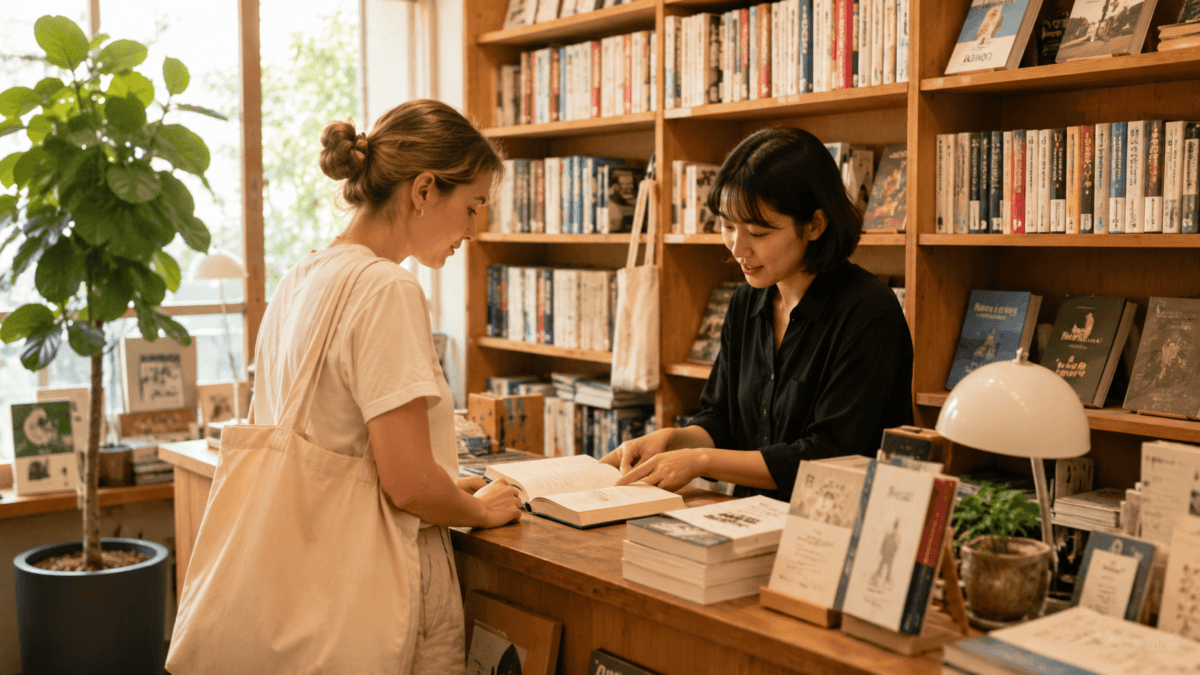
The owner knows the inventory not as a database but as a collection of individual books they have thought about. Ask them about a title and you will often get not just a location but an opinion — why they stocked it, what kind of reader it tends to find, what else it goes well with. The conversation that begins with a book recommendation can go somewhere neither party anticipated.
This is not customer service. It is a conversation between two people who both care about books.
Korean independent bookstore culture has formalized this instinct in interesting ways. Some shops host regular reading groups, not as marketing but as genuine community infrastructure. Others invite readers to leave annotations in store copies — small paper slips tucked into the books with reactions, questions, disagreements. A few have developed regulars who return not primarily to buy but to check in, to see what has changed on the shelves, to find out what the owner has been reading lately.
What gets built over time is something that no chain can manufacture and no platform can simulate. A relationship between a space and its readers that is specific, accumulated, and quietly irreplaceable. It operates on the same principles often cited in studies of thriving independent bookstores: community, curation, and convening — the three core values that have allowed independent bookstores worldwide to survive the arrival of Amazon, and that in Korea have allowed them to do considerably more than survive.
Why Independent Bookstores in Korea Are Surviving
The conventional explanation for the resilience of independent bookstores in Korea is romantic: people love physical books, they value community, they want to support local businesses. All of this is true, but none of it is sufficient.
The more precise answer is that they are surviving because they are doing something the chains structurally cannot do — and something the internet structurally cannot do — which is to offer a curated selection that reflects a specific human sensibility rather than aggregated demand.
In a world of infinite access, scarcity has become a form of value. When every book ever published is theoretically available with two clicks, the act of choosing three hundred titles and presenting them as a coherent collection is a meaningful editorial act. It says: out of everything, these.
The small bookstore is a statement. The chain is a catalog.
This distinction matters more, not less, as the catalog gets larger. The bigger the algorithm’s database, the more overwhelming the choice. The more overwhelming the choice, the more valuable the human who has already done the discernment work and arranged the results on a shelf you can walk along with your hands.
There is also something specific to Korean reading culture in how this is playing out. The appetite for framework — for a selection that reflects a coherent way of seeing rather than a list of what is popular — runs deep here. It shows up in how people approach books in general: not as entertainment consumed and discarded but as investments in a particular way of understanding the world. The Korean bookstore taps into that appetite directly. They don’t just sell books. They offer a perspective. And in a market where perspectives are increasingly rare, that turns out to be exactly what a certain kind of reader is looking for.
Korean independent bookstores are not surviving despite the digital age. They are thriving because of what the digital age has made newly scarce: a selection that someone actually thought about, for a reader who might actually be you.
You notice it on the way out, when the door sticks again and the street noise comes back all at once. Three hundred books behind you, and one of them in your hand.
This post was planned and edited by a human, with AI assistance.