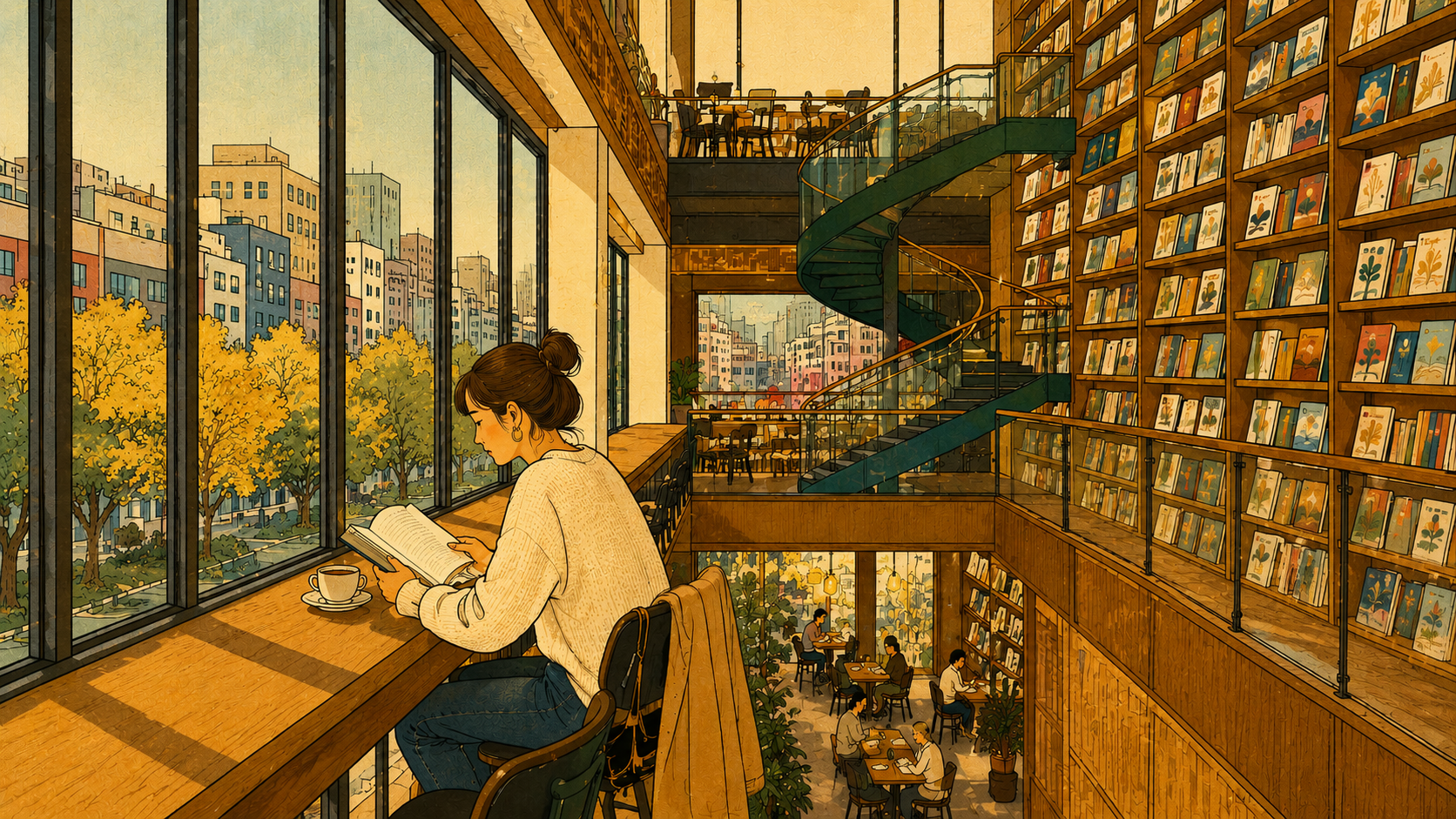

She arrived alone and chose the seat by the window.
Not the one closest to the door. Not the one with the best view of the room. The one where the light came in at an angle, where the table was just wide enough for a coffee and an open book, and where no one would need to pass behind her to get anywhere.
She had been here before. She knew which seat she wanted.
This is how people use Korean book cafés — with the deliberateness of someone who has thought about it. Not as a place to meet, not as a café with books as decoration, but as a specific kind of space designed around a specific kind of solitude: the kind that happens in public, surrounded by other people doing exactly the same thing.
Coffee in One Hand, Silence in the Other

The Korean book café — 북카페 (book-cafe) — is not a recent invention, but in Seoul it has become something more specific over the last decade. The format is simple: coffee, tables, and books that are usually curated, sometimes purchasable, and often available to read during your visit. What is less simple is the way people use the space. They come not to meet, not to work, and not to be seen, but to spend time alone among other people doing exactly the same thing.
The atmosphere of a well-designed Korean book café operates on a different logic than a regular café. In a regular café, the ambient noise is social — fragments of conversations, the sounds of people performing being there. In a book café, the ambient noise is absorbed. People are reading. The sounds that remain are incidental: pages turning, cups being set down, the occasional soft exchange at the counter.
Coffee in one hand, silence in the other. Not literal silence — the kind that holds you at a particular remove from everything that was demanding your attention five minutes ago.
This quality is not accidental. Korean book cafés are designed for it. The seating arrangements tend toward individual tables rather than communal setups. The music, when it exists, is quiet and without lyrics. The lighting is considered — warm enough to read by, soft enough not to feel clinical. The whole environment sends a consistent message: you are here to focus, and we have arranged everything to support that.
Some book cafés take this further. The books themselves are organized not by bestseller rank or genre category but by mood, season, or the owner’s current preoccupation — a shelf labeled “books for when you don’t know what you’re feeling,” another for “slow reads.” The curation is an extension of the atmosphere. It tells you, before you’ve sat down, what kind of attention this place is asking for.
The Seat by the Window and What It Means
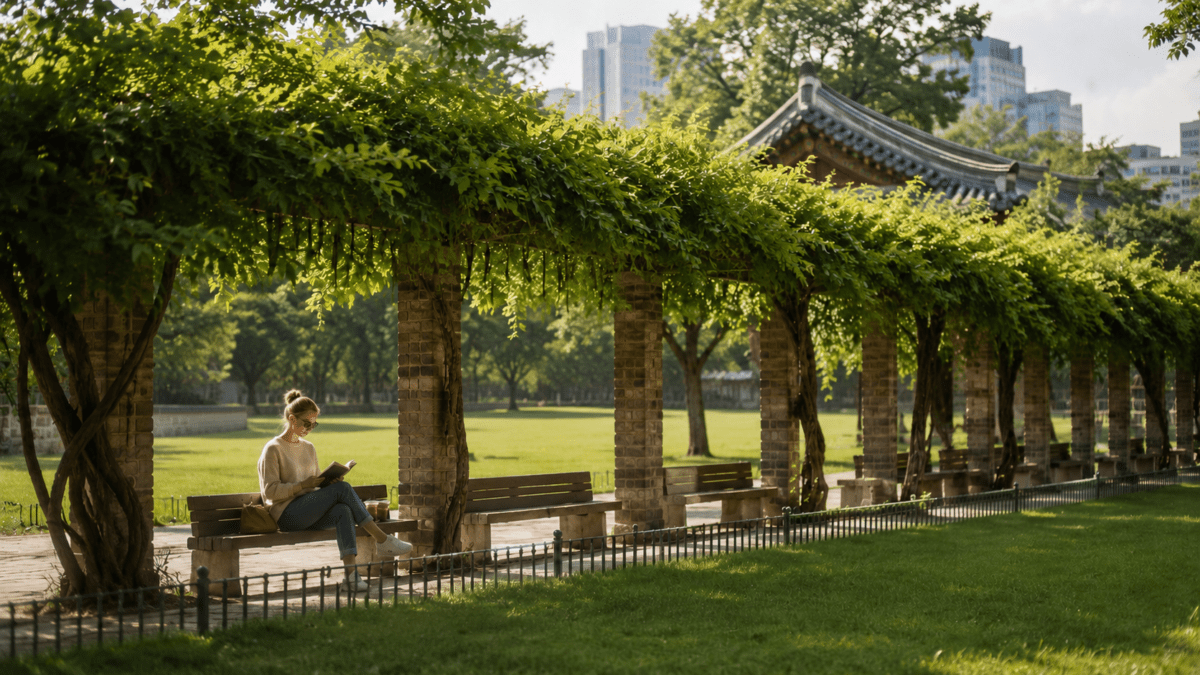
There is a reason the window seat fills up first.
It is not just the light, though the light matters. It is the particular position the window seat offers: facing outward, with the room at your back. You can see the street without being on it. You can watch the city move without being moved by it. You are simultaneously inside and outside — protected by the glass, connected to the world beyond it.
In a city that rarely lets you be a spectator, the window seat is a small act of withdrawal.
Korean book cafés understand this. Many are designed with window seating as the primary offering — long benches along floor-to-ceiling glass, individual stools at narrow shelves, seats positioned to face the street rather than the room. The view is part of the product. Not because the view is always beautiful, but because the act of watching rather than participating is itself a form of rest.
There is something in this that connects to a broader Korean instinct about time and interiority — the understanding that not all productive periods look productive from the outside. The person sitting at the window with a book and a coffee is not avoiding life. They are doing something specific with their attention, something that requires exactly this kind of protected, outward-facing stillness. It is the phase that asks you to go inward — the internal season that the surface world rarely makes room for, but that a well-placed window seat quietly permits.
Together but Not Interrupting
One of the stranger pleasures of a Korean book café is the company.
You are not alone. The space is full, or nearly full, of other people — also reading, also quiet, also turned inward. And yet the presence of these people is not intrusive. It is, in some hard-to-articulate way, supportive. The collective focus creates a kind of ambient permission: everyone here has agreed, implicitly, to the same terms.
Most people know the feeling even if they don’t know the term. Reading alone becomes easier when everyone around you is quietly doing the same thing — the way that working alongside other people, even strangers, even in silence, can make solitary tasks feel easier and more sustainable. The Korean book café has institutionalized this effect without naming it. The result is a space where being alone in public stops feeling like a compromise and starts feeling like a choice — a deliberate, pleasurable one.
You are not lonely. You are solitary. The distinction matters more than it sounds.
Korean culture has historically maintained a complicated relationship with individual solitude. In a society organized around group identity — family, workplace, social circle — being alone can read as a failure of belonging. The book café short-circuits this reading. It provides a socially legible reason to be alone in public: you are reading. You are doing something. The solitude has a container, and the container is accepted.
Over time, this has allowed a different relationship with aloneness to develop — one that is chosen rather than default, purposeful rather than avoidant. The person at the window with a book is not waiting for someone to arrive. They are already where they want to be.
Korean Book Cafés: A New Kind of Social Space
What these spaces have built, without explicitly setting out to, is a new category of social space.
Not a library — too institutional, too quiet, too rule-governed. Not a regular café — too loud, too transactional, too socially pressured. Not a bookstore — too commercial, too oriented toward purchasing decisions. Something in between all of these, with the best qualities of each and the worst of none.
The social contract of the book café is unusually clear. You may stay as long as your drink lasts, sometimes longer. You may read without buying. You may sit in silence without explanation. You may be alone without it meaning anything about you. In exchange, you observe the same courtesy toward others: you keep your voice low, your phone silent, your presence unobtrusive.
This contract is never written down. It is transmitted through the design of the space, the behavior of the staff, and the example of the other people already sitting there when you arrive. Within a few minutes of entering, every new visitor has absorbed it.
The book café works because everyone inside has agreed to the same unspoken terms — and because those terms ask very little while offering quite a lot.
Korean book cafés have become, in this way, one of the few truly democratic spaces in a city that otherwise segments its population aggressively by age, income, and social role. At a window table in Mapo or Seongsu or Hongdae, a university student and a woman in her fifties and a freelancer between projects can all be doing exactly the same thing, in exactly the same way, without it being strange. The book and the coffee are the common language. The silence is the common ground.
What makes this durable is not the format but the feeling it produces. People return to the same book café the way they return to a particular walking route or a particular hour of the morning — because the space reliably delivers a state of mind they can’t easily manufacture elsewhere.
Some regulars don’t even look around when they arrive. They order the same drink, walk to the same seat by the same window, and open the book they left unfinished the week before. The ritual is small, but that is precisely why it matters.
In a city as dense and demanding as Seoul, that reliability is worth more than convenience. It is worth the detour. It is worth the wait for the window seat. It is worth coming back for.
This post was planned and edited by a human, with AI assistance.