
The bookstore was the beginning.
She found it on a Saturday morning — not looking for anything in particular, just following the habit that had developed over months of weekend mornings in Seoul. She walked in, spent an hour, left with two books. One she read that afternoon. The other sat on the nightstand for three weeks before she picked it up.
When she finally did, she read it slowly. Not because it was difficult. Because something about it made her want to stay.
This is Korean reading practice at its most honest — not speed, not volume, not the optimized consumption of information. The willingness to stay with a book until it gives up what it actually has.
Why Reading Once Is Never Enough
Most reading happens at the speed of comprehension.
The eye moves across the line. The argument is understood, the image registered, the emotion noted. The page turns. By the end of the chapter, something has been taken in — but the taking-in happens fast, and what happens fast tends to leave fast.
Korean reading culture has long understood something that productivity-oriented readers miss: comprehension and absorption are not the same thing. You can understand a sentence in three seconds. Letting it change how you think — how you see, how you move through the world — takes considerably longer.
This is why the most serious readers return. Not to the bookstore, though that happens too. They return to the text. The book that moved them gets read again. The passage that stopped them gets read more slowly the second time. The idea that arrived sideways gets followed back to its source.
There is a word in Korean reading culture for this kind of return: 정독 (jeong-dok) — careful, deliberate reading. Not skimming for content, not reading for plot. Reading in order to understand fully, which sometimes means reading the same paragraph four times until it gives up what it was holding back. The word implies patience, but it also implies trust — trust that the text has more to offer than the first pass revealed. Korean readers who practice this don’t think of rereading as inefficiency. They think of it as the reading that actually counts.
Korean reading practice, at its most developed, is a practice of return. The first reading opens the door. Everything after that is entering.
A book read once is a book you have visited. A book read twice is a book you have begun to know.
What Slow Reading Actually Feels Like

There is a specific quality of attention that slow reading produces.
It isn’t the focused attention of someone working through a difficult argument, following the logic step by step, making sure nothing is missed. That kind of attention is effortful — directed, purposeful, slightly tense. Slow reading produces something different: a relaxed attentiveness, a willingness to be surprised by a sentence you thought you already understood.
The reader who slows down begins to notice things. The rhythm of a paragraph. The word that was chosen over a simpler one. The sentence that does something unexpected at its end. These details are present in fast reading too — but they pass too quickly to register. At slow reading speed, they surface.
The text stops being something you move through and becomes something you inhabit.
This is what Korean readers who take their practice seriously describe. Not a technique. An experience. The book that once felt complete on first reading reveals itself as partial — an invitation to return, to look again, to find what was there all along but moving too fast to catch.
Slow reading is also, notably, a different relationship with time. The reader who allows an hour for fifty pages is making a claim: this is worth more than efficient processing. This deserves presence. In a culture that measures reading by books-per-year and highlights-per-chapter, that claim is its own small act of resistance.
The Reader Who Keeps Coming Back

There is a particular kind of reader in Korean bookstores and book cafés.
Not the browser — though browsers are welcome, and Korean reading culture has always made room for them. Not the student building a reading list for practical purposes. The reader who keeps coming back is something else: someone who has developed a relationship with books that goes beyond acquisition or information.
They return to the same authors. They reread. They sit with a book in a café not to finish it but to spend time with it — to be in its presence, the way you might sit with a person whose company you value without needing the conversation to go anywhere in particular.
This reader is not unusual in Korea. The infrastructure exists for them — the bookstores that hold space for browsing, the independent shops where the owner has read everything on the shelf, the book cafés where staying for two hours on a single americano is not just tolerated but expected. The culture has built room for the reader who takes their time.
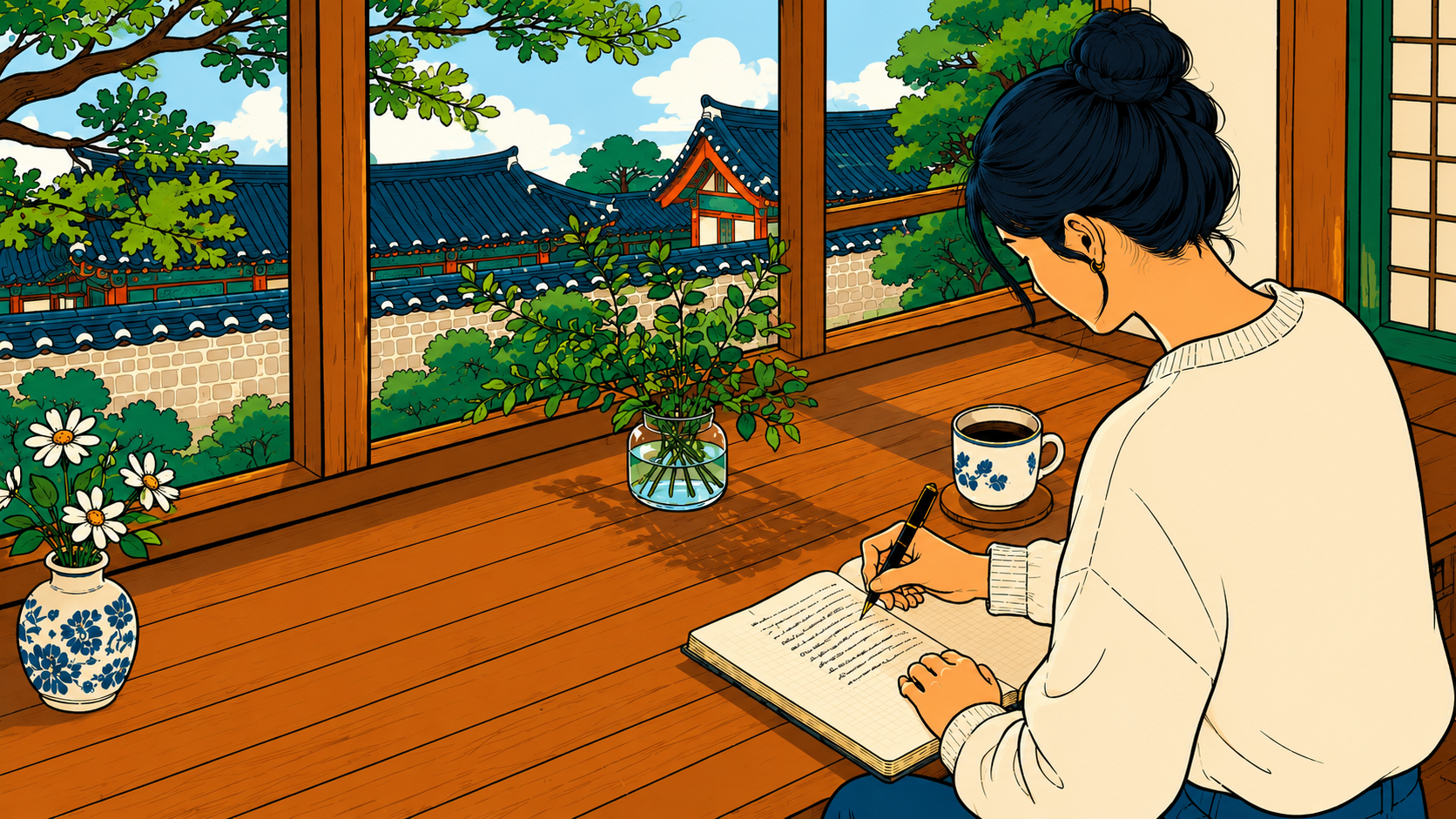
On a Tuesday afternoon in a book café in Seongsu, a woman in her thirties has been at the same table for ninety minutes. The coffee is long finished. The book is the same one she was reading last week — she left a bookmark at page 84 and has moved it to page 106 today. She is not trying to finish it. She is not behind on anything. She is simply continuing a relationship with a text that has been unfolding across several weeks, in the same chair, at the same hour, with the same quality of attention. Nobody finds this unusual. The café was designed for exactly this. The book was written for exactly this kind of reader.
What accumulates for this reader is difficult to measure and easy to feel. A way of moving through language that has been shaped by years of returning — to books, to sentences, to the specific quality of attention that reading slowly, in a space designed for it, produces.
The books change. The practice stays.
Korean Reading Culture and the Practice of Return
The series began with a bookstore full of people on a weekend morning.
It passed through Kyobo, where a commercial space became something closer to a public square. Through independent bookstores where a single curated shelf said more than an algorithm could. Through book cafés where solitary reading in public became not just possible but natural.
What connects all of these is the same logic: Korean reading culture makes room for the reader who wants to stay.
Stay in the bookstore without buying. Stay in the café long after the coffee is finished. Stay with a book through a second reading, a third, until it gives up what it has. The infrastructure — physical, social, commercial — has been built around this particular kind of reader. The one who takes time seriously. Who treats a book as something to return to rather than something to get through.
The reader who keeps coming back is not a type. They are a practice. And the practice, repeated over years, produces something that no reading list or annual total can capture — a relationship with language that is, in the end, a relationship with attention itself.
What Korean reading culture has quietly understood is that the conditions for this kind of reading have to be built and maintained. They don’t arise naturally in a city running at Seoul’s pace. They require spaces that protect a particular quality of time — bookstores that don’t rush you, cafés that don’t watch the clock, shelves curated by someone who read the books before putting them out. The infrastructure is the culture. Remove it and what remains is just another city where people read on their phones on the subway and forget what they read by the time they arrive.
The bookstore. The table. The window seat. The book left open at the same page for a week. These are not incidental details. They are the architecture of a particular way of being with language — one that Korea has built, maintained, and kept returning to. The reader who arrives at the bookstore on a Saturday morning is not just choosing how to spend a few hours. They are participating in something that has been quietly accumulating for generations. And when they leave — sometimes with a book, sometimes without — the practice continues.
Korean reading culture, at its best, is about this. Not how much you read. How fully you arrive.
This post was planned and edited by a human, with AI assistance.