
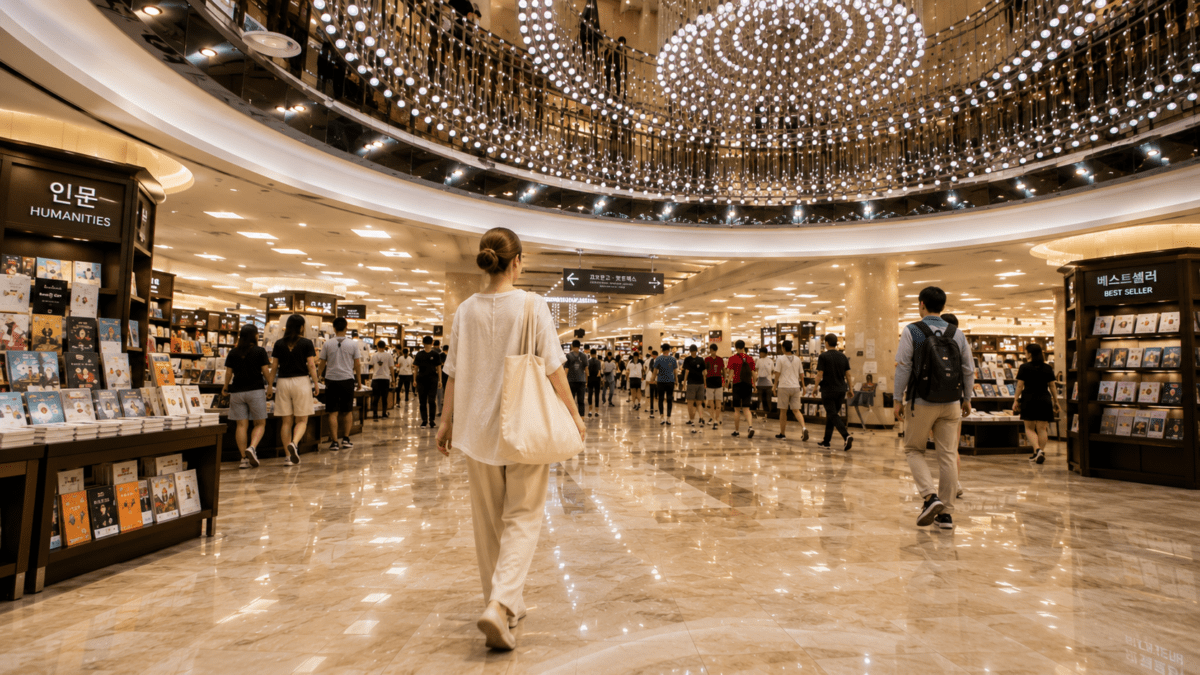
There is a moment, just after the escalator deposits you into the basement of Kyobo Bookstore in Gwanghwamun, when the city above stops mattering.
Not because it disappears. Because something else takes over.
The air is different down here — slightly cooler, quieter in a particular way that has nothing to do with volume. People are talking, music is playing softly somewhere, the space is full. But the texture of the noise is different from the street. It doesn’t demand anything. It sits underneath everything rather than pressing against it.
This is Kyobo Bookstore Seoul at its most ordinary — and its most precise. A basement beneath one of the busiest intersections in the country, somehow operating on a completely different frequency. The city above runs on urgency. The space below runs on something else entirely.
Descending Into a Different Pace
Gwanghwamun is not a quiet part of Seoul. It sits at the intersection of government, finance, and history — ministries and corporate headquarters and the long axis of the old royal palace all converging within a few blocks. The surface pace is what you’d expect from that combination: deliberate, pressured, moving.
Then you go underground.
The descent into Kyobo takes less than a minute. Escalator or stairs, a short corridor, and the space opens. 9,000 square meters of floor, 2.3 million volumes, and — somehow — a quality of slowness that the street above doesn’t have and can’t manufacture.
The people inside are doing the same things they were doing ten minutes ago on the surface. The difference is what the space asks of them.
On the street, Gwanghwamun asks you to move, to transact, to be going somewhere. In the bookstore, nothing is asked. You can stand in front of a shelf for twenty minutes reading the back covers of books you will never buy. No one will notice. No one will mind. The space absorbs that kind of behavior completely, as if it were designed for exactly this — which, in a meaningful sense, it was.
Kyobo Bookstore Seoul opened in 1981 not as a typical retail space but as a public cultural institution. That original intention never fully left. It shows in the proportions — the wide aisles, the generous lighting, the communal reading tables that seat a hundred people at once. It shows in the staff, who are present but not hovering. And it shows in the visitors, who have understood for forty years that this is a place where time moves differently.
What the descent actually does is remove a layer. The obligations of the surface — the pace, the posture, the constant low-level awareness of being seen and evaluated — don’t follow you down. By the time you reach the floor, something has already shifted. You are still in the middle of Seoul. You are no longer quite inside it.
A Retail Space That Became a Public Square
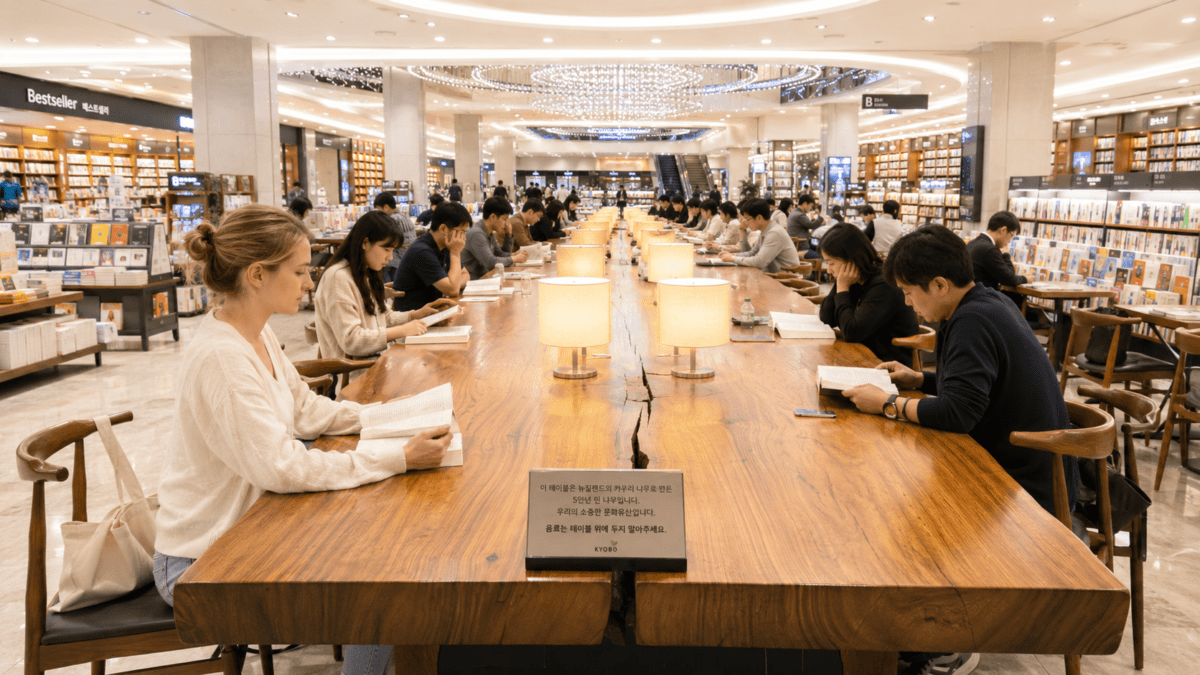
The communal reading table at the center of the Gwanghwamun branch is made from a single Kauri tree, roughly 50,000 years old, sourced from New Zealand. It seats a hundred people. On any given weekend, it is full.
This is not incidental. When Kyobo renovated, the decision was made to remove bookshelves to make room for more seating. In retail terms, this is counterintuitive — less inventory display, less opportunity for browsing-to-purchase conversion. In cultural terms, it is exactly right.
What Kyobo understood is that the table is the product.
Not the books sold at it. Not the coffee from the adjacent café. The experience of sitting at a hundred-person table in the middle of a city, surrounded by strangers who are also reading, also thinking, also temporarily released from the obligation to produce — that is what people come for. The books are the occasion. The table is the point.
Seoul has relatively few spaces that function this way. Parks require weather. Cafés require purchases and have implicit time limits. Libraries carry a specific institutional weight that not everyone wants. Kyobo Bookstore Seoul sits in a different category — public in its access, private in its atmosphere, commercial in its structure but cultural in its actual operation.
People use it the way other cities use plazas. As a place to simply be. To arrive without agenda and leave without guilt. The table holds all of this without commentary, without managing it, without asking anyone to perform a version of themselves that the space requires.
The Culture of Browsing Without Pressure
There is a Korean word that started online — 눈팅 (noon-ting) — for looking at something without participating. Browsing online without buying. Watching without commenting. Being present without committing.
In most commercial spaces, this behavior is tolerated but not welcomed. The architecture works against it: narrow aisles, attentive staff, checkout counters positioned to catch browsers on their way out. The message is clear even when unspoken.
Kyobo Bookstore Seoul is architecturally designed for 눈팅. The aisles are wide enough to stand in comfortably while someone passes behind you. The shelving heights are calibrated so you can see across sections. The lighting is even and unhurried. Nothing about the physical space pushes you toward a decision.
You are allowed to look without choosing. You are allowed to stay without buying. You are allowed to think.
This tolerance for uncommitted presence is rarer than it appears. Most commercial spaces in Seoul — like most commercial spaces anywhere — are optimized for throughput. Kyobo operates on a different logic: that a visitor who comes twenty times and buys nothing is building a relationship that will eventually convert, and that the relationship itself has value independent of conversion.
There is something in this that mirrors how people approach their own interior lives when the pressure briefly lifts. The instinct to consolidate rather than expand. To absorb rather than produce. There is an older Korean understanding that the periods which look like stillness from the outside are often the ones doing the most structural work — the seasons when the ground is being prepared rather than harvested. Kyobo, without intending to, holds that kind of time. It makes room for the internal work that the surface city has no patience for.
Whether or not this is consciously articulated, it is how the space functions. And it is why, four decades after opening, Kyobo Bookstore Seoul continues to fill up every weekend with people who have no particular intention of leaving with a bag.
How Kyobo Bookstore Seoul Becomes a Landmark

Landmarks are usually made from stone, height, or age. They mark themselves against the skyline or against history. Kyobo Bookstore Seoul is underground, unremarkable from the street, and operates inside a building that is primarily known as the headquarters of an insurance company.
And yet it is, without question, a landmark.
Not in the tourist sense — though tourists do visit, and do find it worth visiting. In the civic sense. The kind of landmark that a city’s residents use to orient themselves, to meet, to mark time. I’ll meet you at Kyobo. A sentence that needs no further address, no further specification. Everyone knows where it is and, more importantly, everyone knows what it means to be there.
What Korean reading culture has built at Kyobo is something that most cities struggle to produce by design: a space that belongs to everyone without being owned by anyone’s agenda. The brand is present but not intrusive. The commerce is real but not the point. The result is a kind of civic neutrality — a place where a student and an executive and a retired teacher can all be doing the same thing at the same table without it being strange.
That quality — the quality of a space that absorbs difference and asks nothing in return — is what turns a bookstore into a landmark. It cannot be designed from scratch. It accumulates over time, visit by visit, decade by decade, as a city slowly learns that a particular place can be trusted to remain what it is.
Kyobo Bookstore Seoul has earned that trust. And it is why, in a city that changes as fast as Seoul changes, this basement has stayed exactly where it is — doing exactly what it has always done — for more than forty years.
This post was planned and edited by a human, with AI assistance.