
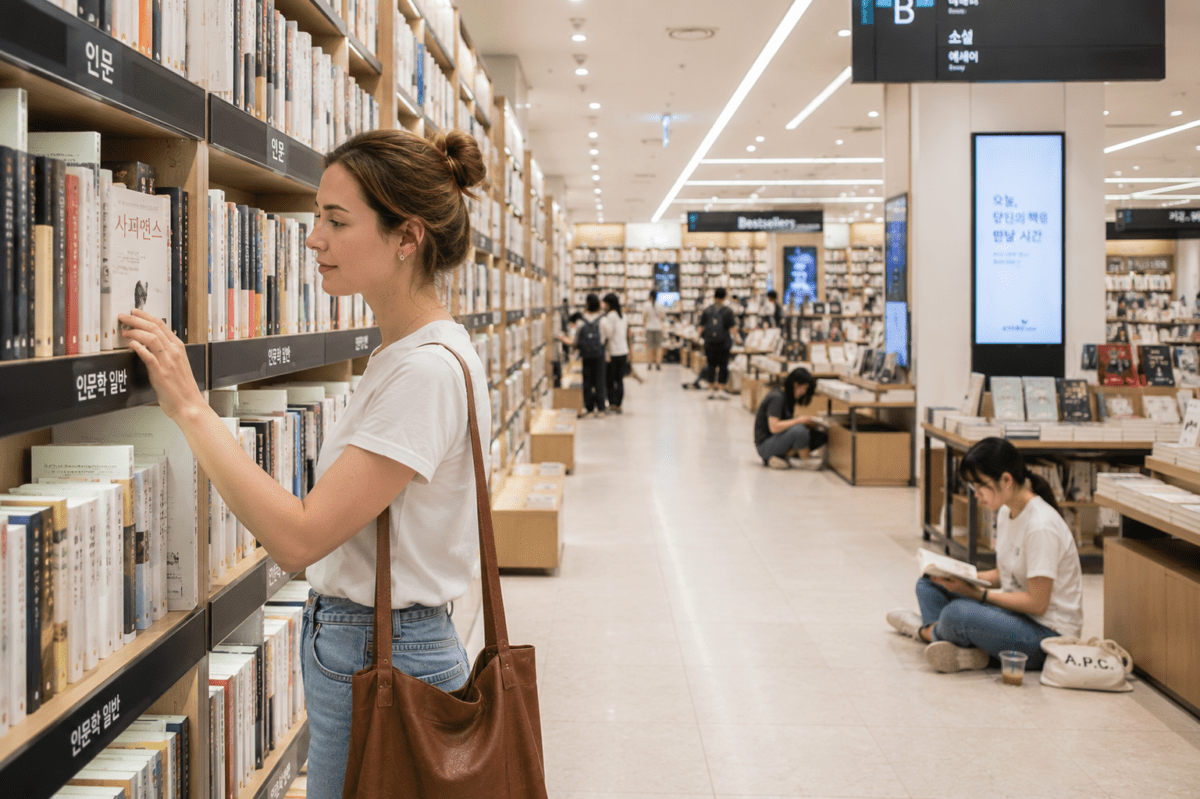
On a Saturday morning in Seoul, the basement of a large bookstore is already full. Not with tourists. Not with people waiting for somewhere else to open. Just people — browsing slowly, sitting on the floor in the aisles, holding books they haven’t decided to buy yet.
No one seems to be in a hurry.
This is what Korean bookstores make possible in their most ordinary form. Not a trend, not an aesthetic — a habit that has quietly outlasted the digital disruption that hollowed out bookstores in much of the world. In the United States and much of Europe, the story of the last two decades has been one of closures: independent stores disappearing first, then the chains contracting, then the chains disappearing too. In Korea, the story unfolded differently. Bookstores proved more resilient than many expected. Some held their ground. Others grew. New stores appeared in neighborhoods that hadn’t had one before.
The question worth asking is not whether this is real. It clearly is. The question is what sustains it — and what it says about the people who keep showing up.
Korean Reading Culture: Weekend Mornings at the Bookstore
The scene repeats across Korean bookstores every weekend. At Kyobo in Gwanghwamun, at the smaller independents tucked into Mapo and Seongsu — people arrive early and stay longer than any transaction requires.
They don’t behave like shoppers. They behave like readers.
A man in his fifties stands in the history section, turning pages slowly, checking nothing on his phone. Two women in their late twenties sit cross-legged in the self-help aisle, each absorbed in a different book. A teenager with headphones on reads a graphic novel cover to cover without buying it. A couple moves through the travel section together but separately, each pulling things off the shelf, reading a paragraph, returning it without comment.
The staff don’t ask if anyone needs help. The other customers don’t mind the crowding. There is no ambient pressure moving people toward the exit.
This is a space designed for exactly this kind of stillness — and everyone inside understands it without being told.
Korean bookstores operate on an unspoken agreement: you are welcome to stay. What’s remarkable is not that the agreement exists, but that it holds at scale, across chains and independents alike, year after year. It persists not because it’s enforced but because it’s understood — absorbed into the rhythm of how people here spend their free time.
What draws people back, weekend after weekend, is not the inventory. It’s the feeling of being inside a place that doesn’t need anything from you.
Reading as a Form of Self-Investment
In Korea, reading carries a specific cultural weight. It is not simply leisure — it sits closer to self-development, to the deliberate act of building something inside yourself that won’t show up immediately but will eventually matter.
This framing shapes what people read and why.
The bestseller lists lean heavily toward practical philosophy, psychology, and essays that examine how to live. Business books that elsewhere promise shortcuts here tend to be the ones about patience, craft, and long-term thinking. There is a cultural appetite not just for information but for framework — ways of understanding why things happen and how to move through them better. A book that reframes how you see a problem is valued more than one that simply solves it.
What matters is not simply collecting information, but finding a structure that helps make sense of where you are.
This is not unique to Korea, but in Korea it runs unusually deep. Reading is something people talk about doing the way others talk about working out — as maintenance, as investment, as the thing you do to stay functional over the long run. Reading is often framed less as an escape from responsibility than as a way of preparing for it. The value lies not in stepping away from life, but in returning to it with a clearer perspective.
Korean reading culture carries this assumption quietly. It doesn’t announce itself as self-improvement — it just behaves that way. People carry books in their bags not as props but as ongoing projects. A chapter on the subway. A paragraph before bed. The accumulation of small reading sessions that add up, over years, to a particular way of seeing.
There is an older Korean instinct behind how many people approach self-understanding: that knowing where you are matters more than knowing what you are. The season shapes what is possible. Your position determines what the effort is actually for.
That instinct runs quietly through Korean reading culture. A book is rarely treated as an escape from the present. More often, it becomes a way of understanding the moment you are already living through — a way of reading your own timing.
That is a meaningful distinction in a culture where the pressure to perform is high and constant. Reading becomes the one place where the pressure briefly pauses — where input is valued over output. Where absorbing something slowly is not laziness but practice.
Browsing Without Buying — and That’s Fine
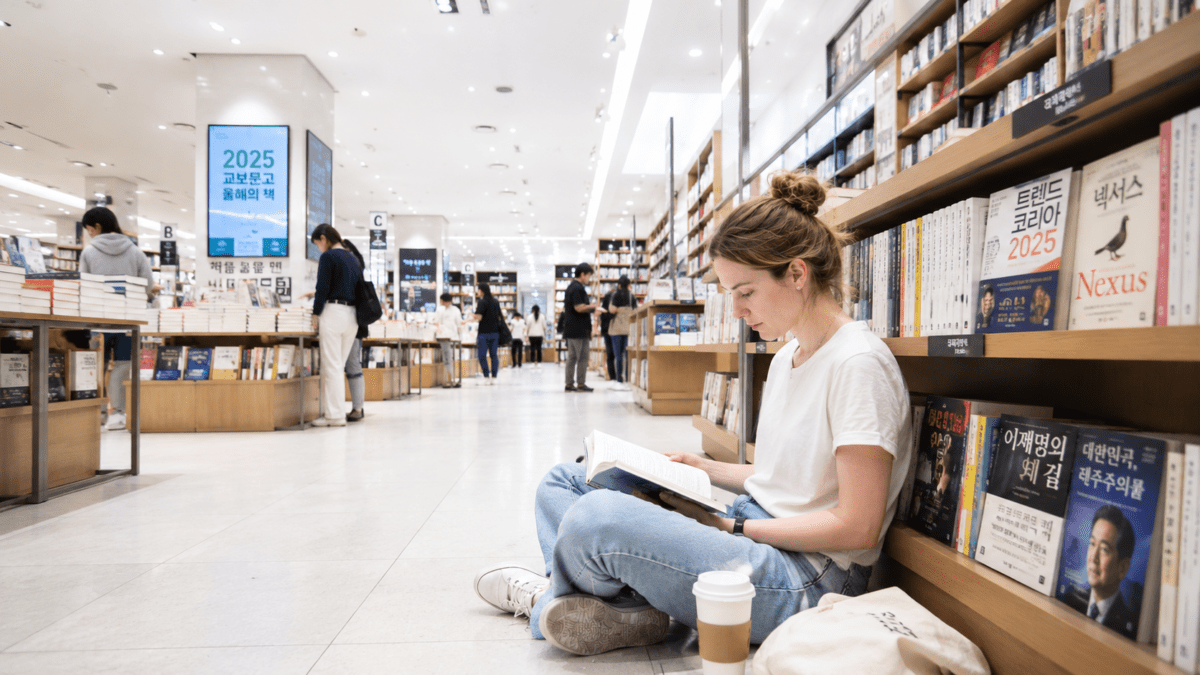
Most people who spend a Saturday morning in a Korean bookstore leave without a bag.
This would register as a failure in most retail contexts. In Korea, it’s simply how bookstores work.
Browsing is its own activity. It is not a preliminary to purchasing. It is the thing itself — an hour of handling books, reading first chapters, absorbing cover design and table of contents before returning the book to the shelf and moving on. No guilt attaches to this. No one is monitoring the ratio of browsers to buyers and adjusting the environment accordingly.
This creates a strange kind of generosity in the space. Because the bookstore is not aggressively optimizing for conversion, it becomes genuinely comfortable to occupy. The chairs are real chairs. The floors are carpeted. The lighting is considered. You are not being moved toward a register.
What’s built here is something more durable than a single transaction: familiarity, loyalty, a felt sense that this store is a place you belong. Which means you return — sometimes to buy, often just to be there. And the returns accumulate into a relationship with the space that no algorithm has yet managed to replicate.
There is a parallel in how people approach self-understanding. What actually works looks nothing like the template — not the curated routine, not the optimized habit, but the practice that fits your actual rhythm. A bookstore that lets you browse without pressure understands this instinctively. So does a reader who returns without needing a reason.
When the Bookstore Becomes the Destination
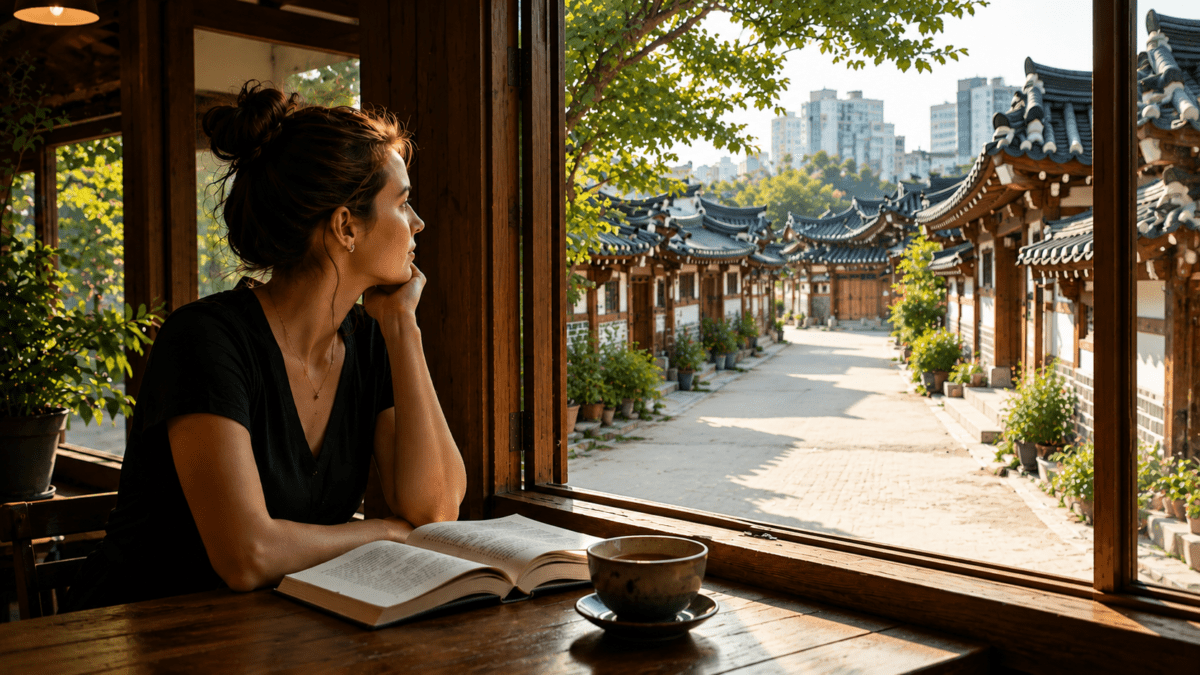
The more interesting question is not why people engage with books this way despite having access to everything online. It is why the bookstore has become, for many Koreans, a destination in itself.
Not a means to an end. The end.
Weekend plans in Seoul regularly include a bookstore visit the way they might include a café or a walk. People meet friends there. They go alone on purpose. They factor in time to sit, to wander, to stay longer than intended. The bookstore appears in conversations about how someone spent their weekend not as an errand that got completed but as a thing that was genuinely done.
The bookstore is one of the few public spaces in a dense, fast-moving city where nothing is expected of you.
No consumption minimum. No time limit. No social obligation to perform engagement or look like you’re having a good time. You can sit in silence next to strangers for an hour and it reads as completely normal — even pleasant. In a city where most public spaces carry an implicit pressure to transact, this is rarer than it sounds.
What Korean bookstores protect, more than anything, is a particular quality of attention. The kind that doesn’t fragment. The kind that follows a single thread for an hour without checking whether anything more urgent has appeared. In a city as connected and fast-moving as Seoul, that quality of attention doesn’t arise naturally — it has to be sought out, and held deliberately.
The bookstore is one of the places people go to hold it.
At its core, Korean reading culture is about permission. The permission to slow down in a culture that rarely grants it. The permission to absorb something without immediately producing anything in return. The permission to be in the middle of something — a book, a thought, a Saturday — without rushing toward the end of it.
The bookstore doesn’t cause this. It holds it. It is one of the few physical spaces designed, consciously or not, around the idea that presence itself has value. And people keep showing up because that kind of space is rarer than it should be — and because, once found, it is very hard to give up.
This post was planned and edited by a human, with AI assistance.