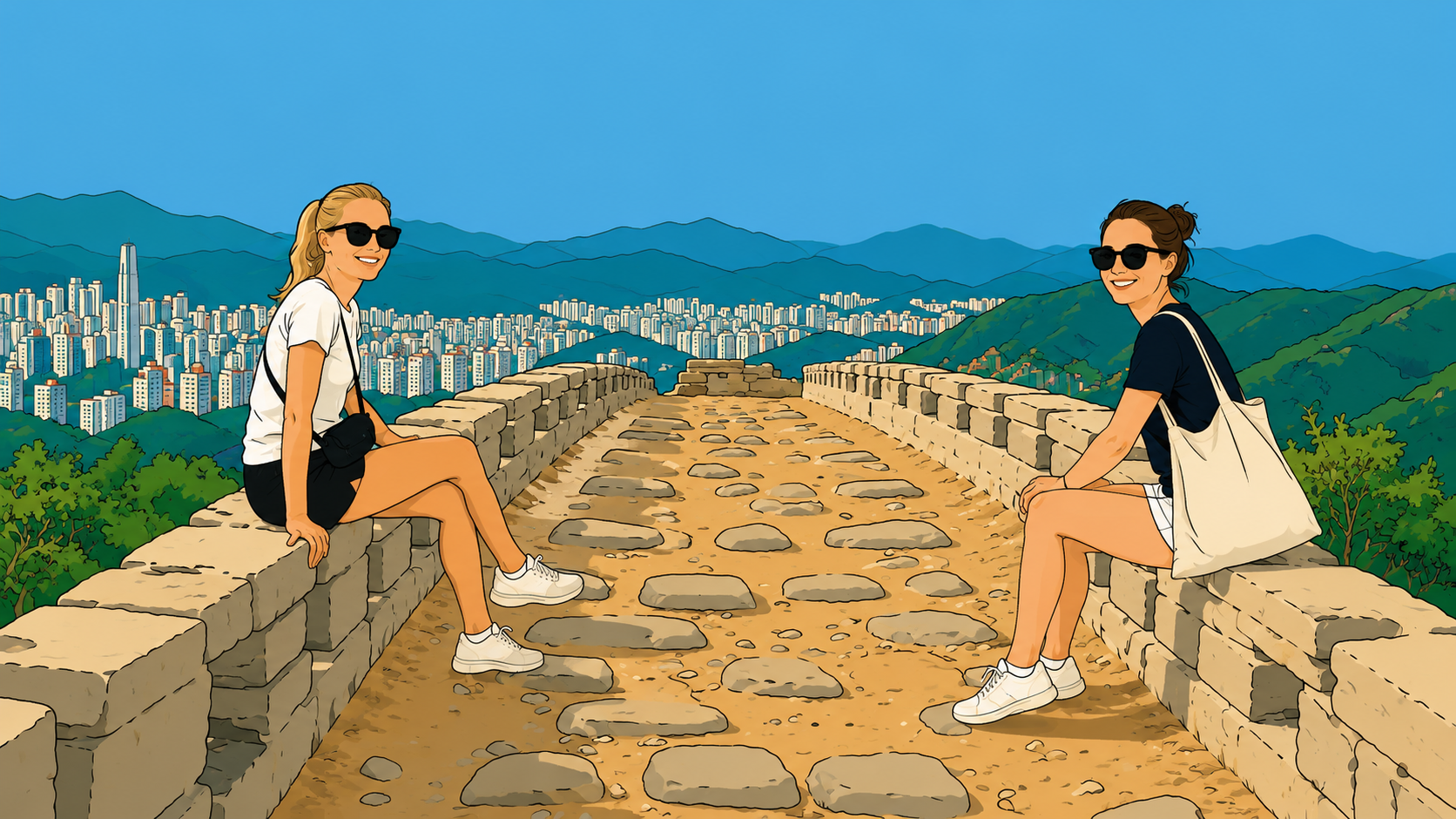
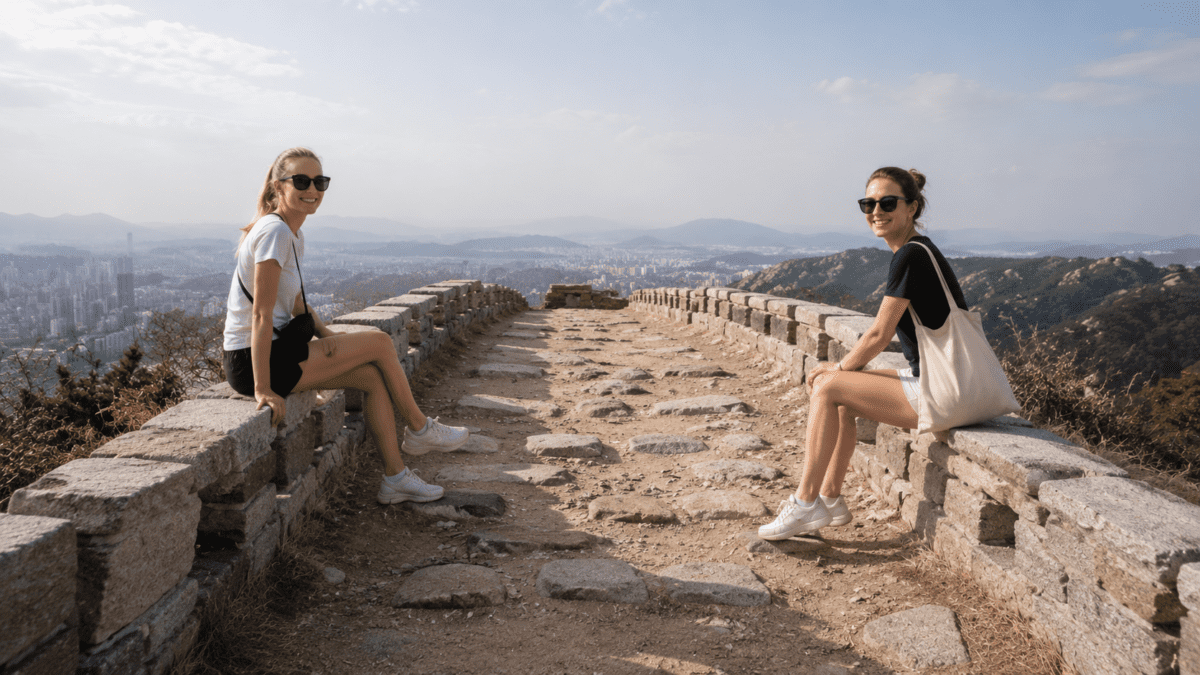
Most people who visit Seoul walk past it without knowing what it is.
A stone wall appears between apartment buildings in Naksan. It climbs a ridge behind a café in Bugak. It runs along the edge of a park near Namsan Tower, half-hidden by trees. Tourists photograph it as background. Locals pass it on their commute. Almost nobody stops to ask the obvious question.
Where does it go?
It goes all the way around. The Seoul city wall walk — 18.6 kilometers of stone, four mountains, one unbroken loop — has been here the whole time.
That’s not a metaphor. The wall forms a complete loop — 18.6 kilometers of stone moving across four mountains, descending through neighborhoods, crossing roads, and returning to where it started. You can stand at any point on the circuit and, if you follow the wall in either direction without stopping, eventually arrive back at the same spot. In a city that has rebuilt itself repeatedly over the past century, this continuity is the strangest thing about it.
The Wall That Didn’t Stop
Seoul has a city wall. Koreans call the full circuit Sunseong-gil (순성길) — literally, the path that circles the fortress. Not a ruin, not a museum exhibit — a continuous stone fortification that circles the original capital, 18.6 kilometers, unbroken except where the Japanese dismantled sections during the colonial period and where roads cut through.
It was built in 1396. Within a few years of King Taejo establishing Hanyang — the city that became Seoul — workers raised this wall across four mountains in two 49-day bursts, one in spring and one in autumn of that year. The stone still reads the layers: rough-cut blocks from the Joseon period sit next to tighter, more uniform cuts from later restorations. You can see the centuries in the masonry if you know to look.
Most city walls in the world exist in fragments. Rome has stretches. Xi’an has a preserved rectangle. York has gaps. Seoul has a loop — one you can walk start to finish, inside a capital city of ten million people, for free. The Seoul city wall walk is, in that sense, something that shouldn’t exist. A complete circuit around a living capital. Still there. Still walkable.
That detail alone makes it strange. The fact that almost no one outside Korea knows about it makes it stranger.
Four Mountains, One Circuit
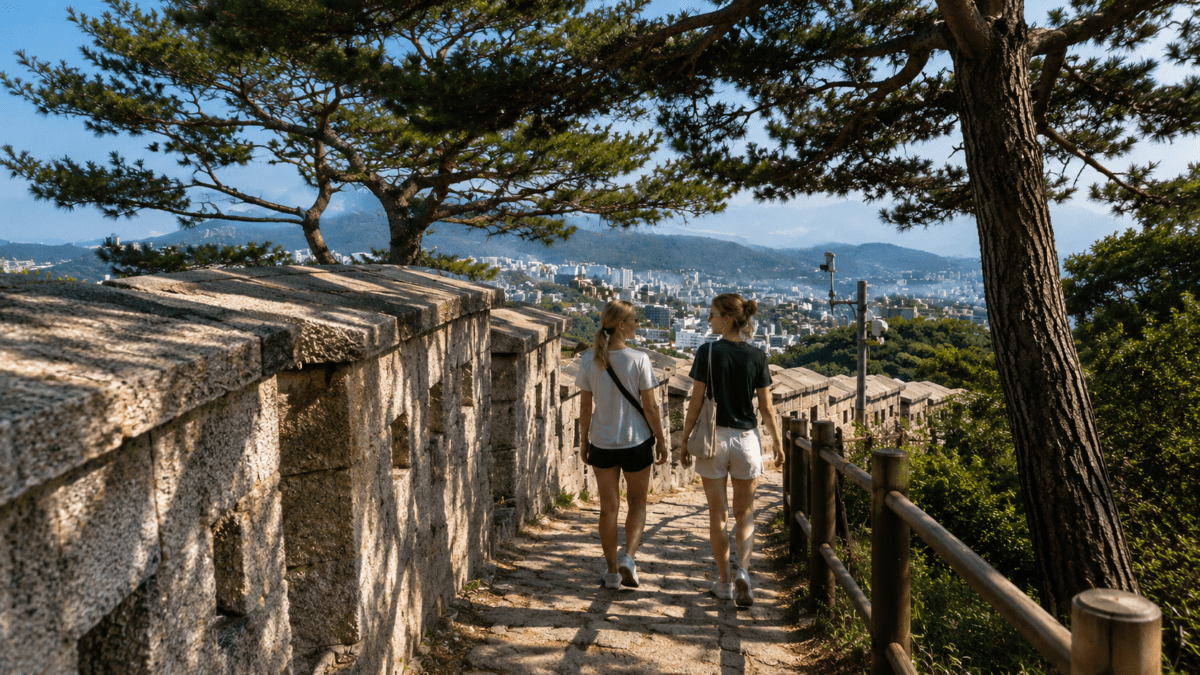
The wall doesn’t follow flat ground. It was built along the four inner mountains of Seoul — the natural ridgelines that gave defenders a view and gave the city its shape. To understand why these mountains were chosen, the logic goes deeper than defense. They were not chosen randomly. Together they reveal how the city understood protection, movement, and balance long before modern urban planning existed.
Four mountains. Four sections. Each one different enough that the walk never feels like repetition.
Naksan (낙산, 125m) — the easiest entry. A low hill in the middle of the city, the wall here runs between rooftop bars and old hanok neighborhoods. You can see both at once: Dongdaemun’s glass and steel to one side, century-old tile roofs to the other. First-timers often start here. The transition happens fast — one block you’re in a convenience store neighborhood, the next you’re on a stone path that’s been here for six centuries.
Namsan (남산, 270m) — the most visited. N Seoul Tower sits at the top, which means this section draws crowds. But walk it at dawn before the cable car opens and the wall is almost empty, the city below still lit from the night before. The stones here are worn smoother than anywhere else on the circuit. More feet, more years.
Bugaksan (북악산, 342m) — the highest and the most restricted until recently. This mountain sits directly behind Cheongwadae, the former presidential residence. Access was closed for forty years after a 1968 North Korean commando raid attempt. A pine tree on this section still carries fifteen bullet holes from that night. The wall here feels different — quieter, less worn, the stone more intact. Like it was preserved by the restriction itself.
Inwangsan (인왕산, 338m) — the most dramatic. Granite boulders the size of houses, shamanist shrines tucked into rock faces, the wall threading between formations that look like they belong somewhere much more remote. This section surprises people every time. It’s the one they don’t see coming, even after the other three.
Each mountain contributes something the others don’t. That’s not accidental — the wall was designed to follow the natural logic of the terrain, and the terrain here is genuinely varied. The Seoul city wall walk is four different experiences stitched into one unbroken line.
What This Walk Actually Is
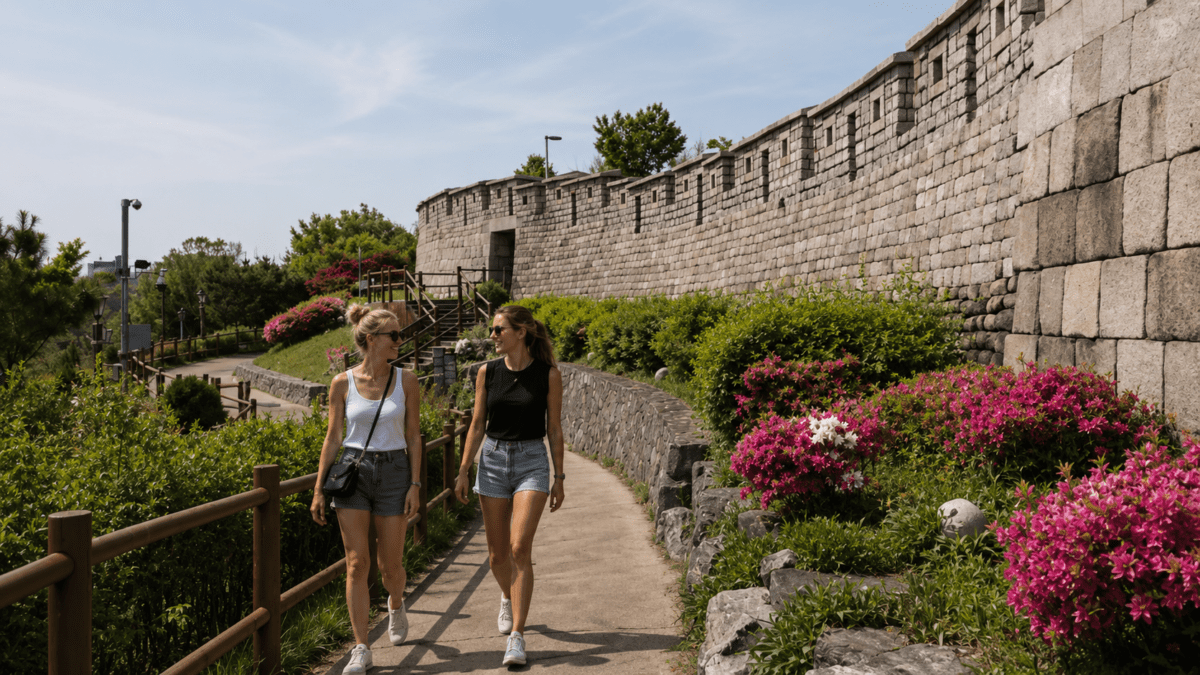
It’s not a hike in the conventional sense. There are no permits, no trailhead fees, no designated start point. You can enter at any gate, walk in either direction, stop for coffee in Naksan Village halfway through, and pick it up again the next morning.
The wall doesn’t require anything from you except the decision to follow it.
The full 18.6 kilometers takes most people two days. One long day is possible for fit walkers starting early — seven in the morning, finishing by late afternoon. Six official sections exist if you want to break it smaller, each one between one and four hours. Some people do one section per weekend for six weeks. The wall accommodates all of it.
On any given morning, the Sunseong-gil draws a specific kind of person. Older Korean men in full hiking gear moving at a pace that suggests they’ve done this section before. A woman eating a rice ball on a bench at the top of Naksan, looking at the city without taking a photo. Two friends walking without talking, the silence comfortable. The Seoul city wall walk is not a tourist attraction in the way that palaces or markets are — it functions more like infrastructure, something the city uses rather than displays.
There’s a stamp passport. Collect all four mountain stamps and bring them to the Hanyangdoseong Visitors Center near Hyehwamun Gate. You receive a completion certificate. It’s the kind of thing that sounds like a tourist gimmick until you’re actually holding it and realize you just walked around an entire capital city on a 600-year-old wall. Route maps, section guides, and stamp locations are all on the Hanyangdoseong official site before you go.
What makes the Seoul city wall walk different from most trail experiences is the city itself. You’re never far from a subway entrance, a café, a convenience store. The wall runs through neighborhoods, not away from them. You exit a dense urban block, climb fifty meters, and the city opens below you. Then you descend back into it. That rhythm — in and out, above and below — repeats for the entire circuit.
The Seoul City Wall Walk and What It Shows You
Travel guides describe Seoul as vertical — a city that moves fast, builds up, tears down, rebuilds. That description is accurate for most of the city.
The wall moves at a different speed.
It has been sitting on these ridgelines since before Gutenberg printed his first Bible in Europe. Neighborhoods have grown up against it, roads have cut through it, a colonial government tried to erase parts of it. The wall absorbed all of that and kept going.
Walking it, you feel the city from outside its own logic. Not as a visitor looking up at skyscrapers, not as a consumer moving between neighborhoods. The Seoul city wall walk puts you above it all — literally, on the ridge — and lets you read the city as a shape. The Han River to the south. The palace compounds to the north. The sprawl in every direction, and right underneath your feet, the stone that defined where the city started.
That perspective doesn’t come from any rooftop bar or observation deck. Those places show you the city as spectacle. The wall shows you the city as structure — its bones, its logic, the geography that determined where everything was placed.
That’s what most people don’t expect. They come for the history and leave having seen Seoul differently. The Seoul city wall walk doesn’t give you Seoul as a destination. It gives you Seoul as a place that has been continuously inhabited, defended, changed, and walked for six hundred years.
You were just the latest person to follow the same line.
Content in this post was created with AI assistance.