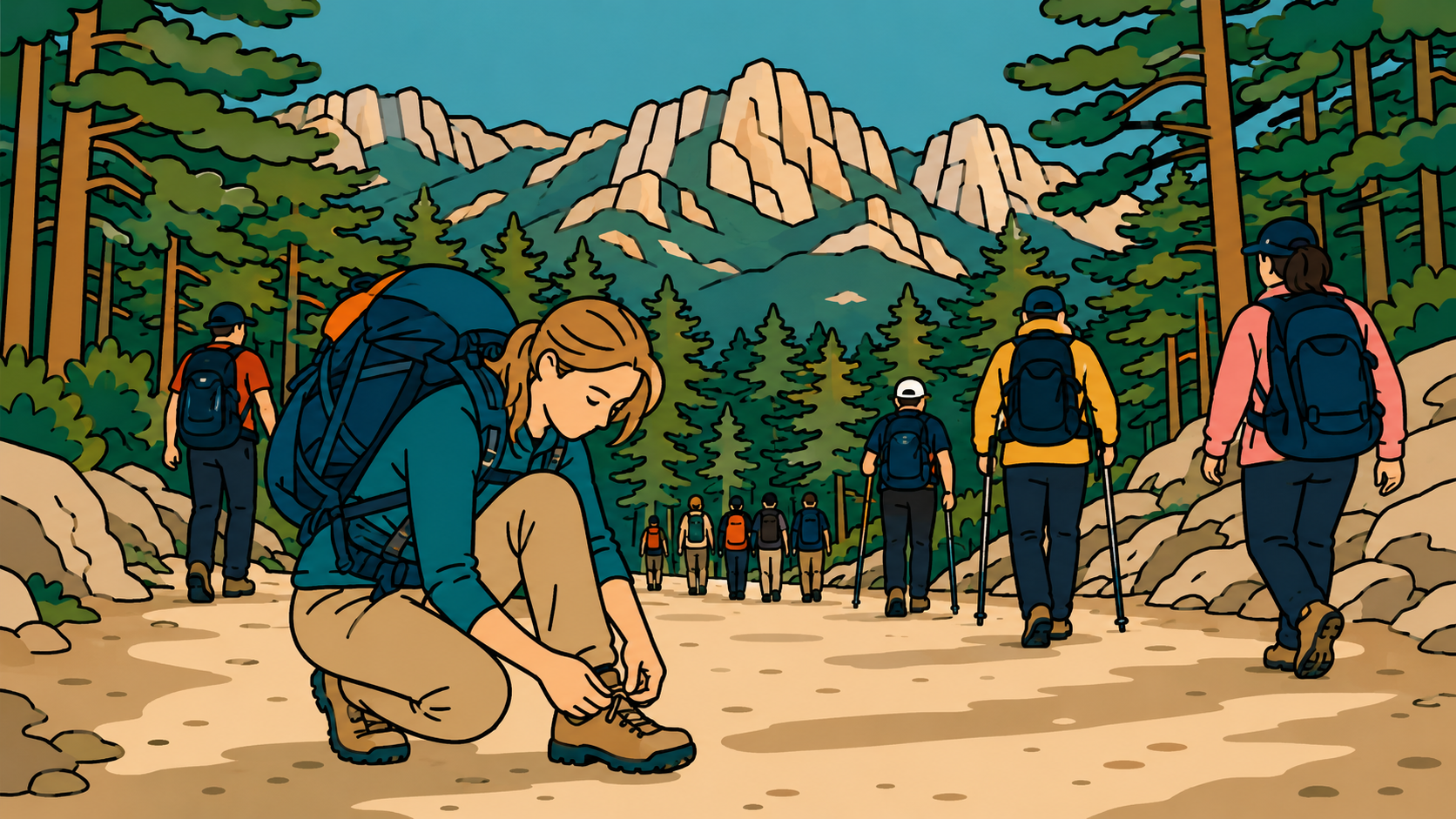

Every weekend, something happens in Seoul that no travel guide quite captures.
A woman in her sixties ties her boots at the subway exit. Two university students eat kimbap on a granite ledge, fog still sitting in the valley below. A man in a collared shirt — he came straight from somewhere — starts up the trail without changing. Nobody finds this strange.
This is what hiking in Seoul looks like from the inside. Not the version that ends up in travel reels. The version that has been running, without interruption, for centuries.
Seoul is a city of ten million people encircled by mountains, cut through by a river, built on a geography that was chosen before a single palace wall went up. The mountains here are not backdrop. They are load-bearing. And right now, for the first time, the world is showing up to climb them.
The Mountain Is Not Outside the City
Most cities push nature to their edges. Seoul didn’t.
Bukhansan (북한산: Buk-han-san, san means mountain) rises inside the city limits.
Bugaksan (북악산: Bug-ak-san) sits directly behind the presidential palace.
Gwanaksan (관악산: Gwan-ak-san) anchors the south. The Han River runs through the middle.
You don’t leave Seoul to reach the mountains. You go deeper in.
This matters more than it sounds.
A city built inside a ring of peaks develops a different relationship with time. You can see the ridgeline from your apartment. On a clear morning, the granite catches the light before the streets do. The mountain tells you what season it is before the calendar does.
Summer arrives on Bukhansan’s north face two weeks before the city feels it — the shade there holds cold longer than concrete ever could.
For centuries, Koreans read this geography as a living structure — not decoration, not escape, but the actual frame the city was built inside. The placement of peaks, the direction of water, the angle of wind through valleys: these weren’t incidental. They were the design. When King Taejo chose this site for his capital in 1394, he wasn’t admiring the view. He was reading a structure that would hold a dynasty for five hundred years.
It did.
Why Foreign Hikers Are Here Now
Since 2022, Seoul’s three hiking tourism centers at Bukhansan, Bugaksan, and Gwanaksan have recorded over 84,000 visitors. More than one-third were international. Each year, that share grows by double digits.
The timing is worth noting.
This isn’t the same wave that brought tourists to palaces and street food alleys. The people arriving at trailheads are coming for something less photographable. They want the version of Seoul that doesn’t perform for visitors — the one that exists at 6am on a Saturday, before the city fully wakes.
They find it.
A trail where grandmothers pass them on steep granite without slowing. A rest stop where someone offers a slice of Korean pear without being asked. A summit where the entire city appears below and nothing about it feels like a view from outside.
Some arrive without gear. The hiking tourism centers at each trailhead rent boots, poles, backpacks — the practical minimum to get someone onto the mountain who showed up in city shoes. What happens after that, the mountain handles.
What the Granite Holds
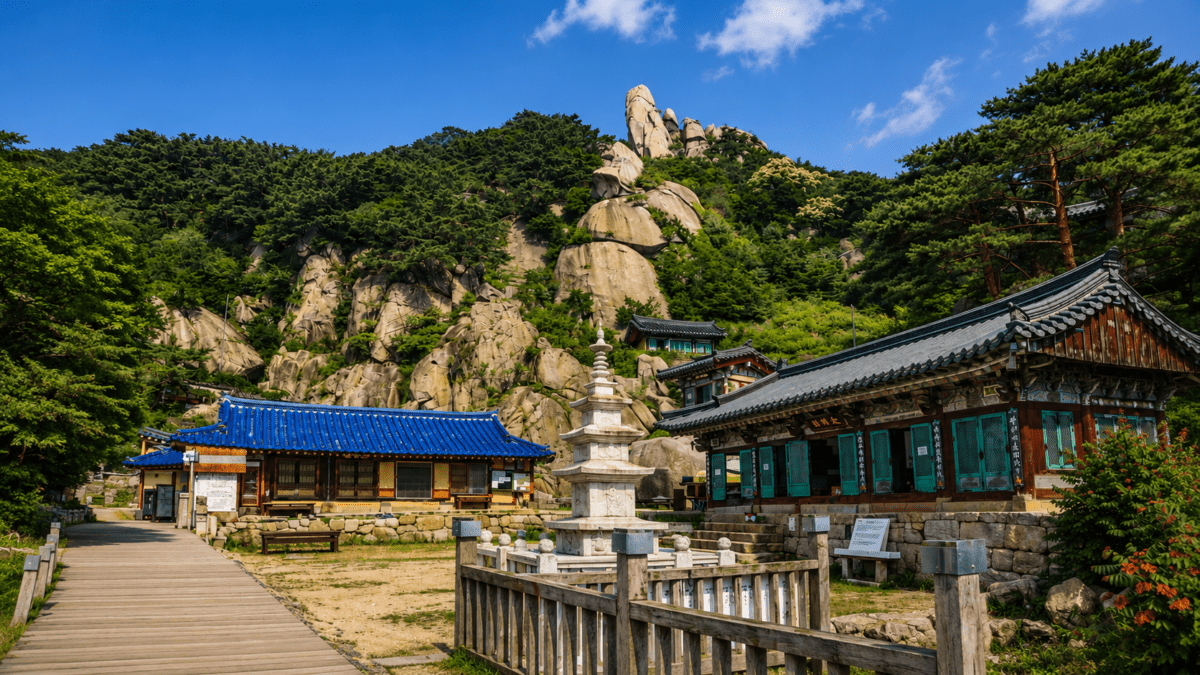
Korean mountains are granite. This isn’t scenery — it’s structure.
Granite doesn’t soften. It doesn’t shift. Trails cut into it stay cut. Fortress walls built on it six hundred years ago still trace the ridgeline. When you put your hand on the rock face to steady yourself on a steep section, you’re touching the same surface a Joseon soldier touched maintaining his post in winter.
The cold comes through immediately.
Stone that old holds temperature the way it holds everything else — completely, without negotiation. This is what the mountain asks of you physically: adjust. Not to the trail’s difficulty, though it is difficult. To its indifference. The granite doesn’t register your effort. It doesn’t get easier because you want it to. The only thing that changes is your relationship to the climb.
Foreign hikers describe something similar, usually after they’ve come down. Not the view — though the view is there, the whole city laid out below, the Han River a silver line through it, Namsan Tower somewhere in the middle distance.
What they describe is the hour before the summit. The particular quality of moving through pine forest on a cold morning, the smell of resin and stone and someone else’s thermos being opened nearby. The sound of the city gone, replaced by footsteps and wind.
Seoul is still there. You just can’t hear it.
The Rhythm Underneath the Trail
There’s a reason Koreans have climbed these mountains for centuries without it ever becoming a trend. It was never separate from daily life long enough to become one.
The mountain is where you go when something needs to be thought through. When a season ends. When you’re not sure yet what comes next. The ascent has a structure that doesn’t change regardless of who’s climbing: effort, then exposure, then the long view. You don’t get the view without the climb. This is not a metaphor Koreans explain — it’s just how the mountain works.
Foreign hikers are picking this up without being told.
They come for the scenery, or the K-culture moment, or because a travel forum said Bukhansan is unmissable. What they describe afterward is something else. The feeling of moving at a pace the city doesn’t allow. The particular quiet of a granite ridge on a cold morning. The sense that the mountain was here before the subway and will be here after.
A rhythm that has no beginning they can point to.
The City Reads Differently From Above
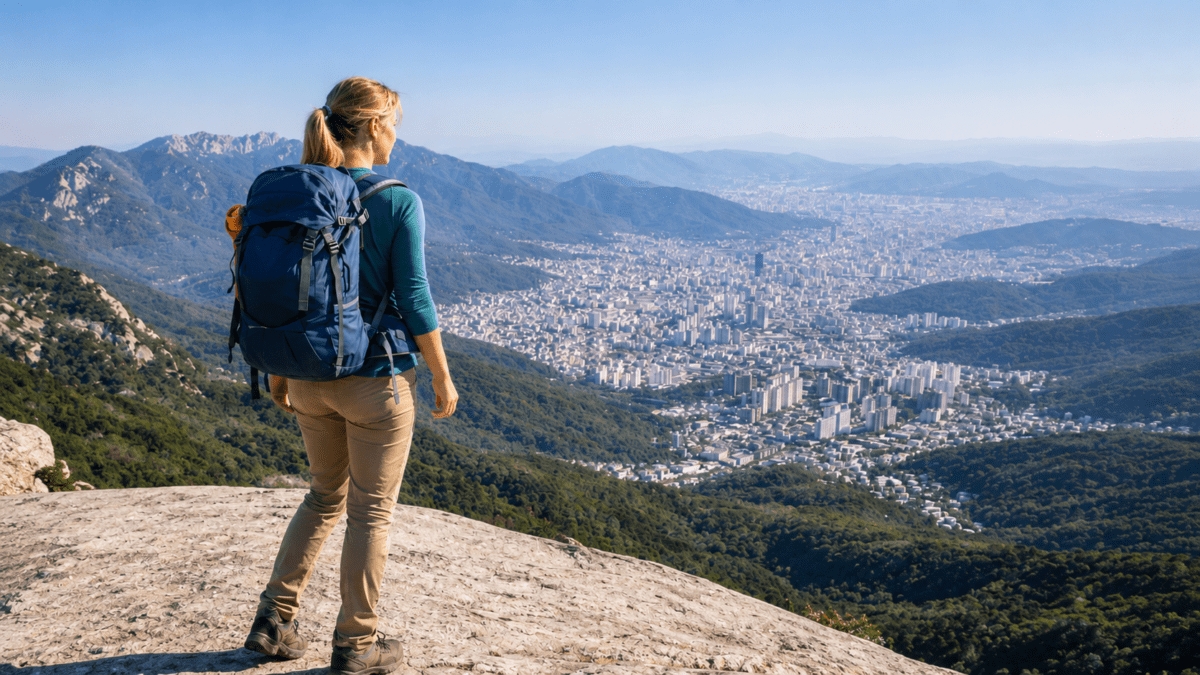
Stand at any of the three summits and the city below stops being a map.
The grid dissolves. What you see instead is the bowl — mountains north, south, east, west, the river cutting through, the city filling the space between like water finding its level. You understand immediately why someone chose this location. Not as strategy. As inevitability.
This is the moment foreign hikers talk about afterward. Not the climb, not the granite, not the gear they rented at the trailhead. This. The city they thought they knew, reassembled from above into something that makes a different kind of sense.
A bowl, not a grid. Held, not sprawling.
Seoul was placed here because the structure was already here. The mountains didn’t surround the capital. The capital organized itself around the mountains.
The four peaks don’t face each other by accident. The river doesn’t run through the center by coincidence. A geography this deliberate doesn’t happen — it gets read, and then it gets built into. What looks from below like a modern metropolis is, from above, a structure that has been holding the same shape for six centuries. The skyline changes. The bowl doesn’t.
For anyone who wants to understand the framework underneath that organization — the logic Seoul was built on runs deeper than urban planning.
The Sound That Stays
Coming down is faster than going up. The trail releases you back toward the subway, toward the apartment, toward whatever was waiting before the climb.
But something in the sensory register has shifted. The smell of pine resin doesn’t leave immediately. The particular silence of the ridge — no traffic, no notifications, just wind moving through rock — takes a few city blocks to fade.
The weight of the descent settles differently than the effort of the ascent. Going up, you’re working. Coming down, something is working on you.
Hikers who come once tend to come back. Not because the summit changes. Because they do, a little, each time. The boots get broken in. The pace on the trail gets familiar. By the third or fourth climb, they’re not visitors anymore — they’re just people who hike in Seoul on weekends.
The mountain doesn’t need to explain itself.
This post was planned and edited by a human, with AI assistance.