From the day Seoul became a capital, Bukhansan was already there. Not a mountain behind the city — the mountain that determined where the city’s northern edge would be.
The axis of Gyeongbokgung Palace aligns toward Bukhansan’s ridgeline. When the king sat on the throne and looked forward, past Gwanghwamun Gate, the peaks were there.
That alignment wasn’t aesthetic. It was structural.
The climb to Baegundae has quietly become one of the most popular things to do in Seoul, drawing more foreign visitors than any other peak in the city. They rent boots and poles at the Seoul Hiking Tourism Center at the trailhead, follow the signs toward Baegundae Peak, and come down saying the same thing.
It wasn’t what they expected.
The Wall That Never Left
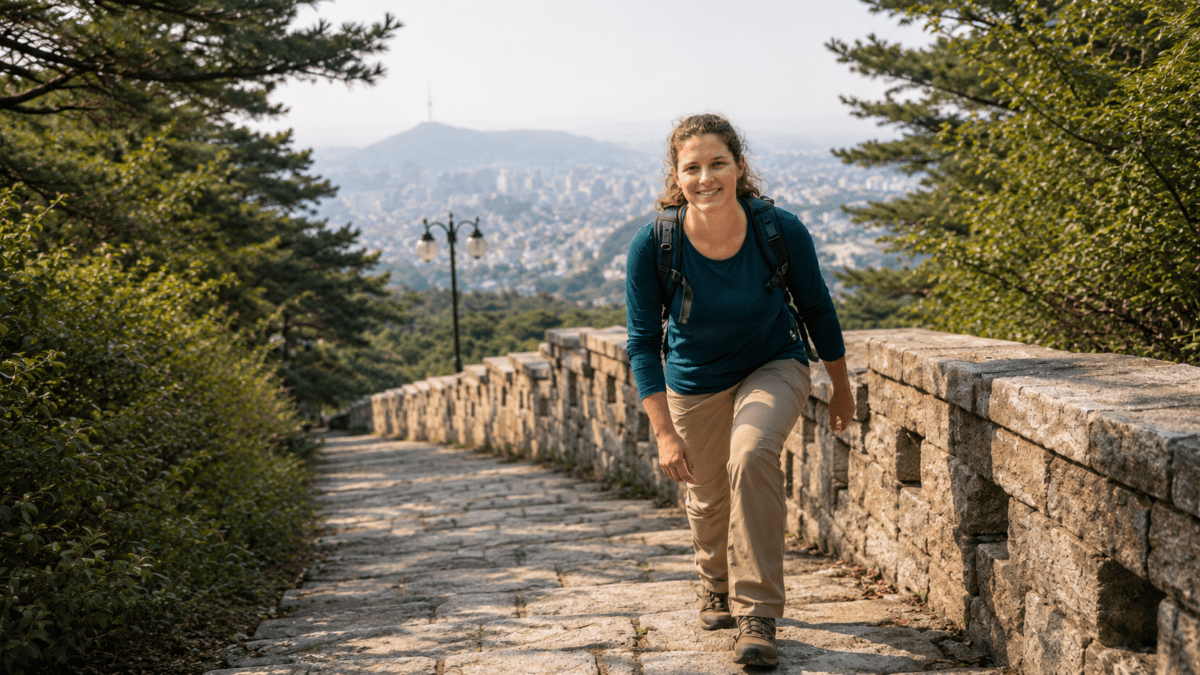
At some point on the ascent, you stop walking beside trees and start walking beside a wall.
Bukhansanseong (북한산성: Buk-han-san-seong, the mountain fortress) was built in 1711 to defend the capital. The fortress wall runs for nearly nine kilometers along the ridgeline, integrating the granite itself into its structure — in places, the rock face is the wall. Thirteen gates once controlled passage through the mountain. Several still stand.
What makes Bukhansanseong different from a ruin is that it isn’t one. The wall is continuous. You follow it upward, and it follows you. Sections that look intact from a distance turn out to be intact up close — the same stones, the same mortar joints, holding the same line they held three hundred years ago.
Foreign hikers slow down here without being told to. Something about a wall that has outlasted every political system the city has gone through since it was built tends to do that. They run their hands along the stone. They look up at where the wall meets the ridgeline and disappears around a corner, and then they keep climbing. The wall keeps going too, in its own direction, indifferent to whether anyone is following.
What the wall makes visible is time. Not history as a concept — time as a physical fact. The stones were cut by hand. They were carried up this mountain by people who had never seen a subway or a skyscraper, who understood this ridge purely in terms of what it could stop and what it could protect. That intention is still in the stone. You can feel it when you touch it. Cold, dense, indifferent to the centuries that have passed since it was placed.
A structure built to stop armies now guides hikers toward a summit. The mountain repurposes things slowly, on its own schedule.
Baegundae: The Roof of Seoul
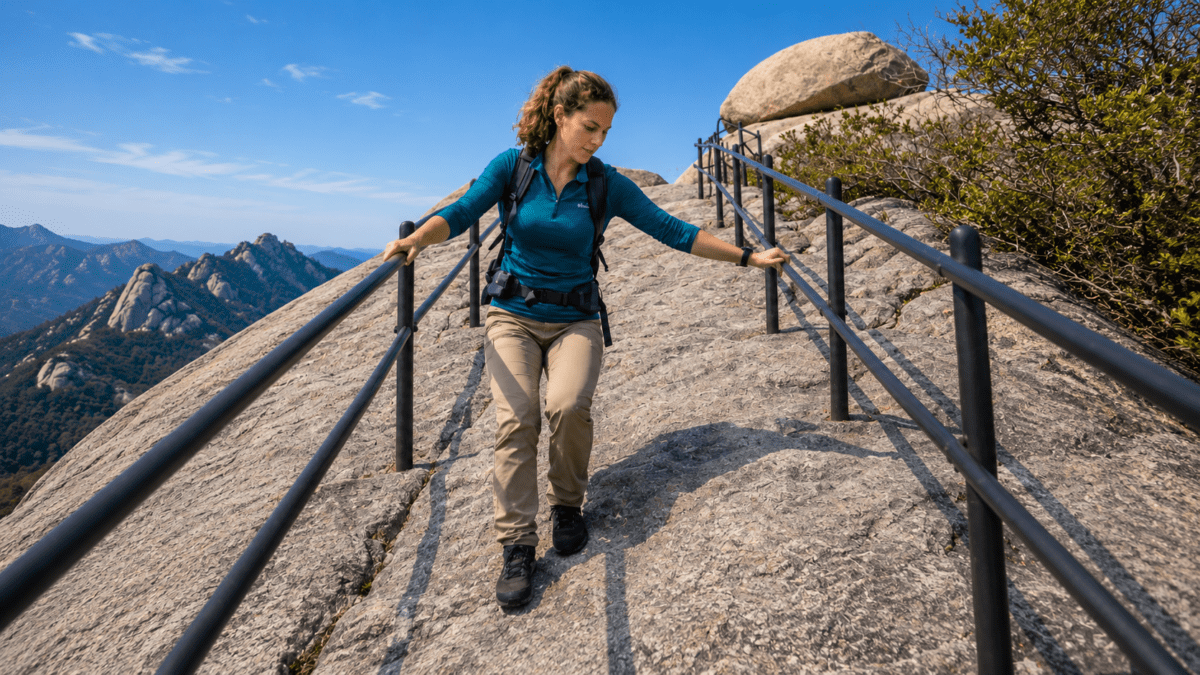
Baegundae (백운대: Baeg-un-dae), 836 meters, is the summit of Bukhansan. The final approach is granite — exposed slabs at an angle that requires both hands, fixed steel cables anchored into the rock for grip. It is the most demanding section of the climb, and the least possible to rush.
At the top, the rock levels into a broad platform. There is nowhere higher to go in Seoul.
What opens below is the same view that has been here since before the city existed in its current form — the Han River cutting its line through the middle distance, the basin of the capital filling the space between the surrounding peaks, the skyline of a modern city sitting inside a geography that precedes it by millennia. On clear days you can see Namsan Tower to the south. On very clear days, further.
The thing foreign hikers describe isn’t the panorama. It’s the scale recalibration. A city of ten million people, seen from above, inside its mountains, looks exactly like what it is: something that was placed here deliberately, inside a structure that was already here. The grid disappears. What remains is the bowl — and suddenly the city makes a different kind of sense.
People stand at Baegundae longer than they planned to. Not because the view is difficult to leave. Because something about it takes time to fully register.
The Fortress and the City Below
Coming down from Baegundae, the fortress wall reappears.
From above, its logic becomes visible in a way it isn’t from the trail. The wall follows the highest points of the ridgeline — not because that was the easiest route to build, but because height was the point. To hold Bukhansan was to hold the northern approach to the capital. Every gate, every tower position, every section of wall was placed in relation to what an enemy approaching from the north would see and where they could be stopped.
The mountain was a weapon before it was a hiking destination.
That history doesn’t announce itself on the trail. There are no dramatic markers, no reconstructed scenes. Just the wall, continuous, running alongside you as you descend through pine forest and granite. The city appears in fragments through the trees — a tower here, a highway overpass there — and the wall keeps going, indifferent to what has accumulated below it.
Six hundred years of Seoul, visible from a single ridgeline.
The system that designed this is older than the wall.
The Hour Before the Summit
Foreign hikers talk about Baegundae. The view, the cables, the granite. But ask them what stayed with them, and the answer is usually something from the hour before.
The particular quality of the forest on Bukhansan’s mid-section — Korean red pine, dense enough to filter the light into something greenish and cool even in summer. The sound of the city gone so completely that the next thing you notice is your own breathing. A rest point where a group of Korean seniors are sharing food with the focused efficiency of people who have done this every weekend for twenty years, and who make space at the stone table without being asked.
Someone passes a mandarin orange. Someone else opens a thermos. A stranger asks where you’re from, in the particular way Koreans ask — not as small talk, but as genuine orientation, the way you’d want to know who you’re sharing a mountain with. The exchange lasts thirty seconds. It doesn’t need to last longer. By the time you stand up to continue climbing, something about the interaction has settled in a way that has nothing to do with language.
This is where the hiking tourism trend reveals what it actually is. Not a trend at all. An introduction. Foreign visitors arrive for the summit and discover that the mountain has an interior — a middle distance between the trailhead and the peak where Seoul’s weekend rhythm runs on its own logic, at its own pace, regardless of who has shown up to observe it.
The summit is the destination. The hour before it is the experience.
There is no way to shortcut this. The mountain doesn’t offer an alternate route that skips the forest and deposits you at the view. You move through the interior at the speed the trail allows, which is slower than the city allows for almost anything. That enforced pace is not incidental. It is the point. By the time Baegundae appears above the treeline, something has already happened that the summit view will confirm rather than create.
The granite knew before you did.
What the Descent Returns You To
The trailhead arrives faster than expected. The Seoul Hiking Tourism Center is where you left it — gear return, the small crowd of people at various stages of preparation and recovery, someone studying a trail map with the focused expression of someone who has just decided to come back.
Bukhansan doesn’t hold you. It processes you and returns you to the city, slightly recalibrated.
The wall stays visible from the lower trail for longer than seems reasonable. Then the trees close around it, and then the subway entrance appears, and then you’re back in Seoul — the version that runs on schedules and notifications and the particular noise of ten million people going about their day.
The mountain that determined this city’s address is still up there.
It will be there tomorrow.
This post was planned and edited by a human, with AI assistance.