
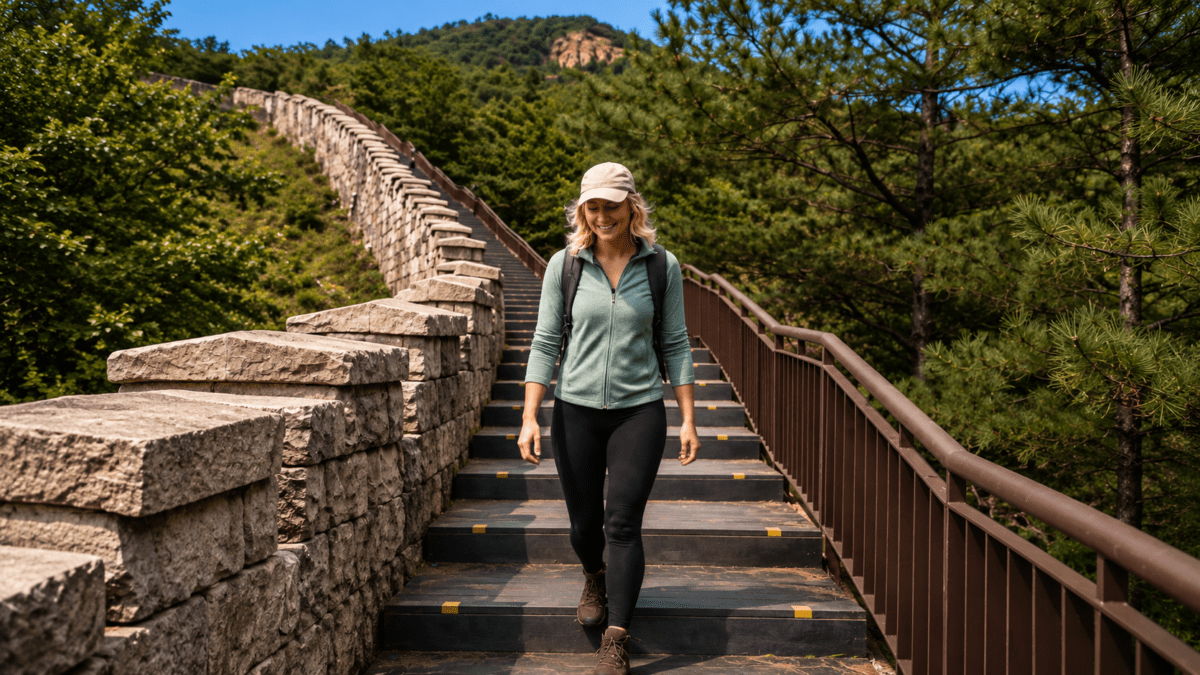
Bugaksan mountain is 342 meters. By Seoul’s standards, that is not tall. By any other standard, it doesn’t need to be.
It sits directly behind Gyeongbokgung Palace. The palace faces south. Bugaksan is what the palace has its back to. In the logic that built this city, a mountain behind you is not scenery — it is cover. The dynasty that chose this site understood that a capital needs something at its back that will not move.
Bugaksan has not moved.
For most of the twentieth century, the mountain was closed. It sat behind the presidential residence — the Blue House — and access required military clearance. The trails were there. The history was there. Nobody could reach either. In 2022, the restrictions lifted. Foreign hikers are among the first generations to walk this ridge freely, on paths that spent decades as a military perimeter.
What they find is a mountain that held its history while it waited.
The Fortress Wall as Trail
The defining feature of Bugaksan mountain is not its summit. It is the Seoul Fortress Wall (한양도성: Han-yang-do-seong) that runs along its ridge.
Hanyangdoseong was built in 1396, two years after Seoul became the capital. The wall connected the four inner mountains — Bugaksan to the north, Naksan to the east, Namsan to the south, Inwangsan to the west — encircling the city in a continuous line of stone. Eighteen kilometers in total. The wall was not only defense. It was the boundary of the capital itself, the line that defined what was inside and what was outside.
On Bugaksan, that line is still walkable.
The trail follows the wall so closely that in places they are the same thing — you walk on the ridge, the wall runs beside you at shoulder height, and below on one side is the palace district, below on the other is the rest of the city. The wall doesn’t let you forget where you are in relation to what was once the center of power. It keeps the geography legible the entire way up.
Sections have been restored. Others are original. The difference is visible if you look — the restored stones are cut more evenly, sit more uniformly — but the line they follow is unbroken. Builders in 1396 made the same decisions about where the wall should go as the restorers did six centuries later, because the ridge didn’t change. The mountain decided the line. The people followed it.
Each stone in the original sections was placed by hand, by workers who understood this wall not as a construction project but as the edge of a world. Inside the wall was the capital. Outside was everything else. That distinction mattered enough to carry granite up a ridge in all seasons, year after year, until the line was complete. Walking beside it now, that intention is still in the stone. The wall is not performing its history. It is still here, doing what walls do — holding a line.
Foreign hikers who have spent time on Bukhansan’s fortress sections arrive here and notice the difference immediately. Bukhansanseong is a military fortification. Hanyangdoseong is a city boundary. One was built to repel. The other was built to contain — to hold a definition of what the capital was and where it ended. That distinction changes how the wall feels underfoot. Less like a weapon. More like a statement.
What the Palace Looks Like From Above
The summit of Bugaksan is modest. A small platform, a marker, wind.
But the view south is not modest. Gyeongbokgung Palace spreads below — its tiled roofs in rows, the central axis running straight to Gwanghwamun Gate, the gate opening onto the long avenue that leads into the modern city. Beyond that, the towers of central Seoul. Beyond those, more mountains.
From here, the city reveals its structure in a single frame. The palace is not the center of a grid. It is the anchor of an axis — a line running from Bugaksan through the throne hall through the main gate into the city, a line of authority made physical in stone and wood and distance. The king sat at one end of that line. The mountain was the other end.
Foreign hikers stand here and look down at a palace they may have visited the day before as tourists. From ground level, Gyeongbokgung is grand and contained — walls, gates, courtyards, the scale of ceremony. From Bugaksan, it is a component. One element in a system that was designed to be read from this angle.
The mountain was always meant to be seen from. And seen from.
A Military Zone That Became a Trail

The decades of restricted access left the Bugaksan trail intact.
No commercial development reached the ridge. No convenience stores, no cable cars, no infrastructure beyond the trail itself and the wall beside it. The mountain that was closed for protection reopened to reveal something that development had no opportunity to alter.
The trail is quiet in a way that Bukhansan, with its higher visitor numbers, is not always quiet. On weekdays, stretches of the wall path can be walked in near-solitude — just the stone, the ridge, the city below, and the particular silence of a place that spent decades with almost no one in it.
Foreign hikers who come to Bugaksan mountain expecting the scale of Bukhansan find something different here. Smaller, slower, more concentrated. The history is closer to the surface because the mountain had less time for accumulation. What the closed years preserved wasn’t just the wall. It was the atmosphere of a place that has been considered important for a very long time.
That atmosphere doesn’t announce itself. It accumulates as you walk. By the time you reach the summit platform, you have been inside it for an hour without noticing exactly when it started. That is how Bugaksan works. Not a dramatic entrance. A slow saturation.
The Sound of the City, Restructured
Halfway up the wall trail, something shifts in the acoustic register.
The city below is visible — you can see traffic moving on the boulevards, construction cranes turning slowly above new buildings, the ordinary daytime activity of a capital at work. But you cannot hear it. The ridge acts as a threshold. Below it, Seoul. Above it, wind through stone and the occasional footstep on packed earth.
This gap between what is visible and what is audible is one of the things foreign hikers describe most often about Bugaksan. The city is right there. You can point to specific buildings. But the sound has been removed, and in its place is the particular quiet of a mountain that has been listening to this city for six hundred years without being absorbed by it.
The wall runs beside you, unhurried. The palace rooftiles catch the light below. You keep walking, past a section where the stone has darkened with centuries of rain, past a gap in the trees where the whole basin opens up for a few seconds before closing again. Nothing announces these moments. The trail doesn’t pause for them. You just happen to be there when they happen, and then you’re past them, still climbing.
The View the King Was Counting On
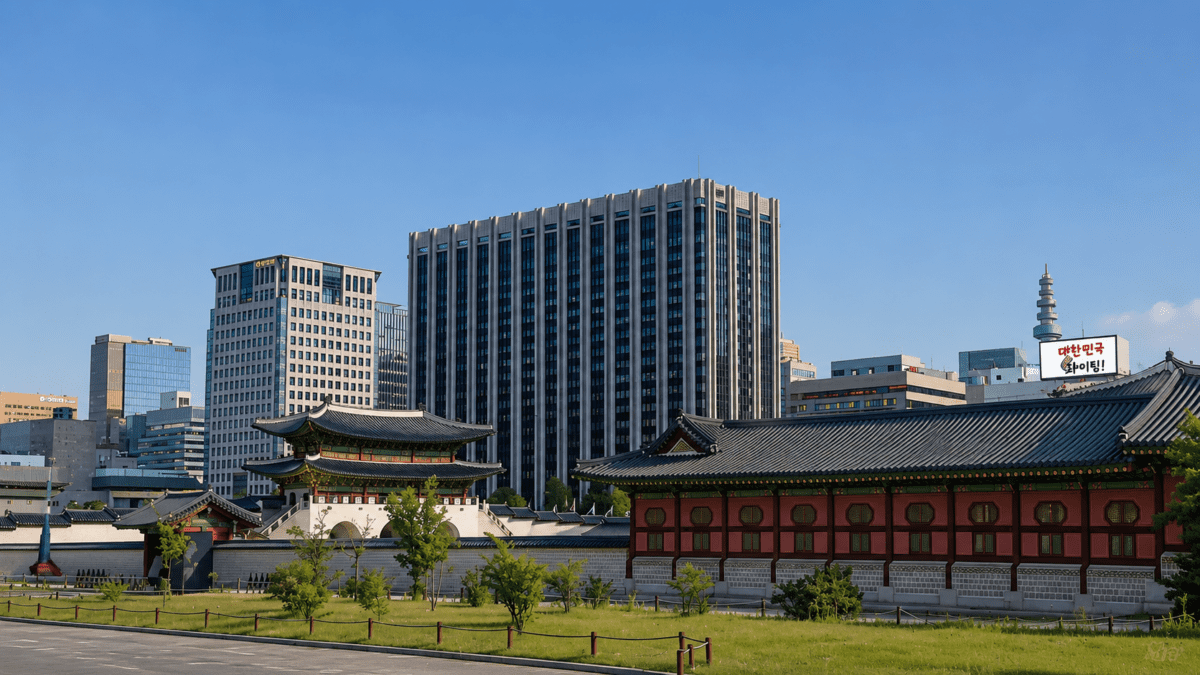
The descent follows the wall back down through the pine forest, the city reappearing in stages.
There is a point on the lower trail where Gyeongbokgung’s roofline and the glass towers of central Seoul appear in the same sight line — one structure from 1395, the other from last decade, both readable from a ridge that predates them both. The wall runs beside you for another hundred meters, then steps aside as the trail widens toward the exit.
For anyone curious about why a mountain this size carried this much strategic weight — the system that Seoul was built inside accounts for more than military logic.
Bugaksan watched the palace for six centuries.
It is still watching.
This post was planned and edited by a human, with AI assistance.