
The wall is 18.6 kilometers. You have three days in Seoul.
Those two facts don’t have to be a problem.
The Sunseong-gil is designed to be walked in sections — six of them, each with its own entry point, its own subway access, its own character. You don’t have to do all of it to understand what it is. One section, walked slowly, tells you more about Seoul than most full-day itineraries.
The question isn’t whether to walk it. It’s where to start.
The Hanyang Fortress hike is not a single trail — it’s a circuit with six entry points, each one leading somewhere different.
The Section That Asks the Least
The Naksan section is 2.1 kilometers. Hyehwamun Gate to Heunginjimun Gate — the eastern edge of the circuit, the lowest mountain on the route at 124 meters. Most people walk it in an hour. Nobody leaves disappointed.
For a first Hanyang Fortress hike, this is the one.
Not because it’s easy, though it is. Because of what it shows you in the shortest distance. The wall here runs through a neighborhood that hasn’t been fully absorbed by the city’s renovation cycles — old hanok rooftops below, the Dongdaemun skyline visible to the south, the stone path cutting between them at an angle that makes both visible at once.
Start at Dongdaemun Station, Exit 1. Turn around, walk west for two minutes. The stairs up to the wall are on your right. There is no gate, no ticket, no sign-in. You walk up and you’re on it.
The transition is immediate. One moment you’re in the noise of a major transit hub. The next you’re on a stone ridge with the city spread below and the wall extending ahead of you in both directions, older than anything else you can see.
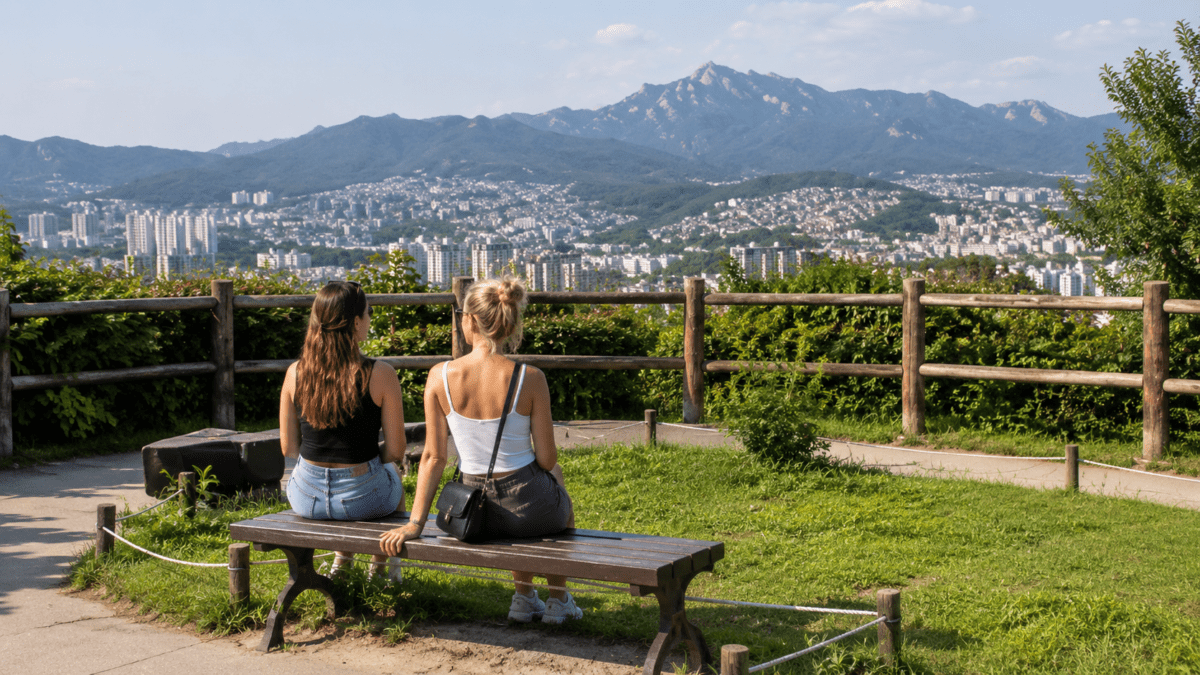
The path is wide enough for two people walking side by side. The stone underfoot is uneven in places — not dangerously, but enough that you feel the age of it. To the left, the rooftops of Naksan Village sit close enough that you could almost reach them. To the right, the wall drops away and Seoul opens up: apartment towers, the curve of an elevated road, the green of Naksan Park below. The sounds of the city don’t disappear. They just move to a different distance.
What the Naksan Section Actually Shows You
The stones here are one of the first things people notice. They’re not uniform. Rough-cut irregular blocks from the original 1396 construction sit directly next to tighter, more precisely shaped stones from later restorations. The difference is visible without any historical knowledge — you can see it with your hands if you touch the wall.
This is what makes the Hanyang Fortress hike different from visiting a palace or a museum. The history isn’t behind glass. It’s the thing you’re walking on. The wall doesn’t read as one era. It reads as several — the same five phases moving through time, compressed into a single stone surface. The wall was built according to the logic of the terrain. Each mountain contributes something different to the circuit, creating a route that feels varied even after centuries.
Naksan Park opens to the left about halfway through. Benches face east over the city. On weekend mornings, older Korean men sit here in hiking gear, not hiking — just sitting, looking at Seoul the way people look at something familiar that still surprises them. A woman reads on a bench with her shoes off. A child runs along the wall path while an adult follows at the pace of someone who has done this many times.
The wall doesn’t draw a crowd. It draws regulars.
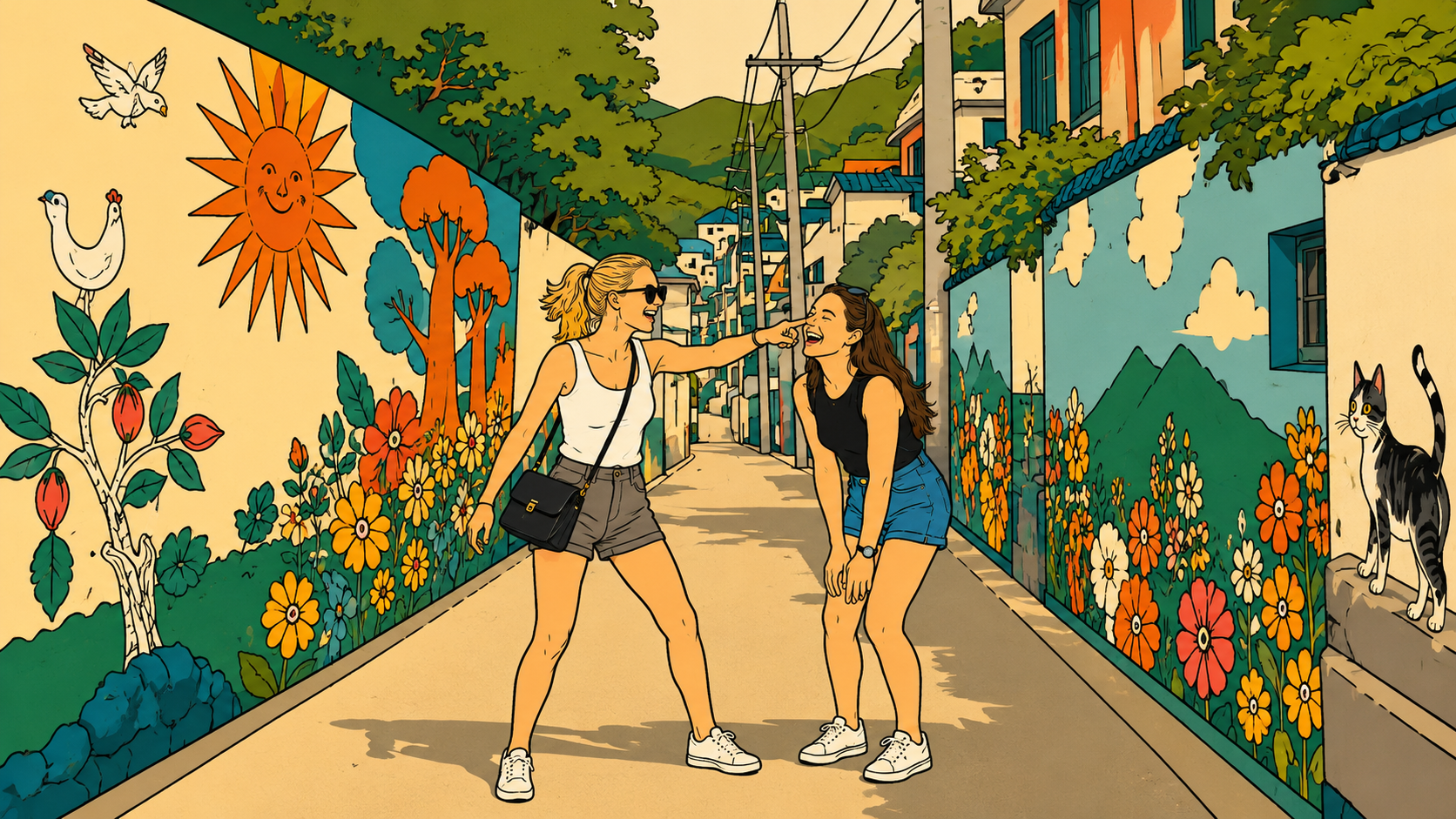
The Ihwa Mural Village branches off to the right before the descent. A signpost points down into Ihwa-dong — narrow alleys that climb and turn without warning, the walls painted with murals that have been here long enough to start fading at the edges. The most photographed is a large owl near the top of the village, though most people find it by accident rather than by looking for it. The alleys are residential. Laundry hangs above the painted walls. A cat sits on a low roof and watches you pass without moving.
The village and the wall exist ten meters apart and feel like different centuries. That’s the texture of the Naksan section — old city and older city, layered so close together that the boundary between them is just a flight of stairs.
After Naksan: What to Add

The Naksan section ends at Heunginjimun Gate — Dongdaemun, the Great East Gate, one of the original eight gates of the old capital. It sits in the middle of a traffic roundabout now, surrounded by the DDP’s curved silver roof and the lighting market that runs through the night. The gate is free to enter.
From here, the Hanyang Fortress hike continues in two directions. For a second day, the choice depends on what you want from the walk.
Namsan is the most familiar. N Seoul Tower is visible from half the city, which means most visitors have already looked up at this mountain without knowing the wall runs across it. The section is 4.2 kilometers and takes about three hours. It passes through Namsangol Hanok Village at the base and climbs through wooded trails to the ridge. At the top, the wall and the tower exist in the same frame — six hundred years of stone next to a broadcasting antenna. The view over the Han River from the Namsan ridge is the one that appears in travel photographs. It earns its reputation.
Inwangsan is the one most people don’t expect. The mountain sits to the northwest of the circuit, and the section runs 4 kilometers from the site of the old Donuimun Gate to Changuimun Gate. What makes it different is the terrain — Inwangsan is granite, and the boulders here are large enough to alter the path entirely. The wall doesn’t go over them. It threads between them, around them, occasionally directly against a rock face that dwarfs the stonework.
Shamanist shrines appear in the gaps, tucked into natural formations that have been used as ritual sites for longer than the wall has existed. The city is still visible from the ridge, but the feeling up here is of somewhere much further from it.
Bugaksan requires the most preparation — not fitness, but logistics. The section is 4.7 kilometers and crosses the highest point on the circuit at 342 meters. An ID checkpoint at the entrance is the remnant of the decades when this mountain was closed entirely. The pine tree with fifteen bullet holes from the 1968 commando raid is marked on the trail. The wall here is the most intact of any section — forty years of restricted access preserved what elsewhere wore away.
The sections don’t require each other. Each one works as a standalone hour or afternoon. Together, they form something larger — but the wall has been patient for six hundred years. It will wait.
The One Thing Worth Knowing Before You Go
The Baegak section — Bugaksan, the mountain behind the former presidential residence — has restricted hours. May through August it opens at 7 AM and closes at 7 PM. November through February it opens at 9 AM and closes at 5 PM. ID is required at the entrance checkpoint. This is the only section with access restrictions.
Everything else on the Sunseong-gil is open 24 hours. The Naksan section at 6 AM on a Tuesday morning has exactly as much access as it does on a Saturday afternoon. Full section details and a downloadable route map are on the Naksan section official trail info page before you go.
No reservation. No fee. No preparation required beyond comfortable shoes.
Most people who walk even one section of the Sunseong-gil come back for another. Not because they planned to — because the first one left something unfinished. The wall doesn’t give you everything at once. It gives you one ridge, one hour, one angle on a city you thought you already understood. The rest stays there, waiting, the same stones in the same place they’ve been since 1396.
That’s the final thing the Hanyang Fortress hike asks of you. The wall has been waiting for six hundred years. It can wait one more day for you.
Content in this post was created with AI assistance.