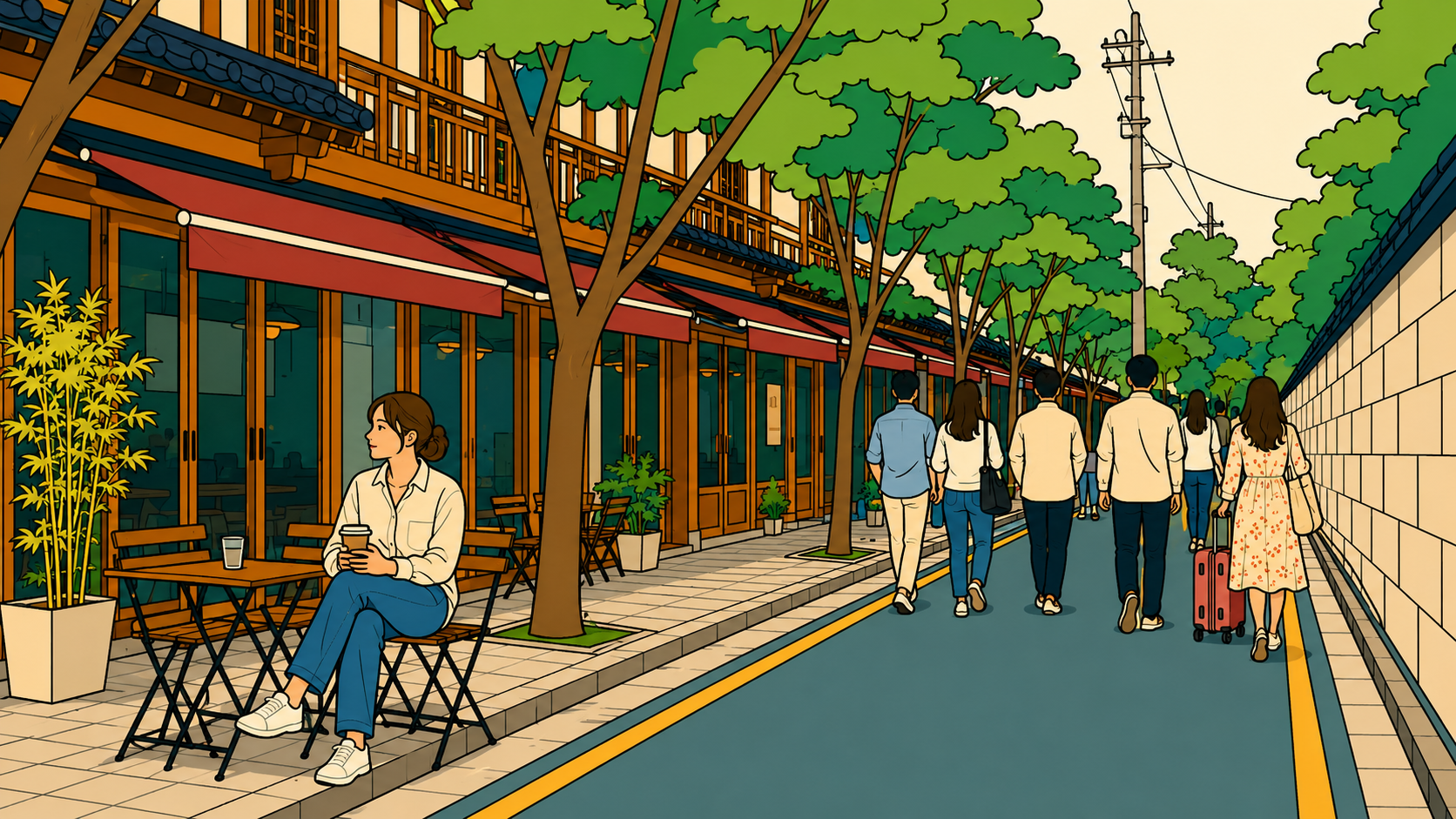

Seosulla gil begins where Ikseon-dong runs out of room. Tables pushed to the edge of the lane. Menus photographed before anything arrives. A shoulder bag catches yours as you pass and nobody stops to apologize because there isn’t really room to turn around.
Two minutes on foot. You turn a corner and the noise drops.
Not because the street is empty. Because the buildings are low.
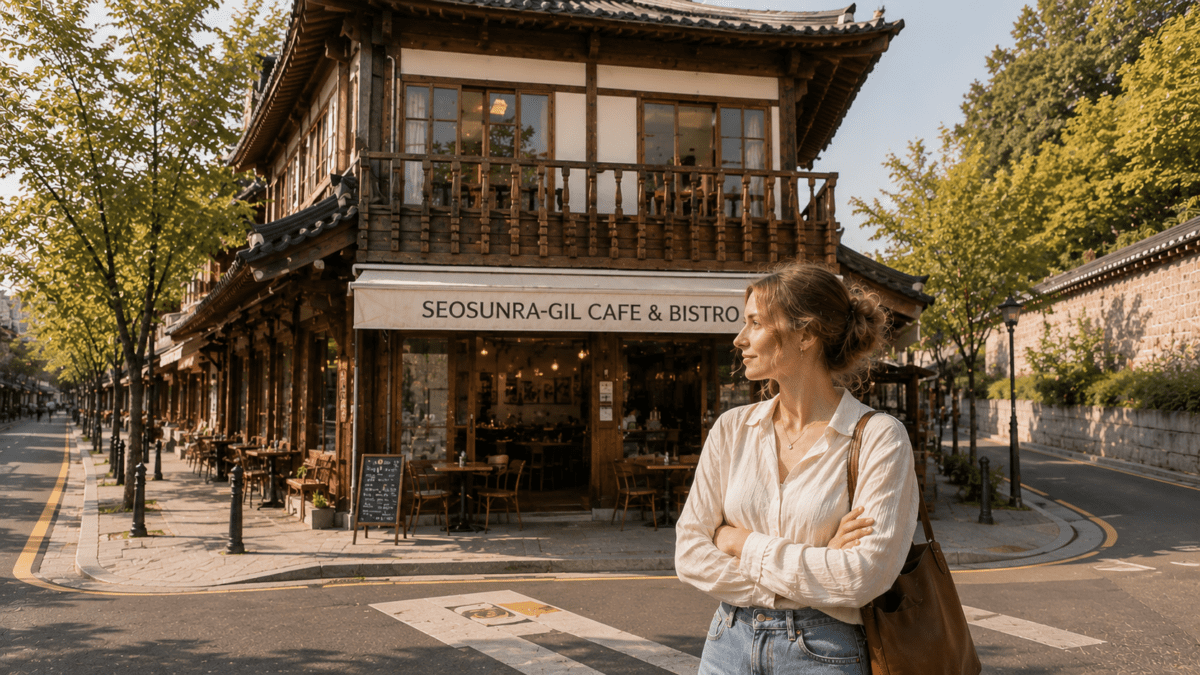
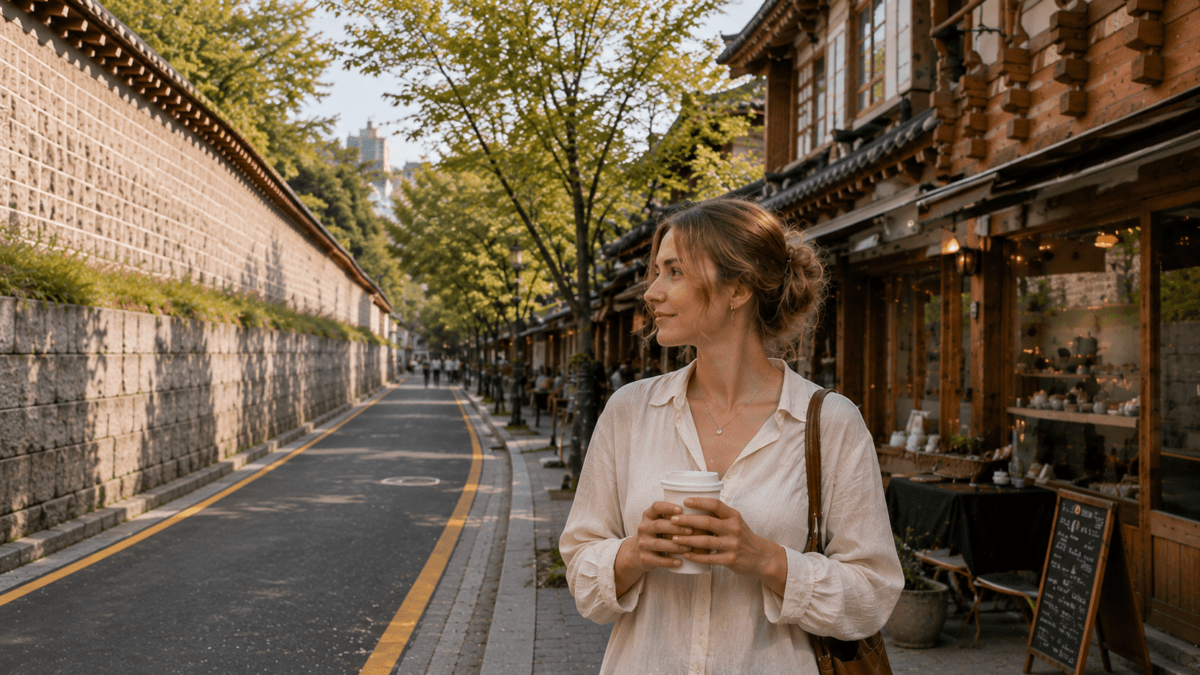
Seosulla gil runs beside the western wall of Jongmyo Shrine — a stone corridor that separates one of Seoul’s oldest royal sites from one of its newest circuits of cafes and bars. On one side, gray stone stacked higher than a man’s head, running the length of two city blocks. On the other, craft beer pubs, a hanok converted into a restaurant, a jewelry workshop where someone inside is bent over a workbench at 9 PM. None of it taller than two floors.
In a city where the skyline competes with itself, this street reads like an error. The kind of error people line up for.
Seosulla gil is not on most first-time itineraries. It doesn’t need to be. It pulls people in from Ikseon-dong when Ikseon-dong gets too loud — which, on any Friday evening, takes about thirty minutes.
A Wall That Stayed
The name comes from Sunra — the night patrol guards of the Joseon dynasty assigned to walk this route and protect the shrine. They were a practical institution: men moving through the dark, checking that the royal ancestral rites would face no interruption come morning. The wall they patrolled is still here. So is the route. Sometimes the same path holds different purposes across centuries without asking permission to shift.
Jongmyo Shrine is the oldest Confucian royal ancestral shrine in the world still conducting its original ritual. The Joseon kings came here to honor their ancestors in ceremonies that required silence, precision, and an understanding that some spaces are not built for daily use. The shrine has been a UNESCO World Heritage site since 1995. The wall bordering it has stood for considerably longer than that designation has existed. It doesn’t announce itself. It just remains.
Ikseon-dong sits five minutes away. It built its reputation first — hanok alleys converted into cafes, narrow lanes made photogenic through repetition. By the time weekend queues at Ikseon-dong’s more popular spots extended past comfortable waiting, the overflow had to go somewhere. Seosulla gil absorbed it, without advertising that it would.
The two streets don’t formally connect. They share an axis — Jongno 3-ga station underneath both of them — and a sensibility that neither place planned. Ikseon-dong takes the crowds, the hanok aesthetic, the daytime hanbok. Seosulla gil takes the walk, the wall, and the hour after dinner when people don’t want to go home yet but aren’t ready for a packed bar.
What Two Stories Made
Buildings along Seosulla gil cannot exceed two stories. The regulation exists to protect the visual integrity of Jongmyo, a UNESCO World Heritage Site since 1995 — no structure that might obstruct or compete with the shrine’s sightlines. No one designed the atmosphere. The building code did.
What a two-story cap produces, in practice: a sky that stays visible. Evening light reaches the pavement instead of dying in the shadow of a glass tower. When the sun angles low in late afternoon, it catches the stone wall and holds there for a moment that the rest of Seoul — glass, steel, thirty floors of residential — doesn’t get. This is what Seosulla gil looks like at 5 PM on a clear day.
The scale shaped what moved in. Seoul Gypsy: craft beer, low lighting, a room that fits the building rather than the other way around. Cafe Sa Sa: a window seat close enough to the street that you’re half inside, half watching whoever’s passing. Sunragil Bibi: Korean small plates, a dinner space that fills without tipping into noise.
These places would read differently in a standard Seoul commercial corridor. The low ceilings, the proximity to the street, the fact that you can see the stone wall through the window — that’s not atmosphere someone installed. It arrived with the restriction.
There’s a quality to the evening light here that photographers have worked out without needing to discuss it. The stone wall faces west. The warm hour before dark lasts longer on Seosulla gil than it should, given how deep into the city you are. Someone sitting outside with a drink at 7 PM is getting something the city wasn’t built to offer. The zoning law accidentally made it available.
Retro Without the Obligation
The spending data: Friday night. Four people sharing one beer flight while taking turns photographing the wall.
The reason is not straightforward nostalgia. The MZ generation in Seoul didn’t grow up in hanok. They grew up in apartments. The traditional architecture here is not their inheritance — it’s something they’re choosing, on their own schedule, without anyone requiring them to care about what it used to mean.
Retro works when it doesn’t demand reverence. Seosulla gil doesn’t explain itself. There are no interpretive panels about the night patrol guards. No reconstructed scenes of Joseon-era security procedures. Just the wall, the low buildings, a craft beer menu, and the understanding that the history is decorative in the best possible sense — present without insisting.
Old Seoul as background. The present tense as the actual subject. That formula is what keeps Seosulla gil full on a Tuesday night.
The photograph being produced on this street, thousands of times a week, is not the shrine. It’s the silhouette of the stone wall against evening sky with something in the foreground — a glass, a friend’s profile, a jacket draped over a chair. That’s a different relationship to heritage than the one museums are built around. It doesn’t require you to be interested in Joseon dynasty ritual to enjoy what the ritual’s protective infrastructure accidentally created. The wall is there. The light is there. The low buildings are there. The rest is up to whoever shows up.
The Street Foreign Visitors Actually Find
Bukchon Hanok Village is on every first Seoul itinerary. It’s architecturally significant. The walking routes are well-signed. By mid-morning on a weekend, it is also a managed experience: designated photo spots, multilingual signage, a pace set by group tours moving through in sequence.
Seosulla gil doesn’t have that infrastructure. The wall doesn’t orient you. There are no suggested starting points. If you find yourself on this street, it’s because you walked here from somewhere else and something about it made you slow down.
Foreign visitors describe it as feeling like Korean cinema — not because it’s staged, but because the visual grammar of the city compresses into one walkable stretch. Low rooflines. Stone. Narrow lanes connecting to smaller lanes. The kind of frame that appears in a Seoul drama before the plot begins.
They function as a circuit. One feeds the other. That dynamic wasn’t designed by anyone, which is probably why it works. It follows the same logic as any cycle that completes itself — not by intention, but by structure. Visitors already coming for Gyeongbokgung or Changdeokgung are in the neighborhood. Ikseon-dong appears on their maps. Seosulla gil appears when Ikseon-dong fills up, or when someone mentions it’s five minutes away and considerably quieter.
The standard circuit has become predictable without becoming a tour: afternoon at Ikseon-dong, late afternoon drift to Seosulla gil as the light changes, dinner somewhere along the wall, drinks after. The hanbok rental shops in Ikseon-dong and the stone wall backdrop on Seosulla gil are fifteen minutes apart. The foreign visitor in hanbok standing against the Jongmyo wall at golden hour didn’t follow a guide. They followed the layout of the neighborhood.
That’s the circuit. It starts in Ikseon-dong. It tends to end here.
This post was planned and edited by a human, with AI assistance.