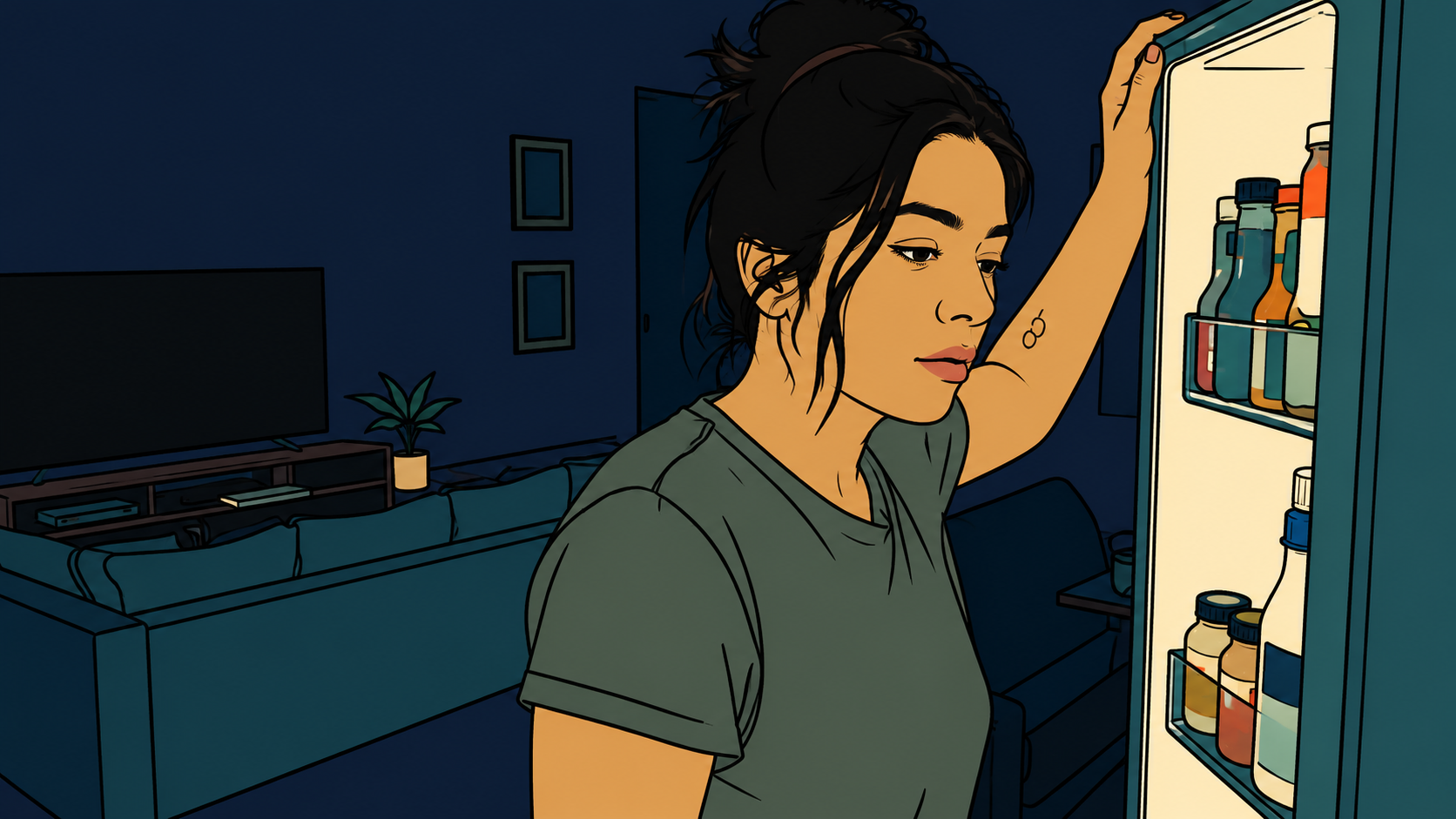

It’s 10:40 PM and the refrigerator door is already open. You don’t remember deciding to walk over here. You were on the couch, the day was basically done, and now there’s a plate in your hand — the plan you made on Sunday quietly losing to a Tuesday night that doesn’t feel like it counts.
That’s the thing about small daily reversals. They never feel like the problem. The problem is supposed to be something big — quitting, failing, giving up in a way you’d have to admit to. This is just a snack. Just one purchase. Just checking the phone one more time before starting. None of it looks like self sabotage while it’s happening, which is exactly how it keeps happening.
Big plans almost never get undone by big failures. They get undone by small choices, repeated, each one too minor to argue with.
The Decision That Happens Before You Notice It

Here’s the uncomfortable part: by the time you notice the choice, it’s usually already been made.
You assume the order goes decision first, action second. That’s how it feels from the inside. But watch these moments closely and the order is reversed. The hand is already reaching. The thumb is already on the app. The cart you filled “just to think about it” has already become an order confirmation sitting in your inbox, and the thinking you were going to do never actually got scheduled.
The body runs these sequences the way it runs any well-practiced routine — without waiting for a vote. What the mind contributes, arriving a half-second late, isn’t a decision. It’s a narration. A reason, produced on demand, for something that was already in motion. You’ve had a long day. You deserve it. It’s not a big deal.
You didn’t choose the snack. You narrated it.
This is why small daily reversals are so hard to catch with willpower alone. Willpower operates at the level of decisions, and these don’t present themselves as decisions. They present themselves as things that are already happening — and arguing with something that’s already happening feels pointless, so you don’t.
Why Self Sabotage Never Feels Like the Problem
Taken alone, each instance is genuinely harmless. That’s not a trick of perception. It’s true. One late-night snack changes nothing. One impulse purchase doesn’t wreck a budget. One skipped session doesn’t undo a body.
The trick is in the word one.
You skipped Wednesday’s workout for a real reason — the meeting ran late, you were exhausted, the math of the evening genuinely didn’t work. Friday’s skip also had a reason. So did Monday’s. Each one was evaluated on its own, found reasonable, and filed away. What never happened was the other calculation: the one where three skips in six days stop being three separate events and start being a direction.
Nobody abandons a plan on purpose. They abandon it one reasonable exception at a time.
The accounting system only ever runs single entries. It never runs totals. And a plan doesn’t die from any single entry — it dies from the total that nobody was keeping.
There’s a reason the totals never get run. Running them would mean stepping back far enough to see the week as a whole, and the week as a whole contains information the single evening doesn’t. The single evening says: tired, long day, reasonable. The week says: this is the third time, and the reasons are getting easier to produce. You can live inside single evenings indefinitely. Most people do. The week-level view is technically available at any moment — it just never gets scheduled, because some part of you already suspects what it would show.
You can see this clearly in other people. A friend describes her month — the class she keeps missing, the reasons, each one solid — and from the outside the direction is obvious within two sentences. She can’t see it. Not because she’s less perceptive than you, but because she’s inside the single entries and you’re hearing the total. The pattern is always legible from one seat and invisible from the other. Small daily reversals depend on you staying in your seat.
The Pattern Hidden Inside “Just This Once”
There’s a phrase that shows up at the exact moment the reversal activates, and it’s worth learning to hear it.
Just this once. Sometimes said out loud, more often just passed through the mind on its way to permission. It sounds like a boundary — an acknowledgment that this is an exception, that the rule still stands, that normal service resumes tomorrow. It sounds responsible, the way small daily reversals usually do.
But notice when the phrase appears. It doesn’t show up on actual exceptions — the birthday dinner, the genuinely unusual day. Those don’t need it. The phrase shows up when some part of you already knows this isn’t once. It’s a signature, not a description. The moment you need to say just this once, the once is already over.
The phrase does two jobs at the same time. It grants the current exception, and it quietly erases the record of the previous ones. Every “just this once” is counted as the first, which is how the same exception gets to be made twenty times without ever becoming a pattern you’d have to look at.
Say it while pouring the second glass. Say it while tapping buy. The words are doing the same work every time: keeping the choice small enough that it never has to answer for the choices before it.
What the Small Choices Are Actually Protecting

Now the harder question — not how this works, but why.
The easy answer is weakness. Low discipline, no willpower, some defect of character that stronger people don’t have. That answer is popular because it’s simple, and wrong because it explains nothing. If it were just weakness, the reversals would be random. They’re not. They show up with suspicious precision — right when the plan starts working, right when following through would start producing results that could be measured.
Self sabotage keeps the stakes small. That’s its actual function. As long as the plan keeps getting quietly undone, you never arrive at the point where the outcome gets evaluated — where you find out whether the finished version is good enough, whether the changed body draws attention you’re not ready for, whether the saved money makes the next decision unavoidable. The reversal keeps you in the version of the story where you could have. Could have is a comfortable tense. It contains no verdict.
She kept a folder of half-finished applications on her desktop for two years. Opened them sometimes, adjusted a sentence, closed them again. Sending one would have produced an answer — yes or no, either one final. The folder produced nothing, which was the point. As long as the applications stayed drafts, she stayed someone who might still be chosen. The night snack works the same way, just smaller: every reversal keeps a verdict from arriving.
So the small choice isn’t a failure of the plan. It’s a defense against what the plan, completed, would force you to face.
Which changes what’s worth doing about it. Not more discipline — discipline fights the choice, and the choice is already made by the time discipline shows up. What actually helps is smaller and earlier: one second of noticing, placed between the motion and the narration. Standing at the refrigerator, thumb on the app, cursor on buy — the pause isn’t there to stop you. It’s there to let you see the choice while it’s still a choice, and to ask it the only question that matters.
Not why do I keep breaking the plan. The question is: what does the breaking keep safe?
Answer that, and the small daily reversals lose their best cover — the one where they were never about anything at all.
This post was planned and edited by a human, with AI assistance.