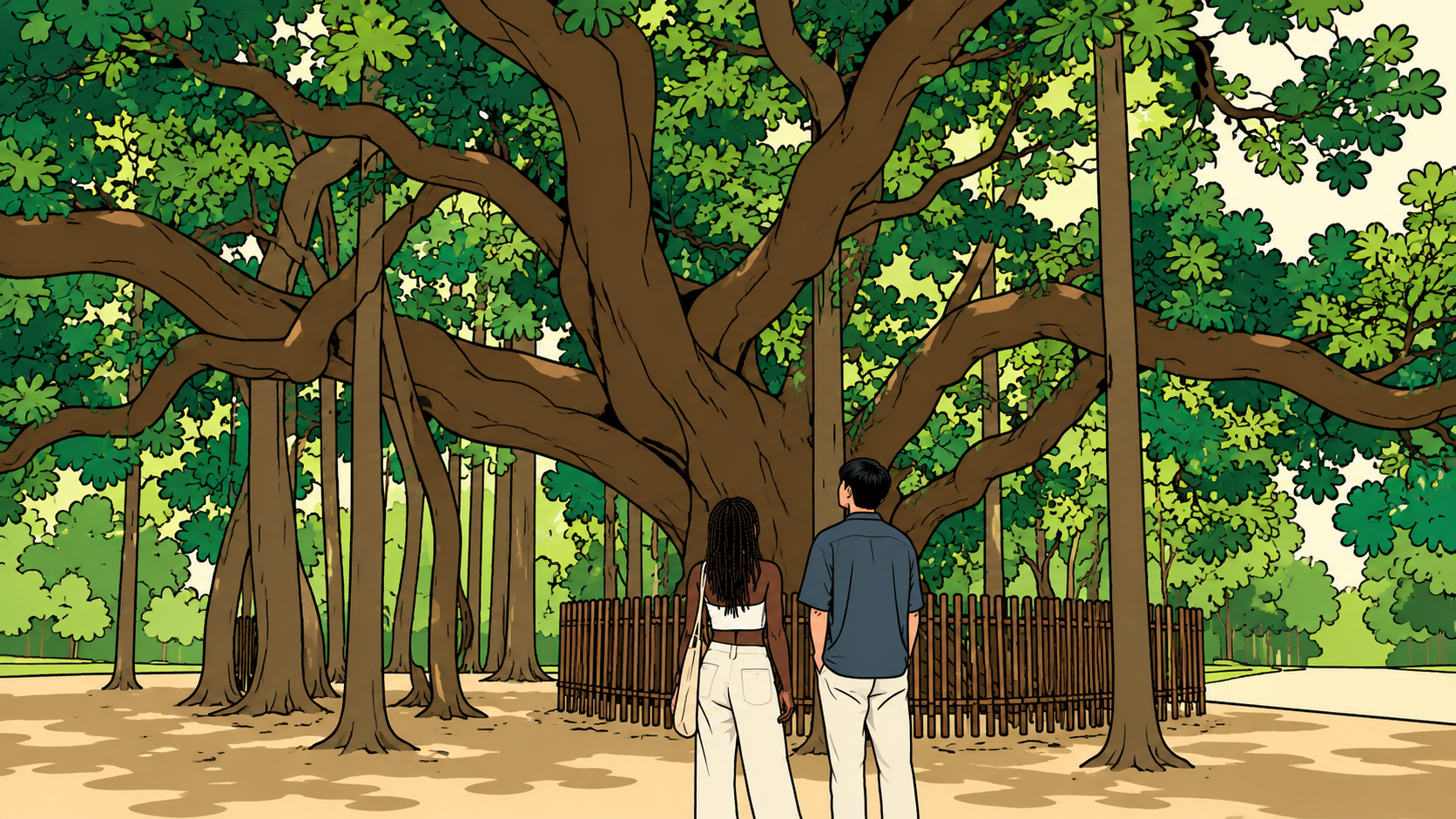
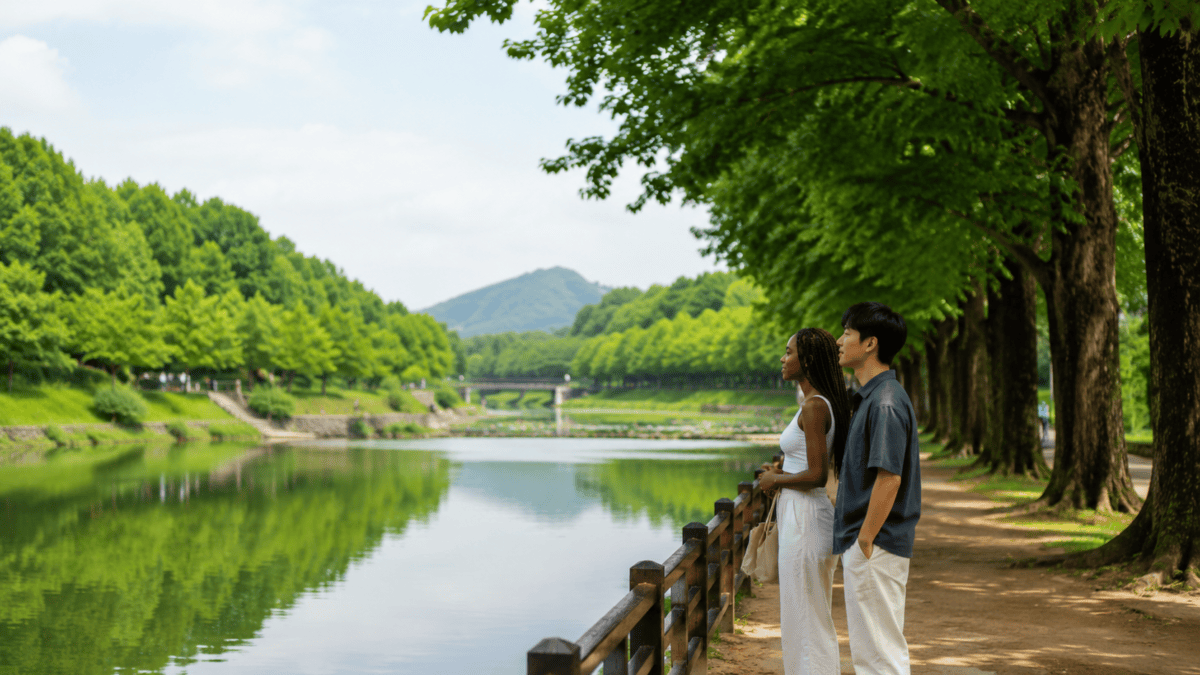
Follow the stream at the edge of town and the trees find you before you look for them. Not planted in rows this time — these are old, thick, leaning, their crowns spread wide and tangled overhead, and the shade they throw is the deepest of any Damyang forest. Under them a path runs along the water, and the moment you step onto it the afternoon heat drops away and stays away.
This is Gwanbangjerim, a strip of forest three or four centuries old, and in the middle of a Korean summer it does one thing better than anywhere else nearby: it keeps you cool.
Three Hundred Summers of Shade
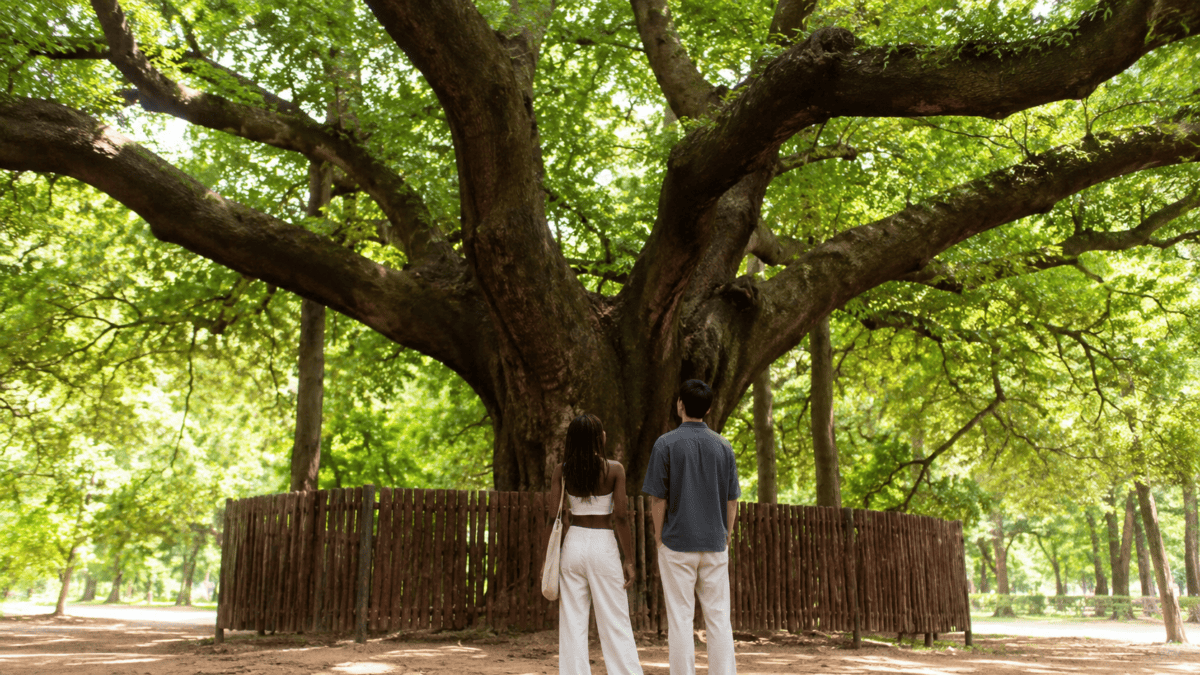
The trees are the reason this Damyang forest exists at all. They were planted long ago along the levee to hold the river back, and they’ve had three centuries to grow into the job — hackberries and zelkovas mostly, huge now, their trunks wider than a person can reach around, the bark deep-grooved and grey-green with age.
Overhead their branches have knitted together into a low, dense roof. Very little sky gets through. What light does come down arrives soft and dim and green, and the ground beneath is cool and slightly damp, the packed earth of the path holding the coolness the way a stone floor does. You walk in and out of the shade of individual giants, and under the biggest of them the temperature drops noticeably, a pocket of held cool you could stand in for a long time.
There’s a weight to old trees that young ones don’t have. These have shaded this exact stretch of water since before the town around them existed, through every summer of every year, and something of all those summers seems stored in them — in the thickness of the trunks, the spread of the shade, the slow way the leaves stir when a little wind gets under the canopy. You feel small under them, and cool, and unhurried.
These trees were old before the town around them had a name. A few of the oldest lean far out over the path, held up now by wooden props, and you walk beneath them the way you’d pass under a raised arm. Gwanbangjerim doesn’t announce any of this. It just stands there being old and green and shading the water, the way it always has.
The Stream Does the Cooling
But it isn’t only the shade. Listen, and you’ll hear the other half of it.
The stream runs right alongside the path, shallow and quick and clear over a bed of round stones, and it makes the sound that summer in a place like this is really made of — a continuous low rush and chatter, water over rock, rising where it narrows and quickens, softening where it pools. It’s always there, under everything, and after a while you stop hearing it as a separate thing and start feeling it as the temperature of the whole place.
Because the water is cooling the air. You feel it as you walk near the bank — a draft coming off the stream, several degrees cooler than the path, damp and clean-smelling, moving with the current. Where the trees lean out over the water the two coolnesses meet, the shade from above and the cold draft from below, and the air there is the freshest thing for miles, on a day when everything outside this strip of forest is baking.
Down at the edge the water is properly cold. Crouch and put a hand in and it aches pleasantly against the summer heat still in your skin, colder than you expected, moving fast enough to tug at your fingers. This is the coolness that water carries at its plainest — the stream pulling the heat out of the air above it, out of your hand, out of the whole afternoon, and carrying it off downstream without any effort at all.
Feet in the Water, Time Slows
By early afternoon the water’s edge fills up, quietly, with people who have given in to it.
They’ve taken off their shoes and rolled up their trousers and stepped down onto the stones, and now they’re just standing there, or sitting on a flat rock with their feet in the cold current, doing nothing in particular. Children go in deeper, shrieking at the cold and then getting used to it. Older people sit further back in the shade with a fan, watching the water. Someone has spread a mat under a tree and is lying on it, half asleep. It has the feel of a slow place that asks nothing of you, only that you take your shoes off and sit down.
Put your own feet in and you understand it at once. The cold closes around your ankles, sharp for a second, then just cool, and the fast water pushes steadily past your shins. Your feet go slightly numb and it feels wonderful. And with them cool, the rest of you settles — the heat that was sitting on your shoulders eases, your breathing slows, and the afternoon, which had a shape and a schedule when you arrived, goes loose and shapeless in the best possible way.
Nobody here is in a hurry. The stream doesn’t allow it. You sit with your feet in the cold and the sound of the water fills your ears and the green light moves on its surface, and half an hour goes by that you couldn’t account for afterward and wouldn’t want to. The cold water pulls the hurry out of you the same way it pulls the heat out of your skin.
A dragonfly holds its place over the current, drops, lifts again. Somewhere upstream a child’s shriek and a splash, then the water closing back over the sound. This is what people come to Gwanbangjerim for in July, though most of them would just say they came to cool off.
The Damyang Forest at Its Coolest Hour
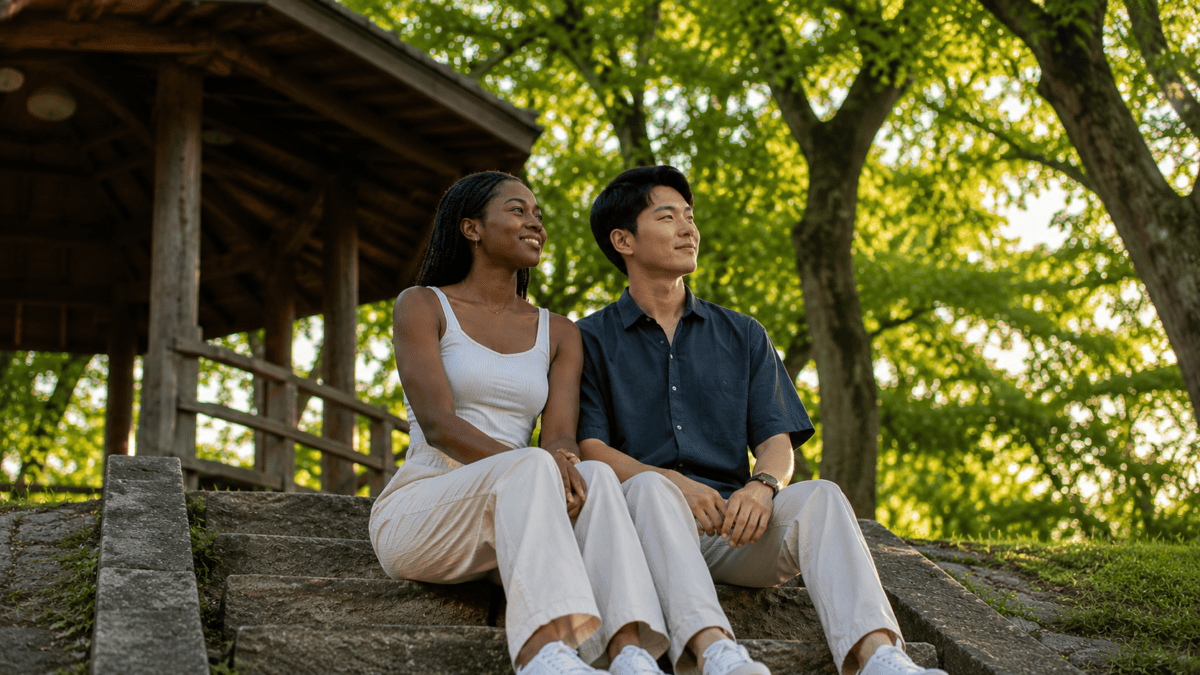
Stay until the light starts to go, and the forest changes again.
Late in the afternoon the sun drops low enough that it stops reaching the water altogether, and the whole Damyang forest slides into a deeper, bluer shade. The heat still hanging in the open fields beyond the trees finally lets go, and a cooler air moves down the stream. This is the coolest hour, the one the regulars know — the trees dark overhead, the water sounding somehow louder as the day quiets around it, the stones underfoot cold now even where the sun had warmed them earlier.
People start to gather their things, slowly. Feet come out of the water and dry in the cool air. Mats get rolled up. A grandmother calls a reluctant child out of the stream, twice, then a third time. The smell changes too, the day’s warmth giving way to the damp green breath the stream sends up as the light fails, and you pull your feet from the water and feel the evening cool touch the wet skin. The light through the old branches turns from green to grey-green to something dimmer, and the shade that felt like pure relief at noon begins, just faintly, to feel like the front edge of evening.
You could stay a little longer. The water will keep running cold long after dark, over the same stones, under the same three-hundred-year-old trees, cooling the same air it has cooled every summer night for centuries. Tomorrow the heat will come back, and the shade will be waiting for it, and the stream, and the people with their shoes in their hands. But for now the day is emptying out of the forest the way the light is, slowly, and the last thing to go, when you finally walk back out into the warm dusk, is the cold still in your feet.
This post was planned and edited by a human, with AI assistance.