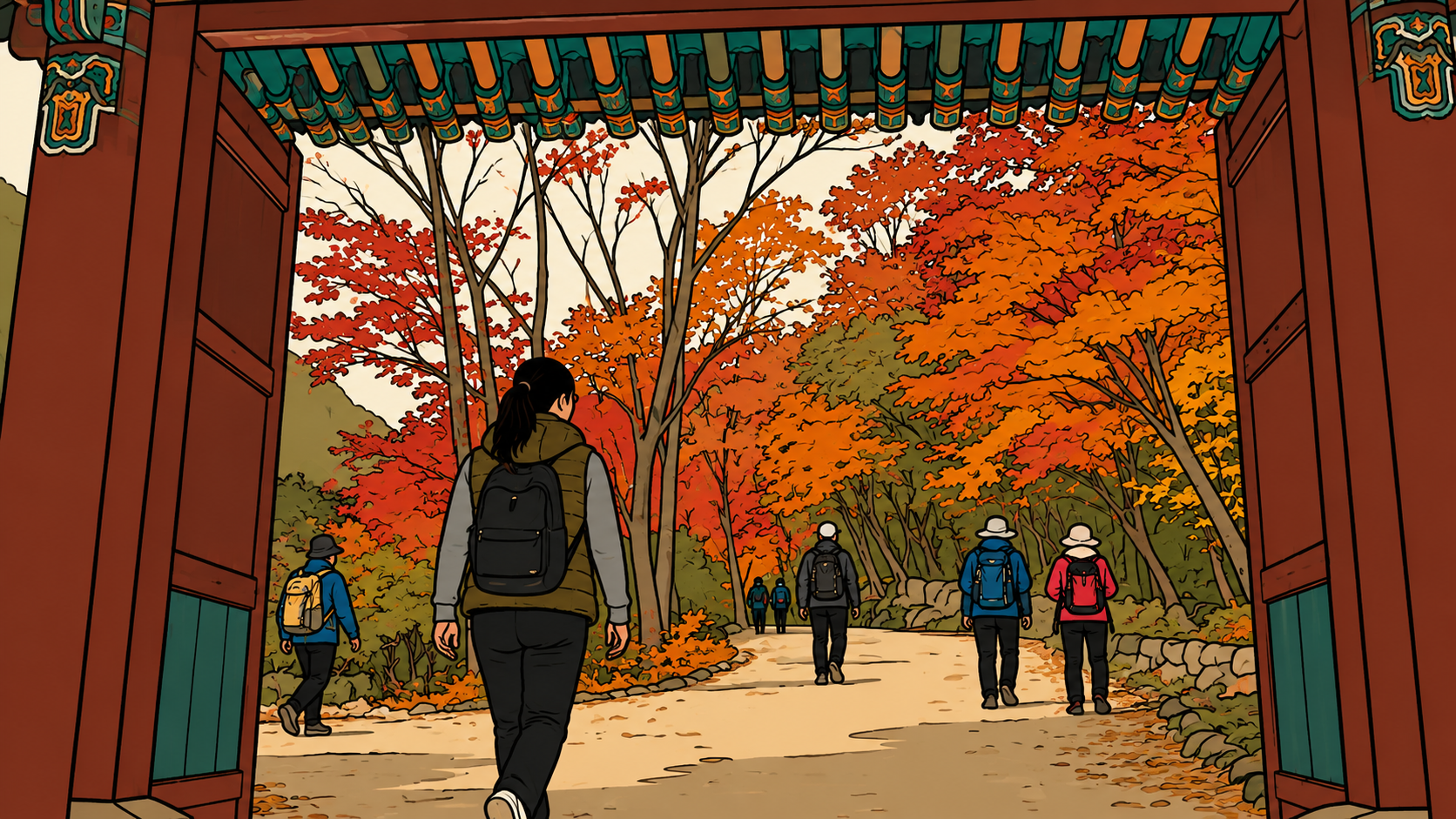
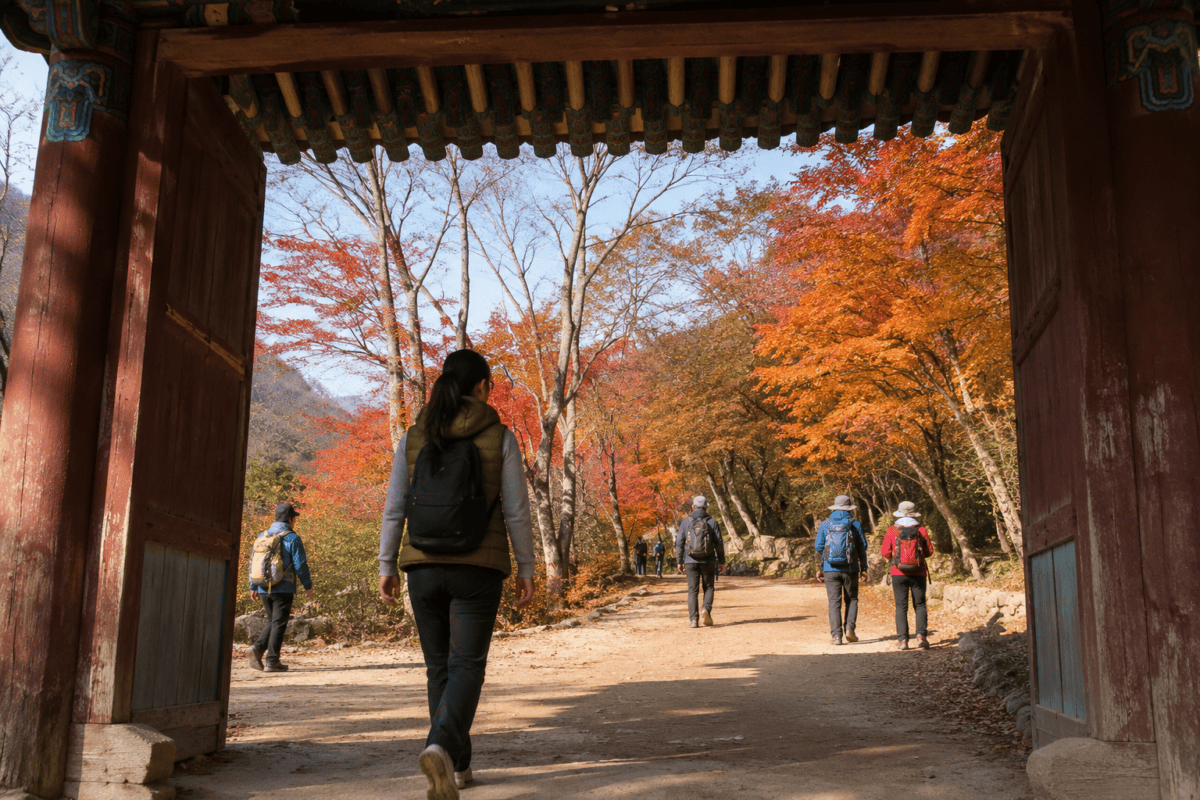
The maple tunnel ends at a bend, and the road keeps going without its ceiling. Most people stop here. They have their photographs. Naejangsa (내장사: nae-jang-sa, naejangsan temple) is another fifteen minutes up, and fifteen minutes is enough to thin a crowd of four hundred down to forty.
The mountain closes in on both sides after the bend. The name of this place means something kept inside, and from here you can see what that refers to — the ridges come around in a half circle, and the temple sits at the bottom of the bowl they make.
Past the Tunnel, the Road Empties
The walking changes. On the tunnel road everyone moved at the speed of the group. Here the line breaks apart and people find their own pace, and within two hundred meters there are gaps of thirty seconds between one party and the next.
An older man passes going the other way, already finished, jacket tied around his waist, face wet. He nods at nobody in particular.
The stream stays on the left, wider now and quieter, moving through a bed of pale stone. Where it slows against the bank there is a film of leaves on the surface, packed edge to edge, and under them the water is still going. Moss on the rocks is soaked dark green. This is water that does not run so much as sink in — into moss, into stone, into the roots along the bank — and the sound it makes is lower than the sound the same stream made down at the entrance.
A crow goes off somewhere above the ridge line and does not stop for a while.
A signboard at the side of the road gives the distance to Naejangsa in three languages and a different number in two of them. Nobody checks it against anything. Past it the road bends once more and the buildings appear all at once — grey roofs, low, sitting flat under the ridges, smaller than the mountain behind them by a factor no photograph will get right. Two people ahead stop walking without discussing it. Then they start again.
What Naejangsa Sounds Like at Eleven in the Morning
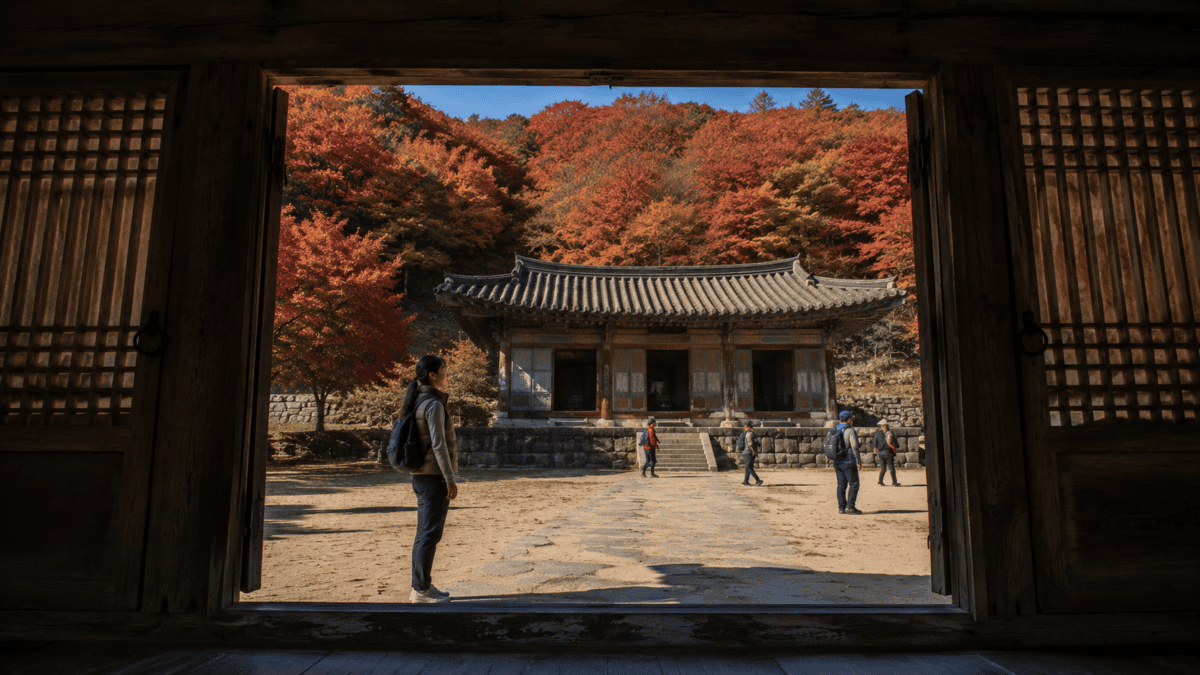
Through the gate, the ground changes from asphalt to packed dirt and then to flagstone.
The courtyard is wide and mostly empty. A temple has stood on this spot since 636, under two different names, taken down by war and fire and rebellion more times than the signboard has room to list, and what is here now is a courtyard of buildings in different states of age — some with paint gone chalky and thin, some with color still sharp enough to read every line of the pattern under the eaves.
Sound arrives in pieces. A broom on stone, slow, from behind the far hall. Someone’s boot heel. A recorded chant coming from a speaker mounted high on a post, low enough that you notice the birds over the top of it.
Then the bell.
It is one strike, not a sequence, and it does not end where you expect it to end. The sound goes out flat across the courtyard, comes back off the ridge behind the buildings, and thins into nothing somewhere over the trees. Three people stop walking. Nobody looks at the bell tower. They look at the ground, or at the middle distance, the way people do when they are listening to something they cannot see.
A tour group comes through the gate behind, mid-conversation, and drops to half volume within five steps. Nobody tells them to. The courtyard does it — the width of it, the flagstone, the ridges standing up on every side.
Incense from the burner in the middle of the yard goes straight up in the cold and then breaks apart at head height.
Shoes at the Threshold
The main hall is open. Shoes come off at the step.
Almost nobody goes all the way in. They stop at the threshold, put their palms together, bow twice from the doorway, and step back into their shoes. Inside, the floor is bare and warm-colored and there is room for sixty people. There are four.
Everyone finds a way to be here without fully entering. One woman stands at the doorway for a long time and then does not go in at all. Two students look at the ceiling from outside — paper lotus flowers, hundreds of them, hanging in rows with slips of paper trailing from each one — and photograph it from the step, arms extended past the threshold they will not cross.
It is not reverence exactly. It is closer to the habit of staying near the edge, which most people bring with them and do not put down at a temple gate.
The four who went in do not look up when the others leave.
A woman comes out with her shoes in her hand and puts them on standing, one hand on the doorframe, balancing. On the step there are maybe thirty pairs lined up and none of them match — hiking boots, city loafers, a pair of slides worn over socks. Someone has set a walking pole against the wall and left it there. The wood of the step is worn pale in a strip down the middle, the width of a person. Nobody looks at anyone else’s shoes and everybody looks at everyone else’s shoes.
Outside, a monk in grey crosses the courtyard with a plastic basin under one arm, walking fast, and disappears behind the kitchen wall.
Up Geumseon Valley

Behind the temple the path narrows and turns to stone steps.
This is where the day sorts itself. The people in dress shoes turn around at the first flight. Everyone else keeps going, and by the tenth flight the temple roofs are below and the color is at eye level instead of overhead.
The steps are wet. Not from rain — from the valley itself, which stays damp under the canopy well past noon, so that every stone has a dark strip down the center where a thousand boots have polished it. Cold comes up through the soles. Hands go to the rail and come back with rust on them.
Geumseon Valley runs alongside the whole way. The stream is narrow here, dropping in short falls of a meter or two, and the sound is constant enough that after five minutes you stop hearing it and only notice it again when the path swings away and it goes quiet.
Halfway up, a couple sits on a flat rock, sharing a thermos cup and passing it back and forth without talking. Below them the water goes over a lip of rock and lands in a pool the color of weak tea, and the leaves that come down land on it and turn, once, twice, and go over the next edge.
A woman coming down warns the group behind her about the fourth flight, where one stone sits loose. They thank her and forget within a minute. Below, through a gap in the branches, the roofs of Naejangsa show for a second and then close again, and after that the valley is all there is — rock, water, and the sound the two make together. A pair of gloves is spread out to dry on a boulder where somebody left them. They are still there on the way down.
Further up there is a waterfall with a name. Most people never reach it. They get to a bend with a view back down the valley — temple roofs small and grey, the bowl of ridges holding them, red on every side and going redder toward the top — and they stop there, and stand, and after a while they turn around and start back down the wet stone with the sound of the water behind them the whole way.
This post was planned and edited by a human, with AI assistance.