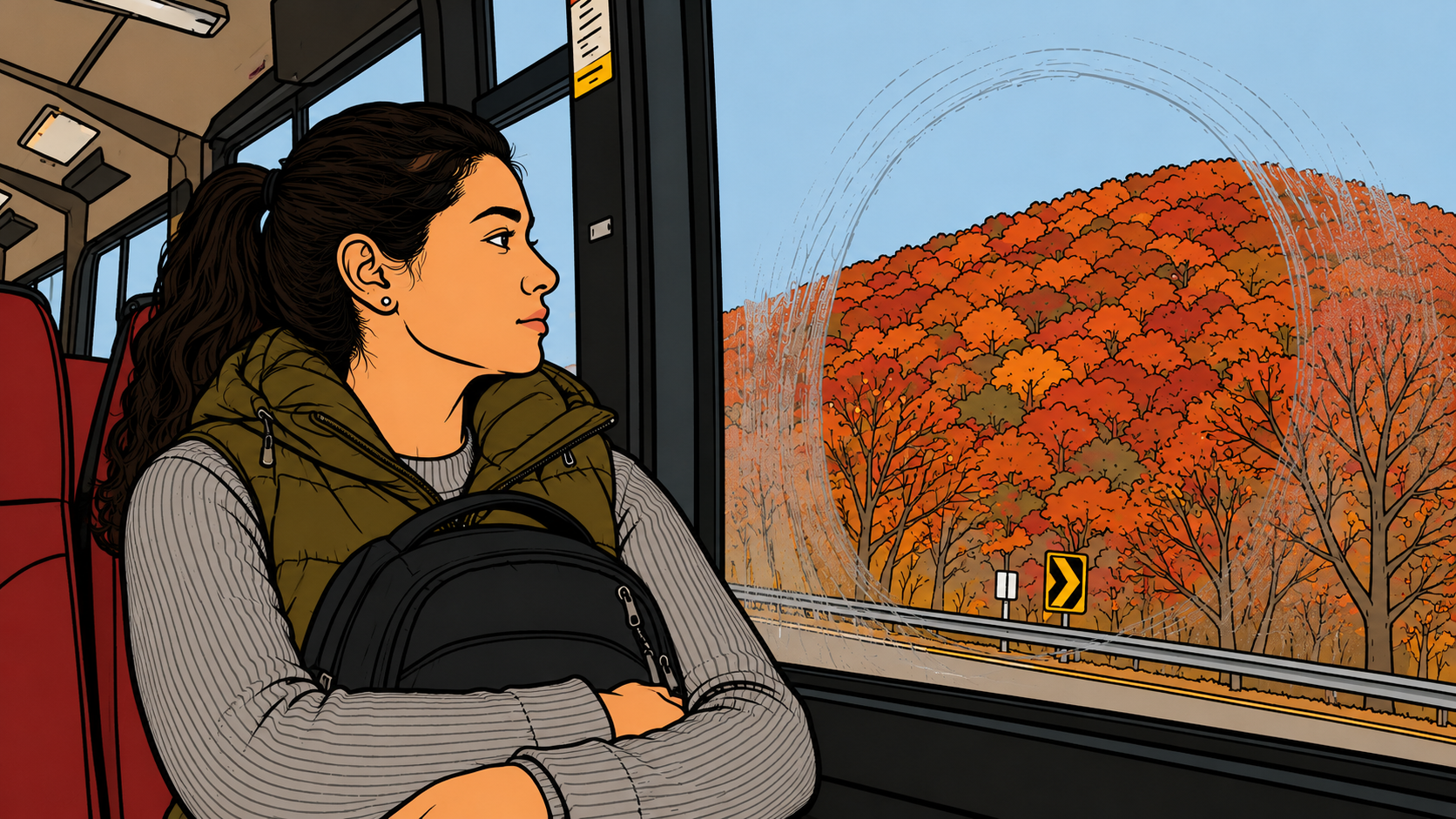
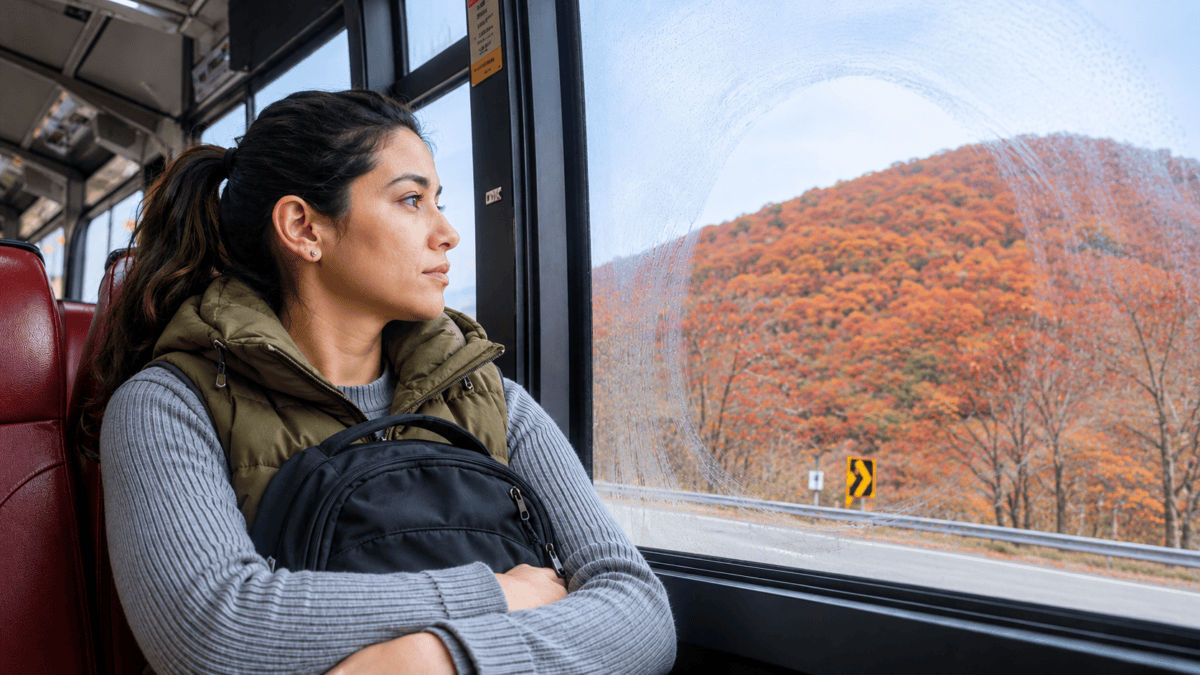
The first bus out of Jeongeup leaves before the station café opens. Six people wait at the stop, all of them holding coffee from a vending machine, all of them looking at the same patch of sky over the low buildings. Naejangsan (내장산: nae-jang-san) is forty minutes away. Everyone here already knows that the naejangsan autumn foliage runs late — that by the time this mountain turns, Seoraksan has been bare for three weeks and the news has moved on to something else.
That is the whole reason for the early bus.
The First Bus From Jeongeup
The windows fog from the inside. Someone wipes a circle clear with a sleeve and keeps their face near it for the rest of the ride.
Rice fields go past, cut down to stubble, the frost on them already going. Then a river. Then the road narrows and starts to climb, and the driver takes the curves without slowing, and a plastic bag in the luggage rack swings out and back, out and back.
The mountain does not appear all at once. It comes in pieces through the gaps between ridges — a wedge of red, then nothing, then a longer wedge, orange this time, then nothing again. Nobody in the bus says anything about it. But the wiping of the windows gets more frequent.
Cars stop at the rest area below the entrance. Past that point the road belongs to shuttles and to walking. The bus empties into cold air that smells like wet stone and diesel and, underneath both, something sweeter and half-rotted — leaves that came down last week and have been sitting in the ditch since.
At the ticket window, a woman in a park uniform is already answering the same question she will answer four hundred more times today.
Is it peak yet.
She says give it four days. She says it every year, and every year the mountain does whatever it wants.
Behind her, a laminated board shows the dates the naejangsan autumn foliage peaked for each of the last ten years. The earliest is October 30. The latest is November 14. Someone photographs the board instead of the mountain. A man reads the numbers out loud to his wife, who is not listening, because she has already started walking toward the gate with her hands pushed deep into her sleeves.
Uhwajeong Holds Still in the Water
The path from the entrance runs flat and easy along a stream. This is the part people skip when they are in a hurry, and it is the part that decides how the rest of the day feels.
The stream stays on the left the whole way, shallow and loud over flat rock. Leaves collect in the slow places against the bank, three deep, going brown at the edges. A child crouches to push one out into the current with a stick and watches it turn twice and go. Her father waits, then does not wait, and she runs to catch up with wet fingers.
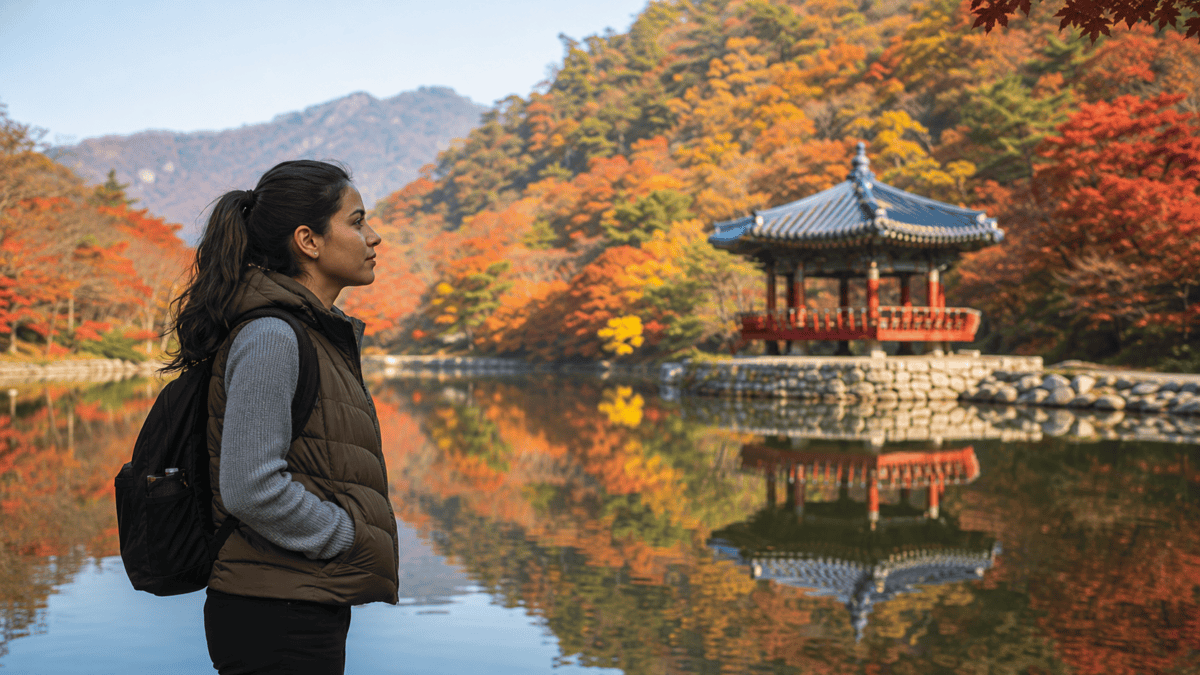
Uhwajeong (우화정: u-hwa-jeong) sits on a small pond a short walk in. An octagonal roof, a wooden rail, water so still in the early hour that the whole thing appears twice — once standing, once upside down and slightly darker.
The reflection is what people came for. Around the edge of the pond, twenty phones are held at the same low angle, arms extended over the water, everyone waiting for the same second when the surface stops moving.
A duck ruins it. Then the surface closes again.
Behind the pavilion the trees are not one red. They are a dozen reds stacked against each other — the ones at the water’s edge already deep and blood-dark, the ones halfway up the slope still orange with green centers, the ones at the ridge line untouched, waiting. The leaves here are small. Locals call them baby maples, and the name is exact: each one fits inside a palm with room left over.
Cold comes off the water. Hands go back into pockets. Somebody’s thermos opens with a hiss and the smell of barley tea moves through the group and disappears.
Where Naejangsan Closes Red Overhead
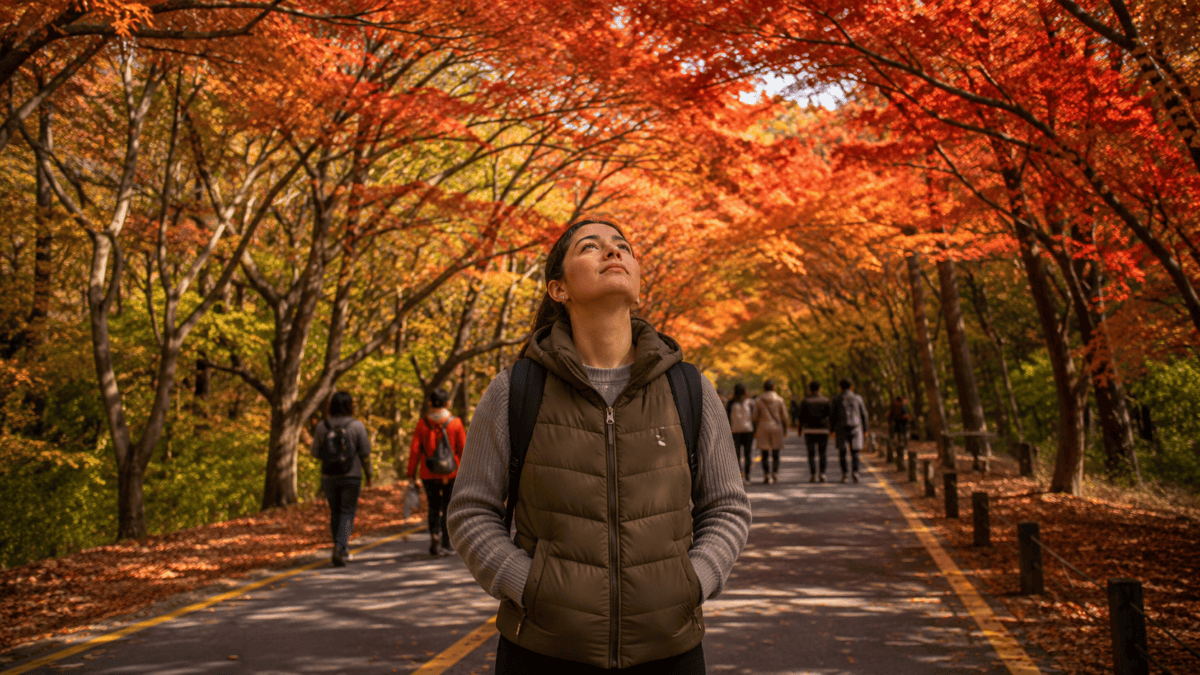
Past the information center the road passes under a gate, and then the ceiling drops.
This is the stretch people mean when they talk about this mountain. A paved road, four hundred meters, lined the entire way by 108 maple trees whose branches have grown across and knitted together overhead. The light that gets through is not white. It comes down already colored, and it lands on the road, on jackets, on the backs of hands, so that everyone walking under it is briefly the same shade.
Sound changes too. The road is closed to cars, so what fills the tunnel is footsteps on asphalt, the click of a walking pole, and a low continuous murmur that never resolves into any single conversation. Every twenty meters, someone stops without warning to shoot straight up. The person behind them stops too. The whole column accordions and reassembles and keeps moving.
Halfway through, a man in his seventies stops in the middle of the road, tips his head all the way back, and stands there with his mouth slightly open. His wife walks on ten steps, notices, comes back, and stands next to him without saying anything. They stay like that long enough for three groups to walk around them.
The naejangsan autumn foliage does not photograph the way it looks. Everyone here finds that out within the first minute and keeps shooting anyway.
The Crowd You Walk Inside Of
By ten o’clock the tunnel is full.
Not crowded in the way a subway is crowded. Crowded in the way a river is full — still moving, still going one direction, but with no gap anywhere. Tour flags go up. A guide counts heads in a language that is not Korean. Vendors along the shoulder set out roasted chestnuts and steamed corn, and the smell of scorched sugar sits over everything for about thirty meters and then is gone.
Something happens to people in this. You were fine until more people arrived, and now you are walking at a speed you did not choose, stopping where the person ahead stops, looking where forty other faces are already looking.
Some fight it. They break for the shoulder, get ahead by ten meters, and then hit the next cluster and slow down again.
Some give in early and walk with their hands behind their back.
An older woman at the edge of the road says to nobody in particular that this mountain always goes last because it holds the summer heat longer than the rest. She says it like a complaint. Then she says the other thing people here say — that autumn on this mountain is when what the summer stored finally gets counted — and her friend laughs and tells her to stop talking and take the picture.
They take the picture. They move on.
Near the temple wall the crowd thins for the first time. A side path goes up into the trees and most people do not take it — Naejangsan looks the same from the road, and the road is easier. Ten steps in, the murmur drops by half. Twenty steps in, it is gone, and what is left is wind moving through dry leaves overhead, a steady rustling, closer to paper than to water. Two women sit on a rock with their boots off, socks steaming faintly in the cold. Neither of them is talking. When they leave, the sound of the road comes back before they are out of sight.
The leaves keep coming down the whole time. Not many. One or two in the corner of your eye, always in the direction you are not looking, so you turn and there is nothing there, only the road going red into the distance and the next crowd walking into it.
By afternoon the color on the ridge will have moved down another meter. Nobody standing here will be able to see it happen.
This post was planned and edited by a human, with AI assistance.