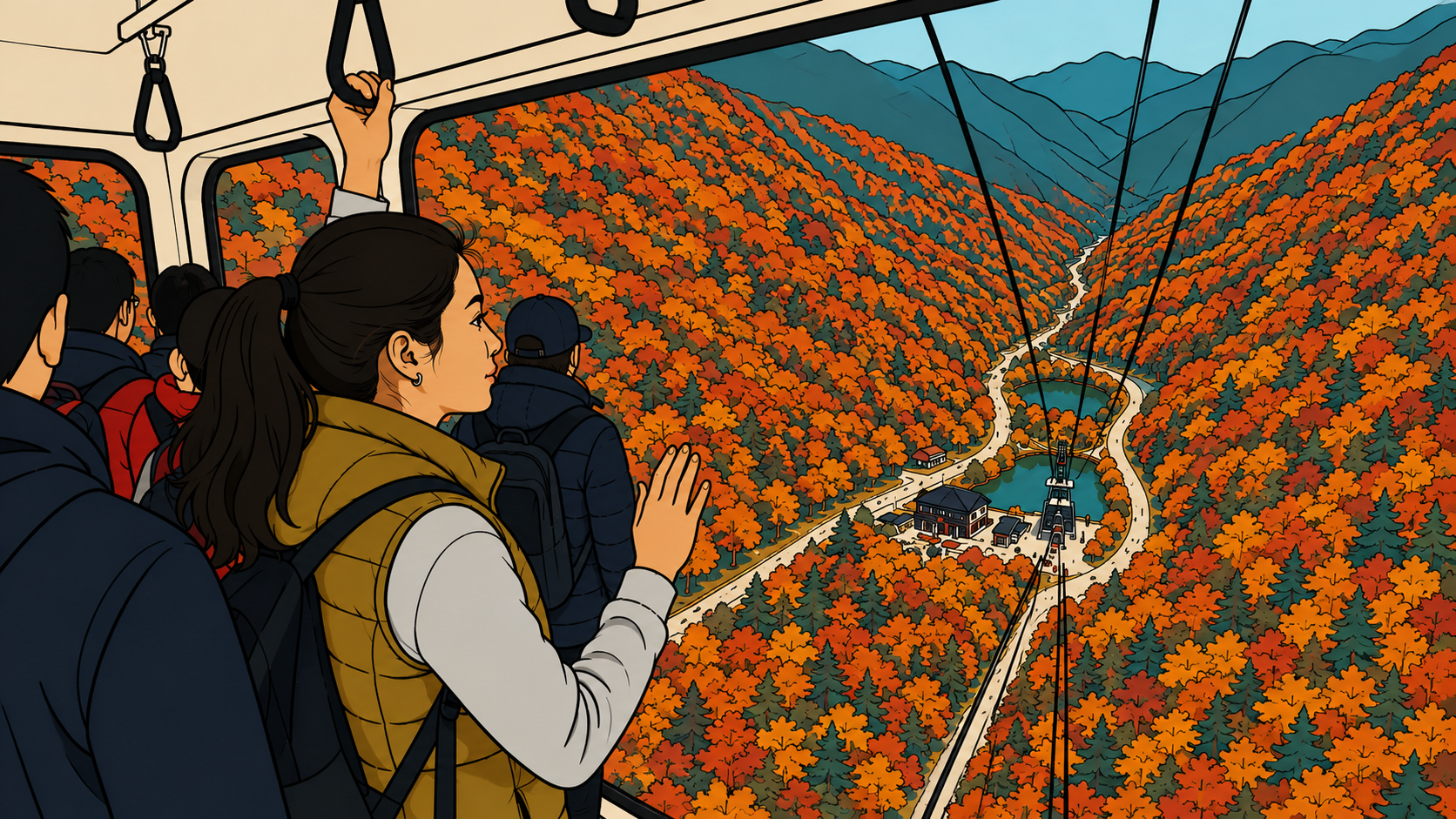

The line starts forming at nine. By nine forty it has doubled back on itself twice, and the man at the front of it has been standing there since before the ticket window opened. Nobody is annoyed. This is the naejangsan cable car in the third week of foliage season, and everyone in the line already did the math on the walk up.
Two kilometers of steep steps, one to two hours. Or five minutes.
The Line at the Lower Station
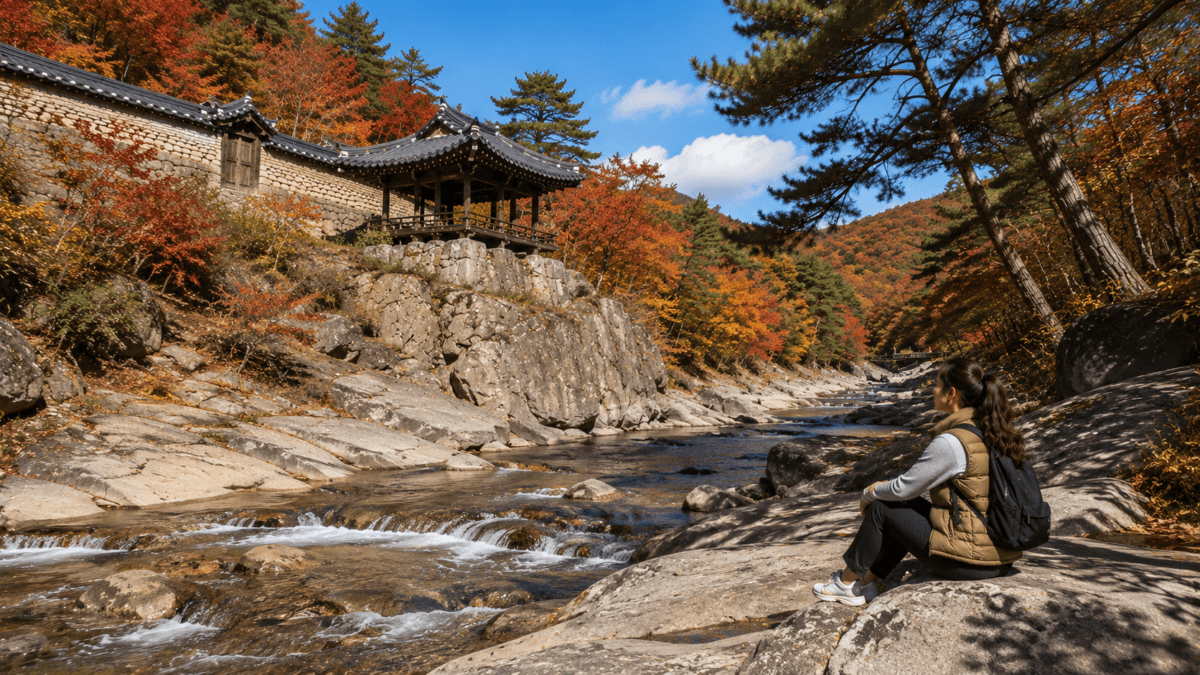
The path to the station passes a wide place in the stream where the rock flattens out and the water spreads thin across it. There is a pavilion up on the bank, roof low, pine trees leaning over it from behind. Three men are sitting inside with their boots off, and one of them is asleep sitting up.
Below the pavilion the granite is pale and dry in the middle of the channel, worn smooth in long grooves that run with the current when there is more of it. Right now there is not much. The water goes around the edges of the rock in threads and collects in shallow basins where leaves have gathered and stopped.
Two hundred meters further on, the line.
It moves in bursts. A car arrives, twenty minutes of nothing, then everyone shuffles forward at once and stops again. People eat while they wait. Someone has brought a folding stool. A grandmother in a purple visor negotiates with the group ahead to let her granddaughter squeeze in, and they do, and the granddaughter looks at nobody the entire time.
The mountain is right there the whole wait, filling the sky above the station. Nobody in the line is looking at it.
Five Minutes on the Naejangsan Cable Car
The car holds fifty. It fills to fifty.
For the first thirty seconds nothing much happens — the roofs of the station drop away, then some scrub, then the tops of trees that were above eye level a moment ago. People are still adjusting bags and finding somewhere to put their elbows.
Then the ground falls off underneath and the whole car goes quiet at once.
Below, the road appears. The one everyone walked up this morning, the one with the ceiling of maples over it, and from up here it is a thin pale thread with a red seam running along both sides. The tunnel that felt enormous from inside is a line you could cover with two fingers. The temple is a cluster of grey rectangles at the far end of it, and behind the temple the valley of stone steps is a dark crease that goes nowhere visible.
A child asks where are all the people. Her father says they are there, you just cannot see them.
Somebody’s phone slips and they catch it against the glass and there is a small collective noise, half laugh, half something else. Then quiet again.
Halfway up, the car crosses a tower and jolts once. Everyone’s knees bend the same amount at the same time.
Nobody rides the naejangsan cable car for the ride. They ride it to arrive somewhere they could not have walked to in the time they have, and the five minutes are spent mostly looking down at the part of the day that is already finished. A man near the door keeps turning his head back toward the entrance long after it has gone behind the ridge. His wife has already faced forward.
The Three Hundred Meters Nobody Warns You About
The upper station empties out onto a platform, and this is where the day divides for the second time.
From here it is a three hundred meter walk to the observatory at Yeonjabong (연자봉: yeon-ja-bong). Three hundred meters sounds like nothing. It is not paved, it is not flat, and it goes up over bare rock and railroad-tie steps that are set at heights nobody’s legs agree with. Eight minutes if you are moving well. Twenty if you are not.
The people in city shoes discover this immediately. Some turn around. Most keep going slowly, one hand out for the rope strung between posts, and the line stretches and thins along the ridge until it is not a line anymore.
The wind is different up here. Down at the temple it moved through the trees. Here it comes across the ridge with nothing in the way and goes straight through a jacket, and within a minute everyone who unzipped on the climb is zipping back up.
The rock underfoot is dry and gritty and pale. Boot soles make a scraping sound on it that they did not make anywhere below.
Near the top a woman stops, puts both hands on her knees, and says something to her husband about never again. He waits. She straightens up. They keep going.
Nine Peaks in a Horseshoe
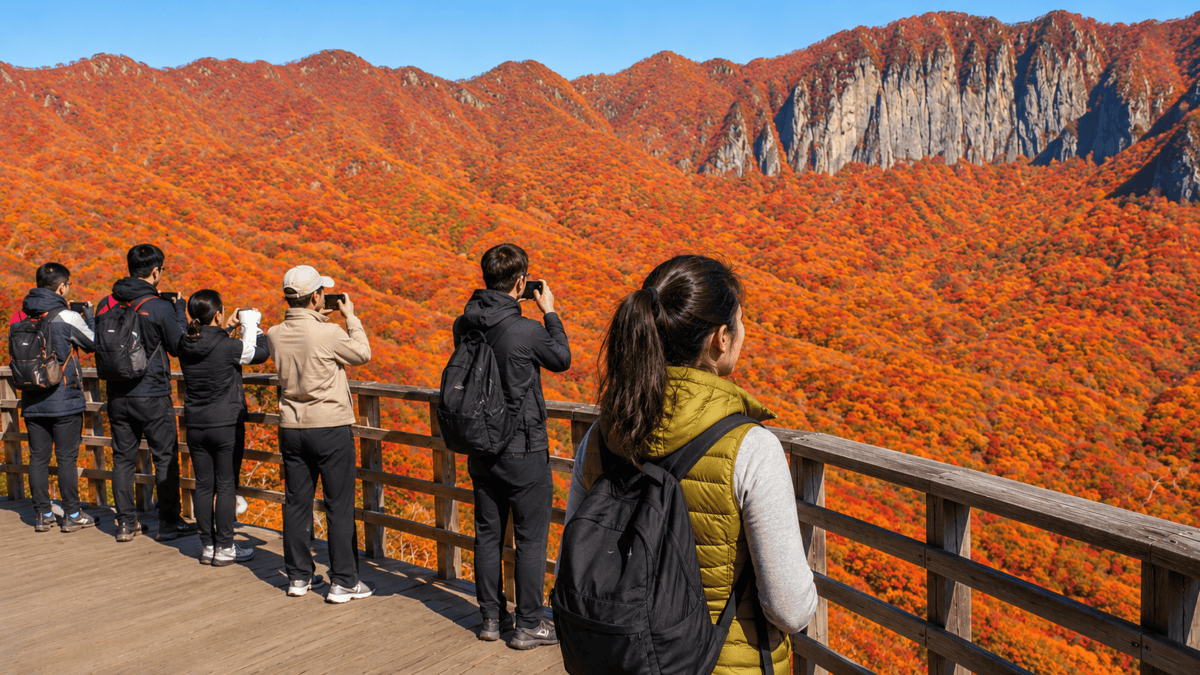
The observatory is a wooden deck with a rail, and it is full.
What it looks out over is the reason for the whole day. Nine peaks stand around the valley in a horseshoe, open at one end, and the basin they enclose is entirely red — not one red but the same dozen reds that were stacked along the pond this morning, only now they are laid out flat and seen from above, so the layering reads as blotches instead of depth.
That is the difference nobody expects. From underneath, the color had thickness. You walked into it. From up here it is a surface. A pattern on a bowl.
Across the basin, Seoraebong (서래봉: seo-rae-bong) shows its rock face, grey and vertical, with color running right up to the base of it and stopping. Somewhere behind and to the left is the highest peak, and three people are arguing mildly about which one it is.
Everyone photographs the same view. Then they lower their phones and keep standing there, which is not what happens at most viewpoints.
An older man explains to nobody in particular that autumn is the season for deciding what to keep and what to leave out, and that you cannot do it from inside the thing. His companion says that is what he said last year. He says he will say it again next year.
Below, the road is still there, still narrow, still moving. The crowd on it has not thinned at all since morning — from here you can see that it never does, that people are entering at one end at the same rate they are leaving at the other, and that the whole thing has been in steady state for hours while everybody inside it felt like they were making progress.
It is the same with a year. You cannot tell what phase you are in while you are walking through it, and knowing which year you are actually in changes what the walking means.
The wind comes across again. Somebody’s hat goes over the rail and down, and four people watch it turn twice on the way and disappear into the color.
Nobody goes after it. There is nowhere to go after it.
The last car down leaves at five. By four thirty the deck is emptying, people going back over the three hundred meters more carefully than they came, and the light on the basin has gone from flat to slanted, so the reds on the far slope are lit and the reds on the near slope have already gone brown with shadow.
On the way back down the naejangsan cable car is nearly empty. Six people in a car built for fifty, all of them sitting, none of them talking. The valley comes up to meet the glass and the reds resolve back into trees, then into branches, then into individual leaves, and by the time the station roof appears the mountain has stopped being a pattern and gone back to being a place you are standing in.
The mountain does that every afternoon. It has been doing it since before the road, before the temple, before anyone thought to run a cable up the side of it to look.
This post was planned and edited by a human, with AI assistance.