The second day starts later. Nobody is racing the light this time, and the restaurant below the park entrance is already half full at eleven.
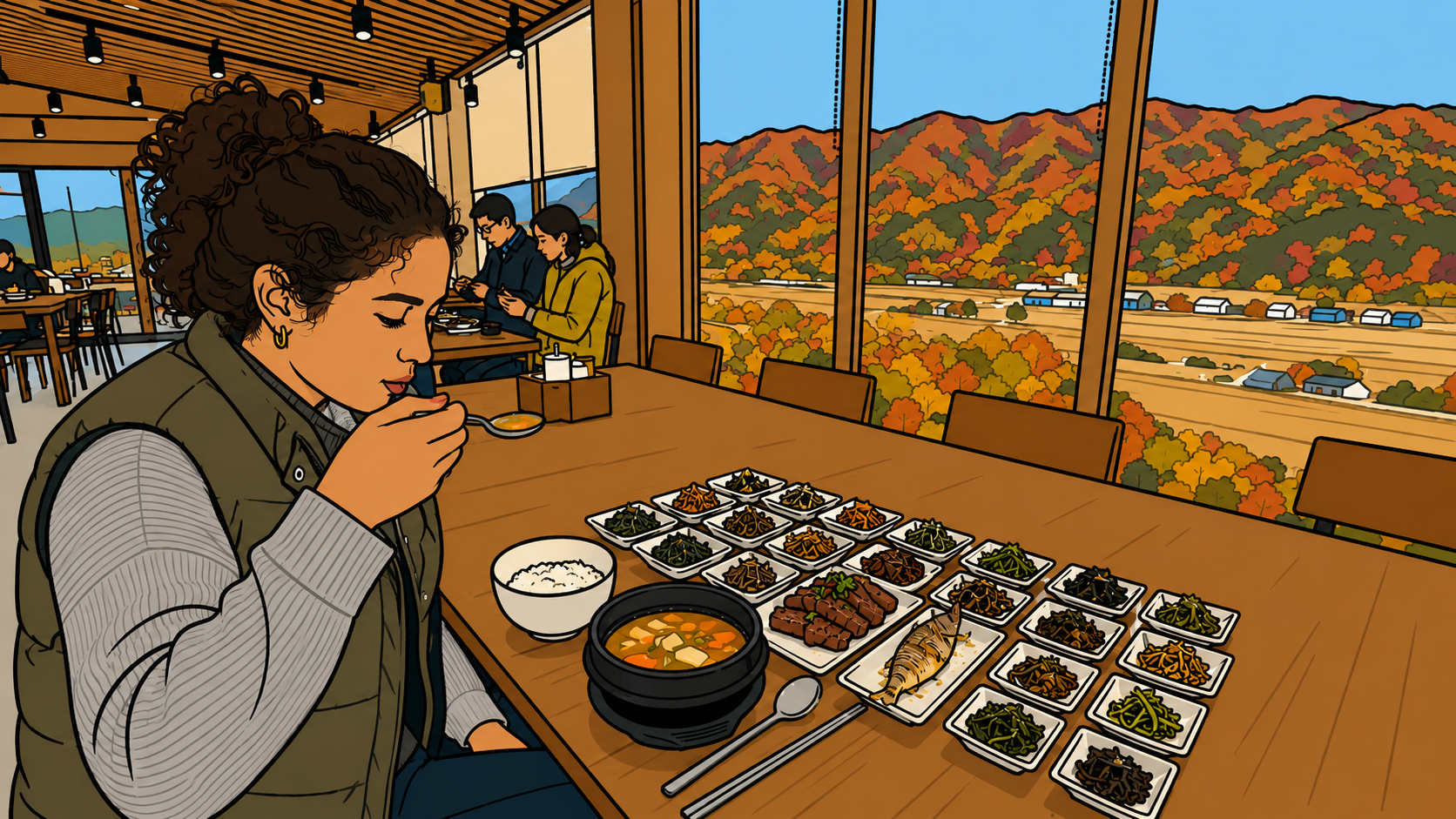
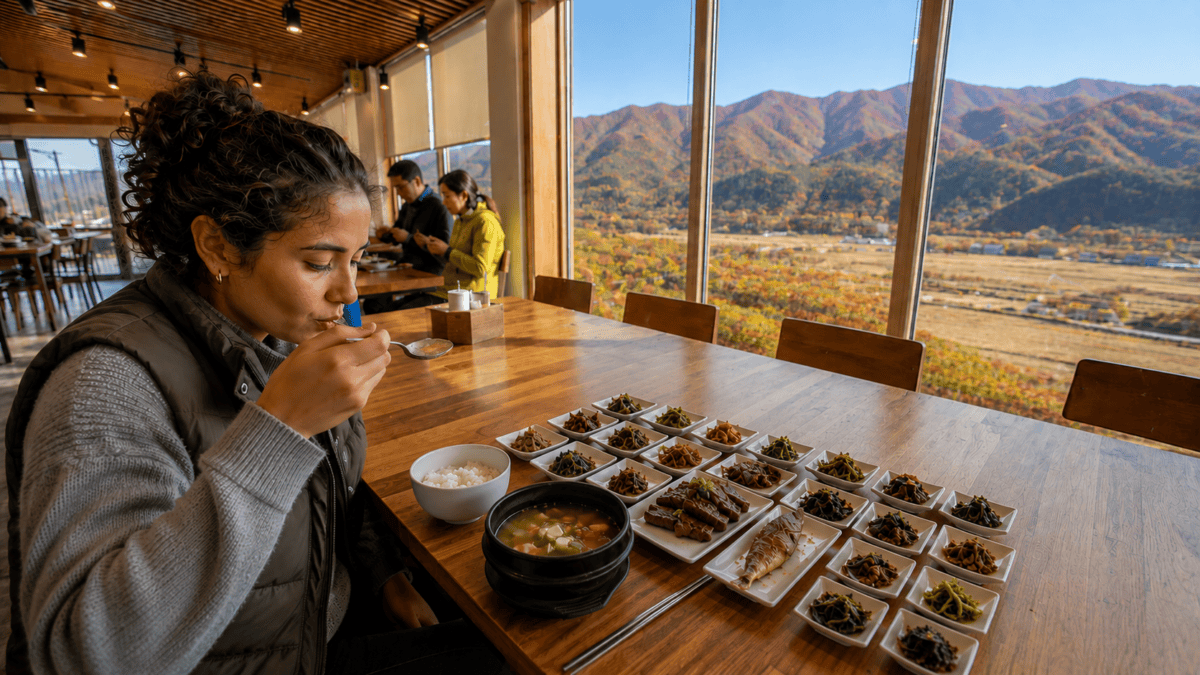
It is not what visitors expect. Naejangsan food comes out of a room with a slatted wood ceiling, track lighting, and a wall of glass with the mountain sitting in it. There is a long shared table down the middle in one piece of timber. You keep your shoes on. You sit in a chair.
The window is the whole point of the room and nobody sitting in it says so.
Hiking jackets go over the backs of chairs. Poles lean in the corner by the door, six or seven pairs, none of them labeled. A group of four comes in still talking about the ridge and drops to normal volume within a few steps, the way people do when they walk from outside into somewhere warm.
The glass is cold if you put your hand on it. Beyond it there is a stretch of fields gone brown, low farm buildings, and then the ridge, far enough off that the red on it has gone soft and the grey near the top reads as one flat color.
Two women take the seats facing it. Everyone takes the seats facing it. The ones who come late sit with their backs to the window and turn their heads every few minutes.
What Naejangsan Food Doesn’t Come With
Water arrives in a steel kettle. No one is handed a menu. There is one thing to order and the woman writes down how many.
It arrives all at once, and it arrives in pieces.
Two dozen small square dishes come down across the table in about nine seconds, carried by one person on one arm. A bowl of rice each. A pot of soybean stew still moving. Grilled ribs on a long plate, one dried fish, a tray of something red and charred at the edges that turns out to be root, split and pressed flat.
And then nothing that looks like a main course.
There is one name for all of it, and it is what naejangsan food means to almost everyone who eats it here.
That is the part nobody explains. Everything on this table is a component. What you do with the components is not written anywhere, and the room is full of people doing it differently.
The greens are the mountain itself. Bracken, flat and green-bitter, the bitterness sitting at the back of the tongue and staying. Bellflower root, sharper, almost peppery. Aster leaves. Deodeok shavings in vinegar. Dried radish greens gone soft and dark. Each one seasoned separately, each in its own dish, each tasting like nothing else on the table.
You can eat them that way. The old man by the window does — rice, then one dish, then rice, then the next, working across the table in order, and nothing on his side of the table ever gets combined.
His wife does the opposite. She asks for an empty bowl, takes a little from everything, drops it in, adds rice, adds sesame oil, adds a spoonful of red paste from the small dish at the corner, and mixes it hard for twenty seconds until the colors are gone and it is all one warm brown-red. That is what sanchae jeongsik (산채정식: san-chae-jeong-sik, a set meal built around mountain vegetables) turns into when someone decides to make one bowl out of it. Nothing on the table came out looking like that.
Neither of them is doing it wrong. Nobody at the next table is doing it wrong either, and one of them is doing a third thing — mixing half, eating the rest separately.
These are the rules nobody said out loud, and the room teaches them the same way it teaches everything: you watch, and then you do something, and the table beside you keeps eating.
What goes into sanchae jeongsik changes with the day and with whatever came off the slope that week, and even with a rib or a fish at the edge of the table, the bitterness has nowhere to hide. The foil tray empties first. It always does.
Naejangsan food is not a dish. It is a table you are handed, and what comes of it is yours.
The Green That Stays

The path up behind the temple grounds is different from the stone steps. Wider, softer underfoot, running alongside a shallow stream that has flattened out over rock.
Twenty minutes up, the color stops.
Not gradually. You come around a bend and there is a stretch of forest where everything is green — deep green, glossy, and dense enough that the red on the ridge above it looks like it belongs to a different season. The leaves are thick and heavy and about the size of a palm, and they hang down rather than spread out.
A sign at the edge of it says this is a protected grove of gulgeorinamu (굴거리나무: gul-geo-ri-na-mu), and that this is about as far north as the tree grows on its own. It gives a protection number and a date. Underneath, in smaller type, it adds the Latin, the way signs do when a thing has no name in most languages.
An older man reading it out loud to his group adds the part that is not on the sign. The old leaves on this tree do not fall in autumn. They hold on through the winter and let go the following spring, and only once the new ones are already coming. Nothing is released until the replacement is already there.
Somebody says that must be why it stays green. Somebody else says that is not how it works. They keep walking.
Somebody has left a thermos on the stone wall and gone off somewhere. The green goes on for another hundred meters, and then the red starts again.
Under the Rock Face

Byeongnyeonam (벽련암: byeong-nyeon-am) sits where the path runs out.
It is small — a main hall, a stone pagoda, a low wall along the drop, a few buildings behind. What makes people stop in the yard is not the hall. It is what is above it.
Seoraebong stands up out of the trees on the slope behind, grey and broken into towers, close enough that people in the yard are looking up instead of at the buildings. Two days ago it was the thing across the basin, seen from a deck with a rail and a hundred other people. Now it is the thing this yard sits under.
The scale is wrong in a way photographs will not carry. The roof of the hall, the pagoda, the people standing in the yard — all of it reads as small print at the bottom of the rock.
A low tiled wall runs along the drop on one side of the yard, and below it the maples are at full color. The paint under the eaves is at full color too, and the two are close enough in tone that from across the gravel it is not obvious where the building ends.
The yard empties as fast as it fills. There is not enough room in it to stand around.
The Lake Takes the Whole Mountain
Naejang Lake is below all of it, on the road out.
A boardwalk runs along the water on the near side, curving out over the shallows in a wide loop. Late in the afternoon the surface goes still, and what happens then is the same thing that happened at the small pond on the first morning, at a scale that does not fit in one look.
The mountain comes down into the water whole. Nine peaks, the basin between them, the red running from the ridge to the shoreline and then again in reverse, upside down and slightly darker.
A car door shuts somewhere behind and the whole thing does not move.
People walking the boardwalk stop about halfway around, all of them at roughly the same place, without any sign telling them to. They stand there for a minute or two. Then they finish the loop and go to their cars.
The light goes orange, then flat. The reflection holds until the wind comes up off the far bank and takes it apart, and then it is just a lake with a dark ridge behind it, and the road out is already full of tail lights.
This post was planned and edited by a human, with AI assistance.