
The shuttle is not running. A laminated sheet taped inside the window of the ticket booth says when it stopped, and the date on it is eleven days ago.
For about two weeks every year this is what half the country is looking at. Buses leave Seoul before dawn to get here. The lot fills by nine, the shuttle runs full both directions, and the road under the trees moves at the speed of whoever is in front of you.
The naejangsan maple season ended somewhere in that gap, and the mountain has been standing here since without an audience.
The Lot Nobody Is Fighting Over
Three cars in a lot built for four hundred. One of them belongs to a park employee and it has been there long enough to have frost on the windshield at noon.
Half the stalls along the approach are shuttered with steel roll-downs. The two that are open have a woman in each, sitting inside with a small electric heater aimed at her feet. One of them is watching something on a phone propped against a jar of dried persimmons. She does not look up when someone walks past, and she does not need to.
The wind turned about two weeks ago, she says when asked. Before that it came down the valley. After that it came over the ridge, and once it comes over the ridge the leaves are finished inside a week.
She does not say it as a prediction. She says it as a date that already passed, and she says it without looking away from the phone.
Ticket booth is open. Same window, same price, no line at all. The woman inside is doing paperwork and has to find the roll of tickets.
The wind comes over the ridge and goes through everything. In early November people were unzipping on the walk up. Now the jackets stay closed from the parking lot.
Where the Naejangsan Maple Went
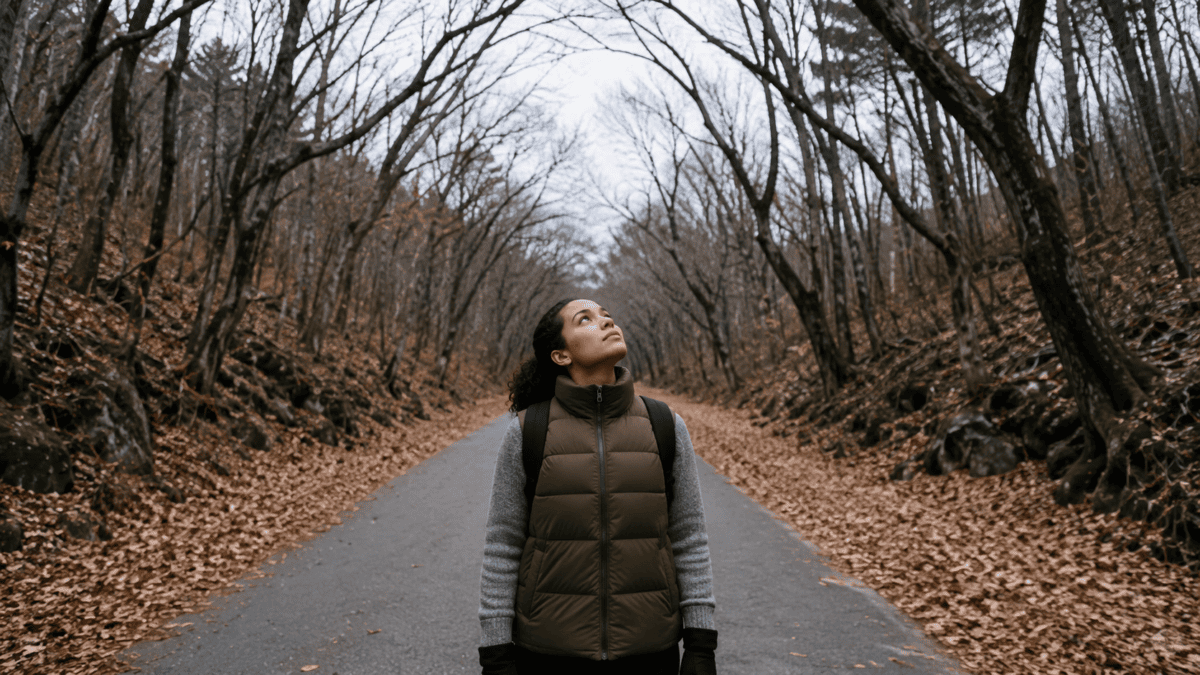
Past the gate the road looks longer than it did.
Four hundred meters of pavement with a ceiling of 108 maples over it — that was the thing. The branches are still there, knitted across overhead exactly as they were, and now you can see the knitting itself. Grey and black and bare, crossing and re-crossing, and above them the sky, which nobody looked at once in the whole of early November.
The light comes down white. Not red, not filtered, not landing on everyone’s hands in the same shade. Just ordinary daylight reaching a road that has not had any for a month.
The leaves are on the ground and they are loud. Ankle-deep at the shoulders where the wind has pushed them, thinner in the middle where feet have been, and dry enough now that every step is audible from twenty meters off. Someone walking ahead can be tracked without looking.
Underneath the dry layer the older leaves have gone dark and flat and slightly wet, and that is where the smell comes from — a low, sweetish rot that was there in early November too, buried under roasted chestnuts and scorched sugar and four hundred people. There is nothing on top of it now.
Pick one up off the top of the pile and it is small. That is the thing people forget about the naejangsan maple once it is on the branch and forty feet up and photographed against the sky — the leaf itself fits inside a palm with room left over. Locals call them baby maples. On the ground there are millions of them, overlapping five deep, each one brittle enough to break along a vein when it is turned over, and every single one of them was part of the ceiling six weeks ago.
A man in his sixties is walking the tunnel with his hands behind his back, no camera, no phone out. He goes the whole length that way and does not stop once.
Two women pass going the other direction, talking, and the conversation carries the entire length of the road.
What the Leaves Were Hiding

The temple appears earlier than it used to.
In color you came around the bend and it arrived all at once — grey roofs at the bottom of the bowl, and the ridges around them holding everything in. Now the buildings show through the branches from three hundred meters out, and so does the slope behind them, and so does everything on that slope.
This is the part that is not in any photograph taken here in October. The rock is visible. All of it. The grey faces and the broken towers that spent six weeks behind a screen of red are standing exposed on every side, and the shape of the whole basin reads at a glance — where it opens, where it closes, how steep the back of it actually is.
The mountain was this the entire time. The color was the thing on top of it.
In the temple yard a monk and two workers are stacking something under a tarp. The courtyard broom sounds different on bare flagstone than it did on flagstone with people on it. Shoes come off at the main hall step and there are four pairs there, which is the same number that was inside on the busiest morning of the year, except now they are the only four in the compound.
The stream behind is lower and clearer and colder. The stone steps up the valley are wet the same way they were wet then. A film of ice has formed in the still corners of the pools where the leaves collected and stopped, thin enough to break with a fingernail, thick enough to hold the leaf shapes underneath it in place.
Further up, past where the color used to stop, the grove is still green. Thick glossy leaves, palm-sized, hanging down. They were green when everything around them was red and they are green now that everything around them is bare, and it turns out that was never a trick of contrast.
The Mountain Puts It Away
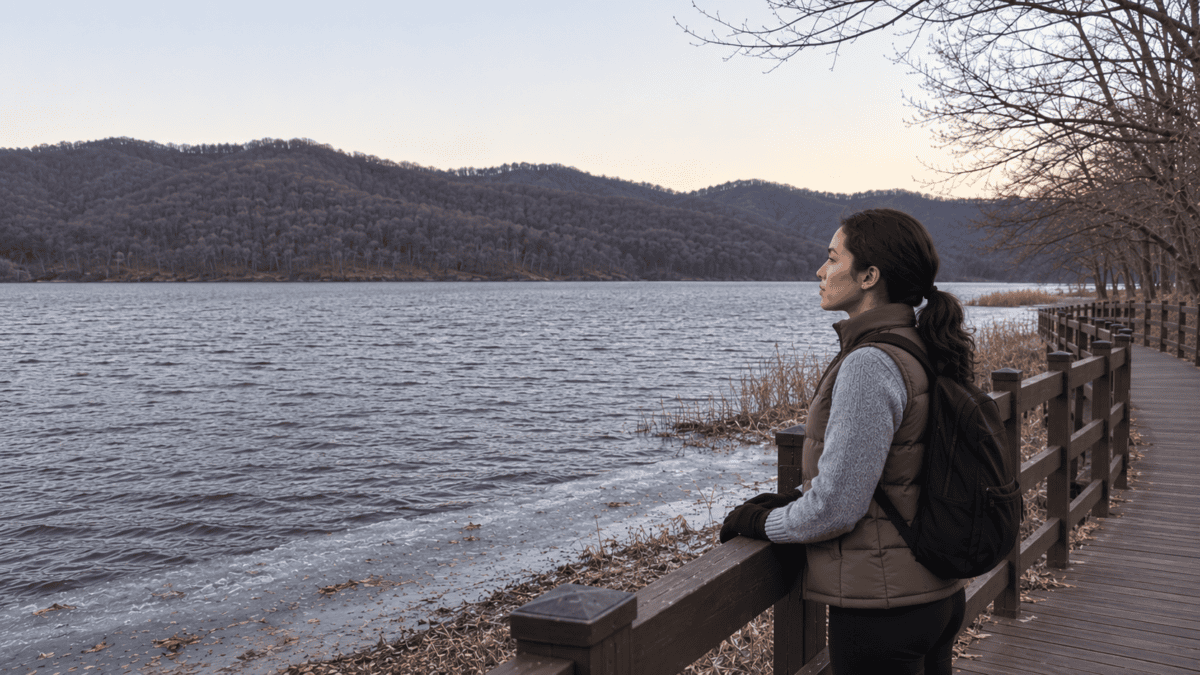
The lake at the bottom is not still.
Late November takes the surface most afternoons — wind off the far bank, no reflection, just grey water with a dark ridge behind it. The boardwalk is empty. The place where everyone stopped halfway around, without a sign telling them to, has nothing to stop for.
But the ridge across the water is legible in a way it was not in color. The nine peaks stand in their horseshoe with nothing softening the line, and the shape they make is the shape they have made every year, under the red and after it.
The boardwalk boards are wet and they knock under a single pair of feet in a way they could not have done in early November. Along the shore the water has skinned over in the shallows, a rim of ice maybe a meter wide, holding leaves and a bottle cap and one white feather. A heron stands out past it and does not move for the length of the walk.
A tour bus goes past on the road out without slowing.
The last light comes early and goes fast. The season changed without anyone announcing it, and the announcement everyone waited for — the peak forecast, the crowd that filled the road, the phones held out over the pond — turns out to have been about two weeks in the middle, not about the mountain.
What the year made is still here, in its last shape. Leaves down and breaking apart in the ditches. Roots holding under the frost line. Water going into the ground instead of over it.
The walk back out goes through the tunnel again, and this time it is worth stopping under it.
The leaves have been swept off the pavement in one long stripe down the middle, pushed to the shoulders in ridges, and somebody did that with a broom and not a machine because the edge of the stripe wanders. Where the ridges have sat longest they have started to pack down and go grey.
The branches are not empty. Out at the end of every twig there is a bud — small, hard, reddish-brown, shut tight. It is about the size of a grain of rice and there are thousands of them over the road.
The naejangsan maple will carry those through December and January and February, through whatever snow comes, <strong>doing nothing anyone would stop to look at, and open them in April for a road with nobody on it</strong>.
The road out is dark by five. There are no tail lights ahead, and the fields on both sides have been cut down to stubble, silver where the frost is not lifting anymore.
This post was planned and edited by a human, with AI assistance.