
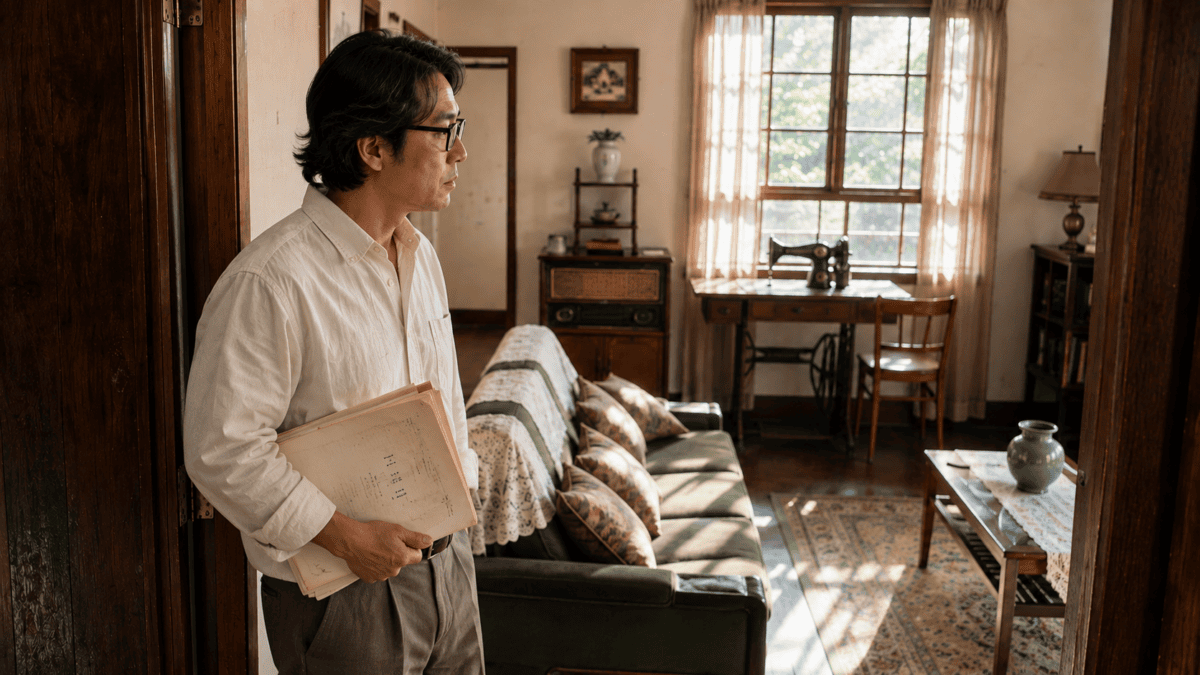
After The Housemaid, Kim Ki-young cinema didn’t move on. It didn’t evolve into something new. It stayed.
He stayed with the house. He stayed with the system. He stayed with the question: What else can this space teach me?
Kim Ki-young continued revisiting similar themes through films such as Woman of Fire, The Insect Woman, and other later works. Each film returned to the same obsession—the closed space, the locked logic, the way people become trapped inside conditions they didn’t create.
This wasn’t lack of imagination. This was precision.
The Laboratory Grows More Complex

A laboratory requires constraints. This is what Kim Ki-young cinema became. A scientist doesn’t change the conditions in every experiment—she changes one variable at a time, keeps everything else the same, and watches what shifts.
This is what Kim Ki-young’s house became. A laboratory.
In The Housemaid, the structure was simple: money. One man had it. Three others didn’t. That inequality became the entire story. Watch who speaks at dinner. Watch who decides when to leave. Watch who can want something without permission.
In later films revisiting the same structure, he added another variable: what if you kept replacing the maid? What if the woman entering the house changed, but the house itself remained? Would the outcome change?
The answer was no: The structure produced the same result. Different women, same destruction. Different desires, same betrayals. The house didn’t care who entered it. It operated on a logic that transcended individual personality. He was testing a hypothesis: Is the problem the person, or the position? The answer clarified everything.
In The Insect Woman, he moved the laboratory outside the house. A woman in the workplace. A woman in poverty. The same trapped logic, different geography. In later films, he placed the same system inside new hierarchies—workplaces, institutions, economies. Same structure, new form.
The variables kept multiplying. What if the same logic appeared in different settings beyond the home? What if the system was economic, sexual, psychological—operating simultaneously?
The outcome remained the same. Systems reproduce themselves. People inside systems believe they’re acting freely while actually following a script written by the structure itself. The trapped logic didn’t care about the setting. It adapted. It survived. It perpetuated.
This wasn’t pessimism. It was observation. And observation, properly conducted, is a form of honesty.
Making Films in the Age of No
Censorship existed. The state had opinions about what could be shown. Filmmakers were supposed to make films that affirmed values—family, nation, morality. Films that comforted rather than disturbed.
Kim Ki-young cinema made films that disturbed.
Many of his peers compromised. Some made propaganda. Some made films that seemed to criticize the system while actually reinforcing it. Some filmmakers adapted to censorship in different ways, while others reduced or changed the kinds of films they made. Some stopped making films altogether. They adapted to the reality: you could make films, but only certain kinds of films.
Kim Ki-young didn’t leave. He didn’t stop. But he also didn’t make the films the state wanted.
He didn’t make films that attacked the government directly. He didn’t use cinema as a political weapon in an obvious way. Instead, he did something more dangerous: he showed how systems work. How hierarchy perpetuates itself. How ordinary people maintain structures that destroy them.
This was more subversive than any political manifesto. Because it asked audiences to see themselves inside the system. To recognize that they weren’t victims of external tyranny—they were participants in their own oppression.
Every censored government needs a mythology. It needs citizens to believe that their suffering is personal rather than structural. That if they just worked harder, chose better, understood more, everything would be fine. The system isn’t the problem—you are. Your choices are.
Kim Ki-young’s films said the opposite: The problem was never only you. Changing yourself won’t change the system.
He made these films anyway. During decades of political instability, during censorship, during periods when many filmmakers left or compromised, he stayed. He kept returning to the same hallway, the same staircase, the same locked room. He found ways to make the films he needed to make within whatever constraints existed.
He didn’t argue with the censors. He didn’t make grand statements about artistic freedom. He worked quietly. He made the films. He showed what he needed to show.
The Refusal to Evolve
Critics sometimes called him stubborn. They meant it as criticism—a filmmaker who wouldn’t grow, who repeated himself, who seemed unable or unwilling to change.
But what if repetition is a choice? What if returning to the same question over and over is not failure but commitment?
Musicians know this. A jazz musician doesn’t play the same song the same way twice. She plays the same structure with infinite variation. The constraint—the melody, the chord progression—is what allows infinite freedom within it. Ornette Coleman didn’t become greater by abandoning jazz harmonic structure. He became greater by understanding it so deeply that he could dissolve and rebuild it from the inside.
Kim Ki-young’s constraint was the enclosed space. The system. The logic of closed doors.
Within that constraint, he created variations. Different characters, different decades, different versions of the same essential conflict. Each film learned from the previous one. Each film asked: What else can this structure show me? What happens if I change this variable? What becomes visible if I remove that safety measure?
This wasn’t stubbornness. This was discipline.
He was the opposite of the filmmaker who needs to be constantly doing something new, constantly proving their range, constantly chasing what’s fashionable. Kim Ki-young cinema found one true question and spent a lifetime answering it in infinite variations.
Most artists get bored with their material. Most artists want to prove they can do anything. Kim Ki-young wanted to understand one thing completely. To exhaust its possibilities. To know it so intimately that nothing it could show him would be a surprise.
This kind of commitment is rare. It requires ego death—the willingness to be known for one thing, to return to the same obsession, to accept that you might never be called a “versatile” artist.
But it produces something most versatility never reaches: mastery.
The Fire That Consumes
In Kim Ki-young cinema, fire appears repeatedly. It’s never an accident. It’s always the logical conclusion—the system consumes itself. The structure that created the conflict is the only thing that can end it.
In the early films, fire is controlled. It’s one event among many. Part of the pattern.
In the later films, fire dominates. It becomes inescapable. Smoke gathers near the ceiling before anyone notices the flames. The systems don’t just trap people—they consume them entirely. The machinery doesn’t just perpetuate itself—it burns.
The world hadn’t changed. The structures he’d identified in 1960 remained in place. Money still decided who could leave. Gender still decided who got to want. Position still insulated people from consequences. He’d spent decades showing this. He’d made thirty films. He’d been restored and celebrated internationally. Scholars had written about him. Young filmmakers had studied him.
And the world still operated exactly as he’d shown it would.
Perhaps that’s why the fire burns brighter in his later films. Not because he became more pessimistic. Because he’d earned the right to be. Because he’d spent forty years being honest about what he saw, and nobody had done anything with that honesty except admire it.
What Remains
Kim Ki-young died in 1998. He made films about closed systems his entire life, in a world that preferred to believe systems could be reformed, that individuals could transcend their circumstances, that understanding was enough.
Many viewers today still find his observations about social structures strikingly relevant. The structures he filmed in 1960 still operate today. The domestic structures he explored continue to resonate with contemporary audiences. Many of the structural dynamics portrayed in his films still feel recognizable today.
We watch his films now and we see ourselves. The wife who can’t leave. The maid who can’t refuse. The husband who doesn’t have to see. The son learning what he’ll have to become.
We recognize the structure. We can name it now. We understand how it works.
And we’re still inside it.
This is why he matters now. Not because his films offer solutions. But because they offer clarity. They show the mechanism. Once you see it, you can’t unsee it.
And sometimes, that’s the first step. Not toward change. Toward honesty.
The DNA of Korean cinema runs directly through Kim Ki-young. Not the K-cinema of spectacle or sentiment, but the K-cinema that refuses to explain itself. That focuses on structure over psychology. That shows how closed systems trap human beings and leave no escape route.
When the world encountered Korean films that moved audiences without obvious explanation—that offered no moral guidance, no redemption, no comfort—it was encountering the full flowering of a principle a dentist-turned-filmmaker had established sixty years earlier. The principle was simple: If you truly want to change how people see the world, you don’t make better messages. You make them realize the room was dangerous long before the fire started.
This post was planned and edited by a human, with AI assistance.