

A boy listens to the wind in Tongyeong. Not metaphorically. Literally—Isang Yun is listening to how the wind sounds different when it passes through different objects, at different times, carrying different intentions.
This is Isang Yun, born 1917 in Sancheong, raised largely in Tongyeong—the coastal city his family moved to when he was three. Before he becomes a world-famous composer. Before major European orchestras perform his work. Before he becomes one of the most internationally recognized Korean contemporary composers of the 20th century. He’s just a boy in Tongyeong, listening.
What he heard there—in that geography, in that particular moment—would echo through concert halls in Paris, Berlin, New York, Tokyo for the rest of his life. Not as nostalgia. As necessity.
The Sound of Tongyeong
Colonial Korea in the 1920s and 1930s was a place where multiple cultural influences intersected. Japanese occupation. Chinese influence. Western music arriving through missionaries and modern schools. Korean identity. A place where cultures collided and merged, where nothing was purely one thing.
Isang Yun grew up inside this collision. His family was Korean, but Tongyeong was the place where he spent most of his childhood and formed his early musical sensibility. His first music wasn’t notation on a page—it was the sound of a place that contained multitudes. He grew up hearing Korean traditional music, folk performance traditions, and Western music introduced through modern education during the colonial era. Korean folk melodies survived in hidden rooms.
What a child’s ear absorbs in such a place is radical. Not “multicultural.” That word is too clean. It’s messy. Contradictory. Multiple systems operating simultaneously, sometimes in harmony, sometimes in violent discord.
A musical education arrived later. Piano lessons. Formal training in Western harmony and counterpoint. The structures of European classical music, with their rules and hierarchies. But something had already happened before the lessons began.
He learned early that music doesn’t belong to a single tradition. The most compelling sounds emerge between systems. By adolescence, Yun wasn’t shaped by one structure but by several at once. Not confusion, but knowledge. Every tradition had its logic. None was natural—each was constructed. And what is constructed can be recombined.
This awareness—that tradition is learned, not innate—would become the foundation of everything he created.
Between Japan and Europe
(Wikimedia Commons, Public Domain / Edited)
He moved to Japan for more formal training. Osaka offered something that Korea couldn’t: access to Western classical music institutions. Conservatory training. In 1935, he studied at a music institute in Osaka, where he studied cello and music theory.
After studying in Japan, he later continued his musical education in Paris and West Berlin. This was not escape. It was expansion.
In Berlin, Isang Yun encountered the cutting edge of 20th-century music. Serialism. Dodecaphony. Experimental sound. Composers like Arnold Schoenberg and Alban Berg had already dismantled the harmonic system that had governed European music for centuries, and a new generation was pushing further. Nothing was sacred anymore. Everything could be questioned.
For someone trained in multiple traditions, this was both terrifying and liberating. Terrifying because it meant nothing was stable. Liberating because it meant everything was possible.
Most musicians in Berlin came with one tradition—European. They had to break it, reject it, revolutionize it. The rebellion was against their own inheritance.
Isang Yun came with multiple traditions. He didn’t need to rebel against one because he’d never been entirely bound by any single one. Instead, he could ask different questions: What happens if I combine Schoenberg’s serialist techniques with Korean modal structures? What if I use the microtonal possibilities of the violin to explore intervals that Western training had dismissed as out of tune?
European composers noticed. This wasn’t a musician borrowing from Asian traditions as exotic flavor—adding a pentatonic scale here, a gong there, for atmosphere. This was someone who’d grown up inside multiple traditions simultaneously, who understood their logic from the inside, and who could make them speak to each other with rigorous intellectual intensity.
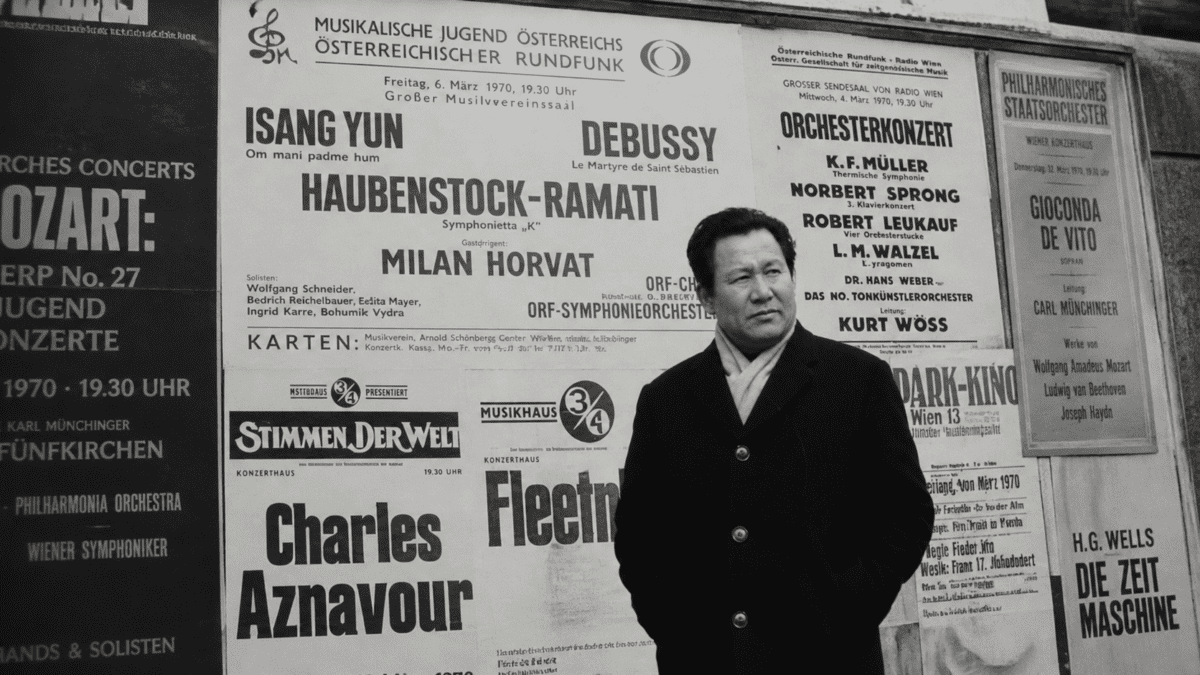
His early works began to circulate. Berlin. Paris. Vienna. The international contemporary music scene recognized something: a voice that sounded like nothing else because it came from nowhere else. Neither fully Korean, Japanese, nor European, but a synthesis shaped into a singular artistic language.
Looking for Something Beyond
By the early 1960s, Isang Yun was gaining recognition within the international contemporary music scene. Not a peripheral figure borrowing Western ideas. An increasingly central voice in postwar contemporary music.
Why? Because he’d solved a problem that plagued modernist composers: how to be radical without erasing everything that came before. How to honor tradition while pushing music into uncharted territory.
Most modernists rejected tradition entirely. They said: the past is dead, we must destroy it, we must start fresh. Isang Yun rejected that rejection. He said: tradition contains knowledge. Knowledge about what is possible, about how sound can be organized, about what human beings respond to. Western innovation contains different knowledge—about breaking rules, about dissonance as expression, about intellectual rigor.
The question isn’t which one is true, he seemed to be asking. The question is how they can illuminate each other. How can I use the freedom that European modernism offers to explore the depths that Eastern tradition contains? How can I use the depth of Eastern tradition to deepen what European experimentation is attempting?
This required a particular kind of courage. Not the courage to destroy the past—that’s easy, it’s rebellion, it feels righteous. The courage to hold past and present simultaneously without flinching when they contradicted each other. To say yes to both at once.
In concerts across Europe, audiences encountered something disorienting: his compositions sounded simultaneously ancient and utterly contemporary. A melody that seemed to reference something traditional while obeying serial composition rules. Harmony that followed European structural logic while sounding like it originated in a completely different musical universe.
Critics and composers faced something unfamiliar: a musical language that expanded the instrument without abandoning discipline.
They recognized it. Because dismissing it would have required denying the evidence of their own ears.
Speaking the East Through Western Instruments

Here’s what made Isang Yun essential to global music: he proved that you don’t need Eastern instruments to express Eastern sensibility. You don’t need to preserve tradition in its “pure” form. You can transform it, translate it, make it speak through an entirely different medium.
Take a violin. A violin is Western. Completely Western. Centuries of European tradition encoded in its design, its construction, the way musicians are trained to use it. The very act of playing a violin in a certain way—with certain bowing techniques, with vibrato, with a specific tone quality—carries European aesthetic assumptions.
Isang Yun picked up the violin and made it speak Korean. Made it sing with microtones that European string players had been taught to avoid. Made it bend and slide in ways that violated Western technique but honored an entirely different set of principles: the way a single tone bends, slides, and breathes in Korean traditional music, translated into instrumental sound.
The Western music establishment had a choice: recognize this as legitimate innovation that genuinely expanded what an instrument could do, or dismiss it as technical violation.
They recognized it. More than that—they learned from it. Young European composers began studying Isang Yun’s string works to understand how he’d expanded the expressive possibilities of instruments they thought they understood completely.
By the 1960s, Isang Yun was internationally performed and internationally influential. Europe’s leading orchestras performed his compositions. His works increasingly appeared in contemporary music study programs and academic discussions. Conductors championed his work. Critics wrote about him seriously, not as a curiosity but as a central figure in the evolution of contemporary music.
Not because he’d compromised his vision to fit Western expectations. Because his vision was so complete, so rigorous, so internally coherent, that it couldn’t be ignored or dismissed.
Isang Yun: A Voice the World Needed
What the world discovered in Isang Yun wasn’t a curiosity. It was a necessity.
Post-World War II, the West was grappling with radical uncertainty. How do you make art that reflects fragmentation, violence, the collapse of certainties that had seemed permanent? How do you express complexity that European traditions alone seemed inadequate to contain?
Isang Yun offered an answer: by refusing to stay within any single tradition. By creating work that held contradiction as its fundamental principle. By proving that the most powerful art emerges not from purity but from synthesis.
He wasn’t the only non-Western composer working in Europe. But he was the one who became truly central. Not as a representative of “the East” brought in for diversity. As an essential voice reshaping the possibilities of contemporary music.
This is why Isang Yun matters to the history of Korean culture becoming globally indispensable. Not because he represented Korea in some transparent way. But because he proved that a Korean artist, working rigorously in the international avant-garde, could become indispensable to how the entire world understood itself.
He didn’t bring Korean music to the West. He created something new—music that couldn’t have existed without Korean sensibility, without the musical and cultural sensibility he carried from Tongyeong and colonial Korea, but also couldn’t have existed without Europe, without the intellectual freedom and experimental rigor of Berlin’s music scene.
And in doing so, he proved something essential: that belonging to multiple worlds doesn’t weaken an artist. It amplifies them. That the person who understands multiple traditions deeply enough can see things that people locked within a single tradition cannot see.
He was proof that identity itself could be a creative resource.
This post was planned and edited by a human, with AI assistance.