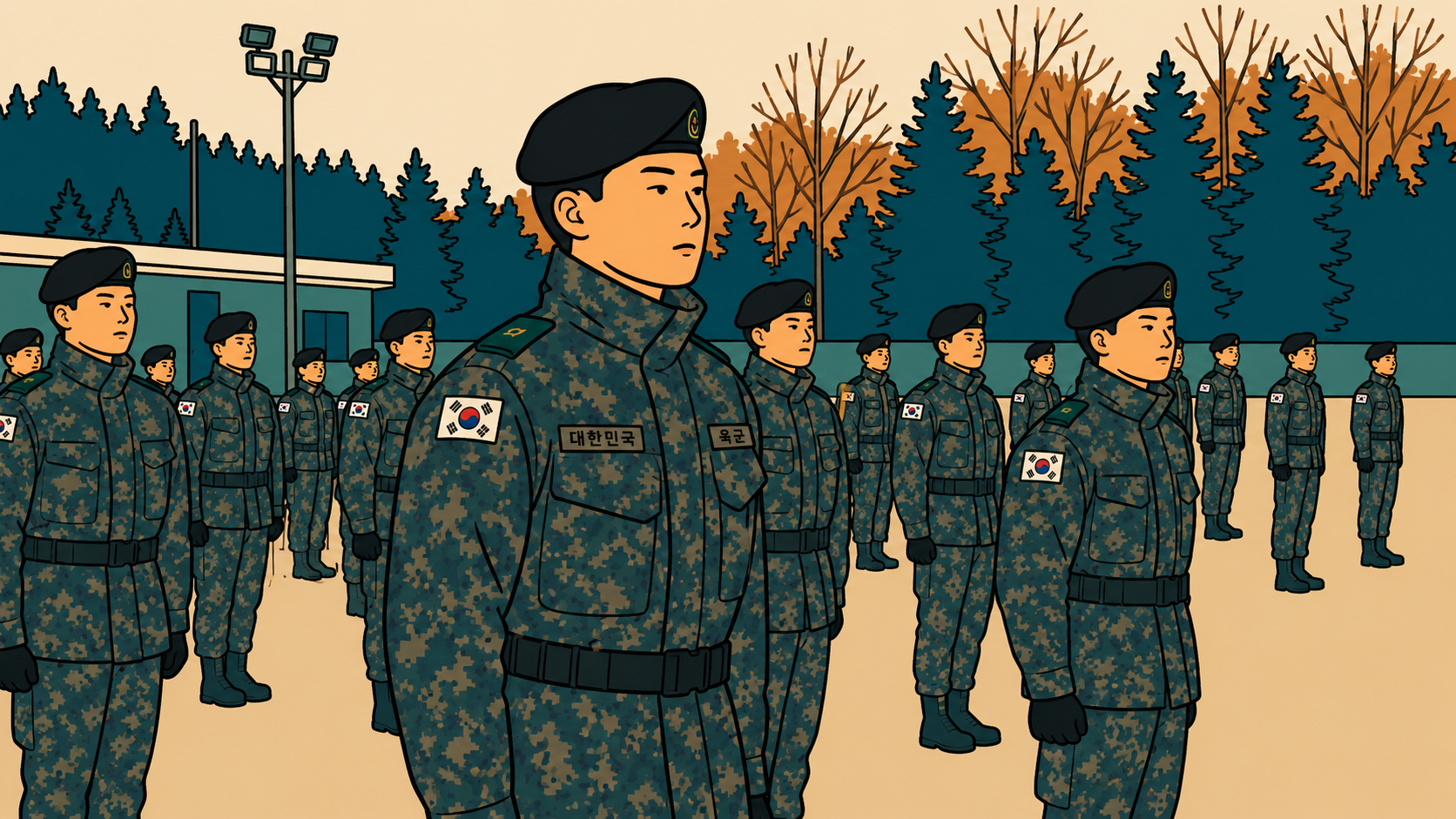
The West has a word for it. Gay-pop.
Not an official term. Something that circulates in comment sections, in reaction videos, in the particular tone people use when they want to dismiss something without engaging with it. Male K-pop artists wear makeup, therefore they are feminine, therefore they are weak, therefore the whole thing can be safely ignored.
Korean male makeup and military service are not separate categories. They exist in the same body.
The 18 Months Behind Korean Men and Makeup Military Culture
Every Korean man serves. Not as a choice, not as a career — as a legal obligation that arrives in the mail and does not negotiate.
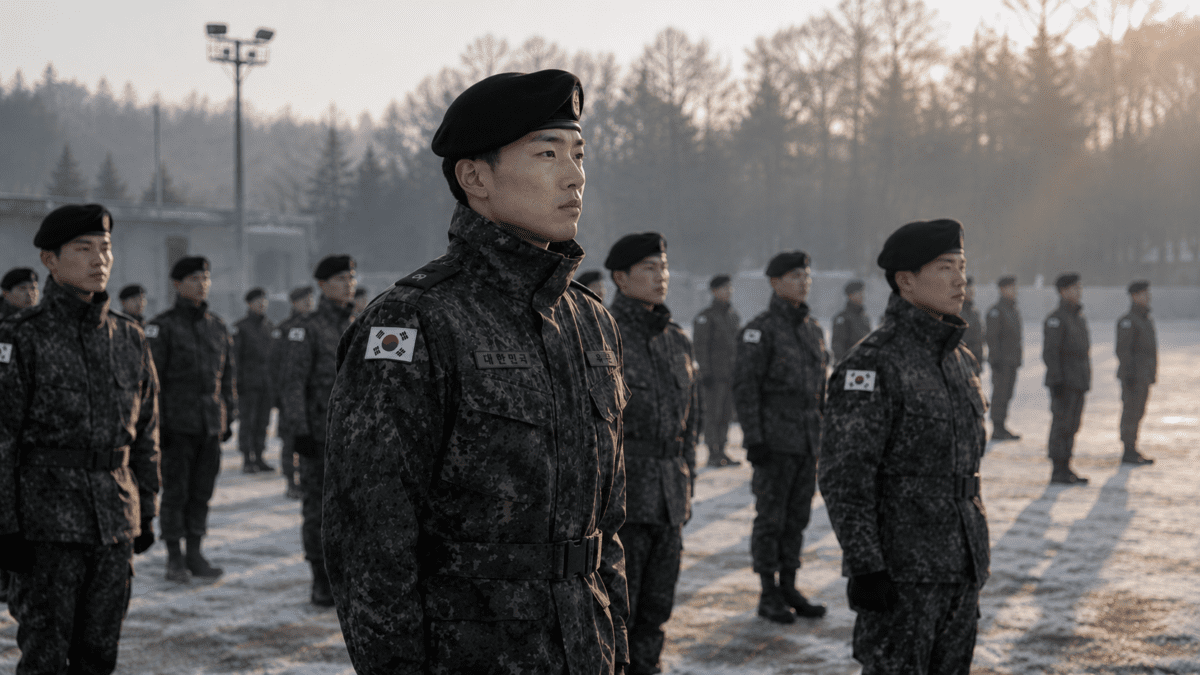
Eighteen to twenty-one months. The first weeks are designed to strip everything familiar: hair shaved to the scalp, civilian clothes exchanged for a uniform, a schedule that begins before dawn and ends when someone else decides. The body adjusts or it breaks. Most adjust.
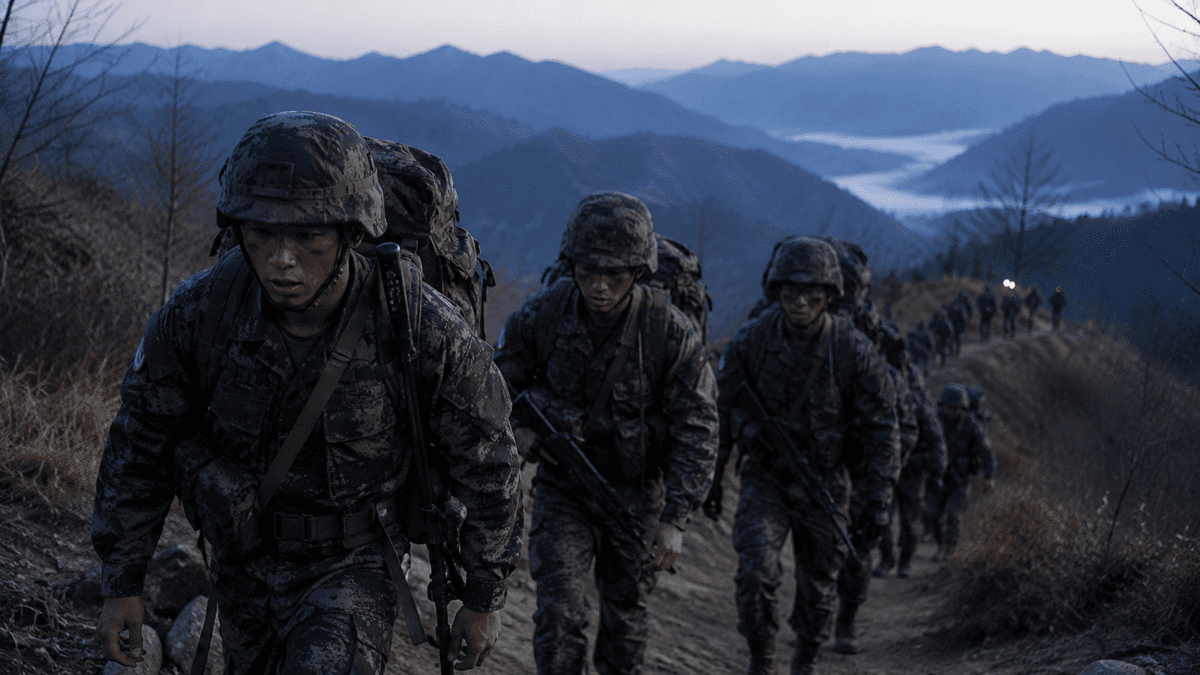
What follows is not dramatic in the way war films suggest. It is relentless in the way ordinary life rarely is. Crawling under wire in mud. Sprinting with weight until the lungs burn. Standing in formation at 5am in January, the cold coming through the boots, knowing the man beside you is feeling the same thing and neither of you will say so.
The gas chamber is a rite. Every recruit enters, removes the mask, breathes the air inside, and waits. There is no shortcut through this. The point is not punishment — it is the removal of the option to flinch.
Guerrilla training runs through mud, fire, and water. Winter marches carry full packs through snow. Summer drills run under helmets in heat that makes the air above the asphalt shimmer.
None of this is optional. None of it can be bought out of or scheduled around. The obligation lands on every Korean man regardless of what he does for a living, what he looks like, or how many people watched his last performance. The recruit in the bunk beside you might be a construction worker or a chart-topping artist. Inside the gates, the distinction does not exist. The mud is the same mud. The 5am is the same 5am.
This is the same institution that the country’s most famous performers have entered when their time came. Cameras have followed them to the gates before. Inside the gates, the cameras stop. What continues is the same routine faced by every Korean man before them — the same shaved head, the same 5am, the same gas chamber. No exemption is filed. No alternative arrangement is made. They go in the same way everyone goes in, and come out the other side the same way everyone comes out.
The gap between the stage and the barracks is not as wide as the comment sections imagine. Both require showing up. Both require performing under conditions that do not accommodate hesitation. Both measure a person not by how they look going in, but by whether they are still standing at the end. The man who held an arena of fifty thousand people is the same man who held a formation line at dawn. The audiences are different. The demand is the same.
The people typing “gay-pop” in comment sections did not know this. Or chose not to.
The Morning Before the Interview
The soldier who completes service returns to civilian life. The civilian life waiting for him is not soft.
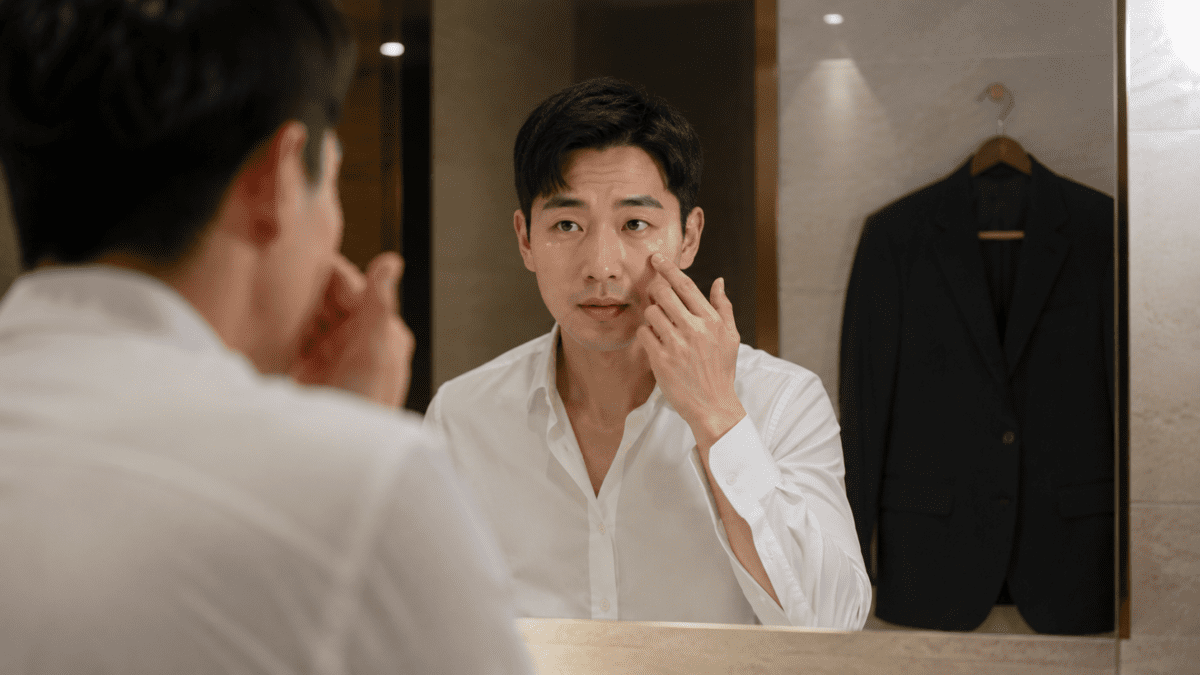
Job interviews in Korea are their own kind of trial. The competition is documented — applicants rehearse for months, prepare presentations, and arrive knowing that first impressions carry weight that is difficult to recover from. In this context, a young man reaching for concealer on the morning of an interview is not performing vanity. He is doing the same thing he did in the barracks: preparing for a situation where failure to show up fully has consequences.
BB cream to even the skin tone. Concealer for the dark circles left by the night before. Lip balm so the face doesn’t look depleted before the first question is asked. Eyebrows defined just enough to signal alertness rather than fatigue. The whole process takes minutes. It is not obsession. It is the same logic as ironing a shirt — the preparation that says this matters enough to get right.
In the barracks, a recruit learns that showing up halfway is not an option. The 5am formation does not accept partial presence. The gas chamber does not pause for the underprepared. That discipline does not disappear when the uniform comes off. It relocates. The interview room becomes the next arena where showing up fully is the baseline, and anything less is visible.
The World’s Largest Market
The man across the table notices. Not the makeup specifically — most of it is invisible by design. What registers is the overall signal: this person is prepared, this person takes the situation seriously, this person is not here by accident.
In Korea, that signal is understood as a form of courtesy. Presentation is not self-indulgence. It is consideration for the people who will have to look at you, work with you, trust you.
This is why Korea is the world’s largest market for men’s cosmetics. Not because Korean men are vain. Because Korean men understand that preparation is preparation, regardless of which arena you’re preparing for. The same logic that builds endurance in a soldier builds readiness in an employee, a performer, a professional. The tools change. The intention does not.
Korean male makeup — BB cream, concealer, lip balm, eyebrow pencil — is not the tools of a man trying to look like someone else. They are the tools of a man who has already learned, in mud and cold and gas, that how you show up matters. That the people across from you deserve your full presence. That readiness is a form of respect — for the situation, for the other person, and for yourself.
Two Moments, One Person
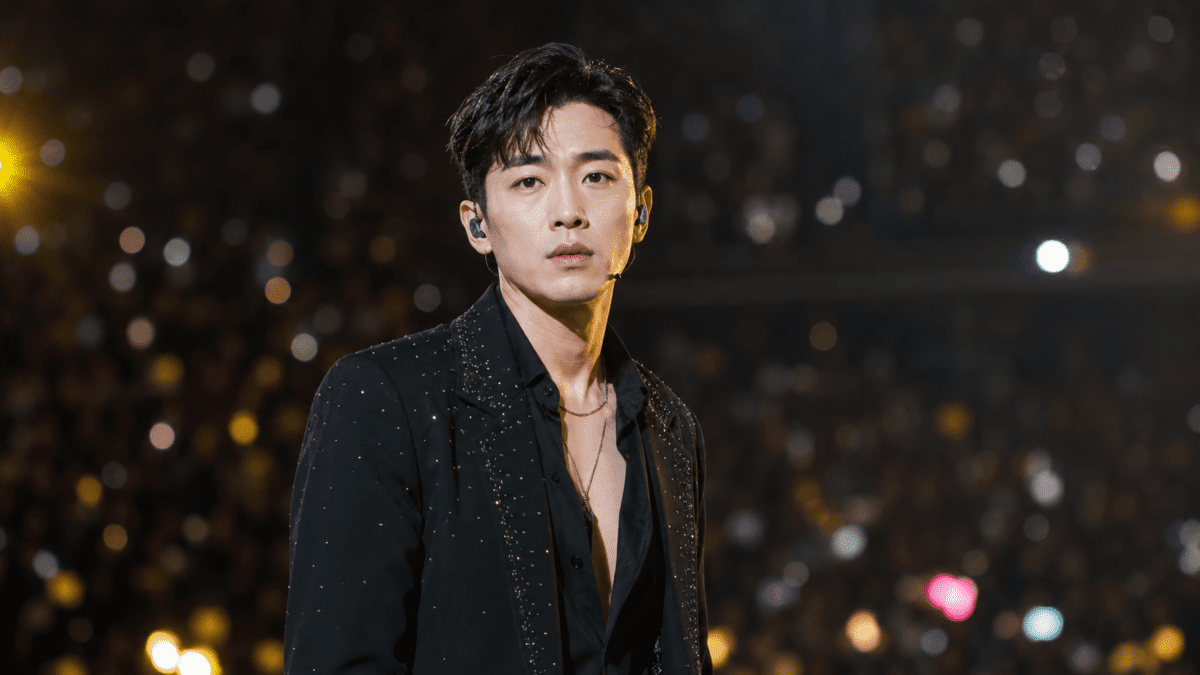
The “gay-pop” frame requires two different men: the man in makeup and the man in the barracks. Korea produces one.
One month, a man stands under stage lights in full cosmetics, performing for an arena. The next, he stands in a formation at dawn with a rifle, accountable to a sergeant who does not care what he looked like on stage.
Korean male makeup and military service are not contradictions. They are the same discipline expressed in different registers. On stage: presence, precision, the control required to hold thousands of people’s attention. In the barracks: endurance, the control required to keep going when the option to stop has been removed.
The makeup does not make the barracks easier. The barracks do not make the makeup less real. Both are preparations for being seen under pressure — which is, in the end, what strength actually means.
What the comment sections miss is not complicated. They assume that the man in makeup has never been tested. That polish and endurance are incompatible — that you can read one from the other’s absence. Korea runs on the opposite assumption. Polish is preparation. Endurance is preparation. They belong to the same person because they serve the same purpose.
The man who spent eighteen months being stripped of every comfort and rebuilt from the ground up is the same man who reaches for concealer before a high-stakes meeting. Not despite that history. Because of it. The discipline that carries a person through a gas chamber is the same discipline that shows up prepared when it matters.
Consider what the comment section actually knows about the man they’re dismissing. They know what he looks like on stage. They know the makeup, the choreography, the constructed image. They do not know the 5am. They do not know the gas chamber. They do not know what it costs to keep moving when stopping is not an option. They are judging the visible surface of a person whose depth they have not seen and cannot imagine from where they’re sitting.
That is not a cultural difference. That is a gap in information. And the information, once known, does not leave room for the original conclusion.
The frame was wrong from the start.
The word they were looking for isn’t “gay-pop.”
It’s just Korea.
This post was planned and edited by a human, with AI assistance.