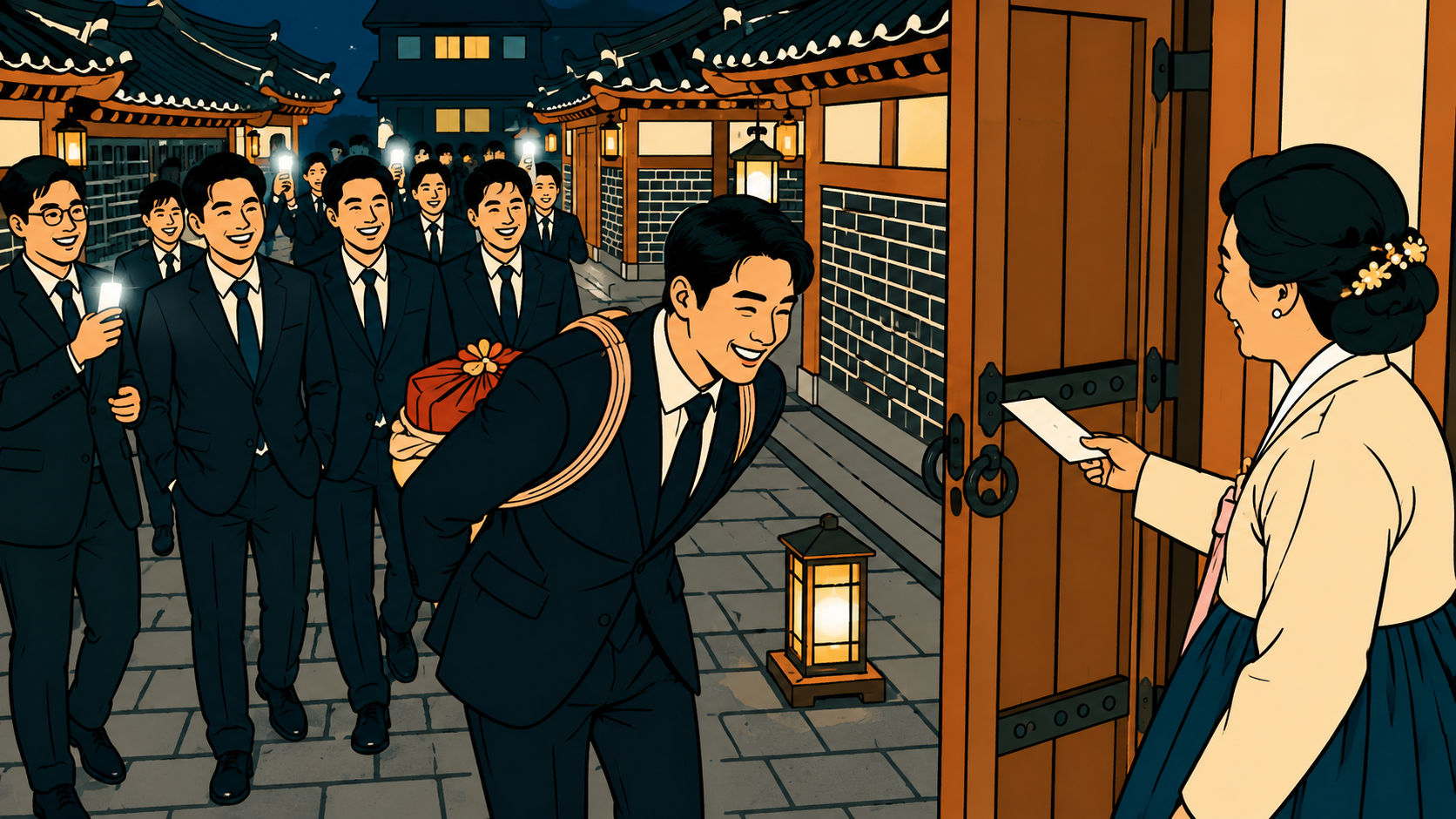
It starts as a noise at the end of the street. Laughter, a little shouting, feet that are not in any hurry. Inside the house the bride’s family has been waiting all evening, and now they go still and listen. Something is coming up the alley in the dark, and everyone already knows what it is. The korean wedding gifts are on their way, and they are not arriving quietly.
A box is coming. It is strapped to a man’s back with a wide cloth, wrapped in red, and it has taken the long way here on purpose. Nobody carries it straight to the door. That would be too easy, and easy is not what tonight is about.
The Box That Arrives After Dark
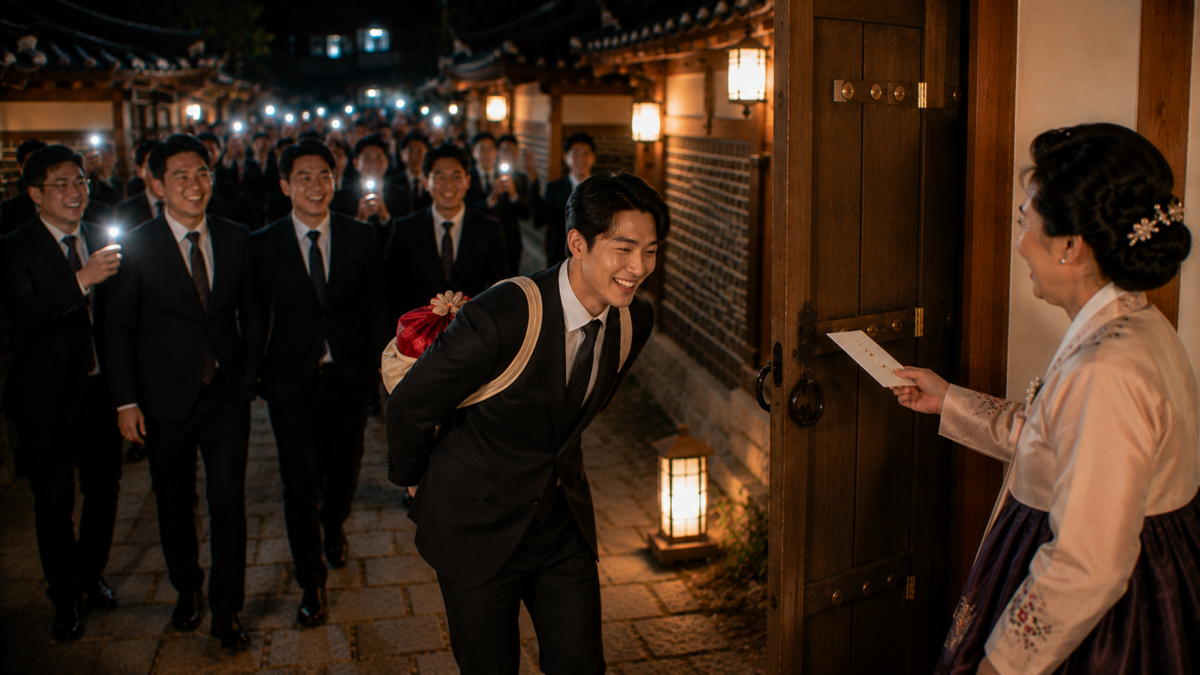
The man with the box on his back is not the groom. He is a friend, chosen for the job, and by old custom he should be someone who has already had a first son, so that whatever luck he carries rubs off on the box. In the old days his face would have been darkened with soot, or half-hidden behind a dried squid held up as a mask, half disguise and half joke. That part has mostly faded now; the friends who come today usually arrive bare-faced. What survives is the role itself, and he plays it with great seriousness.
Around him is a small crowd of the groom’s friends, and they are in no rush at all. They stop. They start. They circle back. A lantern swings, or now a phone light, and it throws the red cloth of the box into brief color against the dark. The box itself is heavy, or the man acts as though it is, staggering a little, leaning on the others.
Inside the house, the bride’s mother stands near the door with money already folded in her hand. She knows how this goes. Everyone knows how this goes. The box will not simply be handed over. It has to be drawn in, coaxed in, paid in, step by step, and the whole street is about to be part of it. From inside, the family can track the box by ear alone, how close the laughter is, whether it is moving or has stopped again. The waiting is part of it. You are meant to hear it coming for a long time before you ever see it.
Buy the Ham!
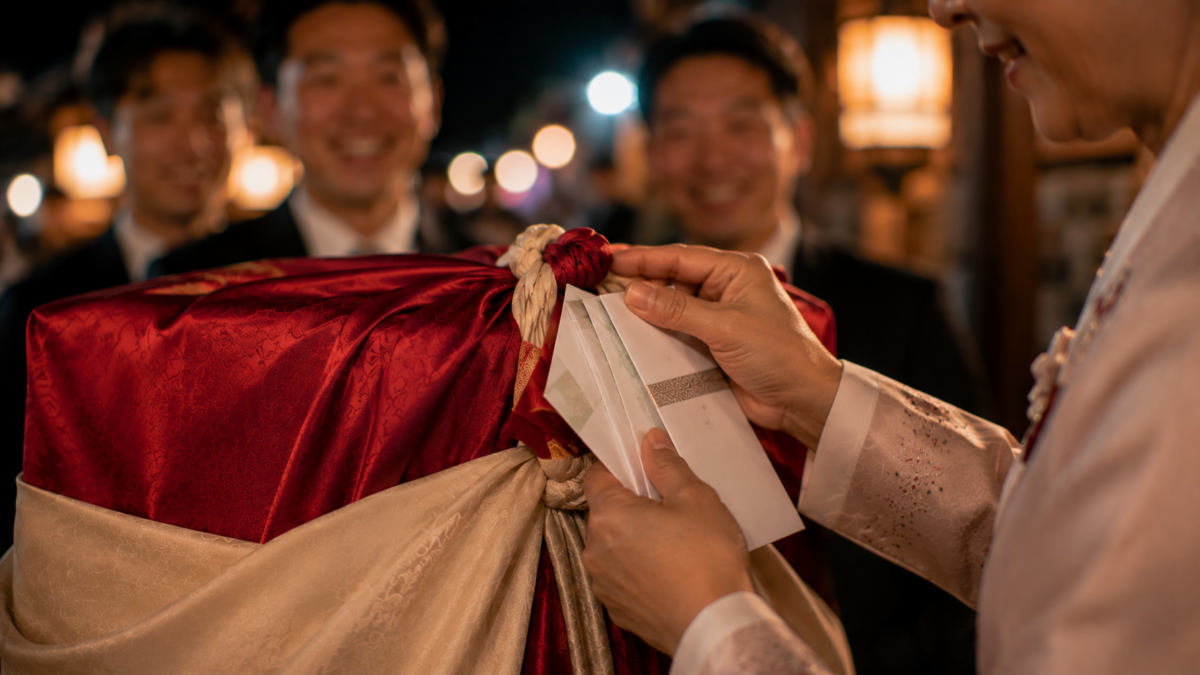
Then the shout goes up, close now, right outside. “Buy the box! Buy the box!“
The man with the box has planted his feet. He will not take another step, he announces, not one, until he is properly persuaded. This is the game, and both sides know the rules without anyone stating them. The bride’s family comes out. Money appears, folded into small envelopes, and it is tucked under the ropes that hold the box, or pressed into waiting hands. One envelope, one step. The box lurches forward, then stops again.
There is food. There is drink pushed on the carriers to soften them. There is loud, delighted arguing over how far one envelope should buy. The carriers complain the box is too heavy, the road too long, the payment too thin. The bride’s side laughs and haggles back. Neighbors lean out to watch. A grandmother heckles from a window.
The carriers demand more each time, a bigger envelope, better food, a song before the next step. The bride’s brothers push back, laughing, and for a while nobody wins on purpose. A crowd has formed without anyone inviting one. This is how the whole neighborhood learns a wedding is happening: not from an announcement, but from the racket of a box refusing to be delivered.
None of it is real bargaining. Nobody is actually being sold anything. It is theater, performed by two families who are, underneath the noise, agreeing to be joined. But the theater has a hard little truth inside it. The box will not come inside until someone pays for it. That is the point. What is being carried is valuable enough that it cannot be received casually, so the whole street is made to slow down and treat its arrival as the event it is.
Step by paid step, the box crosses the last stretch of alley, reaches the gate, and is finally, grudgingly, allowed in.
What the Korean Wedding Gifts Actually Are
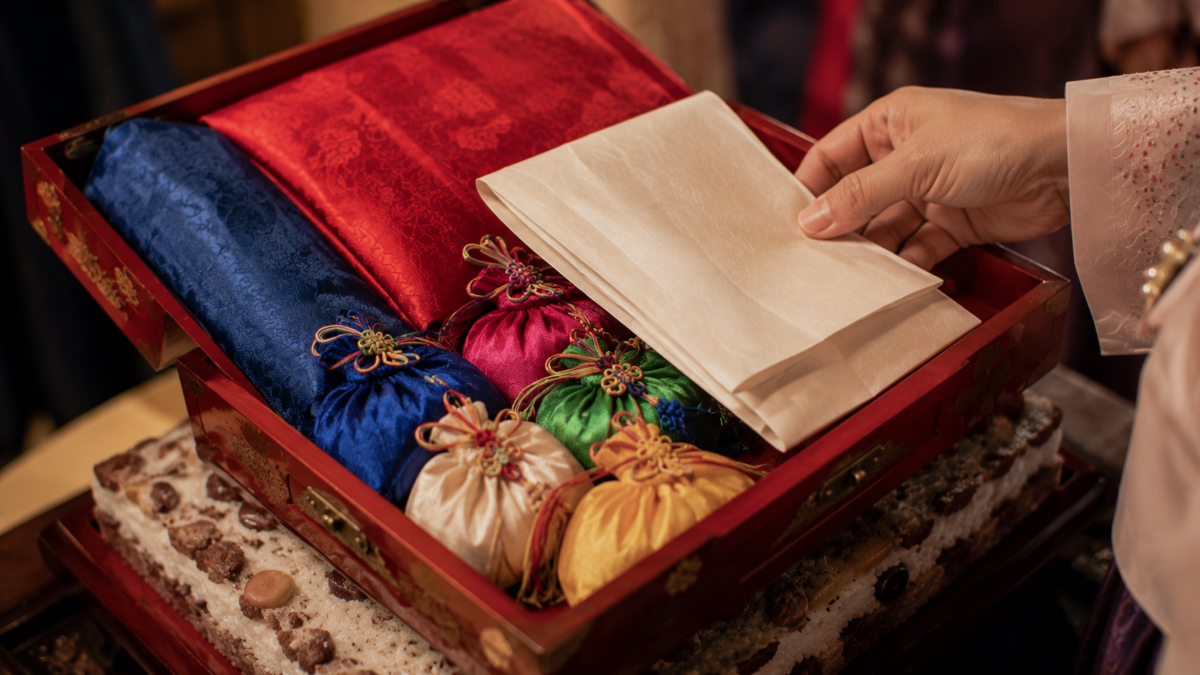
Once inside, the box is set down on a table, and often it is set on top of a red-bean cake made for exactly this, so that the first thing under the korean wedding gifts is something sweet and lucky. Then it is opened, and the noise of the street falls away.
Inside there is cloth, bolts of silk bound in blue and red, the two colors that have run through this whole wedding, tied so that the knot itself carries meaning. There are small pouches in five colors, and inside them are little things, a few grains, seeds, a bit of cotton, each one standing for something a family hopes to grow, children and long life and enough to eat. Nobody has to read the contents aloud. The pouches say it by being there.
And there is a letter. This is the heart of what the box carries, a formal marriage letter from the groom’s family, written on good paper and folded with care. It is the promise made solid, the one object in the box the bride is meant to keep for the rest of her life. Everything else can be worn or spent or eaten. The letter she keeps. In the old days it went with her all the way to the grave.
The bride’s family looks at what has come. Nobody rushes this part either. The gifts are handled, admired, set out. What arrived roped to a man’s back in the dark is now spread carefully across a table in the light.
The Gifts That Travel Both Ways
What most people outside the tradition miss is that the box is only half of it.
The gifts do not run in one direction. The groom’s family sends the box, but the bride’s family sends its own gifts back the other way, to the groom’s parents and household, and this exchange is one of the older korean wedding traditions still kept in some form today. Bedding, cloth, things for a home, things chosen to show respect to people the bride barely knows yet. Each side gives. Each side receives. The two houses spend weeks, sometimes, working out what is owed and offered in each direction.
It can look, from far away, like an accounting problem, and sometimes it becomes one. But the shape of it is older and simpler than money. Two families who did not choose each other are tying themselves together, and they do it by sending things back and forth across the space between their houses until the space feels smaller. A gift is a thread. Enough threads and the two households are sewn to each other, whether or not the bride and groom ever quite understand what was traded in their name.
Seen this way, the korean wedding gifts were never really about the objects at all. The silk will be cut and sewn. The grain will be thrown out or planted. What lasts is the fact that two houses reached across the dark and handed each other something, on a night everyone remembers by its noise.
By late night the alley is quiet again. The carriers have gone home, paid and fed and hoarse. The red cloth that wrapped the box is folded and put away. On the table, the bolts of silk sit in their blue and red, the five little pouches keep their small cargo of grain and seed, and the letter has already been set aside somewhere safe, where the bride will find it years from now and remember a night she spent inside the house, listening to a box being bought at her own gate.
This post was planned and edited by a human, with AI assistance.