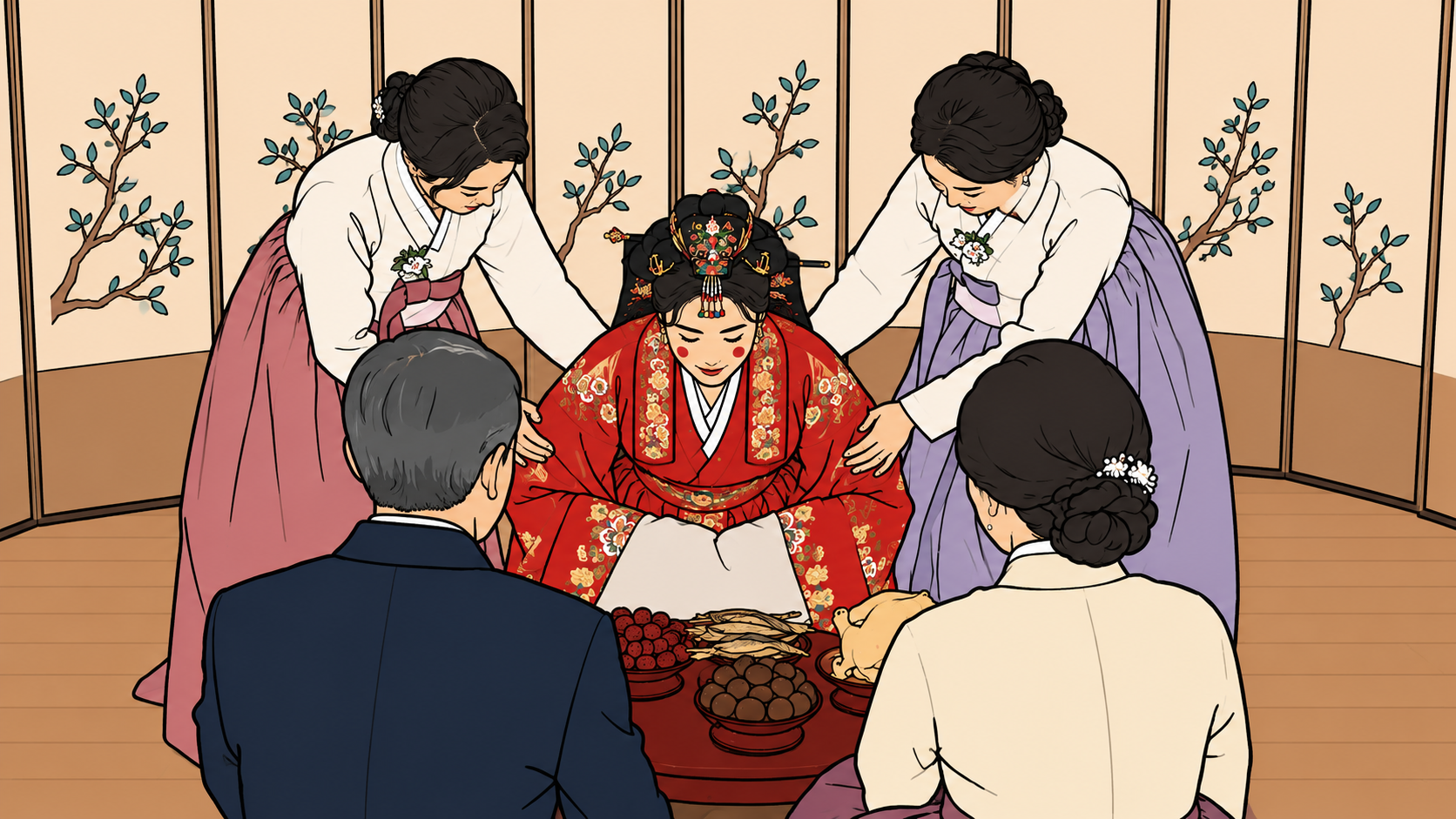
The public part of the day is over. The crowd has thinned toward the food, and the bride is led into a smaller room, out of the sun, where only family will follow. This is pyebaek, the part of the day the guests do not see. The public ceremony belonged to everyone. This one belongs to the people she is about to live among.
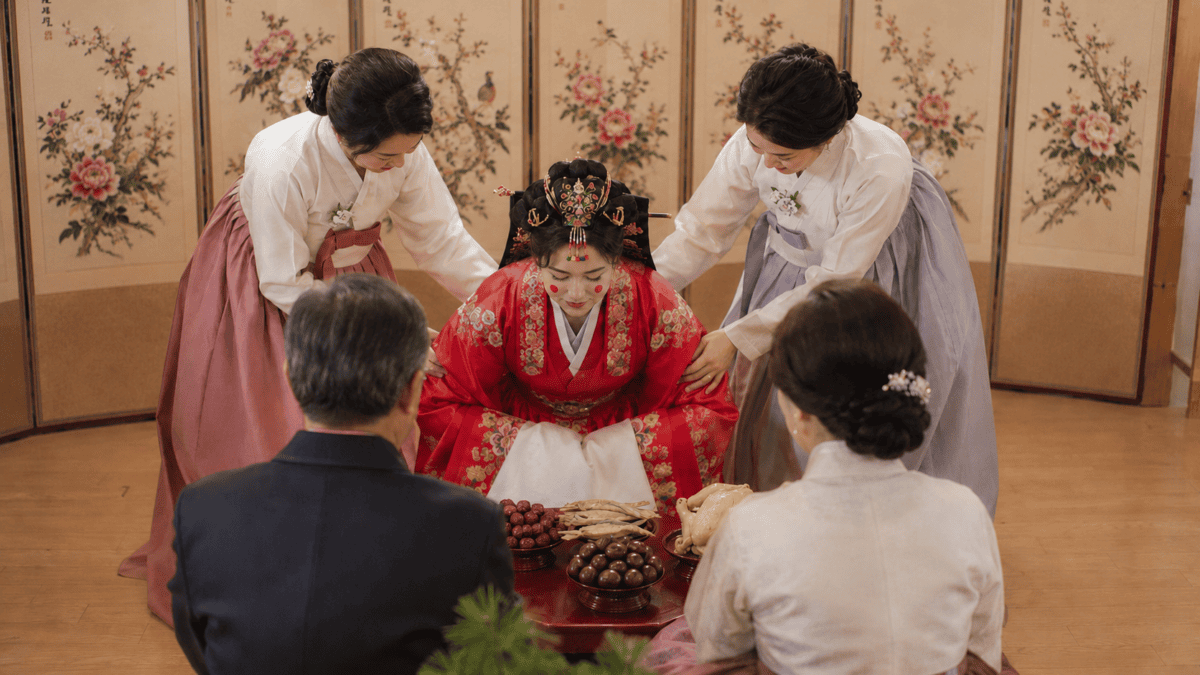
The room is quiet after the noise outside. A low table has been set with a few careful things: a dish of red dates, a dish of chestnuts, strips of dried meat, sometimes a whole chicken wrapped in paper and ribbon. The groom’s parents sit on the far side in their best clothes, waiting. The bride still carries the weight of the morning, the red robe, the crown that fixes her chin. She lowers herself to the floor across from them, and the door slides shut behind her.
The Room the Guests Don’t See
Out in the courtyard she was on display, a figure in red for a hundred strangers to look at from a distance. Here there are maybe eight people, and every one of them will still be in her life next year.
This is a different kind of room. Nobody is performing. The parents-in-law study her the way you study something that has just become yours to keep. She keeps her eyes down, partly from the weight of the headdress and partly because she does not yet know where to put them. The table between them is small and low, and it is covered in food she did not cook but is somehow responsible for.
The dishes are not a meal. Nobody is going to eat the paper-wrapped chicken. The dates and the chestnuts are not there to be tasted either, not yet. Every dish on the table is a word in a language the bride is still learning, set down in advance of anything being said. Someone pours. Someone adjusts a plate by half an inch. The old woman who has steered the bride all morning stands just behind her, ready to move her arms again if they are needed. In this room she is still being handled, still being placed. The difference is that the people watching now are the ones she will answer to for the rest of her life.
What Pyebaek Asks of You
The first thing required of her is a bow, full, to each of them.
Not the shallow nod of a greeting. The full bow, down to the floor, forehead low, the way you bow to something much larger than yourself. In the heavy robe it is not easy. Two women help her fold down and help her rise, and she does it again for the next parent, and again. Each bow takes time. The dress does not bend the way a body bends, and so the bow becomes a small piece of labor, performed slowly, in front of the people it is meant for.
Between the bows she offers them a drink. She lifts a small cup with both hands and holds it out, and the offering is its own quiet sentence: I am yours now, and I will pour for you. The parents receive it. Something in the room settles when they do.
None of this is spoken. The whole exchange runs on gesture, the way the courtyard did. She is telling them, with her back and her hands and the cup, that she understands what she has walked into. And they are telling her, by accepting, that she is in.
The Chestnuts Land, and Someone Counts
Then the mood breaks open.
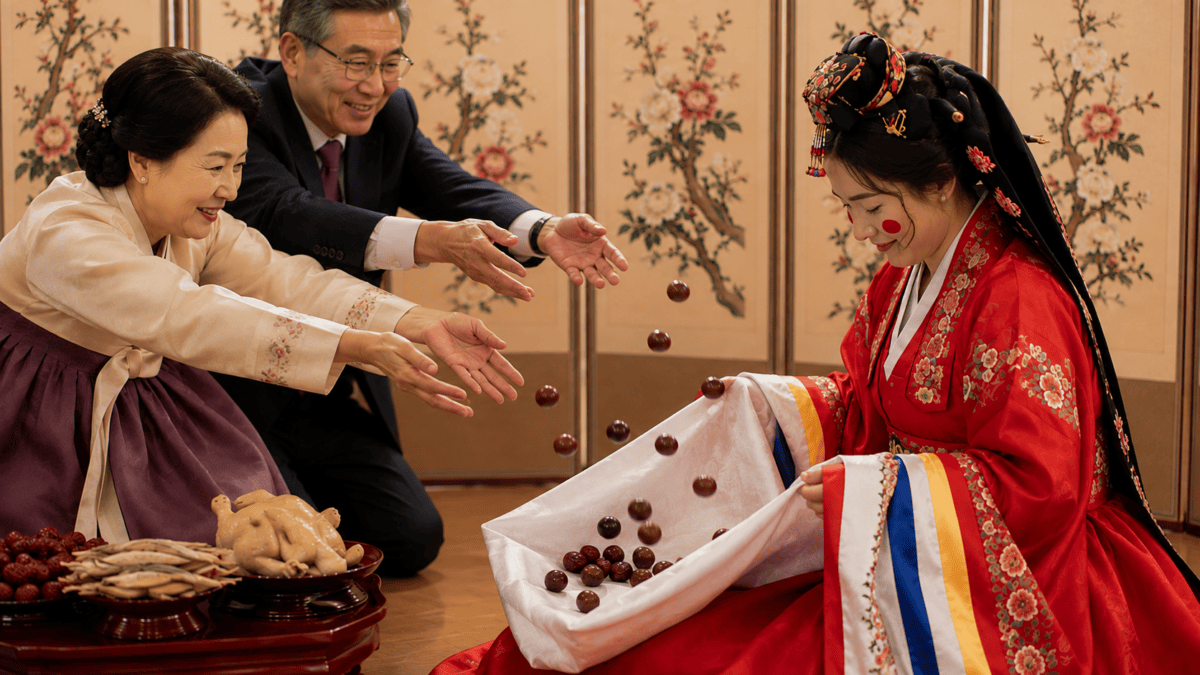
The parents-in-law take handfuls of the red dates and the chestnuts, and they throw them. Not gently. They toss them across the low table at the bride, and she opens her skirt, or a cloth is stretched wide between her hands, and she tries to catch as many as she can as they come down.
It turns, for a moment, into something like a game. The fruit bounces off the silk and rolls on the floor and the family laughs, the first real laughter of the long day. But underneath the laughing there is arithmetic. The dates and the chestnuts stand for children, and the number she catches in her skirt is said to be the number she will have. In the old telling the dates were sons and the chestnuts daughters, and so everyone is watching what lands and what gets away. This is one of the Korean wedding customs people still keep long after the rest of the old ceremony is gone.
They throw the fruit. She catches a future she has not agreed to yet.
The dates are deep red and the chestnuts a dull brown, and they scatter across the pale silk of her lap and across the floor, small and bright and rolling everywhere. One date comes to a stop near her knee. She picks it up because it is easier than looking at anyone, and it is smaller and harder than it looks. When she presses it later it will be almost too sweet, the concentrated sweetness of something dried and kept a long time. For now it sits in her palm. Nobody says the number out loud. But every person in that room did the same quiet math, and she felt them do it.
The Groom Carries Her Around the Room
Last, the room asks one more thing, and this one is his.
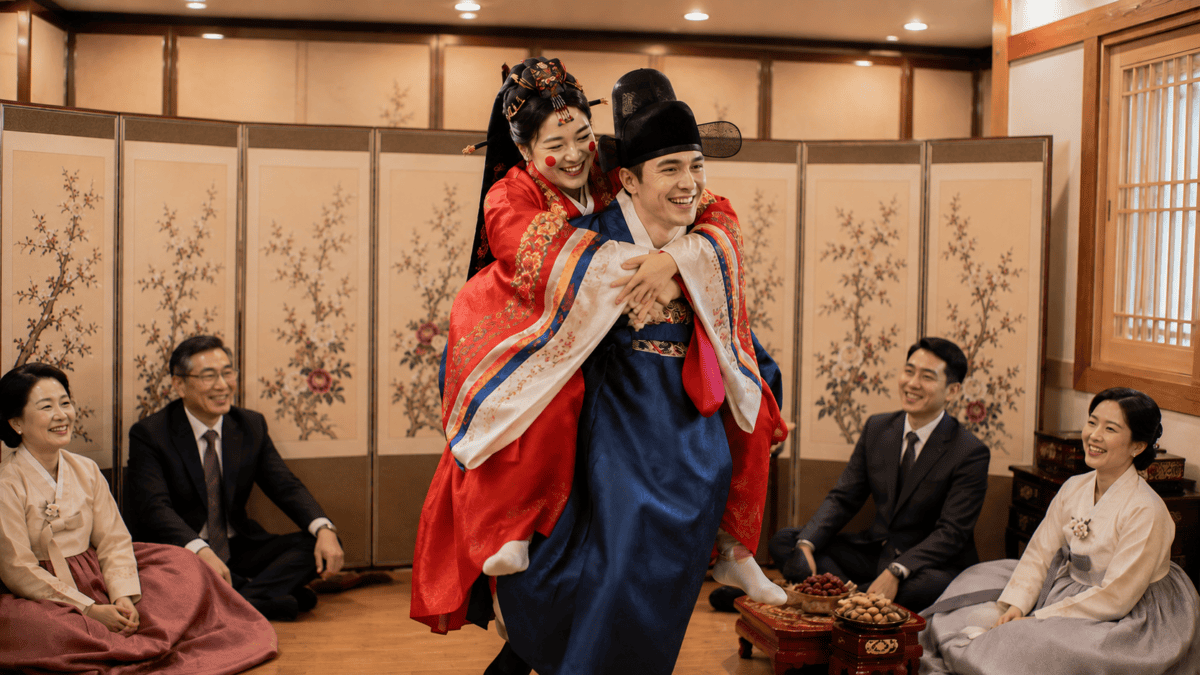
The groom crouches, and she is helped onto his back, the whole weight of the robe and the crown and the woman inside them, and he stands with all of it and carries her around the small room. He is supposed to. It is his turn to hold up what has been held up all day. Sometimes he carries his mother too, a lap around the floor for her, and the family laughs again, and for a few seconds the formality of pyebaek and the whole heavy morning lifts into something almost silly.
He is not graceful. Nobody expects him to be. The point is only that he takes the weight, in front of his parents, once, so that everyone has seen him do it. She holds on. From up there the room tilts and the faces go by, and it is the first time all day she has been higher than the people around her instead of bowed below them.
Then he sets her down. The dates and chestnuts are gathered off the floor. The parents’ faces have changed, loosened, the way faces do once a thing has been decided and there is nothing left to guard. The paper chicken sits untouched on the table, having done whatever it was there to do.
Pyebaek is short. A handful of bows, a scatter of fruit, one clumsy lap around a small room. But it is the part of the day that quietly changes what she is. The courtyard made her married. This room made her a daughter of a house that was not hers this morning, and in the old world that was the heavier of the two changes. The fruit will be swept up and the dishes carried out, but the arithmetic done over her lap tends to follow her, brought up at gatherings for years, counted against every child who does or does not arrive.
The door slides open again, and the noise of the party comes back in. She stands, steadies the crown, feels the ache settle back into her neck. In her sleeve, without quite deciding to keep it, she still has the one date, small and hard and impossibly sweet, waiting for a moment she has not reached yet.
This post was planned and edited by a human, with AI assistance.