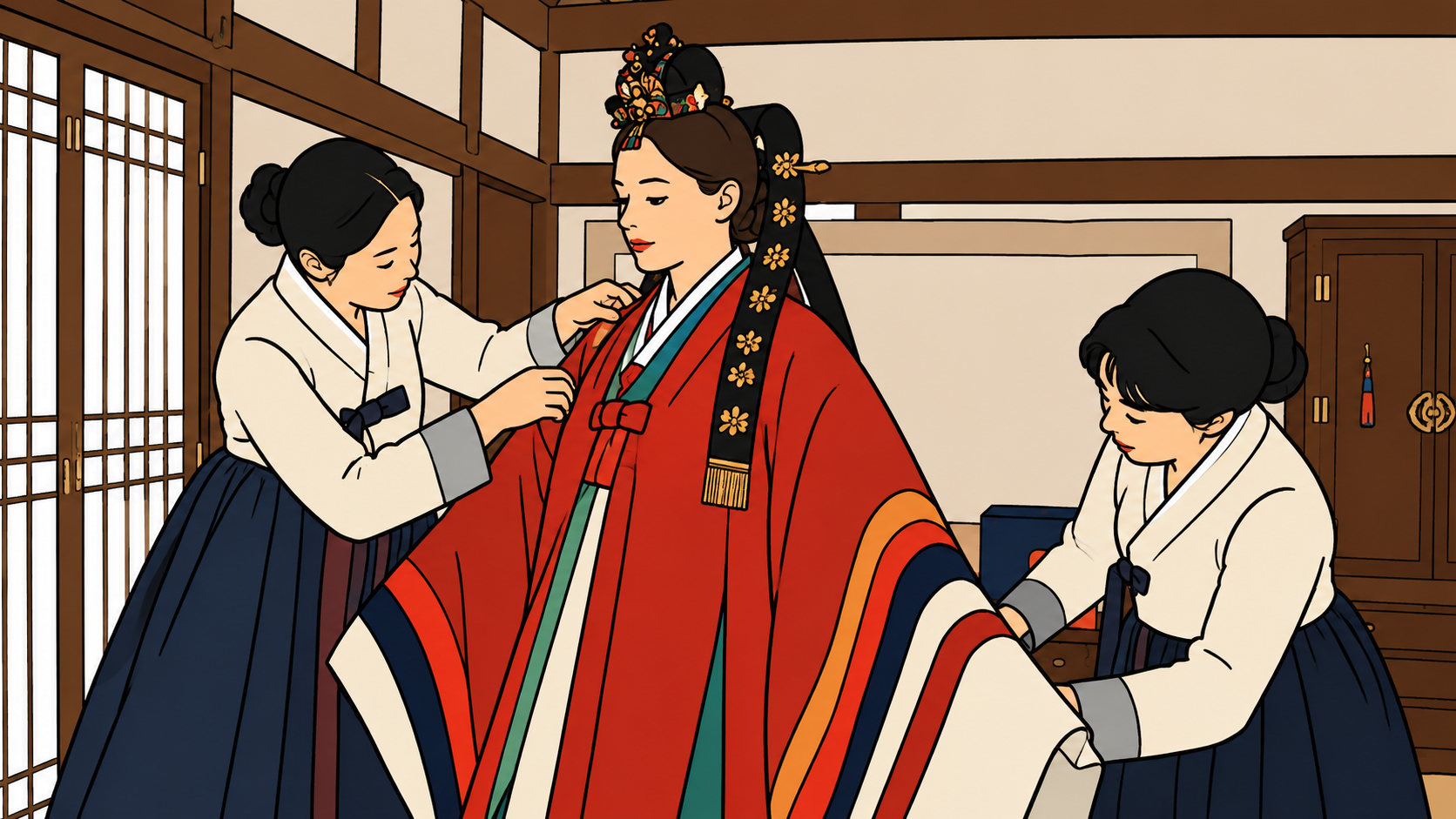

Before the courtyard, before the bows, there is a small room and a bride who cannot dress herself. She stands with her arms slightly raised while two women work around her. A Korean wedding hanbok is not something you put on. It is something that is put on you, layer over layer, until you are no longer quite sure where the cloth ends and you begin.
She has been up since dark. The room smells of pressed cotton and the faint metal of a heated iron. Somewhere down the hall someone is already crying, though the day has barely started. The bride keeps still. Moving would only slow the women down, and there is a great deal of cloth to get through.
The Order You Cannot Do Yourself
It starts close to the skin and works outward. First the thin underthings, then a wide skirt that wraps and ties high on the chest, then a short jacket with sleeves cut long. Each layer is smoothed flat before the next goes on. Nothing is rushed. A wrinkle now will show for the rest of the day.
The women know the order without speaking it. One holds a panel taut while the other ties. A ribbon is looped, checked, undone, tied again a finger’s width tighter. The bride lifts an arm when a hand touches her elbow and lowers it when the hand lets go. She is learning to be moved.
Her own mother is in the room but does not help. She sits to one side with her hands in her lap, watching other women dress her daughter. Once, she stood where the bride stands now. She knows exactly how the next hour will feel and says none of it.
By the third layer she can feel the weight settling onto her shoulders and down her back. It is not heavy the way a bag is heavy. It is heavy the way water is heavy, spread across all of her at once, pressing evenly from every side. She stands straighter to carry it, because there is no other way to carry it. This is how a Korean wedding hanbok goes on: not chosen, not adjusted by the one wearing it, but assembled around her by other hands.
You don’t wear this dress. You’re held up by it.
What a Korean Wedding Hanbok Hides in Its Thread

Then the outer robe comes, and the room changes color.
It is red, a deep and serious red, and it is covered in embroidery so dense the silk underneath barely shows. Peonies open across the chest. A pair of birds face each other on the back. Vines run down the long sleeves, and near the hem, if you look closely, there are small characters stitched in gold, old words wishing the couple a long life and many children. Most guests will never get close enough to read them. They were sewn anyway.
The embroidery is not decoration alone. Every flower and bird was chosen to mean something, chosen by people who believed that what you stitched into a marriage was what you called into it. So they stitched abundance, and long life, and pairs of things that stay in pairs.
The sleeves end in bands of white that fall past her hands and cover them completely. She could not pick anything up now if she wanted to. That is part of it. Up close it is less a Korean wedding dress than a piece of armor made of silk, built to make the wearer beautiful and unable to act in the same motion, a person to be looked at and led, not a person who does.
Long ago a robe like this belonged to the palace. An ordinary woman would never have been allowed to wear so much red, so much gold, such open extravagance. The wedding was the exception. For this one day, and only this day, she was dressed like someone far above her station, and no one called it above her station. The color that was forbidden yesterday is required today.
The Crown and the Two Red Dots

Her hair has already been pulled back and bound low, fixed with a long pin that will not move for anything. Nothing about the head is left loose. By the time the crown is on, a Korean wedding hanbok has reached all the way from the floor to the top of her head, and there is no part of her it does not touch.
They lift a small black coronet into place and pin it into her hair. It is not large, but it is set with beads and stones that catch the light, and once it is fixed she cannot turn her head freely. Her chin drops level and stays there. The small muscles of her neck take on the weight within minutes and will ache by afternoon. The headpiece decides how she will hold herself for the rest of the day.
Then someone comes at her face with a small brush. A round dot of red goes on each cheek. The paint is cool going on, and she is told not to touch it. It is not makeup, not exactly. Red was believed to turn away bad luck, and so they put it where everyone would see, two small marks standing guard on a face that is not allowed to smile too much.
She looks, now, less like herself and more like an idea of a bride. That is the point. Under the red robe and the crown and the two red dots, the individual woman recedes, and what steps out into the courtyard is the role itself, wearing her.
The Groom Dresses Above His Station
The groom’s turn is faster, but it follows the same logic.
He is put into a blue robe with a round collar and wide, formal lines. On his chest and back sit embroidered panels, a crane or a pair of birds worked in bright thread, the kind of insignia that once marked a government official. A stiff belt is fastened at his waist, low and loose, more a sign than a fastening. On his feet go tall boots he will walk carefully in.
Last comes the hat. It is black, with two thin wings standing out from the sides, and it makes him look suddenly older and more serious than he did an hour ago. This too was court dress. An ordinary man had no right to it. But like the bride in her palace red, the groom on his wedding day was allowed, for a few hours, to dress as something he was not.
For a moment he catches sight of himself and goes still, as if meeting someone he had been told about but never expected to see. That is the quiet joke sewn into both outfits. Two people who owned nothing like this, playing the parts of nobility, in borrowed grandeur everyone agreed to believe in for a day.
They stand ready now, both of them, in clothes heavier and brighter than anything they will wear again. The red catches the morning light. The blue holds it. Somewhere a door slides open, and the sound of the courtyard reaches the small room for the first time.
She takes a step and feels the whole weight of it move with her, half a beat behind, the way something large follows something small. This is what she will remember later, longer than the vows, longer than the faces. Not the meaning of the color. Just the weight of it on her shoulders, and the two cool dots of red she was told not to touch.
This post was planned and edited by a human, with AI assistance.