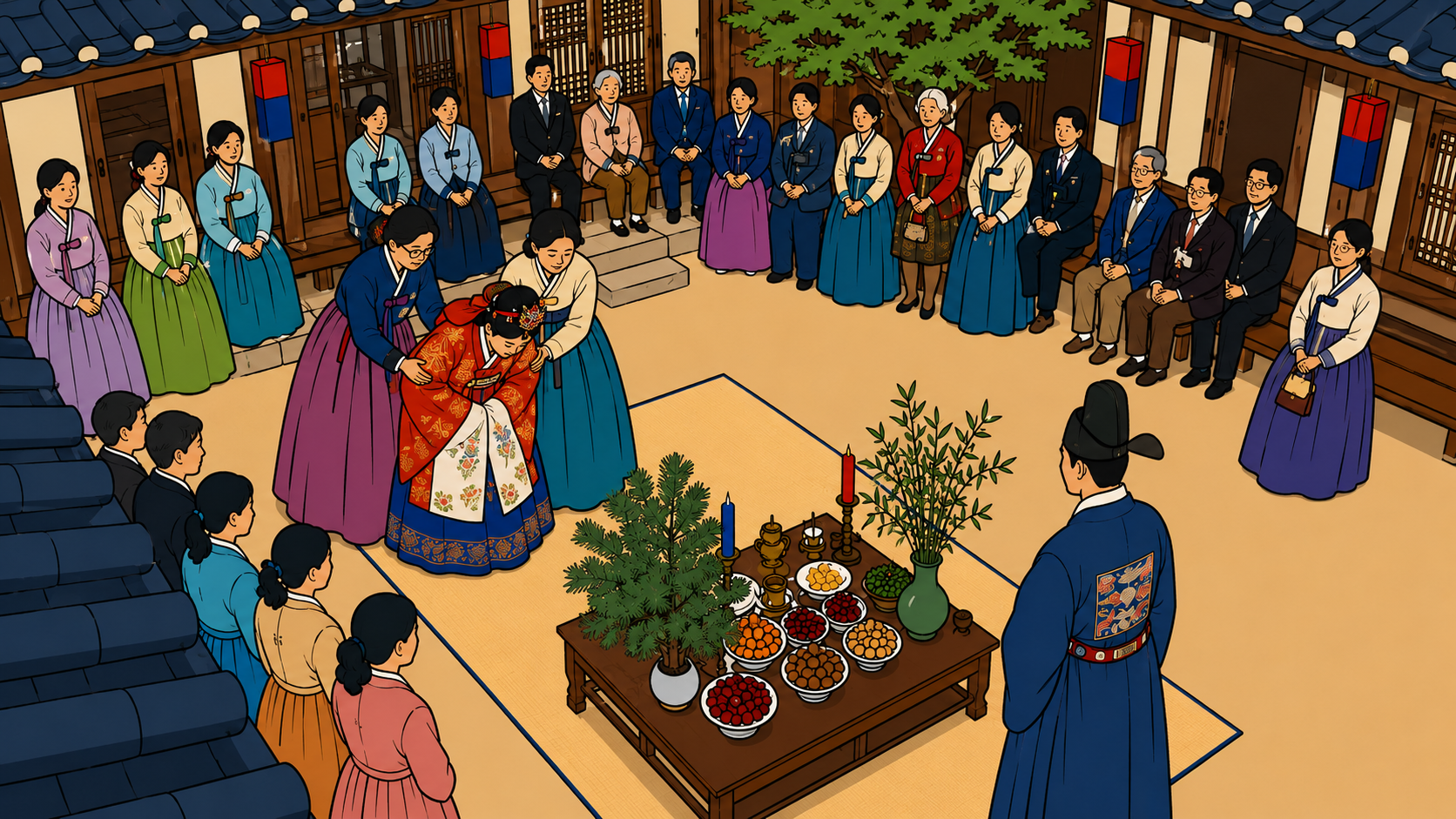
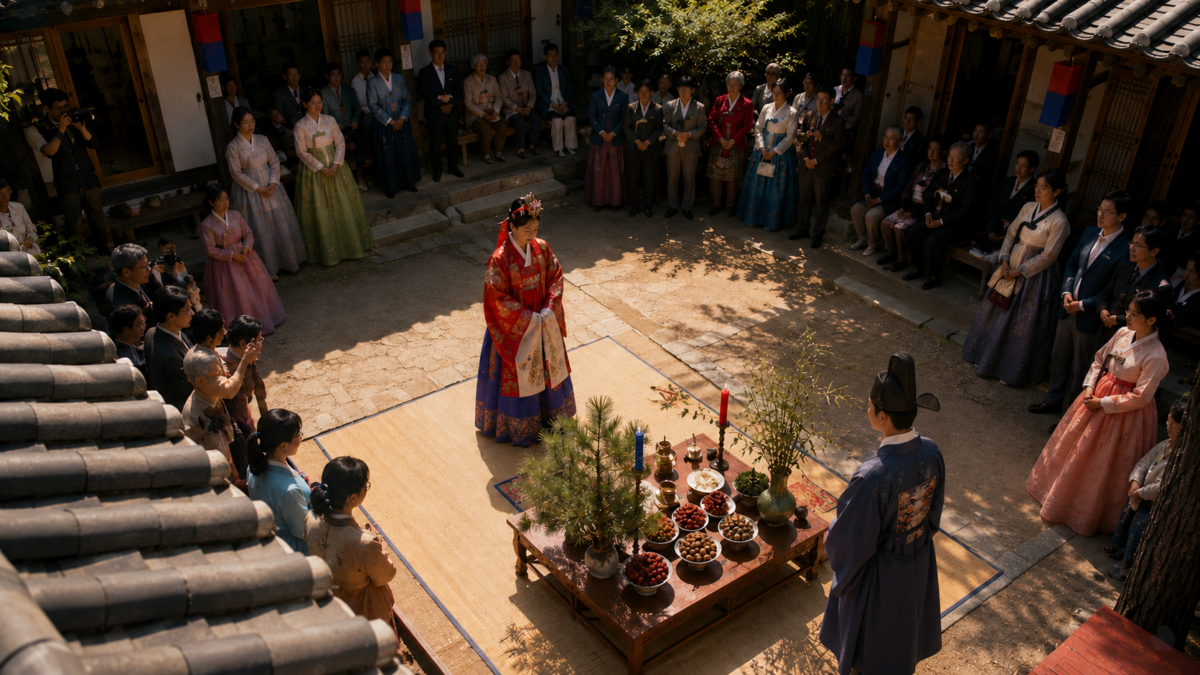
The courtyard is swept before anyone arrives. By mid-morning it holds a low table, two candlesticks, and a crowd that keeps shifting to see. This Korean wedding tradition does not begin with a walk down an aisle. It begins outdoors, in daylight, with a table set between two people who may be meeting for the first time.
You stand at the edge with the other guests. Someone’s grandmother has claimed the best spot and will not give it up. Off to one side, two musicians tune their instruments, and the sound they make is thin and reedy, closer to a bird than a band. The bride is not out yet. The groom arrives first, and everyone watches how he walks. He is dressed in blue, moves stiffly in clothes he did not choose, and does not quite know what to do with his hands. An older man walks half a step behind him, murmuring what comes next.
The Table the Korean Wedding Tradition Is Built Around
The table is the center of everything, and it is crowded. Two candles burn on it in broad daylight, one wrapped in red, one in blue. There is a short pine branch and a stalk of bamboo, both green against the pale wood. Chestnuts sit in one dish, red jujubes in another. And there are two live chickens, a rooster and a hen, wrapped in cloth so only their heads show, blinking at the crowd.
Nothing on the table is decoration. The red and the blue are the two people about to be joined. The pine and the bamboo stay green through winter, so they stand in for something that holds. The chestnuts and the dates will come back later, in another room, thrown into a bride’s skirt. For now they wait.
The rooster shifts inside its cloth and no one moves to settle it. Its head turns, takes in the crowd, and turns back. For the length of this ceremony it is not livestock. It is a promise wearing feathers, and everyone treats it that way.
You notice there are no flowers, none of the white you might expect. The colors here are loud and chosen on purpose, red and blue and the deep green of the branches. Against all of it, the two small flames look almost invisible in the sun. A child near the front reaches for a chestnut and has his hand pulled back without a word. The air smells of pine sap and warm dust, and somewhere behind the wall, oil has already met a hot pan.
The reciter takes his place. He is older, unhurried, holding a paper he barely looks at. He will call out each step of the day in a flat, carrying voice, and the couple will follow him line by line. Nothing about this ceremony is left to the couple to figure out on their own.
A Goose That Doesn’t Change Its Mind

The groom comes forward holding something wrapped in blue cloth. He kneels, sets it down carefully, and bows twice, all the way to the ground, his forehead near the dirt.
Inside the cloth is a goose. Once it would have been a live bird. Now it is almost always carved from wood, painted, small enough to hold in two hands. He is presenting it to the bride’s family, and everyone here knows why, though no one says it aloud. In the Korean wedding tradition, this is the first thing the groom does, before any vow is spoken.
In the old symbolism, geese paired for life. Even after one died, the other was said to remain alone rather than choose another mate. That is the whole meaning of the gift, handed over in silence. The groom is not promising to be kind, or patient, or good. He is promising to be the kind of creature that only does this once.
The goose was said never to choose a second mate. That was the entire vow, laid on the ground before a single word had passed between them.
The bride’s mother steps forward to receive it. She does not smile. She holds the wooden bird the way you hold something you have agreed to keep. Then it is set aside. It has done its work. Later it will sit somewhere in the new home, and for years to come someone will lift it to dust underneath and set it back down.
Two Bows Across the Table
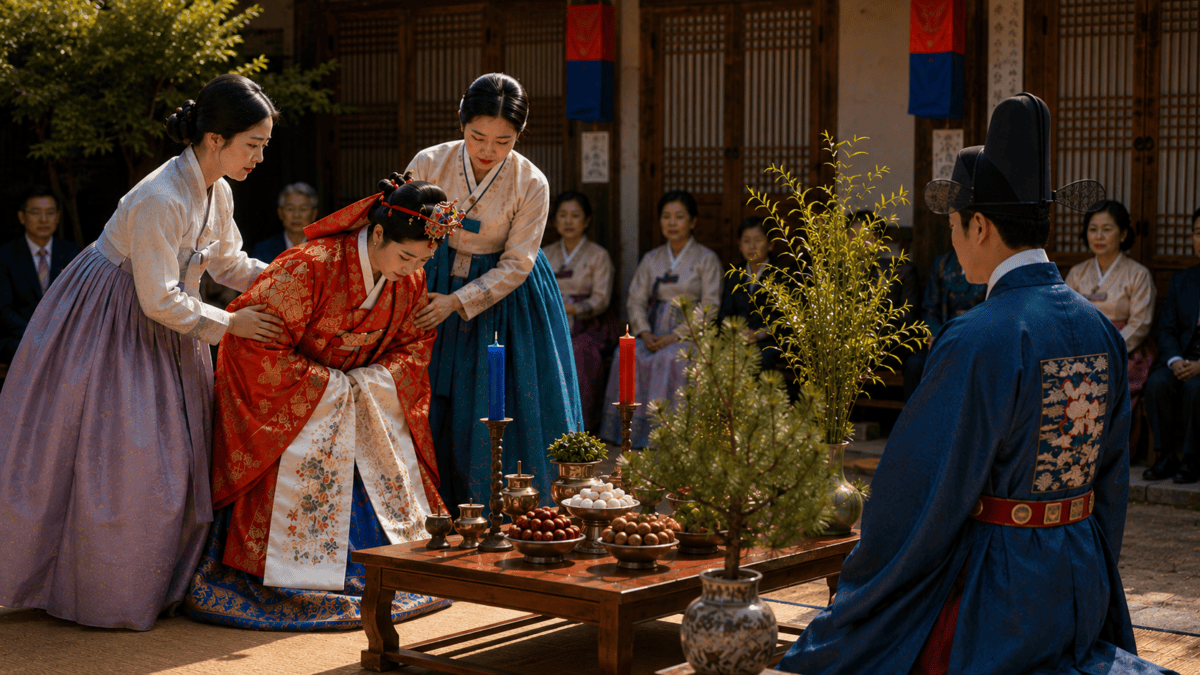
Now the bride is brought out, held up on either side by two women. She can barely see where she is going. Her face is painted, a red dot on each cheek and one at the center of her forehead, and her headdress sits heavy enough that she keeps her chin level and her eyes lowered the whole time.
They place her on the far side of the table, across from the groom. The reciter calls the next step, and the two of them begin.
The bride bows twice. The groom answers with one. She lowers herself twice again; he answers once more. Across a table loaded with candles and fruit and two nervous chickens, they greet each other in the only language the day gives them, which is not speech. In many of these older marriages, the two had exchanged almost nothing before this hour. The bows carry the whole conversation. They are introducing themselves with their entire bodies because no one has let them use words yet.
It takes longer than you expect. The bride cannot rush; the weight on her head decides her speed. Each time she lowers herself the two women at her sides move with her, and each time she rises they lift. The groom waits between her bows, still, letting her set the pace of the only exchange they will have today.
The crowd goes quiet for this part. Even the grandmother stops narrating. You can hear the candles, the shift of feet on swept earth, one of the chickens registering a complaint. Somewhere behind you, cooking smoke drifts in from the kitchen, and you realize the food has been going the whole time. A woman near the front presses a hand to her mouth. Nobody explains what the bows mean. Everyone already knows.
One Cup, Split in Half
At the end, they drink.
A gourd is brought out that has been cut cleanly in two. Each half is filled, and they each drink from their own. The two halves belong together — one gourd split apart, the way it grew before anyone divided it.
That is the close of the ceremony. Two halves from a single shell, separated so they could be filled, joined again to show what the two of them have now become. No one stops to explain it to the guests. You either catch it or you don’t, and most people are already thinking about lunch.
The drink itself is nothing, a mouthful, slightly sweet. Neither of them reacts to the taste. The point was never the cup. The point was that it was one thing, then two, then one again, in front of everyone who would hold them to it.
The candles are still burning, red and blue, lower than before. The musicians start up again, that thin reedy sound rising over the courtyard. The bride is helped back toward the house, chin still level, eyes still down. The day is far from over for her, but this part of it is finished.
This is the oldest part of the Korean wedding tradition, and also the shortest. Two people who bowed before they ever spoke are married now. The courtyard that was swept clean this morning is scattered with footprints and dropped programs and one chestnut a child finally got away with. And somewhere inside the house, in a quieter room, a dish of dates and chestnuts is already waiting for what comes next.
This post was planned and edited by a human, with AI assistance.